

OBD-II Code C1242: ABS/Traction Control Power or Motor Circuit Fault
What C1242 means, why it triggers, and how to fix it
- Code C1242 is an electrical fault indicating a loss of power or ground to the ABS and traction control system.
- Always test the 12V battery first; a voltage drop below 9.5V during startup is the leading cause of this code.
- Verify your manufacturer's specific definition for C1242, as it means 'Pump Motor Circuit Open' on a GM but 'Brake Booster Pressure Sensor' on a 2022+ Honda.
- Standard hydraulic brakes remain functional, but the disabled ABS increases stopping distances and skid risk by up to 30% on wet roads.
What Does C1242 Mean?
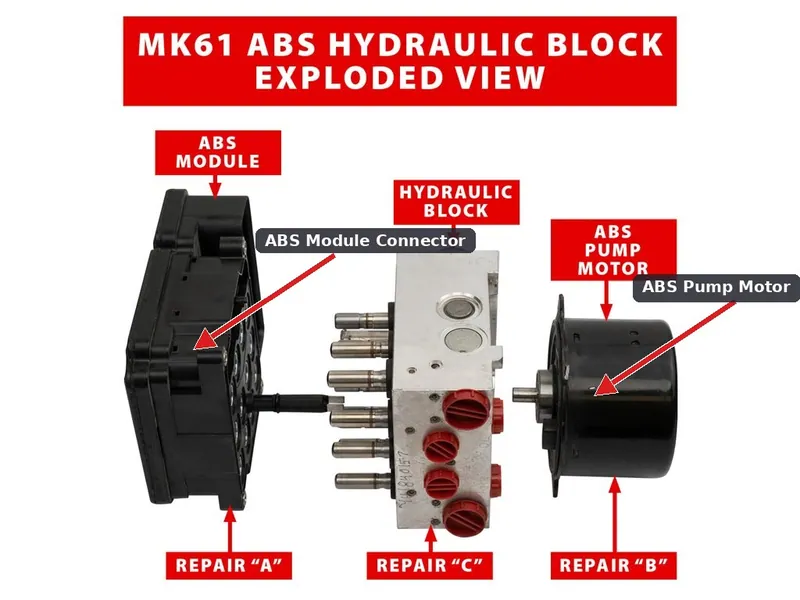
Code C1242 indicates the vehicle's main computer detected a fault in the power supply or motor circuit for the anti-lock brake and traction control system. This points to an open circuit, a short, or an abnormal voltage reading in the power feed to the Electronic Brake Control Module (EBCM) or Skid Control ECU. It also indicates a failure within the ABS pump motor itself, such as a seized motor or an internal open circuit. When this code sets, the ABS and traction/stability control systems are disabled as a fail-safe measure.
Technical definition: The official SAE/OBD-II definition for C1242 varies significantly by manufacturer. For Toyota and Lexus, it is 'Open in IG1 / IG2 Power Source Circuit', meaning one of the two main power feeds to the skid control ECU is lost. For General Motors, it means 'Pump Motor Circuit Open', pointing to an electrical break between the EBCM and the pump motor. On Fords, it specifies 'ABS Outlet Valve Coil LR Circuit Failure', an internal module fault. On 2022+ Hondas, it means 'Brake Booster Pressure Sensor Signal Voltage' is out of range. Always verify the definition for your specific vehicle.
Can I Drive With C1242?
Yes, But With Caution. Yes, but drive with extreme caution. Standard hydraulic brakes remain functional, but the ABS and Traction/Stability Control are disabled. This eliminates critical safety features designed to prevent wheel lock-up, increasing stopping distances and the risk of skidding on wet surfaces. Repair this issue promptly to restore full safety functionality.
Common Causes

- Failing or weak 12V vehicle battery (Very Common) — The ABS module is highly sensitive to voltage. If the vehicle's battery is weak, its voltage drops below the required threshold (often below 9.5V during a self-test), triggering C1242 alongside C1241.
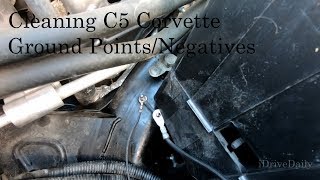
- Poor electrical grounds or corroded connections (Very Common) — The ground connection for the ABS module (EBCM) is a frequent culprit. It loosens or corrodes over time, creating high resistance and triggering the code. This is a well-known issue on vehicles like the C5 Corvette. 🎬 Watch: How to clean the ground points on a C5 Corvette.
- Blown fuse(s) (Common) — The ABS system has dedicated fuses for its power supply circuits (labeled 'ABS', 'IGN', or 'ECU-IG'). A single blown fuse cuts power to a critical part of the module and sets this code.
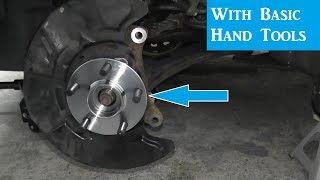
- Damaged or incorrectly installed wheel bearing (Subaru) (Common) — On many Subaru models, this code appears immediately after a wheel bearing replacement. This is caused by installing the bearing backwards, using a cheap aftermarket part with a faulty magnetic encoder ring 🎬 Watch: Proper wheel bearing and hub replacement for Subaru models., or damaging the ring during installation.
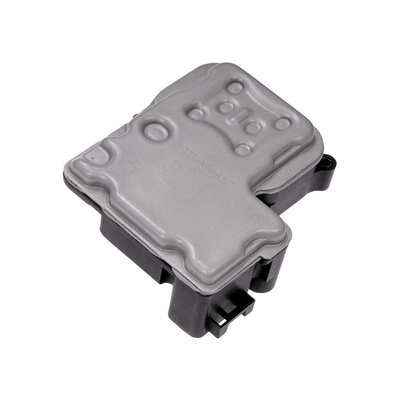
- Faulty ABS pump or control module (EBCM) (Less Common) — The ABS pump motor seizes from lack of use, or the electronic control module fails due to cracked solder joints or internal relay faults. The pump and module are often a single, expensive unit.
- Damaged wiring harness (Less Common) — Wires leading to the ABS module fray, break, or short due to vibration, impact, or exposure to the elements, interrupting the power supply or control signals.
- Faulty Brake Booster Pressure Sensor (Newer Hondas) (Uncommon) — On 2022 and newer Honda models, C1242-12 or C1242-14 indicates the brake booster pressure sensor is sending a signal voltage that is too high or too low. 🎬 See this walkthrough for diagnosing Honda brake booster pressure sensors.
Symptoms

- ABS and Traction/Stability Control lights illuminated — The ABS light, along with 'TCS,' 'VSC,' 'ESC,' or a car with squiggly lines, will light up and stay on. This is the primary indicator of a system fault.
- Warning messages on the dashboard — The vehicle's information center displays specific messages like 'Service ABS System,' 'Service Stability System,' or 'Service Active Handling'.
- ABS and Traction Control do not work — Traction control fails to activate on slippery surfaces, and the ABS does not engage during hard braking, allowing the wheels to lock up and skid.
- Brake pedal feels different — If the ABS module's hydraulic unit is involved, the brake pedal feels harder or softer than usual.
Diagnostic Flowchart
Tap your situation to follow the diagnostic path that matches what you're seeing on this code.
Common Fixes & Costs
- Replacing the 12V battery
— Parts: $150-$350, Labor: $20-$50, ~0.5 hr book time
(DIY)
Toyota Prius (2010-2015): OEM 28800-21191 (Alt: Optima DS46B24R) - Cleaning ground connections — Parts: $0-$5, Labor: $0-$50, ~0.5 hr book time (DIY)
- Replacing blown fuses — Parts: $1-$10, Labor: $0, ~0.1 hr book time (DIY)
- Repairing the ABS Control Module (EBCM) — Parts: $250-$500, Labor: $100-$200, ~1.5 hr book time (Intermediate)
- Replacing the ABS Control Module/Pump Assembly
— Parts: $800-$2500, Labor: $150-$300, ~2.5 hr book time
(Professional)
Toyota Prius (2010-2015): OEM 47050-47150 (Alt: Cardone Remanufactured)
Chevrolet Corvette C5 (2001-2004): OEM 12216561 (Alt: Bosch Remanufactured)
DIY vs Professional
- Cleaning ground connections 🟢 Beginner
Tools: ['Socket set', 'Wire brush', 'Dielectric grease'] - Replacing blown fuses 🟢 Beginner
Tools: ['Fuse puller', 'Multimeter'] - Replacing the 12V battery 🟢 Beginner
Tools: ['Socket set'] - Repairing the ABS Control Module (EBCM) 🟢 Beginner
Tools: ['Socket set', 'Torx bit set'] - Replacing the ABS Control Module/Pump Assembly 🟢 Beginner
Tools: ['Socket set', 'Flare nut wrenches', 'Bi-directional scan tool', 'Brake bleeding equipment']
Used vs. New Parts: Buying Guide
When a used part is worth it: A used ABS module makes sense for older vehicles (10+ years) where a new part is discontinued or prohibitively expensive, provided it is sourced from a reputable salvage yard with a warranty.
Donor-vehicle mileage cap: roughly under 100000 miles for the part to have meaningful remaining life.
Donor quality checklist:
- Verify the part number matches exactly.
- Obtain the VIN of the donor car to check its history.
- Choose a seller offering at least a 90-day warranty.
- Inspect for physical damage, heavy corrosion, or cut wiring harnesses.
Decision logic:
- If The fault is internal to the electronic module (EBCM) → Choose a mail-in repair service. It is cheaper than new, more reliable than used, and requires no reprogramming.
- If The vehicle is newer and the part is available → Buy new OEM for the best reliability and warranty.
- If The vehicle is old and budget is the main concern → A used part is a viable option, but carries the risk of premature failure.
Warranty tradeoff: Used parts typically have a 30-90 day warranty. Aftermarket new parts offer 1-year to limited lifetime warranties. Repaired modules often come with a 1-year to lifetime warranty.
Worst-case if a used part fails: $300-600 if a used part fails soon after the warranty period, requiring a second labor charge and replacement part.
What Happens If You Wait — Timeline
- Immediate: Code C1242 sets, ABS and Traction/Stability Control warning lights illuminate. The systems are immediately disabled as a fail-safe. (MPG impact: 0%% · Added cost: $0)
- 0-12 months: The primary consequence is the ongoing safety risk of driving without ABS and stability control. No direct mechanical damage occurs to other systems. (MPG impact: 0%% · Added cost: $0)
- 12+ months: If the cause is a seized ABS pump motor, leaving it inactive makes it permanently unrecoverable, requiring a full pump replacement. (MPG impact: 0%% · Added cost: $500 - $2000)
- 18+ months: If the cause is an internal EBCM electronic fault, continued electrical stress causes the failure to cascade, making a $250 mail-in repair impossible and forcing a full module replacement. (MPG impact: 0%% · Added cost: $1000 - $2500)
Cost of Not Fixing It
- Immediate: ABS, Traction Control, and Stability Control are disabled. Increased risk of skidding and loss of control. (Added cost: Unquantifiable; risk of accident.)
- 0-6 months: No direct damage to other components. The primary cost remains the elevated safety risk. (Added cost: Negligible)
- 6+ months: An internal EBCM fault worsens, leading to complete module failure. A seized pump motor becomes permanently inoperable. (Added cost: $500 - $2500)
Diagnosis Steps

- Check the 12V Battery and Charging System
Use a multimeter to check the voltage of the 12V battery. A healthy battery reads above 12.4 volts with the engine off and 13.7-14.7 volts with the engine running. A reading below 9.5V during startup triggers this code.
Tools: ['Multimeter'] (Beginner) - Inspect All ABS-Related Fuses
Locate the fuse boxes (engine bay and cabin). Consult the owner's manual to identify fuses related to the ABS, EBCM, ECU, and ignition circuits. Visually inspect each fuse and use a multimeter to test for continuity. Replace any blown fuses.
Tools: ['Multimeter', 'Fuse puller'] (Beginner) - Inspect and Clean ABS Module Ground Connections
Locate the main ground point for the ABS module using a repair manual. Disconnect the battery, unbolt the ground, and use a wire brush to clean the terminal and chassis contact point until shiny. Re-secure it tightly.
Tools: ['Socket set', 'Wire brush'] (Beginner) - Visually Inspect the Wiring Harness and Connector
Inspect the wiring harness connected to the ABS control module for chafing, melting, corrosion on the pins, or broken wires. Unplugging and replugging the main connector several times scrapes away minor surface corrosion.
Tools: ['Flashlight'] (Beginner) - [Advanced] Check for Power at the ABS Module Connector
Using a wiring diagram, identify the power input pins on the ABS module's electrical connector. Disconnect the connector and, with the ignition ON, use a multimeter to check for battery voltage (11-14V) at these pins. Missing voltage indicates a wiring fault between the fuse box and module.
Tools: ['Multimeter', 'Vehicle-specific wiring diagram'] (Advanced) - [Advanced] Check for Resistance to Ground
With the connector disconnected, switch the multimeter to resistance (Ohms). Check the resistance between the ground pins on the connector and a clean, unpainted spot on the chassis. The reading must be less than 1-2 Ohms. A higher reading indicates a bad ground wire.
Tools: ['Multimeter', 'Vehicle-specific wiring diagram'] (Advanced) - [Advanced] Test the ABS Pump Motor (GM specific)
Locate the two large-gauge wires for the pump motor at the module connector. Using fused jumper wires, apply 12V directly from the battery to these terminals. A brief whirring sound indicates the motor is functional. A motor that doesn't run is seized.
Tools: ['Fused jumper wires'] (Advanced) - [Advanced] Test Pump Motor Winding Resistance (GM specific)
After separating the EBCM from the pump, measure the resistance of the pump motor between the power input terminal and the external ground stud. A reading greater than 10 Ohms suggests a damaged internal motor winding.
Tools: ['Multimeter'] (Advanced) - [Advanced] Test Brake Booster Pressure Sensor (Honda 2022+)
For newer Hondas with C1242-12 or -14, back-probe the brake booster pressure sensor signal wire with a multimeter. The voltage must change as brake pedal pressure is applied and released. Static voltage points to a faulty sensor.
Tools: ['Multimeter', 'Back-probe kit'] (Advanced) - [Advanced] Analyze Live Data with a Scan Tool
Using a bi-directional scan tool, access the ABS live data list. Monitor parameters like 'Battery Voltage', 'IG1 Voltage', and 'IG2 Voltage'. A reading below 9.5V on any of these PIDs while driving points directly to a failing circuit.
Tools: ['Bi-directional OBD-II Scan Tool'] (Advanced)
When This Code Triggers (Freeze-Frame Conditions)
- System Voltage: 8.0V - 16.0V (Sets during the initial system self-test at startup if battery voltage drops below 9.5V.)
- Vehicle Speed: 0 mph (Detected during the power-on self-test before the vehicle moves.)
- ABS Pump Motor Status: Commanded OFF (The ECU detects an improper voltage reading when the pump motor is not supposed to be running.)
- Time Since Ignition On: < 5 seconds (Logged within seconds of turning the key as the ABS module performs initial checks.)
Related Codes
- C1241 — The most common companion code on Toyota/Lexus. C1241 points to 'Low or High Power Supply Voltage'. If both are present, the root cause is a power supply issue (battery, alternator, fuses), not the ABS module.
- C1243 — On GM vehicles, C1243 indicates 'ABS Pump Motor is Stalled', while C1242 indicates 'Pump Motor Circuit is Open'. C1242 points to external wiring or grounds, whereas C1243 means the module is trying to run a stuck pump.
- C1256 — On Toyota hybrids, 'Accumulator Low Pressure' appears alongside C1241/C1242. A voltage drop prevents the electric brake pressure accumulator pump from running, setting C1256 as a symptom of the electrical problem.
- U0293 — A complete power loss to the ABS/VSC module causes a 'Lost Communication With Hybrid Powertrain Control Module' code in other modules, reinforcing that the ABS module is offline.
Climate & Environmental Factors
- Cold Weather: Low temperatures reduce battery efficiency. A weak 12V battery drops below the ABS module's 9.5V threshold during cold startups, triggering C1242.
- High Humidity & Road Salt: Accelerates corrosion on the ABS module's chassis ground connection, leading to high resistance and setting this code.
- Extreme Vehicle Maneuvers: On Ram trucks, drifting in snow causes the dynamic sensor to send illogical signals, triggering a performance-related C1242 code.
How to Talk to a Mechanic About This Code
Say this: "I have an ABS and traction control light on, and my scanner is showing a C1242 code. Please start by testing the battery and charging system, checking the ABS fuses, and testing the resistance of the ABS module's main ground wire before assuming the module itself has failed."
This signals to the mechanic that you are aware the most common causes are cheap to fix. It directs them to perform a logical, cost-effective diagnostic routine first, preventing an immediate quote for an expensive module replacement.
Avoid saying:
- My ABS light is on, can you just fix it?
- I think I need a new ABS module.
- Just do whatever it takes to get the light off.
Questions to ask before authorizing the repair:
- What were the results of the basic electrical tests? Specifically, what was the battery voltage and the resistance reading on the module's ground connection?
- If recommending a module replacement, what specific tests confirmed the old module is faulty and the wiring to it is good?
- Can you show me the damaged part or a photo of the multimeter reading that confirms the failure?
- Is the recommended fix a new part, a used part, or a mail-in repair of my existing module? What is the warranty?
Where to Take It: Dealer vs Independent vs Chain
- Dealer:
Recommended only if the vehicle is under warranty or covered by a customer support program. Otherwise, an independent shop is more cost-effective.
Best for: Vehicles under a factory or extended warranty., Newer vehicles (less than 5 years old) requiring manufacturer-specific tools., Complex cases on Toyota/Lexus vehicles where a warranty enhancement program covers the repair.
Downsides: Highest labor rates and parts costs, often 40-70% more than independent shops., Quick to recommend a full module replacement rather than exploring nuanced repairs. (Typical cost: +50% vs. baseline) - Independent Shop:
Best fit for most C1242 repairs. A good independent shop performs electrical diagnostics effectively and is open to cost-saving measures like using a repaired module.
Best for: Out-of-warranty vehicles where cost is a major factor., Diagnosing common C1242 causes like batteries, fuses, and grounds., Vehicles with well-known issues like C5 Corvettes or Subarus after a wheel bearing job.
Downsides: Shop quality and diagnostic skill vary widely. Vet shops based on reviews and ASE certifications., May lack the latest manufacturer-specific scan tools for bleeding very new models. (Typical cost: +0% vs. baseline) - Chain Shop:
Acceptable for a free battery test, but AVOID for the primary diagnosis of C1242. Their business model is not optimized for complex electrical troubleshooting.
Best for: Simple, clear-cut tasks like a battery test or replacement.
Downsides: Technician skill varies dramatically; they lack in-depth electrical diagnostic experience., High pressure to upsell leads to misdiagnosis and recommending expensive module replacements. (Typical cost: -10% vs. baseline)
When to Walk Away From the Repair
If the estimated repair cost exceeds 50% of the car's current private-party market value, seriously consider selling or trading in the vehicle instead of repairing it.
- Car worth $8000, fix is $450: Fix it. The repair cost is a small fraction of the car's value.
- Car worth $5000, fix is $2200: Borderline. The repair is approaching the 50% threshold. Get a second opinion and explore cost-saving options like a mail-in module repair.
- Car worth $3000, fix is $2500: Walk away. The repair cost is nearly the entire value of the car. It is not financially sensible to proceed.
What Scan Tool You Need for This Code
Minimum: A scanner that reads and clears codes from the ABS/SRS control modules. Basic engine-only code readers will not work.
A standard $20 OBD-II reader only communicates with the Engine Control Unit (ECU). The C1242 code is stored in the Anti-lock Brake System (ABS) module, requiring a more capable scanner.
Budget: BlueDriver Pro or Autel AutoLink AL619 (~$90) — Reads and clears ABS codes, displays live data for battery voltage, and shows freeze-frame data. This confirms the code and rules out a simple voltage issue.
Mid-range: Foxwell NT530 or NT630 Plus (~$150) — Provides manufacturer-specific code definitions and live data. Offers bi-directional control to perform an 'ABS bleed' function, required after replacing the ABS hydraulic unit.
Professional: Autel MaxiCOM MK808BT or XTOOL D7 (~$450-600) — Offers full bi-directional control of the ABS pump and solenoids for advanced testing, comprehensive live data graphing, and ECU coding functions for module replacement.
How to Clear the Code After You Fix It
- Reconnect battery if disconnected for repair.
- Use an OBD-II scan tool to clear the C1242 code from the ABS module.
- Perform a test drive including several stops to allow the ABS module to verify the repair.
Drive cycle (~20 minutes): Start the vehicle and let it idle for 2 minutes. Drive for 10-15 minutes, including a mix of city and highway speeds, with several gentle stops. The system self-tests at every startup.
Readiness monitors affected: Does not directly affect emissions readiness monitors., If the battery was disconnected, all emissions monitors reset to 'incomplete'.
Before emissions retest: drive at least 50 miles to fully set monitors.
Watch out for:
- Clearing the code without fixing the electrical fault causes it to return instantly on the next startup.
- Forgetting that a battery disconnect resets emissions monitors, leading to a failed smog test.
Will This Fail Emissions / State Inspection?
No — by itself this code doesn't fail OBD inspection (but it can keep readiness monitors from setting, which causes a separate fail).
- California: An ABS light does not fail the emissions test. However, if the battery was disconnected, reset readiness monitors block the test until a drive cycle is completed.
- New York: The NYS inspection includes safety systems. An illuminated ABS warning light is an automatic failure.
- Texas: During the annual safety inspection, the ABS lamp must illuminate when the key is turned on and then go out. If it stays on, the vehicle fails.
Most Commonly Affected Vehicles
- Toyota Prius (2004-2015) — Prone to C1242 due to a weak 12V auxiliary battery or blown 'ECU-IG' fuses, causing power loss to the skid control ECU. Actuator replacement is expensive but sometimes covered by warranty enhancement programs.
- Chevrolet Corvette (C5) (1997-2004) — Experiences C1242 due to a poor EBCM ground (G103), a seized ABS pump motor from infrequent use, or internal EBCM failure.
- Lexus RX 450h (2010-2015) — Appears with C1241 as 'Low Battery Positive Voltage', pointing directly to a weak auxiliary battery or charging system fault.
- Ford Explorer, F-150 (2004-2018) — Defined as 'ABS Outlet Valve Coil LR Circuit Failure', indicating an internal fault in the ABS hydraulic control unit rather than a general power issue.
- Subaru Outback, Forester, Crosstrek (2010-2023) — Sets C1242 immediately after a rear wheel bearing replacement due to damaging the magnetic encoder, installing it backwards, or using a faulty aftermarket part.
- Toyota FJ Cruiser (2007-2014) — Points to a fault in the IG2 power source circuit for the skid control ECU. Diagnosis focuses on the 'IGN' fuse and ECU wiring.
- Honda Civic (2022-present) — C1242 uses a suffix (-12 or -14) to indicate a voltage problem with the brake booster pressure sensor signal, not the main ABS power circuit.
- Ram 1500 (2009-2018) — Defined as 'Dynamic Sensor input signal performance'. Triggered by extreme maneuvers providing illogical sensor inputs. Driving normally resets the sensor.
Manufacturer-Specific Notes
- Toyota/Lexus: The system uses two power feeds (IG1 and IG2). An advanced scan tool reads a secondary 'INF code' (111 or 112) detailing exactly which circuit lost power, cutting diagnostic time in half.
- Toyota/Lexus: For 2010-2015 hybrids, Toyota issued Warranty Enhancement Programs for failing Brake Booster Assemblies. If C1242 appears with C1391 or C1252, the expensive repair may be covered for up to 10 years/150,000 miles.
- General Motors: The ABS pump motor seizes from inactivity. Repeatedly braking hard on a safe, wet road forces the ABS to activate, which sometimes frees a sticky pump motor and clears the code.
- Honda: On 2022+ models, C1242 no longer refers to the main ABS power circuit. It points to a voltage problem with the brake booster pressure sensor.
- Subaru: This code frequently appears immediately after replacing a rear wheel bearing due to installing the bearing backwards or damaging the delicate magnetic encoder ring.
Real Owner Stories
2003 Chevrolet Corvette with C1242
ABS and Traction Control warning lights appeared intermittently, especially after driving in heavy rain. The only code present was C1242.
What they tried:
- Cleaned all major ground points, including the one near the battery.
- Cleaned the main EBCM connectors, removing white corrosion.
- Unplugged and re-plugged the two EBCM connectors multiple times.
Outcome: Simply re-seating the connectors multiple times resolved the issue for over 8 months. For another owner, the code returned instantly until the EBCM was sent to a mail-in repair service, which permanently fixed the problem.
Lesson: For C5 Corvettes, C1242 is very often an electrical connection issue. Before paying for a costly module repair, thoroughly clean all grounds and the main EBCM connectors.
2008 Toyota Prius with C1241 & C1242
Car would not go into 'Ready' mode. Skid control buzzer came on, and multiple warning lights illuminated. The 12V auxiliary battery was recently replaced.
What they tried:
- Checked the new 12V battery.
- Scanned codes, revealing C1241 (Low Voltage) and C1242 (Power Source Circuit Open).
Outcome: The issue was traced to loose connections at the 12V battery terminals and the main chassis ground point in the rear of the car. Tightening these connections resolved the no-start condition and cleared the codes.
Lesson: On a Toyota/Lexus hybrid, if you see C1241 and C1242 together, the problem is almost certainly the 12V power supply. Double-check that battery terminals and the main body ground are clean and tight.
2016 Subaru Outback 3.6R with C1242
Immediately after a DIY replacement of the driver's side rear wheel bearing, every dashboard warning light illuminated, and a C1242 code was stored.
What they tried:
- Re-seated the wheel bearing.
- Cleaned the ABS sensor and its mounting hole.
- Replaced the ABS sensor twice with new parts.
Outcome: The problem persisted despite replacing the sensor. The root cause was a faulty magnetic encoder ring inside the new aftermarket wheel bearing. The fix required replacing the wheel bearing assembly again with an OEM part.
Lesson: On Subarus, C1242 appearing right after a wheel bearing replacement is a classic symptom of a bad bearing part or incorrect installation. Do not assume the ABS sensor is the problem.
2004 Chevrolet Corvette with seized ABS pump
Car sat for a long period and developed the C1242 code for an open pump motor circuit. Diagnostic tests showed the wiring and grounds were good.
What they tried:
- Hooked the pump motor directly to the battery with jumper wires and confirmed it would spin.
- Removed the EBCM, opened it, and found a previous repair attempt had failed.
- De-soldered and re-soldered the main relay and pump motor connections on the circuit board.
Outcome: The DIY solder repair worked, and the C1242 code was resolved without buying a refurbished module.
Lesson: If external wiring is good, the fault is likely internal to the EBCM. For those with electronics skills, re-flowing solder joints is a no-cost fix. Otherwise, a mail-in repair service is the correct next step.
How to Prevent This Code From Triggering
- Replace 12V battery proactively (Every 3-5 years) — The ABS/EBCM is highly sensitive to low voltage. An aging battery is the #1 cause of voltage-related codes like C1241/C1242.
- Periodically 'exercise' the ABS pump (Once every 6 months) — On cars driven gently, the pump motor seizes from inactivity. Performing hard stops on a safe, low-traction surface forces the pump to run, keeping it lubricated.
- Flush brake fluid (Every 2-3 years) — Brake fluid absorbs moisture over time. This moisture causes corrosion inside the delicate valves of the ABS hydraulic unit, leading to mechanical failure.
- Clean and protect main electrical grounds (Once, or when working in the area) — Corrosion on the EBCM-to-chassis ground creates high resistance. Cleaning these points to bare metal and applying dielectric grease prevents future rust.
Frequently Asked Questions
Can I clear the C1242 code myself?
You can clear the code with an OBD-II scanner, but it will almost certainly return immediately. The ABS module performs a self-test every time you start the car, and if the electrical fault persists, the code sets again instantly.
Is it safe to drive with the C1242 code?
While your primary hydraulic brakes function, your ABS and stability control are disabled. This is a significant safety risk in slippery conditions or during a panic stop, as wheels can lock up and cause a skid.
Why did C1242 appear after replacing my battery?
This happens if the new battery is not fully charged, terminals are loose, or a voltage spike damaged a fuse. Always verify connections are clean and tight after a battery replacement.
My mechanic quoted a very expensive ABS module replacement. What are common misdiagnoses?
A frequent mistake is replacing the expensive ABS module without performing basic electrical checks. This code is often caused by a weak battery, a $5 fuse, or a corroded ground wire. Insist these simple items are ruled out first.
Can a bad wheel bearing cause code C1242?
Yes, particularly on Subarus. The wheel bearing assembly contains a magnetic encoder ring read by the ABS sensor. If this ring is damaged, installed backwards, or is a cheap aftermarket part, it triggers ABS faults like C1242.
The code appeared after I did donuts in a snowy parking lot. What happened?
On vehicles like Ram trucks, extreme maneuvers provide sensor inputs the stability control system interprets as a fault, setting a C1242 code. Driving normally for a short period allows the system to verify correct sensor function and clear the code.
Is it cheaper to repair my ABS module or replace it?
For many common failures, it is significantly cheaper to send your existing module to a specialized repair service. A mail-in repair costs $250-$500, whereas a new replacement module exceeds $1,200.
Key Takeaways
- Code C1242 is an electrical fault indicating a loss of power or ground to the ABS and traction control system.
- Always test the 12V battery first; a voltage drop below 9.5V during startup is the leading cause of this code.
- Verify your manufacturer's specific definition for C1242, as it means 'Pump Motor Circuit Open' on a GM but 'Brake Booster Pressure Sensor' on a 2022+ Honda.
- Standard hydraulic brakes remain functional, but the disabled ABS increases stopping distances and skid risk by up to 30% on wet roads.
Helpful Videos

Shop the Parts Behind C1242
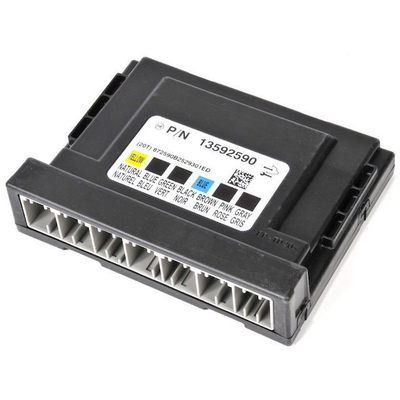
Below are the parts most often responsible for code C1242, ranked by how frequently each one is the actual culprit (per the diagnosis above). Tap any to see what we have for your vehicle.



The information in this article is provided for general reference and educational purposes only. Vehicle specifications, procedures, and part compatibility can vary by production date, trim level, and region. Always consult your vehicle's factory service manual and verify part numbers before purchasing or performing repairs. Safety-critical components such as airbags, seat belts, and braking systems should be installed by a qualified professional.
- 🧭 Diagnostic Flowchart
- 🎬 Helpful Videos
- 🛍️ Shop This Part
- What Does C1242 Mean?
- Can I Drive With C1242?
- Common Causes
- Symptoms
- Common Fixes & Costs
- DIY vs Professional
- Used vs. New Parts: Buying Guide
- What Happens If You Wait — Timeline
- Cost of Not Fixing It
- Diagnosis Steps
- When This Code Triggers (Freeze-Frame Conditions)
- Related Codes
- Climate & Environmental Factors
- How to Talk to a Mechanic About This Code
- Where to Take It: Dealer vs Independent vs Chain
- When to Walk Away From the Repair
- What Scan Tool You Need for This Code
- How to Clear the Code After You Fix It
- Will This Fail Emissions / State Inspection?
- Most Commonly Affected Vehicles
- Manufacturer-Specific Notes
- Real Owner Stories
- 2003 Chevrolet Corvette with C1242
- 2008 Toyota Prius with C1241 & C1242
- 2016 Subaru Outback 3.6R with C1242
- 2004 Chevrolet Corvette with seized ABS pump
- How to Prevent This Code From Triggering
- Frequently Asked Questions
- Can I clear the C1242 code myself?
- Is it safe to drive with the C1242 code?
- Why did C1242 appear after replacing my battery?
- My mechanic quoted a very expensive ABS module replacement. What are common misdiagnoses?
- Can a bad wheel bearing cause code C1242?
- The code appeared after I did donuts in a snowy parking lot. What happened?
- Is it cheaper to repair my ABS module or replace it?
- Key Takeaways
- 🎟️ Get 5% Off