

OBD-II Code C1247: Brake Pedal Position Sensor Malfunction
What C1247 means, why it triggers, and how to fix it
- Code C1247 indicates a brake pedal position sensor fault on Toyota/Lexus vehicles, but points to a hydraulic pressure loss on GM vehicles like the C5 Corvette.
- Before replacing parts on 2004-2014 Toyota and Lexus models, check for TSBs; the official fix is often a $1,500+ Skid Control ECU replacement, not a new sensor.
- Never replace a stroke sensor without performing a Zero Point Calibration using a bidirectional scan tool, or the C1247 code will immediately return.
- Driving with a C1247 code disables your ABS and stability control, increasing skid risk and potentially causing a $2,500 ABS actuator failure if ignored for over 6 months.
What Does C1247 Mean?

Code C1247 indicates the primary computer (often the Skid Control ECU) detects a critical fault in the brake pedal position sensor signal. This sensor translates how far and fast you press the brake pedal into a voltage signal. This data is essential for ABS, VSC, and blending regenerative and hydraulic braking in hybrid vehicles.
Technical definition: The SAE/ISO definition for C1247 is "Malfunction in Stroke Sensor." The signal from the brake pedal stroke sensor is out of its expected voltage range, inconsistent, or has failed entirely. On Toyota vehicles, advanced scan tools reveal specific Information Codes (INF), such as INF 179 (signal mismatch) or INF 181 (power source malfunction). Conversely, on General Motors vehicles (like the C5 Corvette), C1247 translates to "Brake Pressure Differential Switch Activated" or "Brake Fluid Level Switch Grounded," indicating a loss of hydraulic pressure or low brake fluid, not a pedal sensor issue.
Can I Drive With C1247?
Yes, But With Caution. You can drive the vehicle, but do not exceed a few days. Your Anti-lock Braking System (ABS), Traction Control (TRAC), and Vehicle Stability Control (VSC) are disabled. You only have conventional hydraulic braking, significantly increasing the risk of wheel lock-up and skidding. In hybrids, the loss of regenerative braking feels like a sudden loss of engine braking. Prolonged driving forces the ABS/VSC actuator pump to run excessively, leading to premature failure of a $2,500 component.
Common Causes

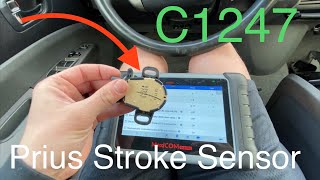
- Faulty Brake Pedal Stroke Sensor (Very Common) — The sensor is the most frequent point of failure. 🎬 Watch: How to replace and recalibrate the stroke sensor. As a wearable electronic component, it fails internally over time, sending incorrect, erratic, or zero voltage signals to the computer.
- Overly Sensitive Skid Control ECU Logic (Toyota/Lexus) (Very Common) — On many 2004-2014 Toyota and Lexus models, the ECU's monitoring software is excessively sensitive and triggers C1247 without a hardware failure. Toyota issued multiple Technical Service Bulletins (TSBs) requiring the replacement of the Skid Control ECU with an updated part.
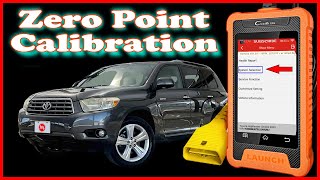
- Improper Sensor Calibration (Common) — After replacing the stroke sensor, Skid Control ECU, or performing front-end alignment work, a 'Zero Point Calibration' is mandatory. Failing to perform this calibration correctly immediately triggers C1247 and C1392. 🎬 See how to perform a Zero Point Calibration correctly.
- Low Brake Fluid or Hydraulic Pressure Loss (GM Specific) (Common) — On specific GM models (e.g., Chevrolet Corvette, Monte Carlo), C1247 is triggered by the brake fluid level sensor or the brake pressure differential switch. This indicates a low fluid level from a leak or a loss of pressure in one brake circuit.
- Wiring and Connector Issues (Less Common) — The wiring harness or connectors between the stroke sensor and the ECU become damaged, corroded, or loose. Moisture intrusion under the dash or physical damage in the driver's footwell are the primary culprits.
- Misadjusted Rear Brakes (Toyota Prius) (Less Common) — Improperly adjusted or worn rear drum brakes cause excessive pedal travel before the brakes engage. The ECU interprets this extended pedal stroke as an out-of-range sensor signal, triggering C1247.
- Failing Skid Control ECU / ABS Module (Rare) — The anti-lock brake computer fails internally, misinterpreting signals from a perfectly good stroke sensor. This is the most expensive repair and is only considered after ruling out the sensor, wiring, and TSBs.
Symptoms

- ABS Warning Light On — The amber Anti-lock Braking System (ABS) warning light illuminates permanently on the dashboard.
- VSC/TRAC Warning Light On — The Vehicle Stability Control (VSC) or Traction Control (TRAC) light illuminates, confirming these safety systems are offline.
- Red 'BRAKE' Warning Light On — The main red 'BRAKE' warning light illuminates, often accompanied by a continuous, high-pitched alarm in Toyota and Lexus hybrids.
- Complete Loss of Regenerative Braking — In hybrid and electric vehicles, braking effect decreases significantly when lifting off the accelerator. The system disables regenerative braking as a failsafe.
- Hard or Spongy Brake Pedal — In hybrids, the pedal becomes very firm and requires more effort. If the code is related to a GM hydraulic issue, the pedal feels spongy and travels further to the floor.
- Jerky Low-Speed Braking — In hybrid vehicles, braking feels inconsistent or grabby at low speeds because the system cannot smoothly blend regenerative and hydraulic forces.
Diagnostic Flowchart
Tap your situation to follow the diagnostic path that matches what you're seeing on this code.
Common Fixes & Costs
- Replace Brake Pedal Stroke Sensor — Parts: $50-$250, Labor: $100-$300, ~1.5 hr book time (Intermediate)
- Replace Skid Control ECU — Parts: $800-$2200, Labor: $200-$400, ~2.1 hr book time (Professional)
- Perform Zero Point Calibration — Parts: $0, Labor: $100-$200, ~0.8 hr book time (Advanced)
- Top Off Brake Fluid and Repair Leaks (GM) — Parts: $10-$500, Labor: $50-$1000, ~1.0 hr book time (Beginner)
- Repair Wiring or Connectors — Parts: $10-$50, Labor: $150-$400, ~2.0 hr book time (Intermediate)
Used vs. New Parts: Buying Guide
When a used part is worth it: A used Skid Control ECU from a reputable salvage yard is a viable cost-saving option for older vehicles. For the stroke sensor, the low cost of a new aftermarket part makes buying used not worth the risk.
Donor-vehicle mileage cap: roughly under 100000 miles for the part to have meaningful remaining life.
Donor quality checklist:
- Match the part number exactly. Superseded part numbers are acceptable.
- Ensure the used part comes with a 30-90 day warranty.
- Verify the donor vehicle was not scrapped due to flood damage.
Decision logic:
- If The fix is a TSB requiring an updated Skid Control ECU → Buy the specific updated new part number or a remanufactured unit to ensure the software logic is corrected.
- If Vehicle is > 10 years old and the Skid Control ECU costs >$1500 new → A used or remanufactured ECU with a warranty is a sensible choice to save money.
- If The part is the brake pedal stroke sensor → Buy a new OEM or high-quality aftermarket part.
Warranty tradeoff: Used parts offer a 30-90 day warranty. Remanufactured ECUs offer a 1-year to lifetime warranty. New OEM parts carry a 12-month/12,000-mile warranty.
Worst-case if a used part fails: $300-$600 if a used part fails, covering repeat labor for diagnosis and replacement.
What Happens If You Wait — Timeline
- 0-1 month: Code C1247 sets, illuminating ABS, VSC, and BRAKE lights. Regenerative braking is disabled. Safety systems are offline, but conventional braking works. (MPG impact: 5-15% reduction in hybrids due to loss of regenerative braking.% · Added cost: $0)
- 1-6 months: The ABS actuator pump runs more frequently as a failsafe response, causing premature wear on the pump's electric motor brushes. (MPG impact: 5-15% reduction (Hybrid)% · Added cost: $50-$200 in wasted fuel (Hybrid).)
- 6-12 months: The ABS pump motor burns out due to excessive runtime. A loud, continuous buzzing occurs, followed by a complete loss of the ABS actuator assembly. (MPG impact: 5-15% reduction (Hybrid)% · Added cost: $2000-$3500 for a new ABS actuator assembly.)
- 12+ months: Catastrophic failure of the ABS actuator assembly. The vehicle is unsafe to drive due to unpredictable brake behavior. (MPG impact: 5-15% reduction (Hybrid)% · Added cost: $2500-$5500+)
Cost of Not Fixing It
- Immediate: Loss of ABS, VSC, and Traction Control. Increased risk of skidding. Loss of regenerative braking on hybrids. (Added cost: $0)
- 1-6 months: The ABS actuator pump runs excessively as a failsafe, causing premature wear on the electric motor brushes. (Added cost: $1200-$3000)
- 6+ months: Catastrophic failure of the ABS actuator assembly. Continued driving with disabled safety systems significantly increases liability in an accident. (Added cost: $2500-$5500)
Diagnosis Steps

- Check for Technical Service Bulletins (TSBs)
Search for TSBs for your specific make and year. For many Toyota/Lexus vehicles, TSBs like T-SB-0174-12 state the cause is an overly sensitive ECU, requiring a replacement ECU with updated software.
Tools: Internet access (Beginner) - Inspect Brake Fluid Level and for Leaks (GM Specific)
For Chevrolet and GM vehicles, check the brake fluid level in the master cylinder reservoir. If low, top it off and inspect the entire brake system for leaks. A low level is the primary trigger for C1247 on these cars.
Tools: Flashlight, DOT 3/4 Brake Fluid (Beginner) - Read INF Codes with an Advanced Scan Tool
Use a bidirectional scan tool to read the Information Code (INF). INF 171 points to a power supply issue, while INF 179 indicates a discrepancy between the two internal sensor signals.
Tools: Advanced OBD-II Scan Tool (e.g., Techstream) (Intermediate) - Analyze Live Sensor Data on a Scan Tool
Monitor the 'Stroke Volt 1' (SKS1) and 'Stroke Volt 2' (SKS2) PIDs. With the pedal released, voltages oppose (e.g., 0.8V and 4.2V). Slowly press the pedal; SKS1 increases and SKS2 decreases smoothly. Jumping or dropouts indicate a failed sensor.
Tools: Advanced OBD-II Scan Tool (Intermediate) - Visually Inspect the Sensor, Connector, and Wiring
Locate the stroke sensor on the brake pedal assembly. Look for physical damage, a loose connector, or chafed wires. Ensure the connector is securely plugged in.
Tools: Flashlight (Beginner) - Test Sensor Power and Ground
Disconnect the sensor. With ignition ON, probe the harness connector. Check for 4.5V to 5.5V between the 5V reference (VCSK) and ground (SKG) pins. Missing voltage means the problem is in the wiring or ECU.
Tools: Digital Multimeter, Wiring Diagram (Advanced) - Check Harness Integrity
With sensor and ECU disconnected, check for continuity (less than 1 Ω) on each wire from end to end. Check for shorts to ground (OL) between any wire and the chassis.
Tools: Digital Multimeter, Wiring Diagram (Advanced) - Perform Zero Point Calibration
If components were replaced or the code appeared after alignment work, perform a Zero Point Calibration. This requires a bidirectional scan tool and must be done on a perfectly level surface with the steering wheel centered.
Tools: Bidirectional Scan Tool (Advanced) - Analyze Sensor Waveform
Back-probe the SKS1 and SKS2 signal wires with an oscilloscope. Press the brake pedal; you should see two clean, opposing analog signals. Glitches or flat spots instantly condemn the sensor.
Tools: Oscilloscope, Back-probe Pins (Professional)
When This Code Triggers (Freeze-Frame Conditions)
- Vehicle Speed: 0 mph (The code sets immediately upon startup as the ECU performs its initial self-check of the sensor's resting voltage.)
- Brake Pedal Status: Not Applied (The fault is detected when the pedal is at rest, as the sensor's baseline voltage readings are outside the expected range.)
- Time After Ignition ON: < 2 seconds (The Skid Control ECU runs a self-diagnostic immediately at startup; if signals are irrational, the code is stored instantly.)
Related Codes
- C1392 — Indicates the computer's stored 'home' position for the stroke sensor is corrupt. If you replace the sensor to fix C1247, you must perform a zero-point calibration to clear C1392.
- C1223 — A general 'ABS Control System Malfunction' code. It signifies the ABS module detected a fault and shut down all related systems. C1247 is the primary code identifying the source.
- C1310 — Appears on Toyota/Lexus hybrids alongside C1247. When the brake ECU detects C1247, it stops communicating with the hybrid ECU, disabling regenerative braking and logging C1310.
Climate & Environmental Factors
- Humidity / Moisture: Water intrusion in the driver's footwell causes corrosion on the stroke sensor connector pins. This increases resistance and causes erratic voltage signals, triggering C1247.
- Extreme Cold: Extreme cold thickens the internal lubricants of the mechanical stroke sensor, leading to slow movement. The electronic signals lag behind physical pedal movement, triggering a fault.
How to Talk to a Mechanic About This Code
Say this: "I have a C1247 code on my [Make, Model, Year]. Please check for relevant TSBs. If it's a Toyota/Lexus, test the stroke sensor's live data before quoting an ECU replacement. If it's a GM, start by checking the brake fluid level and for hydraulic leaks."
Directs the shop to perform a logical diagnosis rather than immediately replacing the most expensive part. Shows you understand manufacturer-specific differences.
Avoid saying:
- 'My ABS light is on, can you fix it?'
- 'Just replace the brake sensor.'
- 'Do whatever you think is best.'
Questions to ask before authorizing the repair:
- Did you find a Technical Service Bulletin for this issue?
- What were the live voltage readings from the stroke sensor?
- Have you confirmed the sensor has proper power and ground?
- Does the estimate include performing the Zero Point Calibration?
- What is the warranty on the part and labor?
Where to Take It: Dealer vs Independent vs Chain
- Dealer:
A safe but expensive bet. Guaranteed to have the tools for diagnosis and calibration.
Best for: Vehicles under warranty., Repairs identified by a TSB requiring an updated ECU.
Downsides: Highest labor rates., Defaults to the most expensive repair (ECU replacement) without testing cheaper components. (Typical cost: +50% vs. baseline) - Independent Shop:
The best option, IF you find a qualified shop. A hybrid specialist diagnoses this efficiently without defaulting to a dealer-priced ECU.
Best for: Out-of-warranty vehicles., Shops specializing in your vehicle's brand (e.g., Toyota/Lexus specialist).
Downsides: You MUST verify they own a bidirectional scan tool capable of performing a Zero Point Calibration. (Typical cost: +0% vs. baseline) - Chain Shop:
AVOID. This code requires diagnostic nuance beyond the scope of a chain repair shop.
Best for: Simple maintenance like oil changes.
Downsides: Technicians lack specialized tools required for this complex code., Cannot perform the mandatory Zero Point Calibration. (Typical cost: -10% vs. baseline)
When to Walk Away From the Repair
If the estimated repair cost exceeds 50% of your car's current private-party market value, consider selling the vehicle.
- Car worth $4500, fix is $2400: Walk away. The repair cost is over 50% of the car's value. Classic scenario for the Toyota TSB fix on an older Prius.
- Car worth $12000, fix is $450: Fix it. A $450 repair to replace the stroke sensor and perform calibration restores critical safety systems.
- Car worth $3000, fix is $3500: Walk away immediately. If the diagnosis points to a failed ABS actuator assembly, the repair exceeds the vehicle's value.
What Scan Tool You Need for This Code
Minimum: A bidirectional tool that reads ABS/VSC codes, displays live data for 'Brake Pedal Stroke Sensor' PIDs, and performs Zero Point Calibration.
A $20 reader only checks engine codes. C1247 is a Chassis code. Basic readers cannot see the code, read INF sub-codes, or perform the mandatory calibration.
Budget: BlueDriver Pro Scan Tool (~$99) — Reads ABS codes and displays live data to check sensor voltages. CANNOT perform the Zero Point Calibration required after repair.
Mid-range: LAUNCH Creader Elite or Foxwell NT510 Elite (~$150) — Minimum level for full DIY repair. Offers bidirectional control to read sub-codes, view live data, and perform the mandatory Zero Point Calibration.
Professional: Autel MaxiCOM MK808 or Toyota Techstream (~$500-1200) — Provides dealer-level diagnostic capabilities. Easily performs Zero Point Calibration, ABS brake bleeding, and ECU coding.
Rent vs buy: Rentals from auto parts stores are basic readers and will not work. Buy a midrange bidirectional scanner capable of Zero Point Calibration to complete this repair.
How to Clear the Code After You Fix It
- Use a compatible scan tool to clear the DTC from the ABS/VSC module.
- Perform the 'Zero Point Calibration' for the yaw rate, deceleration, and stroke sensors using a bidirectional scan tool.
- Perform a test drive to confirm the warning lights do not return.
Drive cycle (~15 minutes): After clearing the code and performing calibration, drive straight on a level surface at over 25 mph for 10 seconds to initialize the steering angle sensor. The system confirms the repair after a few minutes of mixed driving.
Readiness monitors affected: This is a chassis code (C-code) and does not affect emissions readiness monitors.
Watch out for:
- Clearing the code with a generic reader will not fix the issue; the code returns immediately because calibration was not performed.
- Disconnecting the battery does not clear this code from the ABS module.
- On GM vehicles, the code does not clear until the brake pressure differential switch is manually reset.
Will This Fail Emissions / State Inspection?
No — by itself this code doesn't fail OBD inspection (but it can keep readiness monitors from setting, which causes a separate fail).
- California: An illuminated ABS light is grounds for a safety inspection failure. A technician will refuse to certify the vehicle.
- New York: An illuminated ABS warning light is an automatic failure for the annual safety inspection.
- Texas: A chassis code like C1247 does not cause an emissions failure, but the illuminated warning lights fail the safety inspection in counties where it is still required.
Most Commonly Affected Vehicles
- Toyota Prius (2004-2009) — Extremely common. Prone to this code due to stroke sensor failures and overly sensitive ECU logic. TSB T-SB-0174-12 specifies replacing the Skid Control ECU.
- Toyota Camry Hybrid (2007-2011) — Sensitive ECU monitoring logic addressed in TSB T-SB-0040-14 requires a new Skid Control ECU.
- Toyota Highlander Hybrid (2006-2013) — Shares hybrid and braking system design with the Camry and Prius, making it susceptible to identical stroke sensor and ECU issues.
- Toyota Sequoia (2003-2005) — Sets C1247 due to a software issue in the skid control computer, addressed in TSB BR006-06.
- Lexus LS460 (2007-2012) — C1247 often points directly to a failure of the brake pedal stroke sensor on the pedal assembly.
- Chevrolet Corvette (1997-2004) — On the C5 Corvette, this code means 'Brake Pressure Differential Switch Activated.' Caused by a loss of hydraulic pressure from a leak or improper brake bleeding.
Manufacturer-Specific Notes

- Toyota / Lexus: For 2004-2014 models, C1247 is frequently caused by overly sensitive software in the Skid Control ECU. The official fix is a dealer-installed, updated ECU, not a new sensor.
- Chevrolet / GM: C1247 is not related to a pedal position sensor. It indicates a problem with the brake pressure differential switch or fluid level sensor, pointing to a hydraulic leak.
- Toyota (Tundra/Sequoia): The brake pedal stroke sensor is integrated into the brake booster assembly, making replacement significantly more labor-intensive and costly.
Real Owner Stories
2004 Toyota Prius with 130K miles - The TSB Misdiagnosis
ABS, BRAKE, and VSC lights appeared with erratic braking. The dealer diagnosed code C1247.
What they tried:
- Dealer diagnosed per TSB T-SB-0174-12, pointing to a sensitive ECU.
- Dealer quoted $2,321 to replace the Skid Control ECU.
Outcome: Advised by forum members, the owner replaced the $150 stroke sensor first. This permanently fixed the issue, proving the TSB is not always the root cause.
Lesson: Even when a TSB points to the ECU, test and rule out the cheaper stroke sensor first to avoid a $2,000+ unnecessary repair.
2004 Chevrolet Corvette C5 - The Hydraulic Issue
After repairing a blown rear brake line, the 'Service Traction Control' message appeared with an un-erasable C1247 code.
What they tried:
- Bled the brakes and attempted to clear the code with a scan tool.
Outcome: The owner discovered C1247 on a C5 Corvette means 'Brake Pressure Differential Switch'. The switch stuck after the pressure loss. Manually resetting the internal plunger cleared the code.
Lesson: Always verify the code's meaning for your specific vehicle. On GM cars, C1247 is a hydraulic issue, not a pedal sensor problem.
2009 Toyota Prius with 316K miles - The Calibration Fix
VSC, ABS, and red BRAKE lights appeared after replacing a front ball joint and getting an alignment.
What they tried:
- Cleared the code and performed a linear solenoid valve calibration. Lights returned after 100 miles.
Outcome: The initial calibration was performed with the steering wheel slightly off-center. Re-performing the Zero Point Calibration with a perfectly straight steering wheel permanently fixed the issue.
Lesson: If C1247 appears after suspension work, you must perform a highly precise Zero Point Calibration on a level surface.
How to Prevent This Code From Triggering
- Change brake fluid every 2-3 years (Every 2-3 years) — Brake fluid absorbs moisture, causing corrosion inside the ABS module solenoids. This corrosion leads to mechanical failure and triggers fault codes.
- Keep the driver's side footwell dry (Ongoing) — The stroke sensor and connector sit under the dashboard. Water intrusion from wet shoes or clogged drains corrodes connector pins, triggering C1247.
- Address brake system leaks immediately (As needed) — On GM vehicles, C1247 is directly caused by low brake fluid. A small leak triggers the code and leads to complete brake failure if ignored.
- Perform Zero Point Calibration after alignments (After relevant service) — Changing ride height or alignment without recalibrating sensors causes the stability system to see conflicting data, triggering C1247.
Frequently Asked Questions
What are the most common misdiagnosis pitfalls for C1247?
The biggest mistake is replacing the stroke sensor on a Toyota/Lexus without checking for a TSB first. The root cause is often the Skid Control ECU software, requiring a dealer update. For GM vehicles, technicians waste hours looking for a non-existent stroke sensor when the issue is actually hydraulic.
Can I replace the stroke sensor myself?
While replacing the sensor is mechanically straightforward, the mandatory 'Zero Point Calibration' requires a bidirectional scan tool like Toyota Techstream. A basic $20 code reader cannot perform this function. Without this tool, you cannot complete the repair successfully.
The code came back after I calibrated the new sensor. What went wrong?
A successful zero-point calibration requires the vehicle to be on a perfectly level surface with the steering wheel pointed exactly straight ahead. Using a generic scan tool often fails to write the calibration to the ECU correctly. You must clear all old codes before starting and follow the manufacturer's exact procedure.
Is it safe to drive with code C1247?
Your standard hydraulic brakes still function, but your ABS, VSC, and traction control are disabled, significantly increasing skid risk. In hybrids, the loss of regenerative braking puts excessive wear on conventional brakes. Repair the vehicle promptly to ensure safety and prevent a $2,500 secondary failure of the ABS actuator.
Why are my ABS, VSC, and BRAKE lights all on at once?
The brake pedal position sensor provides critical data to all interconnected braking and stability systems. When the main computer detects a C1247 fault, it disables ABS, VSC, and regenerative braking as a failsafe protocol. It illuminates all respective warning lights simultaneously to alert you of the system-wide shutdown.
My mechanic quoted me over $2,000 to fix this. Is that a rip-off?
If your Toyota/Lexus requires a new Skid Control ECU per a TSB, a $2,000+ quote is standard. The genuine OEM part costs between $1,500 and $2,200, plus labor and calibration. You can save money by sourcing a warranted, remanufactured ECU and having an independent specialist install it.
The code appeared after I did a brake job. What happened?
The sensor was likely damaged, a connector was left loose, or the system simply needs a Zero Point Calibration. On GM cars, bleeding brakes with the ignition on trips the pressure differential switch and sets this code. On a Toyota Prius, adjusting the rear brakes changes pedal travel enough to trigger the fault.
Key Takeaways
- Code C1247 indicates a brake pedal position sensor fault on Toyota/Lexus vehicles, but points to a hydraulic pressure loss on GM vehicles like the C5 Corvette.
- Before replacing parts on 2004-2014 Toyota and Lexus models, check for TSBs; the official fix is often a $1,500+ Skid Control ECU replacement, not a new sensor.
- Never replace a stroke sensor without performing a Zero Point Calibration using a bidirectional scan tool, or the C1247 code will immediately return.
- Driving with a C1247 code disables your ABS and stability control, increasing skid risk and potentially causing a $2,500 ABS actuator failure if ignored for over 6 months.
Helpful Videos
Shop the Parts Behind C1247
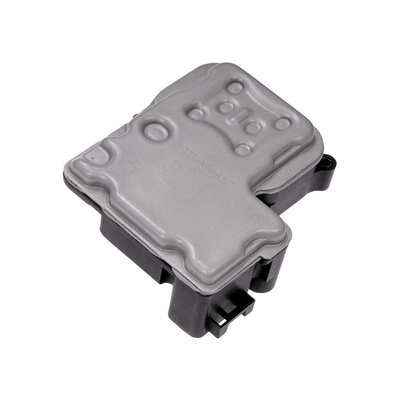
Below are the parts most often responsible for code C1247, ranked by how frequently each one is the actual culprit (per the diagnosis above). Tap any to see what we have for your vehicle.



The information in this article is provided for general reference and educational purposes only. Vehicle specifications, procedures, and part compatibility can vary by production date, trim level, and region. Always consult your vehicle's factory service manual and verify part numbers before purchasing or performing repairs. Safety-critical components such as airbags, seat belts, and braking systems should be installed by a qualified professional.
- 🧭 Diagnostic Flowchart
- 🎬 Helpful Videos
- 🛍️ Shop This Part
- What Does C1247 Mean?
- Can I Drive With C1247?
- Common Causes
- Symptoms
- Common Fixes & Costs
- Used vs. New Parts: Buying Guide
- What Happens If You Wait — Timeline
- Cost of Not Fixing It
- Diagnosis Steps
- When This Code Triggers (Freeze-Frame Conditions)
- Related Codes
- Climate & Environmental Factors
- How to Talk to a Mechanic About This Code
- Where to Take It: Dealer vs Independent vs Chain
- When to Walk Away From the Repair
- What Scan Tool You Need for This Code
- How to Clear the Code After You Fix It
- Will This Fail Emissions / State Inspection?
- Most Commonly Affected Vehicles
- Manufacturer-Specific Notes
- Real Owner Stories
- 2004 Toyota Prius with 130K miles - The TSB Misdiagnosis
- 2004 Chevrolet Corvette C5 - The Hydraulic Issue
- 2009 Toyota Prius with 316K miles - The Calibration Fix
- How to Prevent This Code From Triggering
- Frequently Asked Questions
- What are the most common misdiagnosis pitfalls for C1247?
- Can I replace the stroke sensor myself?
- The code came back after I calibrated the new sensor. What went wrong?
- Is it safe to drive with code C1247?
- Why are my ABS, VSC, and BRAKE lights all on at once?
- My mechanic quoted me over $2,000 to fix this. Is that a rip-off?
- The code appeared after I did a brake job. What happened?
- Key Takeaways
- 🎟️ Get 5% Off