

OBD-II Code C1311: Circuit Malfunction
What C1311 means, why it triggers, and how to fix it
- Code C1311 indicates a brake system power fault on Toyota, Lexus, and Hyundai vehicles, but signals an air suspension failure on Ford, Lincoln, and Jeep models.
- In over 80% of cases, the root cause is an inexpensive $5 fuse, a $40 relay, or a corroded ground wire rather than a $1,500 ABS control module.
- This code disables your anti-lock brakes and stability control, increasing emergency stopping distances by up to 30% on wet surfaces.
- Always test the 12V battery, inspect the under-hood fuse box for water intrusion, and swap the ABS main relay before authorizing a control module replacement.
What Does C1311 Mean?
Code C1311 means the car's main computer (ECU) detects an electrical circuit problem in a key system. It usually indicates an 'open circuit'—like a broken wire, blown fuse, or failed relay—in the power supply for the anti-lock brake system's main relay. On Ford, Lincoln, Mercury, and Jeep vehicles, it points to a fault in the electronic air suspension system's solenoid or compressor circuit.
Technical definition: The official SAE/OBD-II definition for code C1311 depends on the manufacturer. For Toyota, Lexus, and Scion, it is defined as 'Open Circuit in Main Relay 1' for the ABS/VSC system. This triggers when the Skid Control ECU commands the main relay on but detects less than 3.5V on the feedback circuit (pin BS) for more than 0.2 seconds when it expects over 9.5V. For Ford, Lincoln, and Mercury, it relates to a fault in the air suspension solenoid circuit. For Hyundai models, it indicates a 'Defective pump motor' or poor ground in the ABS/ESP system. For Jeep, it relates to the Quadra-Lift air suspension system.
Can I Drive With C1311?
Yes, But With Caution. You can drive the vehicle, but do so with extreme caution. This code indicates a critical fault in your anti-lock brakes (ABS) or electronic suspension. Your base hydraulic brakes function normally, but without ABS, your wheels lock during a hard stop. This increases stopping distances by 20-30% on wet or loose surfaces and causes a complete loss of steering control while the wheels are locked. The primary risk is an inability to steer around an obstacle in an emergency. Driving with the warning lights on also masks other potential brake issues and requires immediate attention.
Common Causes
- Corroded or Blown Fuse (Very Common) — A simple $5 fuse (often labeled ABS MAIN, ECB, or ABS MTR) supplying power to the ABS module blows. More insidiously, the fuse's terminals corrode from moisture, creating high resistance that mimics an open circuit.
- Faulty ABS Main Relay (Very Common) — The relay is a small electro-mechanical switch powering the ABS module. Components like the common Toyota P/N 90987-02027 endure thousands of power cycles and fail internally, creating an open circuit.
- Damaged or Leaking Fuse Box (Common) — On vehicles like the Gen 2 Toyota Prius, the under-hood fuse box develops cracks or bad seals. This allows water to enter and corrode the terminals for the ABS fuses and relays, directly causing the open circuit.
- Poor Ground Connection (Common) — The ABS control module requires a clean, tight ground connection to the vehicle's chassis. A corroded or loose ground bolt causes a voltage drop sufficient to trigger a circuit code like C1311.
- Low Battery Voltage (Less Common) — The ABS ECU monitors its own supply voltage. If the 12V battery is weak, voltage drops below the required 9.5V threshold during startup or high electrical load, causing the ECU to flag a power circuit fault.
- Damaged Wiring Harness (Less Common) — Wires leading to the control module, relay, or solenoid fray, break, or short due to vibration, heat, rodent damage, or improper repairs.
- Failed Air Suspension Solenoid or Compressor (Less Common) — On vehicles with air suspension like the Lincoln Town Car or Jeep Grand Cherokee, this code points to a failed solenoid valve controlling airflow, or a fault in the compressor relay circuit.
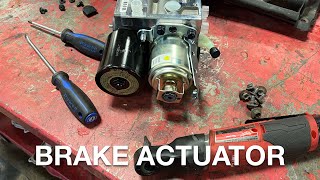
- Faulty Control Module (ECU) (Rare) — The ABS, Skid Control, or Suspension Control Module fails internally. This is the most expensive cause ($1,200+) and requires consideration only after exhaustively 🎬 See this walkthrough for replacing a faulty ABS actuator. testing power, ground, and relays.
Symptoms
- ABS Light On — The Anti-lock Brake System (ABS) warning light illuminates on the dashboard.
- Traction/Stability Control (VSC/ESC) Light On — The stability control system light turns on, as it relies on the ABS hardware to function.
- Red 'BRAKE' Warning Light On — The primary red brake warning light activates, indicating a serious fault in the overall braking system.
- Brake Pedal Feels Stiff or Requires More Effort — The brake pedal feels unusually hard to press, and the car takes longer to stop because the anti-lock and power assist features are disabled.
- Poor Ride Quality or Sagging Suspension — If related to the air suspension, you notice a bouncy or stiff ride, or one corner of the vehicle sags noticeably when parked.
Diagnostic Flowchart
Tap your situation to follow the diagnostic path that matches what you're seeing on this code.
Used vs. New Parts: Buying Guide
When a used part is worth it: A used ABS actuator is a budget-conscious choice for older, high-mileage vehicles (over 150k miles) where the cost of a new part ($1,200+) exceeds a large portion of the car's value. It saves significant money if you source a tested part.
Donor-vehicle mileage cap: roughly under 100000 miles for the part to have meaningful remaining life.
Donor quality checklist:
- Verify the part number matches exactly.
- Purchase from a reputable auto recycler offering at least a 90-day warranty.
- Avoid parts from vehicles with flood or heavy front-end damage.
- Ask for the donor vehicle's VIN to check its history.
Decision logic:
- If Vehicle is newer or has lower mileage (<100K miles) → Buy a new OEM or high-quality remanufactured part. The labor cost is too high to risk doing the job twice.
- If The cost of a new part is over 50% of the vehicle's value → A used part from a warrantied source is a reasonable risk.
- If The part requires VIN programming to the vehicle → Factor in the cost of dealer or specialist programming ($150-$300) for a used part. A rebuilt unit from your original module avoids this.
Warranty tradeoff: Used parts typically have a 30-90 day part-only warranty. New OEM parts carry a 12-month/12,000-mile warranty. Remanufactured units vary from 1 year to a limited lifetime warranty.
Worst-case if a used part fails: $800-$1500 if a used part fails after the warranty period, requiring a second part purchase and repeat labor costs.
What Happens If You Wait — Timeline
- Immediate: Code C1311 sets, and the ABS, VSC, and red BRAKE warning lights illuminate. Anti-lock braking and stability control are disabled. The vehicle's base hydraulic brakes remain functional. (MPG impact: 0%% · Added cost: $0 (Safety risk is the primary cost))
- 1-3 months (if cause is water intrusion): If the cause is a leaking fuse box or connector, ongoing moisture exposure corrodes adjacent terminals and wiring. A single open circuit spreads to other systems. (MPG impact: 0%% · Added cost: $200-$600 (Cost to repair wiring or replace a fuse box section))
- 0-6 months (for air suspension faults): If the code is on a Ford/Lincoln and caused by a leaking air solenoid, the air compressor runs continuously to compensate. This leads to overheating and premature burnout of the compressor motor. (MPG impact: 0%% · Added cost: $300 - $1,000 (Cost to replace the failed air suspension compressor))
- Ongoing: The vehicle automatically fails state safety inspections in many jurisdictions (e.g., New York). Driving with multiple warning lights on masks new, unrelated problems with the braking system. (MPG impact: 0%% · Added cost: $100+ (Towing and inspection re-test fees))
Cost of Not Fixing It
- Immediate: Loss of anti-lock braking (ABS) and vehicle stability control (VSC). Increased risk of skidding and loss of steering control during emergency braking, especially on wet or loose surfaces. (Added cost: N/A (Increased safety risk))
- 0-6 Months (for Air Suspension faults): If the code is due to a leaking air spring solenoid, the compressor runs excessively to compensate, leading to premature burnout of the compressor motor. (Added cost: $300 - $1,000 to replace the air suspension compressor in addition to the original solenoid repair.)
- Ongoing: Failure to pass state safety inspections in jurisdictions where an ABS warning light is an automatic failure. Masking of other potential brake system warnings. (Added cost: $100+ for towing fees and failed inspection re-tests.)
When This Code Triggers (Freeze-Frame Conditions)
- System State: Key ON, Engine OFF or ON (The ABS module performs a self-test upon ignition ON. The code sets if the relay feedback voltage is not seen within milliseconds.)
- Vehicle Speed: 0 mph (The fault is most often detected during the initial power-up self-check before the vehicle is in motion.)
- Battery Voltage (IG1): > 9.5V (The ECU must see sufficient system voltage to reliably operate the relay; if voltage is low, it triggers this code.)
- Relay Command: ON (The code sets when the ECU sends the 'ON' signal to the main relay but the feedback circuit voltage remains low (<3.5V) for more than 0.2 seconds.)
Related Codes
- C1312, C1313, C1314 — These are sister codes to C1311. C1312 indicates a 'Short Circuit' in Relay 1, while C1313 and C1314 indicate an 'Open Circuit' and 'Short Circuit' in Relay 2. They point to the same components, but the diagnostic focus shifts from finding a break (open) to finding an unintended connection to power or ground (short).
- C1300 — This code means 'ABS ECU Malfunction.' It appears with C1311 because if the ECU's power supply circuit fails (C1311), the ECU cannot function and reports an internal error (C1300). Always diagnose and fix C1311 first to automatically clear C1300.
- C1241 — This code indicates 'Low or High Battery Voltage.' The ABS control module requires a stable voltage (>9.5V) to operate its relays. A failing battery or alternator starves the ABS module of power, causing C1311 to set. Verify the main 12V battery is healthy before diagnosing C1311.
- C0278 — This is a generic 'ABS Relay Plausibility Fault' code found on many makes. It functions similarly to C1311, indicating the control module commanded the relay to change state, but the feedback circuit does not reflect that change. The diagnostic process is identical.
Climate & Environmental Factors
- High Humidity / Road Salt: Moisture and road salt accelerate the corrosion of fuse box terminals, wiring harness connectors, and chassis ground points for the ABS module. Water intrusion into a cracked fuse box is a primary cause on older hybrids.
- Extreme Heat: Sustained high temperatures in the engine bay degrade the internal components of relays and the ABS control module over time, leading to premature failure.
How to Talk to a Mechanic About This Code
Say this: "I have a C1311 code and my ABS light is on. Since this is a circuit code, please start by testing the power and ground circuits for the ABS module, including the main relay and fuses, before assuming the module itself is bad."
This signals that you understand the code's meaning and directs the shop to follow a logical, cost-effective diagnostic path. It prevents them from immediately quoting a $2,000 ABS module replacement.
Avoid saying:
- 'Just fix whatever's wrong'
- 'My ABS light is on, can you look at it?' (too vague, invites upsells)
- 'My friend said it's probably the ABS module'
- 'Just do whatever you think is best'
Questions to ask before authorizing the repair:
- Did you test the ABS main relay and its circuit? Was it working correctly?
- Did you inspect the ABS-related fuses for continuity and corrosion?
- Can you confirm you checked the ABS module's chassis ground for corrosion and tightness?
- If recommending an ABS module replacement, can you show me the voltage readings proving the module receives correct power and ground but fails to function?
Where to Take It: Dealer vs Independent vs Chain
- Dealer:
Best for: Vehicles under warranty, Complex electrical issues on hybrid models (e.g., Toyota Prius), When a confirmed faulty module needs replacement and VIN programming
Downsides: Highest labor rates (often $150-$250/hr)., Defaults to replacing the entire expensive ABS actuator assembly rather than diagnosing a simpler circuit fault. (Typical cost: +60% vs. baseline) - Independent Shop:
Best fit. A well-vetted independent shop with ASE-certified technicians specializing in electrical systems is the ideal choice for a cost-effective diagnosis of C1311.
Best for: Out-of-warranty vehicles where cost is a factor., Shops with a strong reputation for electrical and brake system diagnostics.
Downsides: Shop quality and diagnostic tool capability vary widely., May lack access to the most up-to-date manufacturer-specific information or programming tools. (Typical cost: +0% vs. baseline) - Chain Shop:
AVOID. This code requires advanced diagnostic skills beyond the scope of most chain shops. The risk of an expensive misdiagnosis is extremely high.
Best for: Simple, unrelated maintenance like oil changes or tires.
Downsides: Technicians often lack the specialized electrical diagnostic skills for a code like C1311., High pressure to sell parts leads to misdiagnosis and unnecessary replacement of expensive components. (Typical cost: -10% vs. baseline)
When to Walk Away From the Repair
If the estimated repair cost for the worst-case scenario (e.g., a new ABS actuator at $2,000+) exceeds 50% of your car's private-party market value, seriously consider selling the vehicle.
- Car worth $4000, fix is $2500: Walk away. The repair cost is over 60% of the car's value. Sell the vehicle 'as-is' with full disclosure or trade it in.
- Car worth $15000, fix is $2500: Fix it. The repair cost is significant but well below the 50% threshold. Ensure you ruled out cheaper causes first.
- Car worth $6000, fix is $150: Fix it. If the diagnosis confirms a simple relay or wiring issue, the repair is highly cost-effective.
What Scan Tool You Need for This Code
Minimum: A scanner that reads and clears codes from the Anti-Lock Brake System (ABS) module. Basic engine-only code readers will not see this code.
A standard $20 OBD-II reader only communicates with the Engine Control Unit (ECU). C1311 is stored in the ABS control module, requiring an ABS-capable scanner to access.
Budget: Foxwell NT630 Plus / Autel AutoLink AL619 (~$90) — Reads and clears ABS codes, allowing you to confirm the C1311 fault and verify if a simple fix (like replacing a fuse) solved the problem.
Mid-range: Innova 5610 / Foxwell NT809 (~$350) — Provides bi-directional control. This crucial feature allows you to command the ABS main relay to turn on and off directly from the tool, definitively testing the control circuit and avoiding unnecessary module replacement.
Professional: Autel MaxiCOM MK808S / XTOOL D7 (~$450-600) — Offers full OE-level bidirectional diagnostics, live data graphing for voltage checks, and access to manufacturer-specific test procedures.
How to Clear the Code After You Fix It
- Use an OBD-II scan tool to clear the Diagnostic Trouble Code (DTC) from the ABS/Skid Control ECU.
- Turn the ignition completely off, then turn it back to the ON position.
- Listen for the ABS pump/relay self-test, occurring within the first few seconds.
- Drive the vehicle above 15 mph to allow the system to complete its self-checks.
Drive cycle (~10 minutes): After clearing the code, drive for 5-10 minutes, ensuring vehicle speed surpasses 15-20 mph. The ABS light remains off if the repair was successful. Unlike emissions monitors, the ABS system's readiness confirms quickly.
Readiness monitors affected: This code does not affect emissions-related readiness monitors like Catalyst or O2 sensor.
Watch out for:
- Disconnecting the 12V battery fails to clear this code from the ABS module's memory.
- The code returns instantly upon the next key cycle if the root electrical fault remains uncorrected.
Will This Fail Emissions / State Inspection?
Yes — this code typically fails an OBD-II emissions inspection.
- California: An illuminated ABS warning light is not part of the emissions inspection (Smog Check). However, an illuminated red 'BRAKE' warning light fails the basic safety portion of the inspection.
- New York: An illuminated ABS warning light is grounds for automatic failure of the annual safety inspection.
- Texas: An illuminated ABS warning light does NOT cause a failure on its own. However, an illuminated red 'BRAKE' warning light results in an automatic failure of the safety inspection.
Most Commonly Affected Vehicles
- Toyota Prius (2004-2009) — Extremely common. Often caused by a failed ABS main relay or a faulty ABS actuator assembly. Crucially, these models are prone to water intrusion in the under-hood fuse box from a cracked housing, causing corrosion on the ABS fuse/relay terminals.
- Lincoln Town Car (1998-2011) — This code almost always points to a problem with the air suspension system, typically a bad air spring control solenoid. While replacing the solenoid, check the ride height level sensor for free movement.
- Lexus LS430, CT200h, RX350 (2001-2006 (LS), 2011-2017 (CT), 2007-2015 (RX)) — Prone to C1311 related to the electronically controlled brake system's main relay circuit, often integral to the expensive brake booster/actuator assembly.
- Ford Crown Victoria / Mercury Grand Marquis (1998-2011) — Shares a platform with the Lincoln Town Car and experiences the same air suspension solenoid failures.
- Toyota Highlander / Tundra (2008-2013 (Highlander), 2007-2013 (Tundra)) — Owners report C1311 related to the ABS Main Relay 1 circuit, similar to other Toyota models of the era. Diagnosis is identical to the Prius/Lexus procedure.
- Hyundai Santa Fe / Sonata (2007-2012) — On these models, C1311 points to an issue with the ABS/ESP pump motor or its associated circuitry. A corroded ground connection point for the HECU (Hydraulic Electronic Control Unit) is a known weak point.
- Scion xB, tC (2007-2015) — Uses the same Toyota-based brake control system, where C1311 indicates an open in the ABS main relay circuit.
- Jeep Grand Cherokee (2011-2015) — For models equipped with Quadra-Lift air suspension, C1311 indicates a fault in the suspension control module's power supply or compressor relay circuit.
Manufacturer-Specific Notes
- Toyota / Lexus / Scion: This code is exclusively related to the electronically controlled brake system. The cause is usually an inexpensive relay (P/N 90987-02027) or a corroded fuse. On hybrids like the Prius, these codes are also a symptom of a failing ABS actuator assembly. Thoroughly diagnosing the power circuit prevents a $2,000 misdiagnosis.
- Ford / Lincoln / Mercury: On these brands, C1311 points to the air suspension system, not the brakes. The fault is usually a specific solenoid controlling ride height. Focus diagnostics on the suspension compressor, relay, and solenoids.
- Hyundai / Kia: A common point of failure on these vehicles is the main chassis ground for the ABS module (HECU). The ground bolt and terminal are highly susceptible to corrosion. Locate, remove, and clean the ground connection as a primary diagnostic step.
- Jeep / Chrysler: On vehicles with Quadra-Lift air suspension, C1311 indicates a fault in the suspension control module's power supply or air compressor relay circuit. The system is highly sensitive to voltage drops.
Real Owner Stories
2006 Toyota Prius with multiple brake warning lights
Owner experienced red 'BRAKE', ABS, and VSC lights on the dash. The brake pedal felt very hard and required high effort to stop the car. A professional scan tool revealed codes C1311 and C1377.
Outcome: The actual cause was a corroded 10A 'ABS Main 1' micro fuse. The fuse box lid failed to latch properly due to a previous accident, allowing water and debris to enter. Replacing the fuse solved the problem, though corrosion returned two years later.
Lesson: Physical inspection of fuses and the fuse box for corrosion or water intrusion is critical. A cheap fuse is often the root cause, but a damaged fuse box guarantees the problem recurs.
2010 Toyota Prius with C1300 and C1311 after dealer service
A 'Check Hybrid System' warning appeared shortly after having an alignment done at a dealership. The codes were C1300 (ABS ECU Malfunction) and C1311.
Outcome: Forum advice correctly suggested that C1311 (power circuit fault) causes C1300 (ECU malfunction). The recommended action was diagnosing C1311 first by checking the ABS MAIN 1 and 2 fuses and the ABS main relay before condemning the ECU.
Lesson: When an ECU malfunction code (C1300) appears with a circuit code (C1311), always diagnose the circuit code first. A module cannot operate without proper power, so a power fault triggers a secondary, misleading ECU error code.
Lincoln Town Car with C1311 and suspension issues
The owner of a Lincoln Town Car experienced a C1311 code, but instead of brake problems, the 'Check Air Suspension' light was on and the rear of the vehicle was sagging.
Outcome: On Ford, Lincoln, and Mercury vehicles with air suspension, C1311 points to a faulty air spring control solenoid, not the ABS system. The solenoid controlling air flow to the suspension bags failed, causing the leak and the code. Replacing the specific solenoid resolved the issue.
Lesson: The meaning of C1311 is highly manufacturer-dependent. For Ford/Lincoln/Mercury, it is almost always an air suspension issue, whereas for Toyota/Lexus it is a brake system electrical fault.
Hyundai Santa Fe with intermittent ABS/ESP lights
A 2008 Hyundai Santa Fe owner had intermittent ABS and ESP warning lights, accompanied by code C1311. The lights would come and go, seemingly at random.
Outcome: The actual cause was a corroded main ground connection for the ABS module on the chassis. The ground bolt under the battery tray was exposed to moisture and developed high resistance. Cleaning the contact surfaces and re-securing it tightly resolved the intermittent voltage drop.
Lesson: Intermittent electrical faults frequently stem from poor ground connections. For Hyundai/Kia vehicles, checking and cleaning the HECU ground point is a primary diagnostic step for C1311.
How to Prevent This Code From Triggering
- Change brake fluid every 2-3 years or 30,000 miles. (Every 2-3 years) — Brake fluid absorbs moisture from the air. This moisture lowers the boiling point and causes internal corrosion of sensitive ABS module components like solenoid valves and the pump.
- Apply dielectric grease to fuse and relay terminals. (Once, or when replacing a fuse/relay) — In humid or salt-prone climates, applying a thin layer of dielectric grease to the metal contacts of fuses and relays seals out moisture, preventing the corrosion that triggers a C1311 open circuit code.
- Periodically inspect the under-hood fuse box seal and wiring harnesses. (Annually) — Engine heat and vibration cause rubber seals on fuse boxes to become brittle and crack. A visual inspection spots damage that allows water in. Ensure wiring is secure and not rubbing against sharp edges.
- Clean and protect chassis ground points. (When working in the area) — The ABS module relies on a clean connection to the vehicle's chassis for its ground. When working near a ground bolt, remove it, clean the metal surfaces with a wire brush, and re-tighten securely to prevent voltage drops.
- Fabricate a simple heat shield for the ABS module. (Once) — On some vehicles, the ABS module sits near the hot exhaust manifold. Constant heat bakes the electronics and leads to premature failure. Fabricating a simple shield from a thin sheet of aluminum deflects radiant heat, extending the module's life.
Frequently Asked Questions
Why are the ABS, VSC, and BRAKE lights all on at once?
These systems are interconnected. The ABS module is the 'brain', and when it loses power or detects a major fault like C1311, it shuts down itself and dependent systems like Vehicle Stability Control (VSC). The red BRAKE light activates to warn you that your braking system's safety features are disabled.
My mechanic says I need a $3,000 ABS actuator. Is that right?
It is possible, but highly unlikely. C1311 is a circuit code, meaning the problem usually lies in the $5 fuse or $40 relay that powers the actuator. Always insist a shop proves the relay and wiring are good with a multimeter before condemning the $1,500 module.
What is the most common misdiagnosis for C1311?
The most common mistake is replacing the expensive ABS actuator/ECU assembly without thoroughly checking the power supply circuit. Real-world examples show that a cracked fuse box letting in water, a corroded ground wire, or a simple blown fuse are often the true culprits. Failing to use a bi-directional scan tool to perform an active test on the relay is another major pitfall.
Can I just clear the code?
You can clear the code with a scanner, but because C1311 indicates a hard electrical fault, it returns immediately upon the next power cycle. The computer continuously checks this circuit, so the code persists until the underlying open or short is fixed.
Could a weak 12-volt battery cause this code?
Yes, modern electronic modules are highly sensitive to voltage drops. A weak battery causes system voltage to drop below the required 9.5V threshold during startup, triggering C1311. Have your battery professionally tested before starting any expensive ABS repairs.
What's the difference between an 'open circuit' and a 'short circuit'?
An 'open circuit' (like C1311) is like a cut wire or a light switch in the OFF position; electricity cannot flow. A 'short circuit' (like C1312) is an unintended path to ground, like a frayed wire touching the metal chassis, which causes excessive current flow and blows a fuse.
Do I need Toyota Techstream or a special scanner to fix this?
You do not always need a high-end scanner, as a simple relay swap or fuse replacement often works. However, a bi-directional scanner like Techstream is invaluable for a definitive diagnosis. It allows you to command the relay on and off to confirm if the ECU sends the signal and if the relay responds.
Key Takeaways
- Code C1311 indicates a brake system power fault on Toyota, Lexus, and Hyundai vehicles, but signals an air suspension failure on Ford, Lincoln, and Jeep models.
- In over 80% of cases, the root cause is an inexpensive $5 fuse, a $40 relay, or a corroded ground wire rather than a $1,500 ABS control module.
- This code disables your anti-lock brakes and stability control, increasing emergency stopping distances by up to 30% on wet surfaces.
- Always test the 12V battery, inspect the under-hood fuse box for water intrusion, and swap the ABS main relay before authorizing a control module replacement.
Helpful Videos

The information in this article is provided for general reference and educational purposes only. Vehicle specifications, procedures, and part compatibility can vary by production date, trim level, and region. Always consult your vehicle's factory service manual and verify part numbers before purchasing or performing repairs. Safety-critical components such as airbags, seat belts, and braking systems should be installed by a qualified professional.
- 🧭 Diagnostic Flowchart
- 🎬 Helpful Videos
- What Does C1311 Mean?
- Can I Drive With C1311?
- Common Causes
- Symptoms
- Used vs. New Parts: Buying Guide
- What Happens If You Wait — Timeline
- Cost of Not Fixing It
- When This Code Triggers (Freeze-Frame Conditions)
- Related Codes
- Climate & Environmental Factors
- How to Talk to a Mechanic About This Code
- Where to Take It: Dealer vs Independent vs Chain
- When to Walk Away From the Repair
- What Scan Tool You Need for This Code
- How to Clear the Code After You Fix It
- Will This Fail Emissions / State Inspection?
- Most Commonly Affected Vehicles
- Manufacturer-Specific Notes
- Real Owner Stories
- 2006 Toyota Prius with multiple brake warning lights
- 2010 Toyota Prius with C1300 and C1311 after dealer service
- Lincoln Town Car with C1311 and suspension issues
- Hyundai Santa Fe with intermittent ABS/ESP lights
- How to Prevent This Code From Triggering
- Frequently Asked Questions
- Why are the ABS, VSC, and BRAKE lights all on at once?
- My mechanic says I need a $3,000 ABS actuator. Is that right?
- What is the most common misdiagnosis for C1311?
- Can I just clear the code?
- Could a weak 12-volt battery cause this code?
- What's the difference between an 'open circuit' and a 'short circuit'?
- Do I need Toyota Techstream or a special scanner to fix this?
- Key Takeaways
- 🎟️ Get 5% Off