

OBD-II Code C1392: Brake Pedal Stroke Sensor Calibration Not Learned
What C1392 means, why it triggers, and how to fix it
- Code C1392 triggers when the Skid Control ECU loses the brake pedal's zero-point memory, caused by a weak or disconnected 12V battery in over 80% of cases.
- Fix this code by performing an electronic 'Zero Point Calibration' using a bidirectional scan tool or a manual paperclip jumper, costing $0 to $200.
- Driving with C1392 disables your Anti-lock Braking System (ABS) and Vehicle Stability Control (VSC), increasing fatal single-vehicle crash risk by 56%.
- Reject immediate mechanic quotes over $1,000 for brake actuator replacement; demand a simple software calibration first to avoid massive misdiagnosis costs.
What Does C1392 Mean?
Code C1392 means the Skid Control ECU lost the memory of the brake pedal's resting 'zero' position. The anti-lock braking (ABS) and vehicle stability control (VSC) systems require this calibration to understand driver braking intent. A power interruption, such as a dead or disconnected 12-volt battery, causes this memory loss in over 80% of cases.
Technical definition: The official SAE/OBD-II definition is "Stroke Sensor Zero Point Calibration Undone." The Skid Control ECU lost the stored baseline voltage sent by the brake pedal stroke sensor when unpressed. Without this zero point, the ECU cannot calculate ABS and VSC interventions.
Can I Drive With C1392?
Yes, But With Caution. Yes, but with extreme caution. Your primary hydraulic brakes function normally, but your anti-lock brakes (ABS) and vehicle stability control (VSC) are disabled. This significantly increases stopping distances in panic situations and removes the system's ability to prevent skids and spins. Driving with these safety systems offline increases the risk of a loss-of-control accident. Get the vehicle serviced immediately.
Common Causes
- Disconnected, weak, or dead 12-volt battery (Very Common) — The Skid Control ECU requires constant power to retain its calibration memory. Replacing the battery, letting it die, or leaving the vehicle in prolonged storage erases this memory and instantly triggers the code.
- Brake system components replaced without recalibration (Common) — Replacing the brake actuator, master cylinder, Skid Control ECU, or the stroke sensor requires a software recalibration as the final step. Skipping this mandatory procedure sets the C1392 code.
- Connecting or disconnecting an OBD-II scanner while the engine is running (Less Common) — A voltage surge or communication error from a non-compliant diagnostic tool corrupts the ECU's memory. Connecting or disconnecting the tool with the ignition on triggers a cascade of brake system codes, including C1392.
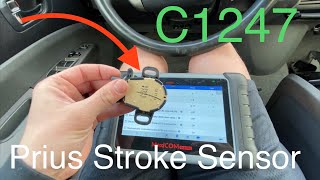
- Faulty brake pedal stroke sensor 🎬 Watch this walkthrough on replacing and recalibrating the stroke sensor. (Rare) — The sensor sends a variable voltage signal to the ECU based on pedal position. Internal wear causes it to send an erratic or out-of-range signal, making calibration impossible.
- Corroded wiring or liquid damage near the center console (Rare) — Liquid spills near the dashboard or OBD-II port cause electrical shorts. This damages wiring or connectors linked to the brake control system, leading to communication errors and signal loss.
- Failed Skid Control / ABS module (Rare) — The control module loses its ability to store calibration data permanently, causing the code to return immediately after every calibration attempt. This requires replacing the entire module.
Symptoms
- Dashboard warning lights illuminated (ABS, VSC, TRAC, and red BRAKE) — The Anti-lock Braking System, Vehicle Stability Control, Traction Control, and general brake warning lights illuminate simultaneously, indicating these safety systems are disabled.
- Regenerative braking disabled (hybrid vehicles) — The system that recharges the high-voltage battery during braking shuts down. This negatively impacts fuel economy and forces the friction brakes to handle 100% of stopping duties.
- Unusual brake pedal feel — The brake pedal feels soft, spongy, or overly sensitive and grabby at low speeds because the electronic brake control is offline.
- Continuous or intermittent audible dashboard alarm — Certain Toyota and Lexus models emit a beeping sound from the instrument cluster to alert the driver of a critical brake system fault.
Diagnostic Flowchart
Tap your situation to follow the diagnostic path that matches what you're seeing on this code.
Common Fixes & Costs
- Perform Zero Point Calibration — Parts: $0, Labor: $75-$200, ~0.7 hr book time (DIY)
- Replace 12-Volt Battery — Parts: $150-$350, Labor: $25-$50, ~0.4 hr book time (DIY)
- Replace Brake Pedal Stroke Sensor
— Parts: $160-$250, Labor: $100-$150, ~1.2 hr book time
(Intermediate)
Toyota Prius (2004-2009): OEM 89510-47010 (Alt: Dorman, Standard Motor Products (SMP))
Toyota Prius C (2012-2019): OEM 89510-47050 (Alt: AISIN)
Lexus LS460 (2007-2012): OEM 89510-30040 (Alt: Genuine OEM is most common) - Repair Wiring Harness — Parts: $10-$50, Labor: $200-$400, ~3 hr book time (Professional)
- Replace Skid Control ECU / ABS Module
— Parts: $800-$2500, Labor: $200-$400, ~4.5 hr book time
(Professional)
Toyota Prius (2004-2009): OEM 44500-47090 (Assembly), 89540-47080 (ECU) (Alt: Dorman 587-765 (Assembly), Cardone (Remanufactured))
Lexus LS460 (2007-2012): OEM 44510-50070 or 44510-50090 (Assembly) (Alt: Cardone (Remanufactured), Used OEM from dismantlers)
DIY vs Professional
- Perform Zero Point Calibration 🟢 Beginner
Tools: Paperclip (specific models only) or Bidirectional Scan Tool - Replace 12-Volt Battery 🟢 Beginner
Tools: Basic hand tools (wrench set, socket set) - Replace Brake Pedal Stroke Sensor 🟢 Beginner
Tools: Socket set, wrenches, flashlight, trim removal tools, bidirectional scan tool - Repair Wiring Harness 🟢 Beginner
Tools: Professional diagnostic tools, wiring diagrams, multimeter, soldering iron, heat shrink - Replace Skid Control ECU / ABS Module 🟢 Beginner
Tools: Professional scan tool for programming and bleeding, flare nut wrenches, socket set
Used vs. New Parts: Buying Guide
When a used part is worth it: If the Skid Control ECU / ABS Module is diagnosed as faulty, a used unit from a low-mileage donor vehicle saves significant money. Given the high cost of a new OEM module ($800-$2500+), a used part is practical for older, high-mileage vehicles.
Donor-vehicle mileage cap: roughly under 100000 miles for the part to have meaningful remaining life.
Donor quality checklist:
- Verify the donor vehicle was not involved in a major front-end collision.
- Match the part number exactly; superseded numbers require programming.
- Purchase from a reputable dismantler offering at least a 30-90 day warranty.
Decision logic:
- If Vehicle is under 8 years old OR part is < $800 new → Favor new or remanufactured parts for better warranty and reliability.
- If Vehicle is > 10 years old AND budget is the primary concern → A tested, used part is an acceptable risk if the part number matches exactly.
- If The part requires VIN programming to function → Factor in the cost of dealer/specialist programming for a used part before buying.
Warranty tradeoff: Used parts typically offer a 30-90 day functional warranty. Remanufactured parts come with a 1-year to limited lifetime warranty. New OEM parts carry a 1-year/12,000-mile warranty if installed by a dealer.
Worst-case if a used part fails: $500-$800 if a used part fails after installation, representing repeat labor costs (4-5 hours) plus the cost of another replacement part.
What Happens If You Wait — Timeline
- Immediate: Code sets, and ABS, VSC, and BRAKE warning lights illuminate. An audible alarm sounds. ABS and VSC safety systems are immediately disabled. (MPG impact: 0%% · Added cost: $0 (but accident risk is significantly increased))
- Ongoing: On hybrid vehicles, regenerative braking is disabled. This leads to a noticeable drop in fuel economy and causes faster wear on the conventional brake pads. (MPG impact: 5-15% (on hybrids)% · Added cost: $50-$200 in wasted fuel and accelerated brake pad wear over a few months.)
- 1-12 months: The driver fails mandatory state safety inspections due to illuminated brake warning lights. There is no direct progressive mechanical damage caused by the code itself. (MPG impact: 5-15% (on hybrids)% · Added cost: Cost of a failed inspection or a traffic citation, plus ongoing fuel and brake wear costs.)
- Catastrophic Event: In an emergency maneuver or on a slippery surface, the driver loses control of the vehicle in a situation where VSC or ABS would have prevented a skid or spin, resulting in a crash. (MPG impact: N/A% · Added cost: $500 to Total Loss of Vehicle. NHTSA studies show Electronic Stability Control (VSC) reduces the risk of fatal single-vehicle crashes by 56%.)
Cost of Not Fixing It
- Immediate and ongoing: ABS and Vehicle Stability Control (VSC) are disabled. This significantly increases stopping distances in panic stops and removes the vehicle's ability to correct for skids or spins. (Added cost: No direct parts damage, but the cost of a potential accident increases dramatically.)
- Ongoing: On hybrid vehicles, regenerative braking is disabled, leading to a noticeable decrease in fuel economy and increased wear on conventional brake pads. (Added cost: $5-$15 per tank of gas; accelerated brake pad wear.)
- Long-term: Altered brake pedal feel leads to driver habits that cause uneven or premature wear on brake pads and tires. (Added cost: Potential for earlier replacement of tires and brake components.)
- Catastrophic Event:
Diagnosis Steps
- Verify Battery Health
A weak 12-volt battery causes this code over 80% of the time. Ensure the battery holds at least 12.4 volts at rest. Have it load-tested at an auto parts store, even if it is new. Clean and tighten all terminals.
Tools: Digital Multimeter or battery tester (Beginner) - Attempt Manual Zero Point Calibration (Paperclip Method)
On 2004-2009 Toyota/Lexus models, calibrate without a scan tool. Turn ignition OFF. Use a paperclip to connect OBD-II terminals 4 (CG) and 12 (TS). Turn ignition ON (engine off). The ABS/VSC lights blink rapidly. After several seconds, turn ignition OFF and remove the jumper. Start the car to verify the lights cleared.
Tools: Paperclip or small jumper wire (Intermediate) - Perform Zero Point Calibration with a Bidirectional Scan Tool
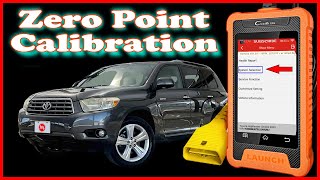
Connect a bidirectional scan tool (Techstream, Autel, Launch). Navigate to the 'ABS/VSC/TRAC' ECU, select 'Utility' or 'Special Functions', and choose 'Zero Point Calibration'. Follow the on-screen prompts exactly. The vehicle must be stationary on a level surface with the steering wheel straight.
Tools: Bidirectional OBD-II Scan Tool (Intermediate) - Inspect Brake Pedal and Sensor Mounting
Visually inspect the brake pedal assembly. Remove obstructions like floor mats preventing the pedal from fully returning. Ensure the stroke sensor is securely mounted to its bracket and the wiring harness is plugged in firmly.
Tools: Flashlight (Beginner) - Test Stroke Sensor Live Voltage Data
Connect a bidirectional scan tool and access the ABS/VSC ECU Data List. Monitor 'Brake Pedal Stroke Sensor 1' and 'Sensor 2'. With the pedal released, voltages must be low and stable (e.g., Sensor 1 around 0.8V). Slowly press the pedal; voltage must increase smoothly without dropouts. Erratic readings confirm a faulty sensor.
Tools: Bidirectional OBD-II Scan Tool (Advanced) - Check Sensor Circuit and Wiring Harness
Disconnect the battery. Unplug the stroke sensor and Skid Control ECU. Using a multimeter, check for continuity (under 1 Ω) on each wire between the connectors. Check for a short to ground (reading 10 kΩ or higher). Reconnect the ECU, turn ignition ON, and back-probe the sensor connector to verify a stable 5-volt reference signal.
Tools: Multimeter, vehicle-specific wiring diagram, back-probe kit (Advanced) - Test or Replace the Skid Control ECU
If calibration fails repeatedly, the sensor tests perfectly, and the wiring harness is intact, the Skid Control ECU is faulty and unable to store learned values. Confirm diagnosis by substituting a known-good ECU. Stop DIY efforts and consult a professional.
Tools: Advanced diagnostic tools, professional expertise (Professional)
When This Code Triggers (Freeze-Frame Conditions)
- Vehicle Speed: 0 mph (Stationary. The code sets during the ECU's power-on self-test before the vehicle moves.)
- Engine RPM: 0 - 800 RPM (Key On, Engine Off or at idle. The fault is detected immediately upon power-up.)
- Brake Pedal Status: Released (The ECU fails the self-test when it cannot verify the sensor's 'zero' (released) position.)
- System Voltage: 12.0 - 14.5V (Normal operating voltage. The code triggers due to lost memory, not necessarily a current voltage issue.)
Related Codes
- C1345 — Linear Solenoid Valve Offset Learning Undone. Appears simultaneously with C1392 on Toyota/Lexus vehicles after power loss. The same Zero Point Calibration procedure fixes both codes.
- C1336 — Zero Point Calibration of Deceleration Sensor Undone. The G-sensor memory is lost during power failure. Calibration requires the vehicle to be on a perfectly flat and level surface.
- C1203 — Vehicle Communication Information Malfunction. Sets when the Skid Control ECU stops communicating properly with the main Engine Control Module. Resolving C1392 typically clears C1203.
- C1310 — HV System Malfunction. The brake ECU sets this code to indicate a fault from the main Hybrid Vehicle control system. It clears once the primary brake system faults are resolved.
Climate & Environmental Factors
- Extreme Temperatures (Cold and Hot): Extreme cold and heat significantly shorten a 12V battery's lifespan. A vehicle struggling to start in extreme weather experiences a voltage drop low enough to erase the ECU's calibration memory, triggering the code.
- High Humidity / Salt Belt Regions: High humidity and road salt increase corrosion on electrical connectors. A corroded connector at the stroke sensor or Skid Control ECU causes high resistance, leading to a signal fault that prevents calibration.
How to Talk to a Mechanic About This Code
Say this: "I have a C1392 code, which I know is for 'Brake Pedal Stroke Sensor Calibration Not Learned'. I'd like to schedule an appointment to have the 'Zero Point Calibration' procedure performed. Please check the 12-volt battery's health first, but the primary job is the calibration."
This language signals to the shop that you understand the code refers to a software calibration, directing them to the specific, low-cost fix. It prevents them from starting a vague 'brake system diagnostic' which leads to misdiagnosis and upselling.
Avoid saying:
- 'My ABS and VSC lights are on.' (Too vague, invites a wide-ranging and expensive diagnostic process).
- 'I think my ABS module is bad.' (Incorrectly diagnosing the problem yourself leads them down the wrong path).
- 'Just fix the brake lights.' (Encourages replacing expensive parts until the lights go out, rather than performing the correct calibration).
Questions to ask before authorizing the repair:
- Can you confirm you have a scan tool, like Techstream or a compatible bidirectional tool, that can perform a 'Zero Point Calibration' for my specific model?
- The work order should state 'Perform Zero Point Calibration for C1392', correct? Not 'Replace Brake Actuator'?
- If the calibration is successful, what will the total cost be for the labor?
- If the calibration fails, what is the diagnostic plan to test the stroke sensor and wiring before considering ECU replacement?
Where to Take It: Dealer vs Independent vs Chain
- Dealer:
A safe but expensive choice. They have the right tools, but you must be firm in requesting calibration ONLY before approving other work.
Best for: Vehicles under warranty., Complex cases where calibration repeatedly fails and advanced diagnostics with factory tools (Techstream) are needed., Owners who prioritize a guaranteed fix, albeit at a higher cost.
Downsides: Highest labor rates., Quick to recommend expensive actuator replacement if the first calibration attempt fails. (Typical cost: +50% vs. baseline) - Independent Shop:
Best fit. A good independent Toyota/Lexus specialist sees this code frequently and goes straight to the calibration, providing the best value.
Best for: Most C1392 cases on out-of-warranty vehicles., Shops specializing in Toyota/Lexus or Japanese imports who are very familiar with this issue., Cost-conscious owners.
Downsides: Must verify they own a professional bidirectional scan tool (Autel, Launch, etc.) capable of this function., Quality varies; seek shops with strong reviews and ASE certifications. (Typical cost: +0% vs. baseline) - Chain Shop:
AVOID for C1392 diagnosis. They are not equipped for this type of electronic, software-based repair and misdiagnose it as a mechanical fault.
Best for: Simple battery replacement if that is the root cause.
Downsides: Unlikely to have the specific bidirectional scan tools or technician training to perform the required Zero Point Calibration., High risk of misdiagnosis, leading to recommendations for unnecessary brake pad, rotor, or caliper replacements. (Typical cost: -10% vs. baseline)
When to Walk Away From the Repair
If the estimated repair cost exceeds 40-50% of the car's Kelley Blue Book (KBB) private-party value, question the repair and consider alternatives.
- Car worth $5000, fix is $200: Fix it. This is the expected cost for a proper Zero Point Calibration and is far below the threshold.
- Car worth $5000, fix is $3500: Walk away. This quote is for an unnecessary brake actuator replacement. Get a second opinion from a shop that will perform the calibration.
- Car worth $15000, fix is $3500: Borderline - Get a 2nd opinion. While the cost is below the 40% threshold, it is based on a likely misdiagnosis. Do not authorize this repair for C1392 alone.
What Scan Tool You Need for This Code
Minimum: A bidirectional scan tool with 'Special Functions' for the ABS/VSC system, specifically 'Zero Point Calibration'.
A basic $20-$50 code reader only reads and clears fault codes. It cannot send the necessary commands to the car's computer to perform the recalibration. Clearing the code without calibrating returns the code instantly on the next startup.
Budget: Paperclip / Jumper Wire (for specific 2004-2009 Toyota/Lexus) (~$1) — For certain older models, jumping pins 4 and 12 on the OBD-II port manually triggers the Zero Point Calibration procedure without a scanner. This is the ultimate budget fix if applicable to your vehicle.
Mid-range: LAUNCH Creader Elite for Toyota / Innova 5610 (~$130) — These brand-specific or enhanced DIY scanners explicitly include bidirectional functions for Toyota/Lexus, such as ABS bleeding and Zero Point Calibration. They are the most cost-effective tool for a DIYer to fix this code correctly.
Professional: Autel MaxiCOM MK808S / Launch X431 Series (~$450) — These professional-grade diagnostic tablets offer full bidirectional control for all vehicle systems, including Zero Point Calibration, linear solenoid learning, and reading detailed live data from the brake sensors to diagnose complex failures.
Rent vs buy: Auto parts stores DO NOT rent the bidirectional scanners needed for this job. If you own a susceptible Toyota/Lexus, buying a mid-range tool for ~$150 pays for itself in one use compared to a single trip to the dealer or shop for this common calibration issue.
How to Clear the Code After You Fix It
- Perform Zero Point Calibration using a scan tool or manual method
- Use scan tool to clear any fault codes from the ABS/VSC ECU
- Perform a complete drive cycle to ensure all readiness monitors are set
Drive cycle (~30 minutes): After a cold start (sit for 8+ hours), idle for 2-3 minutes. Drive for 15-20 minutes with a mix of city (25-45 mph) and steady highway speeds (55-65 mph). Allow the vehicle to cool down completely.
Readiness monitors affected: Catalyst (CAT) monitor, Evaporative System (EVAP) monitor, Oxygen (O2) Sensor monitor, All other monitors
Before emissions retest: drive at least 100 miles to fully set monitors.
Watch out for:
- Attempting to clear the code without performing the calibration first; the code returns immediately.
- Taking the vehicle for an emissions test after a battery replacement without completing a full drive cycle to set readiness monitors.
Will This Fail Emissions / State Inspection?
No — by itself this code doesn't fail OBD inspection (but it can keep readiness monitors from setting, which causes a separate fail).
- California: An ABS/VSC/BRAKE light does NOT fail the emissions (smog) check, which only fails for an illuminated Check Engine Light. However, the test fails if readiness monitors are 'not ready' due to a recent battery disconnect.
- New York: NYS requires a comprehensive safety inspection. An illuminated red 'BRAKE' warning light or amber ABS light causes an automatic failure.
- Texas: An illuminated amber 'ABS' light does not cause a failure, but an illuminated red 'BRAKE' warning light does. Since C1392 triggers the red BRAKE light, it causes an inspection failure.
Most Commonly Affected Vehicles
- Toyota Prius (2004-2015) — Extremely common on 2nd and 3rd generation models. Appears after a 12V battery replacement or prolonged storage. The 'paperclip' manual calibration method works best on 2004-2009 models.
- Toyota Prius C (2012-2019) — Utilizes the same electronically controlled brake (ECB) system as the standard Prius. Misdiagnosis frequently leads to unnecessary and costly brake actuator replacement quotes.
- Lexus LS460 (2007-2017) — Notorious for expensive brake actuator failures, but C1392 alone indicates a calibration loss. Perform the calibration procedure first before condemning the multi-thousand dollar actuator.
- Toyota Camry Hybrid (2007-2017) — Shares hybrid and braking system architecture with the Prius. A weak 12V battery is the primary trigger for losing zero point calibration.
- Lexus GS450h (2007-2012) — The electronically controlled brake system loses calibration settings after a power interruption, triggering C1392 alongside C1345.
- Toyota Highlander Hybrid (2006-2013) — A power interruption from a weak or replaced 12-volt battery is the most common trigger for losing the brake system's zero point calibration.
- Mitsubishi Outlander, Lancer, Mirage (2014-2024) — IMPORTANT: On Mitsubishi models, C1392 indicates an incomplete neutral position learning for the G-Sensor (longitudinal acceleration sensor), NOT the brake stroke sensor. Perform a 'G-Sensor Calibration' using a scan tool.
- Peugeot/Citroën 308, 508, 3008, C4, C5 (2010-2024) — On French vehicles, C1392 is a generic 'ESP system not characterized' fault. Diagnosis requires checking the entire stability system, including wheel speed and steering angle sensors.
Manufacturer-Specific Notes
- Toyota/Lexus: This code is synonymous with Toyota and Lexus hybrids. The problem is almost always a loss of calibration memory from a weak 12V battery, not a mechanical failure. Reject any diagnosis calling for brake actuator replacement without attempting calibration first.
- Mitsubishi: C1392 refers to an unlearned neutral position for the G-sensor within the Active Stability Control (ASC) system. The fix is a 'G sensor calibration' via a scan tool, not a brake pedal sensor calibration.
- Nissan: Indicates the zero point calibration for the brake stroke sensor is unfinished or lost. The cause is typically power loss from a battery change, and the fix is recalibration using a compatible scan tool.
- Peugeot/Citroën: C1392 is a vague code for 'Electronic stability program (ESP): Not characterised'. A technician must perform a full system scan to test inputs from wheel speed sensors, the steering angle sensor, and the brake pressure sensor.
Real Owner Stories
2006 Toyota Prius, 150K miles - The Classic Fix
After replacing the 12V auxiliary battery, the dashboard lit up with ABS, VSC, and the red 'BRAKE' light. The brakes felt grabby at low speeds.
Outcome: The manual calibration procedure worked successfully. The warning lights turned off and did not return. Total cost was $0.
Lesson: On susceptible Toyota/Lexus models, always attempt the simple electronic calibration after a battery change before assuming a serious fault. A basic code reader cannot fix this issue.
2010 Lexus LS460, 95K miles - The Misdiagnosis
ABS and VSC lights appeared intermittently over two weeks. The owner took it to a general repair shop.
Outcome: A Lexus specialist diagnosed a failing 12V battery. They replaced the battery and performed the Zero Point Calibration using Techstream for $450 total. The problem was solved.
Lesson: Code C1392 means 'calibration undone,' not 'actuator failed.' Insist on a simple calibration procedure and battery health check before agreeing to a multi-thousand-dollar actuator replacement.
2010 Toyota Prius, 110K miles - The Unusual Cause
While the car was running, the owner plugged in a cheap OBD-II Bluetooth scanner. Immediately, the dash lit up with ABS, VSC, and brake warning lights, and regenerative braking stopped.
Outcome: A shop with a professional bidirectional scan tool performed the 'Zero Point Calibration' utility, clearing all brake-related codes. The repair cost was 1 hour of diagnostic labor ($120).
Lesson: Low-quality OBD-II devices cause voltage spikes that corrupt ECU memory. Only plug in or unplug diagnostic tools when the vehicle's ignition is completely off.
How to Prevent This Code From Triggering
- Test the 12V battery annually (Once per year, especially before winter) — A weak battery dropping voltage erases ECU memory. An annual load test catches a failing battery before it causes electrical issues.
- Use a computer memory saver during battery replacement (Every time the 12V battery is disconnected) — A memory saver plugs into the OBD-II port and provides temporary power to the car's ECUs. This prevents the Skid Control ECU from losing its calibration memory.
- Use a battery tender for long-term storage (If parking the vehicle for more than 2-3 weeks) — A battery tender provides a slow, steady charge that keeps the 12V battery topped off, preventing voltage drops that cause memory loss.
- Turn ignition OFF before connecting/disconnecting OBD-II devices (Every time a diagnostic tool is used) — Plugging or unplugging scanners with the power on creates a voltage surge on the CAN bus, corrupting the memory of sensitive ECUs like the Skid Control module.
Frequently Asked Questions
Can I fix code C1392 myself?
Yes. If a dead battery caused the code, use the 'paperclip method' for manual calibration on applicable Toyota/Lexus models. Otherwise, use a bidirectional scan tool to perform the calibration.
Why did C1392 appear right after I replaced my 12V battery?
The Skid Control ECU uses volatile memory requiring constant 12-volt power. Disconnecting the battery cuts this power, erasing the learned resting position of your brake pedal. This memory loss instantly triggers the code.
Will clearing the code with a basic scanner fix the problem?
No. A basic code reader only erases the fault code from memory without fixing the underlying data loss. The ECU fails its self-test on the next startup, returning the code and warning lights instantly.
What is the 'paperclip method' for C1392?
The 'paperclip method' is a DIY trick for older Toyota/Lexus vehicles to initiate zero-point calibration without a scan tool. It involves jumping OBD-II terminals 4 and 12 to put the brake ECU into a relearn mode. Search online forums for your specific model's exact pinout and sequence.
My mechanic quoted me $3,000+ to replace the brake actuator. Is this necessary for a C1392 code?
It is extremely unlikely. Code C1392 points to a software calibration loss, not a mechanical actuator failure. Always insist the shop performs a 'zero-point calibration' first, and get a second opinion if they refuse.
Can a cheap OBD-II scanner cause this code?
Yes. Plugging in or unplugging a low-quality scanner while the car is running causes voltage spikes that corrupt ECU memory. Always connect and remove diagnostic tools with the ignition completely off.
Do I need a special tool to fix C1392?
You need a tool capable of performing a 'zero point calibration'. While a paperclip works for some older Toyotas, most vehicles require a bidirectional scan tool (like Techstream or Autel). A basic $20 code reader will not work.
Key Takeaways
- Code C1392 triggers when the Skid Control ECU loses the brake pedal's zero-point memory, caused by a weak or disconnected 12V battery in over 80% of cases.
- Fix this code by performing an electronic 'Zero Point Calibration' using a bidirectional scan tool or a manual paperclip jumper, costing $0 to $200.
- Driving with C1392 disables your Anti-lock Braking System (ABS) and Vehicle Stability Control (VSC), increasing fatal single-vehicle crash risk by 56%.
- Reject immediate mechanic quotes over $1,000 for brake actuator replacement; demand a simple software calibration first to avoid massive misdiagnosis costs.
Helpful Videos

Shop the Parts Behind C1392
Below are the parts most often responsible for code C1392, ranked by how frequently each one is the actual culprit (per the diagnosis above). Tap any to see what we have for your vehicle.



The information in this article is provided for general reference and educational purposes only. Vehicle specifications, procedures, and part compatibility can vary by production date, trim level, and region. Always consult your vehicle's factory service manual and verify part numbers before purchasing or performing repairs. Safety-critical components such as airbags, seat belts, and braking systems should be installed by a qualified professional.
- 🧭 Diagnostic Flowchart
- 🎬 Helpful Videos
- 🛍️ Shop This Part
- What Does C1392 Mean?
- Can I Drive With C1392?
- Common Causes
- Symptoms
- Common Fixes & Costs
- DIY vs Professional
- Used vs. New Parts: Buying Guide
- What Happens If You Wait — Timeline
- Cost of Not Fixing It
- Diagnosis Steps
- When This Code Triggers (Freeze-Frame Conditions)
- Related Codes
- Climate & Environmental Factors
- How to Talk to a Mechanic About This Code
- Where to Take It: Dealer vs Independent vs Chain
- When to Walk Away From the Repair
- What Scan Tool You Need for This Code
- How to Clear the Code After You Fix It
- Will This Fail Emissions / State Inspection?
- Most Commonly Affected Vehicles
- Manufacturer-Specific Notes
- Real Owner Stories
- 2006 Toyota Prius, 150K miles - The Classic Fix
- 2010 Lexus LS460, 95K miles - The Misdiagnosis
- 2010 Toyota Prius, 110K miles - The Unusual Cause
- How to Prevent This Code From Triggering
- Frequently Asked Questions
- Can I fix code C1392 myself?
- Why did C1392 appear right after I replaced my 12V battery?
- Will clearing the code with a basic scanner fix the problem?
- What is the 'paperclip method' for C1392?
- My mechanic quoted me $3,000+ to replace the brake actuator. Is this necessary for a C1392 code?
- Can a cheap OBD-II scanner cause this code?
- Do I need a special tool to fix C1392?
- Key Takeaways
- 🎟️ Get 5% Off