

OBD-II Code C1430: Brake Pedal Load Sensor Circuit Malfunction
The Ultimate Guide to What C1430 Means, Why It Triggers, and How to Fix It for Good
- Code C1430 on Toyota and Lexus vehicles indicates a failed brake pedal load sensing switch in over 80% of cases, requiring a full pedal assembly replacement.
- Always fix related codes like C1249 or C1425 first, as a faulty $20 brake light switch frequently triggers a false C1430 code.
- You cannot buy the load sensor separately; expect to spend $250 to $400 on parts and labor to replace the entire brake pedal support assembly.
- Driving with C1430 disables your Anti-lock Brakes (ABS) and Vehicle Stability Control (VSC), increasing stopping distances by up to 20% on wet or icy roads.
- Verify your vehicle's specific code definition, because C1430 means a power steering failure on Hondas and a suspension fault on Fords.
What Does C1430 Mean?
Code C1430 means the Skid Control ECU detects a logic failure from the Brake Pedal Load Sensing Switch. This sensor tells the computer exactly how hard you are pressing the brake pedal. The ECU sees the switch stuck in the 'OFF' position, while other inputs—like the master cylinder pressure sensor and G-force sensors—prove you are braking hard. The computer flags a contradiction: the car is slowing down rapidly, but the pedal sensor claims you aren't pressing it.
Technical definition: The SAE/ISO definition for code C1430 is "Brake Pedal Load Sensing Switch OFF Stuck Malfunction." The DTC sets when the Skid Control ECU detects the load sensing switch remains OFF for 1 second or more while the stop light switch is ON, and either master cylinder pressure exceeds 6 MPa (870 psi) or vehicle deceleration exceeds 0.4 G. This logical impossibility points to a fault in the load sensor, its circuit, or a conflicting brake light switch.
Can I Drive With C1430?
Yes, But With Caution. Yes, but with extreme caution. Your vehicle's primary safety systems—Anti-lock Brakes (ABS) and Vehicle Stability Control (VSC/ESC)—are disabled. You have lost anti-skid capabilities, and your wheels will lock up during a hard stop, increasing the risk of losing steering control. Stopping distances increase significantly on wet, icy, or loose surfaces. Drive only to a safe location or repair shop.
Common Causes
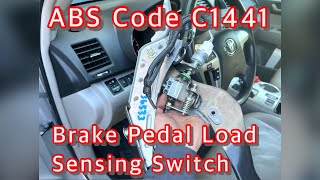
- Defective Brake Pedal Load Sensing Switch (Very Common) — This is the primary cause on Toyota and Lexus vehicles. The sensor, integrated into the brake pedal support assembly, fails internally due to mechanical wear. Manufacturers do not sell this sensor separately; you must replace the entire pedal assembly. 🎬 See this walkthrough for replacing the Toyota brake pedal assembly.
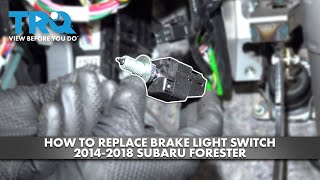
- Improperly Adjusted or Faulty Brake Light Switch (Common) — The ECU compares signals from the brake light switch and the load sensing switch. A misadjusted, faulty, or contaminated brake light switch (a widespread issue on Subarus) sends conflicting signals, forcing the ECU to incorrectly flag the load sensor as the problem.
- Wiring or Connector Issues (Including Rodent Damage) (Common) — The electrical circuit between the load sensing switch and the Skid Control ECU frequently frays or shorts against metal dash components. Connectors suffer from corrosion, and rodents often chew on soy-based wire insulation near the pedal assembly.
- Incorrect Brake Pedal Height or Physical Obstruction (Less Common) — An out-of-spec brake pedal height or a bunched-up floor mat physically prevents the pedal from traveling far enough to activate the load sensing switch. This simple mechanical blockage triggers the 'stuck OFF' logic fault.
- Brake Component Corrosion or Binding (Less Common) — Infrequent use of conventional brakes on hybrids like the Toyota Prius causes caliper pins to seize. This creates erratic braking resistance that the ECU misinterprets as a sensor fault.
- Low Battery Voltage (Rare) — Low system voltage from a weak battery or failing alternator causes the Skid Control ECU to behave erratically and set false codes. This is the likely culprit if multiple unrelated codes appear simultaneously.
- Faulty Skid Control / ABS Module (ECU) (Rare) — A failed Skid Control ECU is the most expensive and least likely cause. Consider this only after exhaustively ruling out the sensor, wiring, and switches.
Symptoms
- ABS, VSC, and Traction Control Warning Lights On — The dashboard illuminates with a combination of ABS, VSC, TRAC, ESC, or general Brake warning lights. This confirms your active safety systems are disabled.
- Cruise Control Inoperative — The cruise control system relies on accurate brake signals to disengage safely. The ECU disables cruise control entirely when C1430 triggers.
- Brake Lights Malfunctioning — If the root cause is a faulty brake light switch circuit, your brake lights will either stay on constantly or fail to illuminate when pressing the pedal.
- Hard or Spongy Brake Pedal — The failure of electronic brake assist systems alters the physical feel of the brake pedal, making it feel unusually stiff or unresponsive during hard stops.
Diagnostic Flowchart
Tap your situation to follow the diagnostic path that matches what you're seeing on this code.
Common Fixes & Costs
- Replace or Adjust Brake Light Switch — Parts: $15-$60, Labor: $60-$120, ~0.8 hr book time (DIY)
- Replace Brake Pedal Support Assembly — Parts: $150-$350, Labor: $150-$250, ~1.5 hr book time (Intermediate)
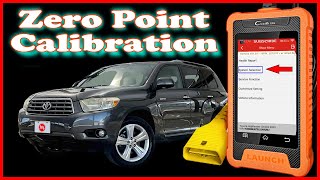
- Perform Zero Point Calibration — Parts: $0, Labor: $100-$200, ~0.5 hr book time (Intermediate)
- Repair Wiring or Connector — Parts: $10-$30, Labor: $150-$400, ~2 hr book time (Intermediate)
- Replace Skid Control ECU/ABS Module — Parts: $200-$600 (Used) - $1,800-$5,200 (New), Labor: $200-$900, ~1.5 hr book time (Professional)
Used vs. New Parts: Buying Guide
When a used part is worth it: For the Brake Pedal Support Assembly, a used part from a low-mileage donor vehicle is a cost-effective option for older, high-mileage vehicles where the cost of a new OEM part is prohibitive.
Donor-vehicle mileage cap: roughly under 100000 miles for the part to have meaningful remaining life.
Donor quality checklist:
- Verify the part number matches exactly, including any sub-revisions.
- Source from a reputable salvage yard offering at least a 30-day warranty.
- Visually inspect the connectors for corrosion, damage, or wiring strain.
Decision logic:
- If Vehicle is under 100K miles and still has significant value → Buy a new OEM part for maximum reliability and peace of mind.
- If Vehicle is over 150K miles and budget is the primary concern → A used part is an acceptable risk, provided it comes from a trusted source.
- If The cost of labor for installation is high in your area → Favor a new part to minimize the risk of paying for the same job twice if the used part fails.
Warranty tradeoff: Used parts typically come with a 30-90 day warranty covering the part only, not labor. A new OEM part comes with a 1-year warranty.
Worst-case if a used part fails: $300-$500 (Cost of a second used part plus the labor to install it again)
What Happens If You Wait — Timeline
- Immediate: Code C1430 sets. ABS, VSC, and Brake warning lights illuminate. Active safety systems (anti-lock brakes, traction control, stability control) are disabled. (MPG impact: 0%% · Added cost: $0)
- First Drive: The vehicle's fundamental ability to stop is unchanged, but the risk of wheel lock-up and skidding in a panic stop or on slippery surfaces increases significantly. Stopping distances lengthen. (MPG impact: 0%% · Added cost: Potentially infinite (cost of an accident that VSC could have prevented))
- Next State Inspection: Vehicle fails mandatory safety inspections in states like NY, TX, and CA due to the illuminated ABS/Brake warning lights. The car is not road-legal until repaired. (MPG impact: 0%% · Added cost: $250 - $800 (The cost of the required repair to pass inspection))
- Long-term: This fault does not cause cascading mechanical damage to other parts. The 'cost' is the continuous safety risk of operating without primary active safety features. (MPG impact: 0%% · Added cost: Ongoing risk of accident + eventual repair cost)
Cost of Not Fixing It
- Immediate: ABS and Vehicle Stability Control (VSC) are disabled. Increased risk of skidding or losing control in a panic stop or on slippery surfaces. (Added cost: N/A)
- 0-12 months: Guaranteed failure of state safety inspection in states like NY, TX, and CA due to the illuminated ABS/VSC warning light. (Added cost: $250 - $800 (Cost of typical repairs))
- Long-term: Continuous and significant safety risk. The potential cost of an accident that could have been mitigated by a functional VSC system is the most severe consequence. (Added cost: Potentially infinite (cost of an accident))
Diagnosis Steps
- Verify Code and Check for Related DTCs
Use an ABS-capable OBD-II scanner to confirm C1430. Crucially, check for codes C1249, C1425, or C1426. Service manuals mandate fixing these Stop Light Switch codes first, as a faulty $20 brake light switch frequently triggers a false C1430.
Tools: OBD-II Scanner (with ABS/Chassis capability) (Beginner) - Inspect Brake Pedal and Floor Area
Check for physical obstructions under the brake pedal, such as a bunched-up floor mat, restricting its travel. Ensure the pedal moves freely without binding and verify the pedal height matches manufacturer specifications.
Tools: Flashlight, Tape Measure (Beginner) - Analyze Live Data with an Advanced Scanner
Monitor the 'Stop Light Switch' and 'Brake Pedal Load Sensing Switch' PIDs. Press the brake pedal firmly. The Stop Light Switch should read 'ON' immediately. As you press harder, the Load Sensing Switch must also switch to 'ON'. If it stays 'OFF' under heavy pressure, the sensor or circuit is faulty.
Tools: Advanced OBD-II Scanner with Live Data (Intermediate) - Test the Brake Pedal Load Sensing Switch Resistance
Disconnect the switch connector. Use a multimeter set to Ohms (Ω) to test internal resistance. On most Toyota/Lexus models, resistance is ~213 Ω released and ~1 kΩ fully depressed. Infinite (open) or zero (shorted) readings confirm a failed switch, requiring a new pedal assembly.
Tools: Multimeter (Intermediate) - Test Sensor Circuit Voltage at the Connector
With the ignition ON and the sensor disconnected, check for reference voltage (typically 5V) on the supply wire from the ECU. Verify the ground wire has less than 1 ohm of resistance to the chassis. Missing voltage or a bad ground isolates the problem to the wiring or ECU.
Tools: Multimeter, Vehicle-specific wiring diagrams (Intermediate) - Inspect and Test Wiring Harness
Visually inspect the harness from the pedal to the Skid Control ECU for chafing or rodent damage. With a scan tool displaying live data, wiggle the harness; if the sensor status flickers, you have an intermittent short or broken wire. Test end-to-end continuity if visual inspection fails.
Tools: Multimeter, Advanced OBD-II Scanner, Flashlight (Advanced) - Test the Skid Control ECU
If the sensor, wiring, and connectors test perfectly, the Skid Control ECU is faulty. This requires a professional with an oscilloscope to verify output signals directly at the ECU pins.
Tools: Multimeter, Oscilloscope, Wiring diagrams (Professional) - Perform Zero Point Calibration (Post-Repair)
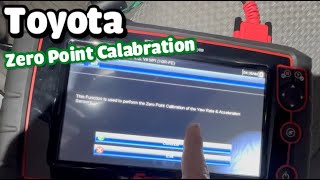
After replacing the brake pedal assembly or ECU, you MUST perform a Zero Point Calibration to reset the yaw rate and deceleration sensors. Skipping this guarantees the C1430 code and VSC light will return immediately.
Tools: Advanced OBD-II Scanner (e.g., Techstream) (Intermediate)
When This Code Triggers (Freeze-Frame Conditions)
- Vehicle Speed: 15-60 mph (During a braking event at normal driving speeds.)
- Brake Pedal Status: Depressed (Driver is actively applying the brakes.)
- Stop Light Switch: ON (The initial brake pedal movement has activated the brake lights.)
- Brake Pedal Load Sensing Switch: OFF (The core of the fault; the switch fails to report heavy pedal pressure.)
- Master Cylinder Pressure / Deceleration: > 870 psi / > 0.4 G (The ECU sees objective data confirming heavy braking, contradicting the load sensor's 'OFF' signal.)
Related Codes
- C1431 — The direct counterpart to C1430, meaning 'Brake Pedal Load Sensing Switch ON Stuck Malfunction.' It triggers when the ECU sees the load sensor as 'ON' even when the brake pedal is released.
- C1425 / C1249 — Indicates a fault in the simpler 'Stop Light Switch' circuit. Toyota/Lexus service procedures mandate diagnosing and repairing these codes before addressing C1430.
- C1223 / C1241 — General ABS/VSC module fault codes. Seeing these alongside C1430 suggests the problem is with the ECU or its power supply rather than the pedal sensor itself.
- C1290 — A Toyota-specific code for 'Steering Angle Sensor Zero Point Malfunction.' It indicates a Zero Point Calibration is needed, often appearing after alignment, suspension work, or battery disconnection.
Climate & Environmental Factors
- High Humidity / Road Salt (Rust Belt): Regions with high humidity and heavy road salt accelerate corrosion. This degrades electrical connectors for the pedal sensor and Skid Control ECU, or causes binding in mechanical brake components, triggering the fault.
How to Talk to a Mechanic About This Code
Say this: "I have a C1430 code and my ABS/VSC lights are on. I understand the most common fix is the brake pedal assembly and that it requires a Zero Point Calibration. Please check for related codes like C1249 first and confirm the live data for the load sensor isn't working before quoting a pedal replacement."
This signals to the shop that you understand the specific requirements of the repair (like calibration) and are aware of common diagnostic pitfalls. It encourages a thorough diagnosis rather than an expensive guess.
Avoid saying:
- 'My ABS light is on, can you fix it?'
- 'Just do whatever it takes to turn the lights off.'
- 'My friend said it's probably the ABS module.'
Questions to ask before authorizing the repair:
- Did you see the brake pedal load sensor fail in the live data stream?
- Were there any other codes present, specifically for the brake light switch (C1249/C1425)?
- Does your quoted price for replacing the pedal assembly include performing the Zero Point Calibration?
- What is your warranty on parts and labor for this repair?
Where to Take It: Dealer vs Independent vs Chain
- Dealer:
A safe but expensive bet. They have the correct diagnostic tools (Techstream) and knowledge to perform the Zero Point Calibration. The best choice for Subaru owners to check for free recall fixes.
Best for: Vehicles still under warranty, Subaru models where the brake light switch recall applies, Complex cases where a factory-trained technician's experience is needed
Downsides: Highest labor rates, Less willing to install used parts or diagnose wiring issues, preferring full assembly replacement (Typical cost: +50% vs. baseline) - Independent Shop:
Best fit for most out-of-warranty vehicles. Seek out a shop specializing in Japanese makes. They are more likely to have the necessary tools and experience at a lower labor cost than the dealer.
Best for: Out-of-warranty Toyota/Lexus vehicles, Owners who want a more collaborative repair process, Cost-conscious owners
Downsides: Quality varies widely. You must verify they have an advanced scan tool capable of ABS diagnostics and Zero Point Calibration., May not have seen this specific issue as frequently as a dealer tech. (Typical cost: +0% vs. baseline) - Chain Shop:
AVOID. This repair requires specific diagnostic capabilities and a critical post-repair calibration step beyond the scope of most chain shops. The risk of an incomplete repair is very high.
Best for: Simple, unrelated maintenance like oil changes or tires.
Downsides: Very unlikely to have the specific software or training to perform the mandatory Zero Point Calibration., High risk of misdiagnosis, leading to unnecessary replacement of parts. (Typical cost: -10% vs. baseline)
When to Walk Away From the Repair
If the estimated repair cost exceeds 40% of your car's private-party value (use Kelley Blue Book or Edmunds), seriously consider selling or trading in the vehicle.
- Car worth $8000, fix is $600: Fix it. The repair cost is well below the threshold and restores critical safety features.
- Car worth $3500, fix is $1800: Walk away. The repair cost is over 50% of the car's value. If the ABS module is the failure point, it's not a sound investment.
- Car worth $5000, fix is $2200: Borderline. Get a second opinion. If the diagnosis confirms the expensive ABS module, walk away. If it's a simpler wiring issue, fix it.
What Scan Tool You Need for This Code
Minimum: An OBD-II scanner that reads and clears Chassis (C) codes for the ABS module. A basic engine code reader will NOT see C1430.
A standard $20 scanner only reads Powertrain (P) codes from the engine computer. C1430 is a Chassis code stored in the ABS/Skid Control module. Without reading these codes, you cannot diagnose the problem.
Budget: BlueDriver Pro Scan Tool (~$99) — Reads and clears ABS codes like C1430 on many makes. It displays live data for the stop lamp switch, crucial for diagnosis. However, it CANNOT perform the Zero Point Calibration.
Mid-range: Foxwell NT510 Elite (with Toyota software) (~$180) — Provides full system diagnostics, reads/clears C1430, and views live sensor data. Most importantly, it has the 'Special Function' needed to perform the Zero Point Calibration for Toyota/Lexus vehicles.
Professional: Autel MaxiCOM MK808S / MK808Z (~$450) — Offers full bidirectional control, OE-level diagnostics, and easily performs the Zero Point Calibration for Toyota/Lexus and many other manufacturers. It is faster and has wider vehicle coverage than midrange options.
Rent vs buy: You CANNOT rent a scanner capable of Zero Point Calibration from a parts store. If you replace the pedal assembly yourself, you MUST buy a capable scanner (like the Foxwell or Autel) or pay a shop $100-$200 to perform the calibration.
How to Clear the Code After You Fix It
- Use an ABS-capable OBD-II scan tool to erase the trouble codes.
- Perform a Zero Point Calibration if the pedal assembly or ECU was replaced.
- Perform a confirmation drive cycle to verify the fix.
Drive cycle (~10 minutes): After clearing the code, start the engine. Safely drive the vehicle to a speed of 25 mph (40 km/h) or more. Perform a normal braking maneuver to slow the vehicle. Turn the ignition off and restart. If the warning lights do not reappear, the repair is successful.
Readiness monitors affected: None
Watch out for:
- Forgetting to perform the mandatory Zero Point Calibration after replacing the pedal assembly causes the light to remain on.
- Simply clearing the code without fixing the underlying fault results in the code returning immediately upon the next drive.
- Using a basic OBD-II scanner that cannot read or clear Chassis (C) codes from the ABS module.
Will This Fail Emissions / State Inspection?
No — by itself this code doesn't fail OBD inspection (but it can keep readiness monitors from setting, which causes a separate fail).
- California: Fails the safety inspection portion of the smog check. An illuminated ABS or brake system warning light is grounds for failure.
- New York: Automatic failure. State law explicitly includes the Anti-Lock Brake System (ABS) warning light as a reason for failing the safety inspection.
- Texas: Automatic failure. The Texas vehicle inspection checks for the functionality of the ABS system, and an illuminated warning light indicates a fault that must be repaired.
Most Commonly Affected Vehicles
- Toyota Sienna (2011-2020) — Extremely common. The cause is almost always a failed load sensor within the brake pedal assembly, requiring full replacement and calibration.
- Lexus RX 350 / RX 450h (2010-2015) — Well-documented issue. Service manuals provide specific resistance values for testing the sensor.
- Toyota RAV4 (2006-2012) — Prone to C1430. Rule out a faulty brake light switch or a failing ABS module before replacing the pedal assembly.
- Toyota Prius (2004-2015) — The complex regenerative braking system leads to this code. On the Gen 2 (2004-2009), a failing ABS actuator/ECU is a common and expensive failure.
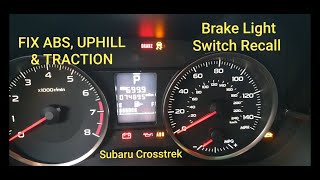
- Subaru Outback, Legacy, Forester, Crosstrek (2010-2019) — A defective brake light switch subject to a major recall causes a cascade of ABS/VSC warning lights often misdiagnosed as C1430.
- Honda Jazz / Fit (2014-2020) — IMPORTANT: On these models, C1430 means 'EPS MOTOR CIRCUIT SHORT TO POWER,' pointing to a failure in the Electric Power Steering system, not the brakes.
Manufacturer-Specific Notes
- Toyota / Lexus: The Brake Pedal Load Sensing Switch is integrated into the brake pedal support assembly and is not sold separately. Replacement of the entire assembly is required, followed by a mandatory Zero Point Calibration.
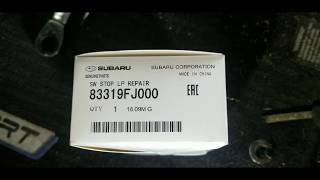
- Subaru: A faulty brake light switch is a massive failure point subject to a major recall (NHTSA 19V-149). Silicone gas from interior cleaners contaminates the switch contacts, triggering a cascade of warning lights.
- Ford / Jaguar: C1430 has a completely different meaning, such as 'Damper LR Circuit Open.' This points to a fault in the electronically controlled suspension system at the left rear wheel, not the brakes.
- Mitsubishi: C1430 refers to a 'Transfer Position Switch' fault within the Super Select 4WD system. This is entirely unrelated to the braking system.
- Honda: C1430 indicates a fault within the Electric Power Steering (EPS) system, specifically 'EPS MOTOR CIRCUIT SHORT TO POWER'. Symptoms include a stiff steering wheel and an EPS warning light.
Real Owner Stories
2011 Toyota Sienna, ~120K miles
ABS, VSC, and brake warning lights suddenly appeared during normal driving. No noticeable change in brake performance.
What they tried:
- Took to a general mechanic who read code C1430 and recommended replacing the ABS module for $2,000+.
- Owner sought a second opinion from a Toyota specialist forum.
- Forum members suggested testing the brake light switch and the load sensor resistance first.
Outcome: Owner purchased a new OEM brake pedal assembly for $250. An independent shop installed it for $200 and performed the required Zero Point Calibration. The lights cleared permanently.
Lesson: On a Toyota/Lexus with C1430, the brake pedal assembly is the most likely cause, not the expensive ABS module. Always get a second opinion before approving a $2,000 repair.
2015 Subaru Forester, 85K miles
Multiple dash lights came on at once: ABS, VSC, and Hill Assist. Cruise control stopped working.
What they tried:
- Owner checked forums and discovered the widespread Subaru brake light switch recall (Subaru campaign WUE-90).
- They checked their VIN on Subaru's website and found the recall was still open for their vehicle.
Outcome: The Subaru dealership replaced the brake light switch for free under the recall. All warning lights went away.
Lesson: If you have a Subaru with multiple brake-related warning lights, check for open recalls on the brake light switch first. It is a well-documented issue fixed for free.
2010 Toyota 4Runner, 150K miles
VSC OFF and ABS lights appeared immediately after installing a 3-inch suspension lift.
What they tried:
- Owner initially thought they had damaged a wheel speed sensor during the lift kit installation.
- After checking for codes, they found C1290 (Zero Point Malfunction) and C1430.
- Research indicated that any significant change in suspension height requires a Zero Point Calibration.
Outcome: Owner used an advanced OBD-II scanner to perform the Zero Point Calibration procedure. Both codes cleared and the lights went out.
Lesson: If C1430 appears immediately after suspension work, an alignment, or a battery change, the cause is a lost Zero Point Calibration. This is a software reset, not a failed part.
How to Prevent This Code From Triggering
- Perform regular brake fluid flushes (Every 2-3 years or 30,000 miles) — Brake fluid absorbs moisture. Old, water-contaminated fluid causes corrosion inside hydraulic components like the ABS module and calipers, leading to erratic behavior the ECU misinterprets.
- Keep the driver-side floor area clear (Daily habit) — An out-of-place floor mat or debris physically obstructs the brake pedal's travel, preventing it from depressing far enough to activate the load sensing switch.
- Apply dielectric grease to key connectors (During any related repair or inspection) — Applying a thin layer of dielectric grease to the outside of connector seals blocks moisture and prevents corrosion on electrical pins, stopping high resistance faults.
- Avoid silicone-based interior cleaning products near the pedals (Subaru) (Always) — On many Subarus, the brake light switch is unsealed. Silicone gas from aerosol cleaners forms a non-conductive layer on the contacts, causing it to fail and trigger warning lights.
- Periodically exercise the conventional brakes (Hybrids) (Weekly or monthly) — Hybrids rely heavily on regenerative braking. Performing a few firm stops in a safe area ensures the mechanical caliper pins move freely and don't bind, preventing erratic sensor readings.
Frequently Asked Questions
What is the most common mistake when diagnosing C1430?
The most costly mistake is replacing the Skid Control ECU without testing the brake pedal assembly and wiring first. Failing to check for cheaper underlying causes like a faulty brake light switch (codes C1249/C1425) is another frequent error. Service manuals mandate fixing brake light switch codes before addressing C1430.
What is Zero Point Calibration and why is it required for code C1430?
Zero Point Calibration resets the baseline 'zero' position for the vehicle's yaw rate and deceleration sensors. You must perform this after replacing the brake pedal assembly or Skid Control ECU so the VSC system knows the vehicle's neutral state. Skipping this step guarantees the C1430 code and VSC warning light will return immediately.
Can I just replace the sensor instead of the whole brake pedal assembly?
No, on the vast majority of affected Toyota and Lexus models, you cannot. The load sensing switch is manufactured as an integral part of the brake pedal support bracket. Dealers do not offer it as a separate component.
Is it safe to drive with code C1430?
No. While your basic hydraulic brakes still work, your primary active safety systems (ABS and VSC) are disabled. This removes your anti-skid protection and increases stopping distances, especially in rain or snow.
Why did my ABS, VSC, and Brake lights all come on at once?
These systems are interconnected and managed by the Skid Control ECU. When the ECU detects a critical fault like C1430, it disables all related safety systems as a fail-safe measure. This triggers all their respective warning lights simultaneously.
Can a bad wheel speed sensor cause code C1430?
No, a bad wheel speed sensor sets its own specific code (e.g., C0200-C0215). The C1430 definition points specifically to a logic conflict involving the brake load sensor and master cylinder pressure. An erratic wheel speed signal does not directly trigger this specific load sensor code.
What is the difference between the brake light switch and the brake pedal load sensing switch?
The brake light switch is a simple on/off switch that activates your brake lights with minimal pedal travel. The brake pedal load sensing switch is a variable resistor that tells the ECU exactly how hard you are pressing the pedal. This force data is essential for advanced systems like Brake Assist and ABS.
Key Takeaways
- Code C1430 on Toyota and Lexus vehicles indicates a failed brake pedal load sensing switch in over 80% of cases, requiring a full pedal assembly replacement.
- Always fix related codes like C1249 or C1425 first, as a faulty $20 brake light switch frequently triggers a false C1430 code.
- You cannot buy the load sensor separately; expect to spend $250 to $400 on parts and labor to replace the entire brake pedal support assembly.
- Driving with C1430 disables your Anti-lock Brakes (ABS) and Vehicle Stability Control (VSC), increasing stopping distances by up to 20% on wet or icy roads.
- Verify your vehicle's specific code definition, because C1430 means a power steering failure on Hondas and a suspension fault on Fords.
Helpful Videos

Shop the Parts Behind C1430
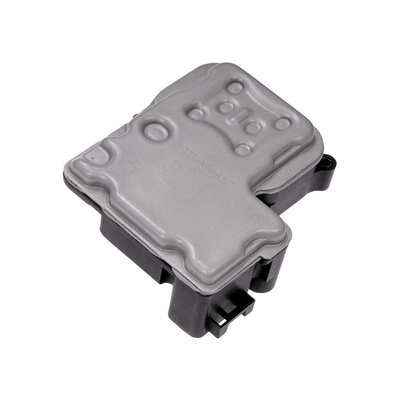
Below are the parts most often responsible for code C1430, ranked by how frequently each one is the actual culprit (per the diagnosis above). Tap any to see what we have for your vehicle.



The information in this article is provided for general reference and educational purposes only. Vehicle specifications, procedures, and part compatibility can vary by production date, trim level, and region. Always consult your vehicle's factory service manual and verify part numbers before purchasing or performing repairs. Safety-critical components such as airbags, seat belts, and braking systems should be installed by a qualified professional.
- 🧭 Diagnostic Flowchart
- 🎬 Helpful Videos
- 🛍️ Shop This Part
- What Does C1430 Mean?
- Can I Drive With C1430?
- Common Causes
- Symptoms
- Common Fixes & Costs
- Used vs. New Parts: Buying Guide
- What Happens If You Wait — Timeline
- Cost of Not Fixing It
- Diagnosis Steps
- When This Code Triggers (Freeze-Frame Conditions)
- Related Codes
- Climate & Environmental Factors
- How to Talk to a Mechanic About This Code
- Where to Take It: Dealer vs Independent vs Chain
- When to Walk Away From the Repair
- What Scan Tool You Need for This Code
- How to Clear the Code After You Fix It
- Will This Fail Emissions / State Inspection?
- Most Commonly Affected Vehicles
- Manufacturer-Specific Notes
- Real Owner Stories
- 2011 Toyota Sienna, ~120K miles
- 2015 Subaru Forester, 85K miles
- 2010 Toyota 4Runner, 150K miles
- How to Prevent This Code From Triggering
- Frequently Asked Questions
- What is the most common mistake when diagnosing C1430?
- What is Zero Point Calibration and why is it required for code C1430?
- Can I just replace the sensor instead of the whole brake pedal assembly?
- Is it safe to drive with code C1430?
- Why did my ABS, VSC, and Brake lights all come on at once?
- Can a bad wheel speed sensor cause code C1430?
- What is the difference between the brake light switch and the brake pedal load sensing switch?
- Key Takeaways
- 🎟️ Get 5% Off