

OBD-II Code C1489: Electronic Limited Slip Differential (ELSD) Motor Internal Failure
A comprehensive guide to what C1489 means on Chrysler, Jeep, and Dodge vehicles, its causes, symptoms, and proven fixes
- On Jeep, Dodge, or Chrysler vehicles, code C1489 indicates a 90% probability that the rear Electronic Limited Slip Differential (ELSD) actuator motor has failed internally and requires replacement.
- Driving with an active C1489 code disables the 4WD system's advanced traction control, defaulting the vehicle to a basic RWD or open-differential mode that reduces safety in slippery conditions.
- Replacing the ELSD motor costs between $450 and $900 and requires a mandatory 'ELSD Quicklearn' computer calibration using a bi-directional scan tool to complete the repair.
- Do not replace the entire rear differential assembly for a C1489 code unless you find heavy metal shavings in the fluid or hear severe mechanical grinding.
What Does C1489 Mean?
Code C1489 indicates the Drivetrain Control Module (DTCM) detected a critical, non-recoverable internal failure within the electric motor for the rear Electronic Limited Slip Differential (ELSD). This motor engages a clutch pack inside the rear differential to lock the rear wheels together for maximum traction. When this code sets, the DTCM disables the ELSD system to prevent damage and illuminates the 'Service 4WD' warning light.
Technical definition: The formal SAE/OBD-II definition for this code on Chrysler, Dodge, and Jeep vehicles is "Rear Differential Motor Brake - Component Internal Failure". This specifies that the control module ran internal diagnostics and confirmed a fault within the actuator motor itself, such as a shorted winding, seized mechanical component, or failed internal brake.
Can I Drive With C1489?
Yes, But With Caution. Yes, you can continue to drive, but do so with caution. The advanced traction and stability functions of the four-wheel-drive system are disabled. Your vehicle defaults to a basic RWD or open-differential AWD mode, significantly reducing traction in rain, snow, or off-road conditions. While driving with the code active does not cause short-term mechanical damage, the compromised handling constitutes a safety risk.
Common Causes
- Internal ELSD actuator motor failure (Very Common) — The electric motor inside the actuator assembly burns out, develops a short in its windings, or seizes due to internal wear or debris from deteriorating magnets.
- Moisture intrusion and corrosion (Very Common) — Water, road salt, and dirt penetrate the motor's seals over time, causing internal corrosion that directly leads to electrical shorts or mechanical seizure.
- Contaminated differential fluid or worn clutches (Common) — Old, low, or contaminated fluid causes the internal clutches to bind. This forces the actuator motor to overwork, overheat, and eventually fail.
- Damaged wiring harness or poor ground (Less Common) — Road debris or exhaust heat damages the ELSD motor wiring harness. Corrosion in the connector pins or a loose ground wire creates high resistance, triggering a fault.
- Drivetrain Control Module (DTCM) failure (Rare) — The control module commanding the ELSD motor fails and incorrectly reports a motor failure. Consider this only after proving the motor and wiring are fully functional.
- Missing post-installation calibration (Rare) — If a mechanic recently replaced the ELSD motor but skipped the mandatory 'Quicklearn' calibration procedure, the system sets an internal failure code because it cannot verify the new motor's position.
Symptoms
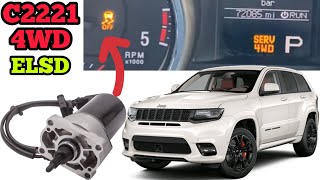
- Flashing 'Service 4WD' light and EVIC message — The dashboard warning light illuminates or flashes, often accompanied by a '4WD System Temporarily Unavailable' 🎬 Watch: How to fix the ELSD warning light and service message. text message on the instrument cluster.
- Reduced traction in 4WD mode — The vehicle lacks grip on snow, mud, or sand, feeling like it is stuck in two-wheel drive because the rear wheels cannot lock together.
- Binding, clunking, or grinding from the rear — The differential struggles to allow the wheels to rotate at different speeds, causing the vehicle to skip or bind during tight, low-speed turns.
Common Fixes & Costs
- Replace ELSD Actuator Motor and Perform Relearn
— Parts: $250-$500, Labor: $200-$400, ~2.2 hr book time
(Intermediate)
Jeep Grand Cherokee (2011-2013): OEM Mopar #68084266AB (Alt: Dorman #600-828)
Jeep Grand Cherokee (2014-2021) / Dodge Durango (2014-2024): OEM Mopar #68214628AA (Alt: Dorman #699-996)
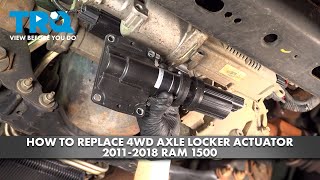
Ram 1500 (2019-2024 with e-Locker): OEM Mopar 🎬 See this walkthrough for replacing the locker actuator on Ram trucks. #68399418AA (Alt: Dorman #600-399) - Change Rear Differential Fluid and Additive
— Parts: $50-$90, Labor: $100-$150, ~0.8 hr book time
(DIY)
All affected: OEM Mopar #68232947AB (Fluid) (Alt: N/A) - Repair Damaged Wiring or Connector — Parts: $20-$50, Labor: $150-$250, ~1.5 hr book time (Intermediate)
- Reprogram/Update Drivetrain Control Module (DTCM) — Parts: $0, Labor: $100-$200, ~1 hr book time (Professional)
- Replace Entire Rear Differential Assembly — Parts: $1500-$3500, Labor: $500-$1000, ~5.5 hr book time (Professional)
Used vs. New Parts: Buying Guide
When a used part is worth it: Buying a used ELSD motor is a massive gamble due to its near-100% failure rate from environmental exposure. Avoid used parts entirely unless your budget is strictly limited and you accept the high risk of repeat failure.
Donor-vehicle mileage cap: roughly under 60000 miles for the part to have meaningful remaining life.
Donor quality checklist:
- Verify the exact Mopar part number matches your vehicle's year; part numbers changed between 2013 and 2014.
- Reject any parts sourced from 'Rust Belt' states, as internal corrosion is the primary failure cause.
- Inspect the connector pins on the used motor for green corrosion or water intrusion.
Decision logic:
- If The vehicle is a daily driver or used in winter conditions → Buy a new OEM (Mopar) or reputable aftermarket (Dorman) part to guarantee safety and reliability.
- If Budget is the absolute primary concern and you perform your own labor → A used part is a temporary option, but expect it to fail again.
- If The part has a known wear-out or corrosion failure mode → Always purchase a new part with a warranty.
Warranty tradeoff: Used parts from a salvage yard typically offer a 30-90 day warranty on the part only, not labor. New aftermarket parts (like Dorman) often come with a 1-year to limited lifetime warranty. New OEM Mopar parts have a 2-year/unlimited mileage warranty if purchased from a dealer.
Worst-case if a used part fails: $300-$600 if a used part fails after the warranty period, as you will have to pay for the replacement part and the labor costs a second time.
Cost of Not Fixing It
- Short Term (0-6 months): Loss of advanced 4WD capability and permanent 'Service 4WD' light. The vehicle loses stability and traction in slippery conditions, creating a safety risk. (Added cost: $0)
- Medium Term (6-18 months): Continued environmental exposure degrades the failed motor's connector and wiring harness. This complicates the eventual repair and requires splicing a new pigtail connector. (Added cost: $50 - $200)
- Long Term (18+ months): Ignoring C1489 does not cause cascading damage to the differential's internal gears. The primary long-term cost is the permanent loss of ELSD function and compromised vehicle safety. (Added cost: $0)
Diagnosis Steps
- Verify Code and Check for Companions
Use a DTCM-capable OBD-II scanner to confirm C1489. Note any companion codes like C1490 (Initialization Failure) or C148F (Circuit Out of Range), which confirm a definitive ELSD system fault.
Tools: OBD-II Scanner (with DTCM access) (Beginner) - Perform Active Motor Test via Bi-Directional Scanner
Command the ELSD motor to activate using a professional scan tool. Attempt to run the 'ELSD Quicklearn' test. If the test fails immediately and C1489 returns, the motor is definitively faulty.
Tools: Professional Bi-Directional Scan Tool (Professional) - Test Motor Winding Resistance
Disconnect the ELSD motor connector. Measure the resistance between the motor control pins on the actuator using a multimeter set to Ohms. A reading of 'OL' (Open Loop) means a broken winding, while zero means a short circuit. Both confirm internal failure.
Tools: Multimeter (Advanced) - Inspect the ELSD Actuator and Wiring
Safely raise the vehicle and locate the rear differential actuator motor. Inspect the housing for cracks, the electrical connector for corrosion or pushed-out pins, and the harness for chafing.
Tools: Jack, jack stands, flashlight (Beginner) - Check Rear Differential Fluid
Remove the fill plug to check the fluid level and condition. Milky fluid indicates water contamination, while excessively dark fluid with metal particles indicates internal mechanical wear overloading the motor.
Tools: Wrench/socket for fill plug, drain pan (Intermediate) - Test the ELSD Motor Circuit for Power and Ground
With the ignition on and motor disconnected, check for battery voltage on the power supply wire and verify a solid ground on the harness side. This confirms the DTCM is sending power.
Tools: Multimeter, wiring diagram (Advanced) - Inspect for Internal Differential Damage
If the motor tests good but grinding noises persist, remove the differential cover. Inspect the internal clutch pack and gears for broken parts or metal debris jamming the mechanism.
Tools: Socket set, drain pan, gasket scraper, RTV sealant (Professional)
When This Code Triggers (Freeze-Frame Conditions)
- System State: Key-On or Initialization (The Drivetrain Control Module (DTCM) runs a self-test on the ELSD motor at startup. The C1489 code is most often set during this initialization phase when the motor fails to respond correctly.)
- Vehicle Speed: 0 mph (Since the primary test occurs at startup, the vehicle is typically stationary when the fault is first detected and logged.)
- Commanded State: Actuator Test Cycle (The code triggers when the DTCM commands the motor to perform a test and the motor's response is out of range or non-existent, indicating an internal failure.)
- System Voltage: 11.5-14.0V (The fault logs under normal battery voltage conditions. Abnormally low voltage causes other codes, but C1489 specifically points to the component itself.)
Related Codes
- C1490-00 — Rear Differential Actuator Initialization Failure. The motor failed its startup calibration test because the internal failure (C1489) prevents it from moving. It also appears if you skip the mandatory relearn procedure after installing a new motor.
- C148F-1D — Rear Differential Measured Motor - Circuit Out of Range. The DTCM detects a voltage or resistance reading outside specified limits due to a short or open in the motor's windings. Chrysler TSBs mandate motor replacement when this code is present.
- U0414-00 — Invalid Data Received From Drivetrain Control Module. A secondary code logged by the ABS or PCM indicating the ELSD module is sending unreliable data over the CAN bus due to the internal motor failure.
- C2220 — Rear Differential Locker Sensor Circuit. Indicates a problem with the sensor verifying the locking mechanism's position. The failed ELSD motor cannot move the sensor, triggering this companion code.
Climate & Environmental Factors
- Moisture and Humidity: The ELSD actuator motor mounts on the rear differential, exposing it to constant road spray. Seals degrade over time, allowing moisture to penetrate the housing and cause internal electrical failure.
- Road Salt: Corrosive saltwater attacks the motor's housing, seals, and electrical connector. This dramatically accelerates water intrusion and guarantees premature motor failure in winter climates.
- Cold Weather: Cold weather does not directly cause the motor to fail, but it exposes the symptoms. A failure that occurs in summer only becomes a noticeable safety hazard when driving on winter snow and ice.
How to Talk to a Mechanic About This Code
Say this: "I have a C1489 code indicating a failed ELSD actuator motor on my rear differential. I need a quote to replace the motor, including the mandatory 'ELSD Quicklearn' calibration procedure."
This proves you are an informed customer. Stating the specific code and required calibration prevents the shop from suggesting an unnecessary differential replacement.
Avoid saying:
- 'My 4WD light is on, can you fix it?'
- 'Just replace the whole rear end.'
- 'I'm not sure what's wrong, just do whatever it takes.'
Questions to ask before authorizing the repair:
- Do you have a bi-directional scan tool capable of performing the Chrysler 'ELSD Quicklearn' procedure?
- Can you confirm the diagnosis is isolated to the external motor and not the internal differential gears?
- Does your quote include the replacement part, labor, and the electronic relearn procedure?
- What warranty do you provide on the new motor and the labor?
Where to Take It: Dealer vs Independent vs Chain
- Dealer:
Recommended, but expensive. The dealer guarantees access to the correct wiTECH scan tool and software updates, eliminating the risk of a failed electronic calibration.
Best for: Vehicles still under powertrain warranty., Repairs that may involve a Technical Service Bulletin (TSB) software update., Owners who want a guaranteed one-stop fix without vetting a new shop's capabilities.
Downsides: Highest labor and parts cost, often 50-100% more than an independent shop., May be less willing to use aftermarket parts to save money. (Typical cost: +75% vs. baseline) - Independent Shop:
Best fit for most owners. You must call ahead and confirm they possess a bi-directional scan tool capable of performing the Chrysler 'ELSD relearn' procedure.
Best for: Out-of-warranty vehicles where cost is a major factor., Building a long-term relationship with a trusted mechanic.
Downsides: Not all shops have the specific bi-directional scan tool required for the final calibration step. You MUST verify this with them beforehand. (Typical cost: +0% vs. baseline) - Chain Shop:
Avoid. Chain shops lack the specialized scan tools and training required to perform the mandatory electronic calibration for this drivetrain repair.
Best for: Simple, high-volume jobs like oil changes, tires, and brake pads.
Downsides: Technicians are very unlikely to have the training or expensive, specialized scan tools needed for this specific drivetrain electronic repair., High potential for misdiagnosis or being turned away after paying a diagnostic fee. (Typical cost: -10% vs. baseline)
When to Walk Away From the Repair
If the total repair cost for the ELSD motor ($600-$900) exceeds 40% of your vehicle's value, evaluate your options.
- Car worth $11000, fix is $800: Fix it. The repair cost is less than 10% of the vehicle's value, making it a sound investment to restore full 4WD functionality.
- Car worth $6500, fix is $800: Borderline. The repair is 12% of the car's value. If the vehicle is in excellent condition, fix it. If it has other major issues, consider selling.
- Car worth $3500, fix is $800: Walk away. The repair cost is nearly 25% of the vehicle's value. Sell the vehicle as-is or continue driving with reduced 4WD capability.
What Scan Tool You Need for This Code
Minimum: Bi-directional control for Chrysler/Jeep/Dodge vehicles, specifically the ability to execute the 'ELSD Quicklearn' procedure in the Drivetrain Control Module.
A standard $50 code reader cannot perform the mandatory electronic calibration. If you skip the 'relearn' step, the new motor will not work and the code returns immediately.
Budget: JScan or AlfaOBD Mobile App (~$20-60) — Pairs with a Bluetooth OBD-II dongle to provide full bi-directional control. It initiates the 'ELSD Quicklearn' procedure, making it the best choice for DIYers.
Mid-range: Foxwell NT510 Elite for Chrysler (~$180) — A handheld unit pre-loaded with Chrysler software. It runs the ELSD relearn procedure without requiring a separate smartphone or laptop.
Professional: Autel MaxiCOM MK808S (~$450-600) — Provides professional-level diagnostics and extensive bi-directional capabilities for multiple vehicle brands, including the ELSD relearn.
Rent vs buy: You must buy. Auto parts stores do not rent bi-directional scan tools capable of this procedure. Their free loaners are basic code readers that cannot complete this repair.
How to Clear the Code After You Fix It
- Replace the faulty ELSD actuator motor.
- Perform the 'ELSD Quicklearn' or 'Clutch Relearn' procedure using a bi-directional scan tool (AlfaOBD, JScan, or wiTECH).
- Clear the C1489 and any related codes from the Drivetrain Control Module (DTCM) using the scan tool.
- Test drive the vehicle to verify the 'Service 4WD' light remains off.
Drive cycle (~15 minutes): The ELSD system does not require a complex drive cycle. After the repair and mandatory 'Quicklearn' procedure, a 15-minute drive with two key-off/key-on cycles confirms the fix. The electronic relearn is the critical step, not the drive cycle.
Readiness monitors affected: None directly. This is a Chassis ('C') code and does not affect the primary emissions readiness monitors required for smog testing.
Watch out for:
- Clearing the code with a basic scanner without replacing the motor causes the code to return immediately.
- Replacing the motor but skipping the mandatory 'ELSD Quicklearn' procedure triggers code C1490 and disables the new motor.
- Disconnecting the battery fails to clear this code permanently from the DTCM.
Will This Fail Emissions / State Inspection?
No — by itself this code doesn't fail OBD inspection (but it can keep readiness monitors from setting, which causes a separate fail).
- California: This code does not cause a smog check failure. California's OBD-II test looks for powertrain ('P') codes that illuminate the Check Engine Light. A chassis ('C') code like C1489 does not affect the outcome.
- New York: This code passes the emissions inspection because the 'Service 4WD' light is not part of the emissions test. However, the vehicle must still pass a separate safety inspection.
- Texas: In emissions-testing counties, the OBD-II scan checks for powertrain codes that command the Malfunction Indicator Lamp (MIL) on. C1489 is a chassis code and passes the emissions test.
Most Commonly Affected Vehicles
- Jeep Grand Cherokee (WK2) (2011-2021) — Extremely common on models with Quadra-Trac II or Quadra-Drive II. TSB 21-001-14 addresses 2011-2013 models and TSB 21-006-14 addresses 2014 models.
- Dodge Durango (2014-2024) — Shares the same platform, differential, and ELSD system as the Grand Cherokee, making it equally susceptible.
- Ram 1500 (2019-2024) — Affects models equipped with the optional electronic locking rear differential. The failure mechanism in the actuator motor is identical.
- Dodge Charger / Challenger (2015-2023) — High-performance AWD models equipped with an ELSD develop this fault due to similar actuator designs.
- Jeep Cherokee (KL) (2014-2020) — Certain 4WD models use a similar Rear Drive Module (RDM) with an actuator that experiences identical failures.
- Nissan Rogue (T32) (2014-2020) — IMPORTANT: On these vehicles, C1489 is unrelated to the differential. It indicates a known software weakness in the engine control unit requiring a dealer update.
- Nissan X-Trail (T32) (2014-2021) — Similar to the Nissan Rogue, C1489 points to a software issue in the engine control unit, not a mechanical part.
- Ford F-150, Explorer, Mustang (2005-2024) — On Ford vehicles, C1489 is a body code related to the restraints system, typically defined as 'Seat belt pre-tensioner (RH) (squib) system fault'. It is completely unrelated to the drivetrain.
Manufacturer-Specific Notes
- Chrysler/Jeep/Dodge: Code C1489 guarantees an internal failure of the ELSD motor. TSBs 21-001-14 and 21-006-14 explicitly state that if C1489, C148F, or C1490 are present, you must replace the ELSD motor and perform the 'Quicklearn' calibration.
- Ford: On Ford vehicles, C1489 is a Restraints Control Module (RCM) code for a 'Seat belt pre-tensioner (RH) (squib) system fault'. It indicates a loose connector under the passenger seat and has zero connection to the drivetrain.
- Nissan: On the Rogue and X-Trail, C1489 indicates a software glitch in the engine control unit. It requires a dealer-performed software update. Replacing drivetrain hardware for this code on a Nissan is a costly misdiagnosis.
- Warranty & Recalls (Chrysler/Jeep/Dodge): No active recalls exist for the C1489 code or the ELSD motor. However, the factory powertrain warranty or a Mopar FlexCare extended service plan covers this repair if the vehicle has an active policy.
Frequently Asked Questions
What is an Electronic Limited Slip Differential (ELSD)?
An ELSD uses an electric motor and clutch pack to intelligently control power distribution between the rear wheels. It progressively locks the differential to shift power to the wheel with more grip. This significantly improves traction and stability compared to a standard open differential.
Why did C1489 return right after I replaced the ELSD motor?
This happens because the mandatory 'ELSD Quicklearn' calibration procedure was skipped after installation. The vehicle's computer must learn the new motor's electronic parameters and travel limits. Without this step, the computer rejects the new part and immediately re-flags the code.
Can I replace the ELSD motor myself?
The physical replacement is a manageable DIY task requiring intermediate mechanical skills and standard hand tools. However, you must have access to a bi-directional scan tool like AlfaOBD or JScan to perform the mandatory final calibration. Without the scan tool, the repair will fail.
Does C1489 mean my whole rear differential needs to be replaced?
No. This code specifically points to a failure of the external electric actuator motor, not the internal gears or bearings. Replacing the entire differential is an expensive misdiagnosis unless you hear loud grinding noises or find heavy metal debris in the fluid.
What happens if I ignore the C1489 code?
Your vehicle remains driveable, but the 4WD system defaults to a basic mode with significantly reduced traction. The 'Service 4WD' light stays illuminated permanently. You lose the enhanced stability required for safe handling in slippery conditions or emergency maneuvers.
Can I use a used ELSD motor from a junkyard?
Buying a used ELSD motor is a significant gamble because these parts have a high failure rate from environmental exposure. You risk installing a part that is already failing or will fail shortly after installation. Always purchase a new OEM or reputable aftermarket motor to ensure reliability.
Could a weak battery cause a C1489 code?
Yes, low system voltage from a failing battery or alternator causes various electronic modules to malfunction and set false codes. If C1489 appears suddenly alongside multiple unrelated electrical codes, test the battery and charging system first. However, an isolated C1489 code almost always indicates a failed motor.
Key Takeaways
- On Jeep, Dodge, or Chrysler vehicles, code C1489 indicates a 90% probability that the rear Electronic Limited Slip Differential (ELSD) actuator motor has failed internally and requires replacement.
- Driving with an active C1489 code disables the 4WD system's advanced traction control, defaulting the vehicle to a basic RWD or open-differential mode that reduces safety in slippery conditions.
- Replacing the ELSD motor costs between $450 and $900 and requires a mandatory 'ELSD Quicklearn' computer calibration using a bi-directional scan tool to complete the repair.
- Do not replace the entire rear differential assembly for a C1489 code unless you find heavy metal shavings in the fluid or hear severe mechanical grinding.
Helpful Videos
Shop the Parts Behind C1489
Below are the parts most often responsible for code C1489, ranked by how frequently each one is the actual culprit (per the diagnosis above). Tap any to see what we have for your vehicle.



The information in this article is provided for general reference and educational purposes only. Vehicle specifications, procedures, and part compatibility can vary by production date, trim level, and region. Always consult your vehicle's factory service manual and verify part numbers before purchasing or performing repairs. Safety-critical components such as airbags, seat belts, and braking systems should be installed by a qualified professional.
- 🎬 Helpful Videos
- 🛍️ Shop This Part
- What Does C1489 Mean?
- Can I Drive With C1489?
- Common Causes
- Symptoms
- Common Fixes & Costs
- Used vs. New Parts: Buying Guide
- Cost of Not Fixing It
- Diagnosis Steps
- When This Code Triggers (Freeze-Frame Conditions)
- Related Codes
- Climate & Environmental Factors
- How to Talk to a Mechanic About This Code
- Where to Take It: Dealer vs Independent vs Chain
- When to Walk Away From the Repair
- What Scan Tool You Need for This Code
- How to Clear the Code After You Fix It
- Will This Fail Emissions / State Inspection?
- Most Commonly Affected Vehicles
- Manufacturer-Specific Notes
- Frequently Asked Questions
- What is an Electronic Limited Slip Differential (ELSD)?
- Why did C1489 return right after I replaced the ELSD motor?
- Can I replace the ELSD motor myself?
- Does C1489 mean my whole rear differential needs to be replaced?
- What happens if I ignore the C1489 code?
- Can I use a used ELSD motor from a junkyard?
- Could a weak battery cause a C1489 code?
- Key Takeaways
- 🎟️ Get 5% Off