

C1531 on 2015-2018 Subaru WRX: Brake Switch, VDC, and Fixes
On a 2015-2018 WRX, code C1531 is almost always caused by a misadjusted or faulty brake light switch, or a need for a VDC module software update. First, check the brake light switch adjustment; if that's okay, a dealer visit for a potential software update is the next step. A faulty switch is also common, and Subaru has released several updated part numbers.
- C1531 on a 2015-2018 WRX disables key safety systems like ABS and VDC.
- The most likely cause is a simple brake light switch adjustment, which is a low-cost, high-probability fix you can check first.
- If adjustment doesn't work, the issue could be a faulty switch part or a software problem in the VDC module that only a dealer can update.
- Always use the correct wattage bulbs for brake lights; an incorrect bulb can blow a fuse and trigger this code.
- Given the multiple TSBs, this is a well-documented issue by Subaru with clear diagnostic paths.
What's Unique About the 2015-2018 Subaru WRX
The 2015-2018 (VA) generation WRX is particularly known for this issue, and Subaru has released multiple Technical Service Bulletins (TSBs) to address it. Unlike many cars where a code points to a single faulty part, C1531 on this WRX has two very common and distinct causes: a simple mechanical switch adjustment at the brake pedal, and a more complex software issue within the Vehicle Dynamics Control module that requires dealer reprogramming. This dual nature means a simple part swap may not always be the solution. The issue is so common that it also affects several platform mates from the same era, including the Forester, Impreza, and Crosstrek.
Diagnostic Flowchart
Tap your situation to follow the diagnostic path that matches what you're seeing on this vehicle.
Symptoms You May Notice
- VDC (Vehicle Dynamics Control) warning light illuminated
- ABS warning light illuminated
- Hill Holder / Hill Start Assist (HSA) warning light illuminated
- EyeSight system disabled (if equipped)
- Cruise control disabled or flashing
- Unable to shift out of Park 🎬 Watch: How to fix ABS, Hill Assist, and Traction lights
- Replacing the VDCCM/ABS module: The module itself is rarely the failure point; it's much more likely to be a software or input signal issue.
- Replacing brake calipers or pressure sensors: While related to the brake system, these are not the typical cause for this specific code, which points directly at the brake light switch circuit logic.
Most Likely Causes
- Brake Light Switch (BLS) Incorrectly Adjusted 🔴 High Probability → Shop Brake Light Switch Subaru has issued multiple TSBs (e.g., 06-46-14R) specifically detailing the adjustment procedure due to its sensitivity. The switch position can drift over time, causing the VDC module to receive an incorrect signal relative to brake pedal position. The adjustment is very sensitive, with one adjustment notch equating to approximately 4mm of pedal stroke change.
How to confirm: Measure the brake pedal stroke required to activate the brake lights. Per TSB 06-46-14R, the specification is 5.5mm +/- 2.5mm (between 3mm and 8mm). An alternative TSB (07-128-18R) lists the spec as 3mm to 7mm for the WRX. If the stroke is outside this range, adjustment is needed.
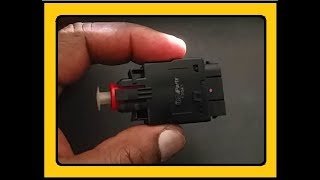
Typical fix: Adjust the brake light switch. This involves rotating the switch ~45 degrees 🎬 Watch: A quick guide to adjusting your brake light switch counter-clockwise to unlock it, moving it inward or outward by one or more notches, and re-locking it.
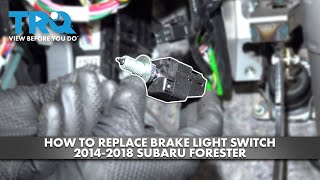
Est. part cost: $0 - Faulty Brake Light Switch (BLS) 🟡 Medium Probability → Shop Brake Light Switch Subaru has updated the brake light switch design multiple times to improve reliability. TSB 06-48-15R announced a change to a blue-colored switch body (p/n 83311FJ000) to prevent this code. Older or original switches can fail internally, causing intermittent or no signal. Many owners on forums report having the switch replaced under recall or as the definitive fix.
How to confirm: After confirming the adjustment is correct, test the switch's electrical continuity with a multimeter as the pedal is pressed and released. If it fails to open/close consistently, it is faulty. Visually check the part number against the latest revision.
Typical fix: Replace the brake light switch with the newest revision available from Subaru (p/n 83311FJ001).
Est. part cost: $20-$50 - Vehicle Dynamics Control (VDCCM) Software Requires Update 🟡 Medium Probability Subaru TSB 06-77-20R explicitly states that reprogramming files are available to optimize the VDCCM logic, as the original software can be overly sensitive and prone to setting C1531 and/or C1741.
How to confirm: A Subaru dealership or a properly equipped independent shop must check the current software calibration ID of the VDCCM against the versions listed in TSB 06-77-20R.
Typical fix: Reprogramming (reflashing) the Vehicle Dynamics Control module with the updated software provided by Subaru. This is a dealer or specialist-level repair.
Est. part cost: $0 (labor only)
Rare But Worth Checking
- Blown Fuse: As demonstrated in a detailed video on a 2015 Forester, using an incorrect brake light bulb (wrong wattage, e.g., 23W instead of 5W) can cause a short that blows the associated fuse (fuse #8, a 7.5A fuse in the driver's side fuse box). This leads to code C1531, a no-shift-from-park condition, and all brake lights failing. Always check fuses first after any work on the lighting system.
- Wiring Harness Issue: Damage to the wiring or a loose/corroded connector for the brake light switch or at the VDCCM can mimic the symptoms of a faulty component. On lowered vehicles, the tire can rub through the wiring loom in the wheel well, causing a short. TSB 06-87-22R for similar models points to brittle connector clips on related systems, suggesting connector integrity can be a weak point.
Diagnosis Steps
- Read all fault codes from the ABS/VDC control module.
- Verify brake light operation. Do they turn on when the pedal is pressed and off when released?
- If brake lights are inoperative, check the related fuse first (often fuse #8, a 7.5A fuse in the cabin fuse panel), especially if a bulb was recently changed.
- Inspect the brake light switch adjustment. Before adjusting, make a reference mark on the switch body and bracket.
- Measure the pedal stroke needed to activate the lights. Compare to the 3mm to 7mm specification from TSB 07-128-18R.
- If out of spec, adjust the switch. Rotate it approximately 45 degrees counter-clockwise to release it, move it inward/outward, and rotate clockwise to lock it. Re-test. Remember one notch is ~4mm of change.
- If the adjustment is correct but the code persists, test the brake light switch's electrical function with a multimeter to check for internal failure.
- If the switch tests good and is adjusted correctly, contact a Subaru dealer to inquire about TSB 06-77-20R. Check if your vehicle's VDCCM has a pending software update.
- For advanced diagnosis if the code still returns, use a scan tool like the Subaru Select Monitor (SSM) to monitor master cylinder pressure when the switch activates. When the brake light switch status turns from 'ON' to 'OFF' as you slowly release the pedal, the pressure should be less than 1 MPa (10 bar or 145 psi). If pressure is higher, further diagnosis per the service manual is needed.
- If all the above steps fail, perform a detailed inspection of the wiring and connectors between the brake light switch and the VDCCM for any signs of damage or corrosion, paying close attention to the harness routing in the wheel wells.
Parts You'll Likely Need
- Brake Light Switch
(OEM #83311FJ001)— This is the most common hardware failure for code C1531. Subaru has superseded the part number multiple times; using the latest version (83311FJ001) is recommended for reliability.
Trusted brands: Subaru (OEM)
OEM price range: $30-$50
Aftermarket price range: $20-$40
Related Codes That Often Appear With This One
- C0054 — This code also relates to the Brake Light Switch circuit and is frequently cited alongside C1531 in Subaru's technical service bulletins.
- C1741 — This code can be set along with C1531 when the VDCCM software requires an update, as mentioned in TSB 06-77-20R.
Technical Service Bulletins (TSBs) & Recalls
- 06-77-20R: Announces availability of reprogramming files for the VDCCM to address C1531 and C1741.
- 06-46-14R: Provides a revised adjustment procedure for the Brake Light Switch (BLS) for DTCs C1531 and C0054.
- 06-46-14: The original TSB for the brake light switch adjustment procedure.
- 06-48-15R: Details a design change of the brake light switch itself to improve reliability.
- 06-55-16R: Announces another design change to the brake light switch, including the use of fluorine grease and a new part number (83311FJ001).
- 07-128-18R: A comprehensive guide for stop lamp switch adjustment relating to C1531 and other codes for 2015-17 WRX and other models.
Platform-Specific Known Issues
- Subaru TSB #06-46-14R provides a revised, detailed procedure for adjusting the brake light switch to resolve C1531, indicating this is a common and sensitive adjustment.
- Subaru TSB #06-77-20R identifies that the VDCCM software itself can be the cause, requiring a dealer-level reprogram to fix the fault.
- An older TSB, #06-48-15R, announced a design change to the brake light switch, moving to a blue-colored body (p/n 83311FJ000) to improve reliability and prevent this code.
- Subaru TSB #07-128-18R is a comprehensive bulletin covering the stop lamp switch for DTCs including C1531 on the 2015-2017 WRX, providing specs and advanced diagnostic checks.
Mechanic-Grade Diagnostic Values
- Master Cylinder Pressure at Brake Light Switch Deactivation — expected: Less than 1 MPa (10 bar or 145 psi). Failure: Pressure is greater than 1 MPa when the scan tool shows the brake light switch signal changing from 'ON' to 'OFF' as the pedal is slowly released.
- VDCCM Power Supply Voltage — expected: 10 - 15 V. Failure: Voltage is outside the 10-15V range with the ignition switch ON.
- Brake Pedal Stroke to Activate Lights — expected: 3mm to 7mm. Failure: Measurement is outside this range, requiring switch adjustment.
Scan Tool Commands That Help
- Subaru Select Monitor (SSM): VDC Inspection Mode — From the 'Function check sequence' menu, this initiates a 'VDC sequence control' to test the hydraulic unit's operation after other checks have been performed.
- Subaru Select Monitor (SSM): Clear Memory Mode — Used to clear stored DTCs after a repair has been completed, before performing an inspection mode road test to confirm the fix.
- Subaru Select Monitor (SSM): Live Data Monitoring (Stop Light Switch & Master Cylinder Pressure) — Used during advanced diagnosis to verify the relationship between the switch's electrical signal and actual hydraulic pressure in the brake system, per TSB 07-128-18R.
Wiring & Ground Locations
- VDC Ground Bolt (GB-5) — On the vehicle body near the VDC module.. A loose or corroded main ground for the VDC system can cause a variety of faults, including illogical readings that could trigger C1531. Checking that this ground bolt is tight and clean is a fundamental electrical check.
- Brake Light Switch Connector — At the top of the brake pedal arm, under the driver's side dashboard.. This is the primary connector for the component that triggers the code. The connector or its terminals can become loose or corroded. Pigtail replacements are available from vendors like iWire.
- Taillight Wiring Harness — Behind the taillight assembly.. A short in the brake light circuit, such as from an incorrect bulb, can blow a fuse and trigger C1531. The brown wire in this harness is typically the brake light positive wire.
- Wiring Harness in Wheel Well — Inside the fender liner/wheel well area.. On lowered vehicles, the tire can rub through the fender liner and chafe the wiring harness that passes through this area, potentially shorting the brake light circuit wire.
Real Owner Repair Stories
- YouTube video 'Subaru stuck in park after brake light repair' (2015 Subaru Forester (platform mate to WRX)) — Car would not shift out of park, ABS and traction control lights on, scan tool showed C1531 'BLS stuck off'.
❌ Tried (didn't work) Initial diagnosis pointed to the brake light switch, but the owner knew it had been replaced under a recent recall.
✅ What actually fixed it The owner had installed an incorrect, higher-wattage (23W vs 5W) brake light bulb, which caused a transient short and blew the 7.5A stop light fuse (fuse #8 in the driver's side fuse panel). Replacing the fuse and installing the correct bulb resolved all symptoms.
"I Checked Everything" — The Actual Cause
- A scan tool diagnosis of C1531 points directly to a fault in the brake light switch logic, which can be misleading. In one documented case on a 2015 Forester, the true cause was a blown 7.5A fuse. The fuse blew because the owner had installed an incorrect, high-wattage brake light bulb which created a short. The scan tool's diagnosis of a switch logic failure was a symptom of the circuit losing power, not the root cause, making the diagnosis more difficult.
When the Usual Fixes Don't Work
- While the most common causes for C1531 are a faulty/misadjusted brake light switch or a VDCCM software issue, the code can also be triggered by a simple blown fuse. A short circuit elsewhere in the brake light system, such as from installing an incorrect wattage tail light bulb, can blow the stop light fuse. The VDC module interprets this loss of power in the circuit as a 'Brake Light Switch Stuck Off' condition, setting code C1531 even though the switch itself is perfectly functional. This means that if the brake lights are not working at all, the fuse should be the very first component checked, regardless of what the DTC description implies.
OEM Part Supersession History
83311FG011 (and earlier)→83311FJ000— Design change to improve reliability and reduce the occurrence of C1531/C0054. The new part has a distinctive blue body.83311FJ000→83311FJ001— Further design change to reduce the possibility of failure due to silicone contamination on the internal contacts.
Model Year Variations Within This Range
- 2015: WRX/STI models with a VIN prior to E*016346 were built with the older, less reliable brake light switch and are more prone to failure than later models that had the updated blue-body switch (p/n 83311FJ000) from the factory.
- 2018: The 2018 model year marked a mid-generation refresh for the WRX, which included a revised front fascia, updated suspension tuning, thicker door glass for a quieter cabin, and other interior refinements. These changes did not directly alter the cause or fix for code C1531, which affects the entire 2015-2018 range.
Helpful Videos
We Have This Part in Stock


The information in this article is provided for general reference and educational purposes only. Vehicle specifications, procedures, and part compatibility can vary by production date, trim level, and region. Always consult your vehicle's factory service manual and verify part numbers before purchasing or performing repairs. Safety-critical components such as airbags, seat belts, and braking systems should be installed by a qualified professional.
- Subaru WRX:
- 🧭 Diagnostic Flowchart
- 🎬 Helpful Videos
- 🛍️ Shop This Part
- What's Unique About the 2015-2018 Subaru WRX
- Symptoms You May Notice
- Most Likely Causes
- Rare But Worth Checking
- Diagnosis Steps
- Parts You'll Likely Need
- Related Codes That Often Appear With This One
- Technical Service Bulletins (TSBs) & Recalls
- Platform-Specific Known Issues
- Mechanic-Grade Diagnostic Values
- Scan Tool Commands That Help
- Wiring & Ground Locations
- Real Owner Repair Stories
- "I Checked Everything" — The Actual Cause
- When the Usual Fixes Don't Work
- OEM Part Supersession History
- Model Year Variations Within This Range
- 🎟️ Get 5% Off