

C1708 on 2004-2006 Infiniti Q45: TPMS 'No Data' Fault Explained
On a 2004-2006 Infiniti Q45, code C1708 indicates the vehicle's computer is not receiving a signal from the front left tire pressure sensor. The most common cause is a dead battery inside the sensor, requiring the entire sensor to be replaced and programmed. Before replacing parts, it is crucial to unplug all aftermarket electronics like phone chargers to rule out radio frequency (RF) interference, a known issue for this platform.
- C1708 means the front left TPMS sensor is not communicating with your Infiniti Q45.
- The most likely cause is a dead battery in the original sensor, which is over a decade old.
- Before replacing the sensor, unplug all aftermarket devices (especially cheap phone chargers) from your car's power outlets to rule out radio frequency interference, a known issue for this model per TSB ITB13039A.
- Replacement requires a new sensor, dismounting the tire, and using a specialized TPMS tool to register the new sensor ID with the car's computer via the OBD-II port.
What's Unique About the 2004-2006 Infiniti Q45
For this generation of Infiniti vehicles, a known issue is radio frequency (RF) interference that can disrupt the 315MHz signal between the TPMS sensors and the receiver. Infiniti issued a Technical Service Bulletin (TSB #ITB13039A) acknowledging that aftermarket electronic devices (like cheap 'smart' phone chargers, dash cams, or GPS units) or even other vehicle systems like a failing HVAC blower motor could cause a 'No Data' condition, triggering codes like C1708. This means that while a failed sensor is common, external interference is a documented possibility that should be considered first during diagnosis. In some cases, even a failing HVAC blower motor has been identified as the source of interference on similar Nissan/Infiniti platforms.
Diagnostic Flowchart
Tap your situation to follow the diagnostic path that matches what you're seeing on this vehicle.
Symptoms You May Notice
- TPMS warning light flashes for approximately one minute after starting the vehicle, then remains illuminated.
- Inability to view the tire pressure reading for the front left tire on the vehicle's information display (if equipped).
- A 'Check Tire Pressure' message may appear on the information display.
- Replacing the tire when the issue is the sensor inside.
- Assuming the TPMS control module is bad when it's just one sensor or RF interference.
- Replacing a sensor without first checking for RF interference from a phone charger.
- Forgetting to register the new sensor ID, causing the light to remain on even with a new part.
Most Likely Causes
- Failed TPMS Sensor (Dead Battery) 🔴 High Probability → Shop Tire Pressure Monitoring System (TPMS) Sensor The batteries inside TPMS sensors are not replaceable and have a finite lifespan, typically 7-10 years. For a 2004-2006 vehicle, it is highly probable that the original sensor batteries have been depleted. The sensors are non-serviceable, so the entire unit must be replaced when the battery dies.
How to confirm: Use a TPMS diagnostic tool to attempt to 'wake up' or trigger the sensor at the front left wheel. If the tool cannot get a response or shows a low battery status, the sensor has failed.
Typical fix: Replace the front left TPMS sensor and register the new sensor ID to the vehicle's BCM using a TPMS tool.
Est. part cost: $40-$120 - Radio Frequency (RF) Interference 🟡 Medium Probability As noted in TSB ITB13039A, these vehicles are susceptible to RF interference from low-quality aftermarket devices plugged into 12V power outlets (especially phone chargers, dash cams, and GPS). These cheap electronics often emit radio noise that can overpower the 315MHz signal from the TPMS sensors.
How to confirm: Unplug all aftermarket electronic devices from all 12V sockets. Clear the codes. Drive the vehicle for 10-15 minutes above 25 mph to see if the code returns. If the light stays off, one of the unplugged devices was the cause.
Typical fix: Remove the source of the RF interference. Replace cheap chargers with higher-quality, well-shielded units. If the HVAC blower motor is the cause, it will need to be replaced.
Est. part cost: $0-$150 - Damaged TPMS Sensor ⚪ Low Probability → Shop Tire Pressure Monitoring System (TPMS) Sensor Sensors can be physically damaged during tire mounting, dismounting, or from hitting a significant pothole. The valve stem can also be broken by improper use of tire inflation tools.
How to confirm: Visual inspection of the sensor after dismounting the tire. The sensor body or valve stem may show signs of cracking or breakage.
Typical fix: Replace the damaged TPMS sensor and register the new sensor ID.
Est. part cost: $40-$120
Rare But Worth Checking
- Faulty TPMS Receiver or BCM: This is rare. The TPMS receiver is what listens for the sensor signals and communicates with the BCM. If multiple TPMS codes (e.g., C1708, C1709, C1710, C1711) are present simultaneously, all sensors were just replaced with correct OEM parts, and RF interference is ruled out, the issue might be with the central receiver or the Body Control Module (BCM) itself. This is a last resort diagnosis after all other possibilities are exhausted.
Diagnosis Steps
- Verify the TPMS warning light behavior: Flashing for ~1 minute, then solid ON.
- Scan the BCM for fault codes using an OBD-II scanner capable of reading Chassis (C) codes. Confirm C1708 is present. A basic engine code reader will not see this code.
- CRITICAL FIRST STEP: Check for and unplug any aftermarket electronics (phone chargers, dash cams, power inverters, GPS units, etc.) from all 12V power outlets.
- Clear the DTCs and drive the vehicle for at least 10 minutes at speeds over 25 MPH to see if the light returns. If it does not, the issue was RF interference.
- If the light returns, use a dedicated TPMS tool to attempt to trigger the sensor at the front left wheel to read its ID, pressure, temperature, and battery status.
- If the sensor fails to trigger ('No Data' or 'Low Battery'), the sensor itself has failed and needs replacement.
- If the sensor triggers successfully with the tool, the problem may be intermittent RF interference or a more complex issue with the vehicle's TPMS receiver or BCM wiring.
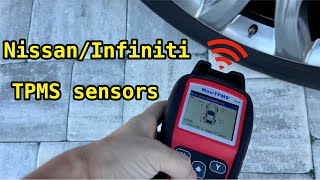
- If a new sensor is installed, use the TPMS tool to perform the OBD-II relearn procedure, 🎬 Watch: How to program new sensors to your Infiniti writing the new sensor's ID to the vehicle's computer system.
- After registration, drive the vehicle for several minutes to confirm the light stays off and the system is reading the new sensor correctly.
Parts You'll Likely Need
- Tire Pressure Monitoring System (TPMS) Sensor
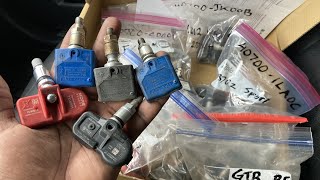
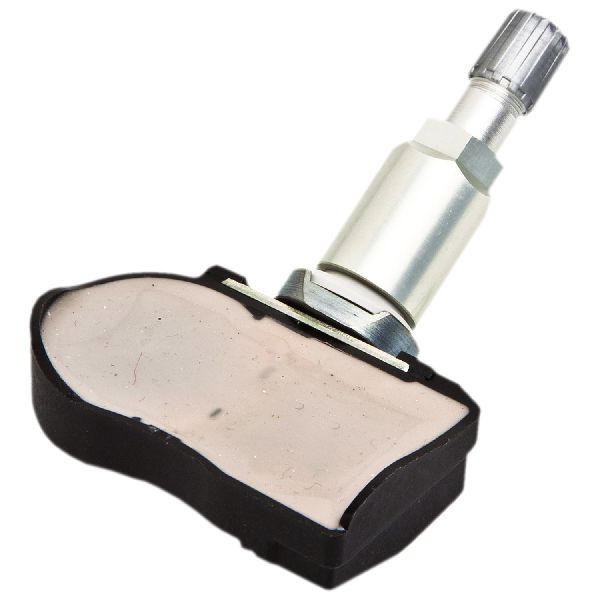
(OEM #40700-CD001)— This is the most common failure point. The internal, non-serviceable battery dies, requiring replacement of the entire sensor unit. This part number is specific to the 315MHz system 🎬 Watch: A guide to choosing the right TPMS sensors used in this era. It supersedes part number 40700-CD000.
Trusted brands: Schrader (OEM Manufacturer), Hitachi, Denso, Dorman, Standard Motor Products (SMP)
OEM price range: $70-$120
Aftermarket price range: $30-$75 - TPMS Sensor Service Kit
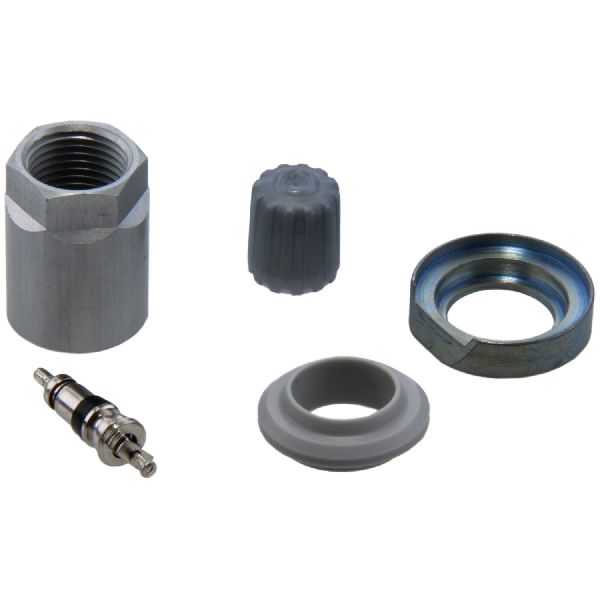
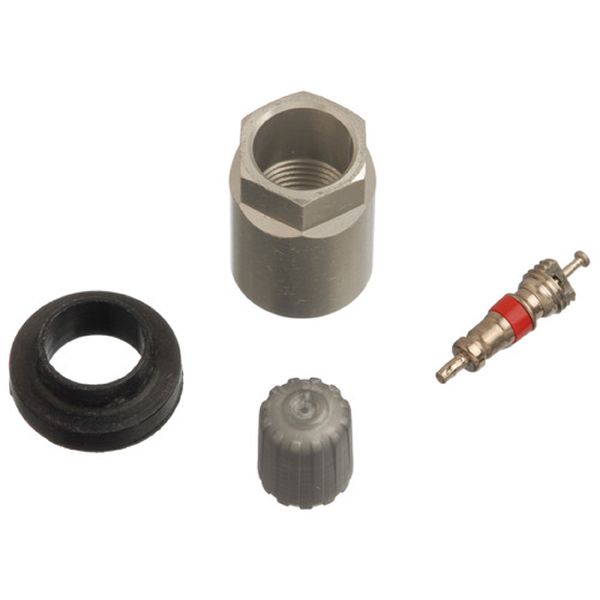
(OEM #N/A)— When replacing a sensor, it is best practice to also replace the valve stem components, including the grommet, nut, valve core, and cap to ensure a proper seal and prevent leaks. These kits are inexpensive and often sold separately.
Trusted brands: AC Delco, Denso, Dorman
OEM price range: $5-$15
Aftermarket price range: $2-$10
Related Codes That Often Appear With This One
- C1709 — This code indicates a 'No Data' fault from the Front Right TPMS sensor. Seeing it with C1708 could point to a systemic issue like RF interference or multiple aging sensors with dying batteries.
- C1710 — This code is for the Rear Right TPMS sensor. If multiple sensor codes appear together, it increases the likelihood of a common cause like widespread RF interference or simply that all sensor batteries are failing around the same time due to age.
- C1711 — This code is for the Rear Left TPMS sensor. Its presence alongside C1708 reinforces the possibility of a system-wide problem rather than an isolated sensor failure.
Technical Service Bulletins (TSBs) & Recalls
- ITB13039A / NTB13-088: Mentions that radio frequency interference from devices like 'smart cell phone chargers' can cause a 'No Data' condition resulting in codes C1708, C1709, C1710, or C1711, and that this is not a warrantable repair.
- NTB19-062: While for newer models (2018 370Z/GT-R), this TSB is notable as it identifies the HVAC blower motor as a specific source of RF interference that can cause these same C1708-C1711 codes, reinforcing the diagnostic path of checking for vehicle-generated RF noise.
Platform-Specific Known Issues
- Infiniti TSB ITB13039A specifically calls out radio frequency interference as a potential cause for C1708, C1709, C1710, and C1711 codes, which is a crucial diagnostic consideration unique to this platform.
- A user on the G35Driver forum experienced a persistent issue with all four TPMS codes (C1708-C1711) even after replacing sensors with OEM units. The discussion pointed towards a potential issue with the remote keyless entry receiver (which processes the TPMS signals) or the BCM itself, highlighting a rare but complex failure mode.
Mechanic-Grade Diagnostic Values
- BCM Power Supply Voltage — expected: Battery voltage (Approx. 12V) at connectors M65 (pin 37), M66 (pin 38), and M67 (pin 41, 57) with ignition ON.. Failure: 0V or significantly lower voltage indicates a power supply issue to the BCM, which can cause various faults including TPMS communication errors.
Hidden / Shadow Codes Worth Checking
- B26E7: Indicates the BCM cannot receive the CAN communication signal from the low tire pressure warning control unit (TPMS receiver). (see via A Nissan CONSULT-II/III scan tool or equivalent advanced scanner capable of reading BCM-specific DTCs. If this code is present with U1000 (CAN Communication Circuit), the U1000 code should be diagnosed first.)
Scan Tool Commands That Help
- Nissan CONSULT-II / CONSULT-III: Work support > AIR PRESSURE MONITOR > ID REGIST — This function is required after replacing a TPMS sensor or the BCM to register the unique ID of the new sensor(s) into the vehicle's memory. The tool is used to initiate the registration process, which is then completed by either driving the vehicle or using a transmitter activation tool.
Wiring & Ground Locations
- BCM (Body Control Module) — Located behind the driver's side kick panel.. The BCM is the central control unit that receives data from the TPMS receiver and activates the warning light. Power, ground, or communication wiring issues at the BCM can mimic sensor or receiver failures.
- Remote Keyless Entry Receiver (TPMS Receiver) — Located at the left 'C' pillar (the pillar behind the rear driver's side door).. This is the actual module that receives the 315MHz radio signals from the wheel sensors. If a sensor is confirmed good but the code persists, the fault may lie with this receiver or its wiring. It is often misidentified as being part of the BCM.
- BCM Ground Circuit — Continuity should be checked between BCM harness connector M119, terminal 13, and a known good chassis ground.. A poor ground connection for the BCM can cause a wide range of unpredictable electronic issues, including the inability to correctly process signals from the TPMS receiver, leading to C1708 and other codes.
Real Owner Repair Stories
- G35Driver Forum (2006 Infiniti G35x (similar platform)) — TPMS light would come on a few days after being reset. All four 'No Data' codes (C1708, C1709, C1710, C1711) were present.
❌ Tried (didn't work) Retraining existing sensors., Replacing all four sensors with new aftermarket VDO units and retraining., Replacing all four sensors again with new OEM Nissan sensors and retraining.
✅ What actually fixed it The thread did not have a final confirmed fix from the original poster, but the expert diagnosis pointed away from the sensors and towards a failure in the signal path: either the Remote Keyless Entry Receiver (which processes TPMS signals) or the BCM itself, including its wiring and grounds. - Reddit r/infiniti (Infiniti G-series) — A long list of error codes, including C1708, C1709, C1710, and C1711, appeared after extensive service.
❌ Tried (didn't work) The dealership presented the list of codes as new problems to be diagnosed.
✅ What actually fixed it The issue occurred immediately after an aftermarket remote starter was removed and a dead battery was replaced. Forum experts suggested the codes were likely triggered by the low voltage event from the dead battery or by improper wiring restoration after the remote starter removal. The recommended fix was to clear all codes and see which ones returned, as many were likely historical faults from the power interruption.
"I Checked Everything" — The Actual Cause
- The equivalent for this electronic code is when a TPMS activation tool successfully reads the sensor at the wheel, confirming the sensor is transmitting with good battery, yet the C1708 code persists in the BCM. In these cases, the problem is not the sensor itself but lies in the signal's path. The actual cause is often either strong Radio Frequency (RF) interference blocking the signal from reaching the car, or a hardware failure in the vehicle's Remote Keyless Entry/TPMS Receiver or the Body Control Module (BCM).
Model Year Variations Within This Range
- 2004: The main engine wiring harness part number changed in May 2004. The harness for vehicles produced from August 2002 to May 2004 is part number 24011-AS200. For vehicles produced from May 2004 to December 2005, the part number is 24011-AT600. This could be relevant for technicians tracing wires for a BCM or receiver issue.
Helpful Videos
We Have This Part in Stock


The information in this article is provided for general reference and educational purposes only. Vehicle specifications, procedures, and part compatibility can vary by production date, trim level, and region. Always consult your vehicle's factory service manual and verify part numbers before purchasing or performing repairs. Safety-critical components such as airbags, seat belts, and braking systems should be installed by a qualified professional.
- Infiniti Q45:
- 🧭 Diagnostic Flowchart
- 🎬 Helpful Videos
- 🛍️ Shop This Part
- What's Unique About the 2004-2006 Infiniti Q45
- Symptoms You May Notice
- Most Likely Causes
- Rare But Worth Checking
- Diagnosis Steps
- Parts You'll Likely Need
- Related Codes That Often Appear With This One
- Technical Service Bulletins (TSBs) & Recalls
- Platform-Specific Known Issues
- Mechanic-Grade Diagnostic Values
- Hidden / Shadow Codes Worth Checking
- Scan Tool Commands That Help
- Wiring & Ground Locations
- Real Owner Repair Stories
- "I Checked Everything" — The Actual Cause
- Model Year Variations Within This Range
- 🎟️ Get 5% Off