

C1717 on 2016-2024 Audi Q7: Adaptive Air Suspension Fault Causes and Fixes
Code C1717 on a 2016-2024 Audi Q7 most likely indicates a fault in the adaptive air suspension system, probably related to a sensor circuit. The most common fixes involve replacing a faulty ride height level sensor or addressing a leak in an air spring, which can overwork the compressor.
- C1717 on a 2016-2024 Q7 strongly suggests a fault in the adaptive air suspension, likely the front left ride height sensor circuit.
- Do not ignore symptoms like a sagging corner or a constantly running compressor; this can lead to a much more expensive compressor replacement.
- The most common root cause of system failure is a leaking air spring. Always perform a leak test before replacing expensive components like the compressor.
- Repairing this system is not a simple DIY job. It requires specialized diagnostic tools for accurate fault finding and for recalibrating the system after parts are replaced.
What's Unique About the 2016-2024 Audi Q7
The second-generation Audi Q7 (Typ 4M) relies on a complex adaptive air suspension system for its ride quality and handling. Unlike many vehicles where a 'C' code might just be for ABS, on the Q7 it's deeply integrated with the chassis control module (Address 74). Owners frequently experience issues with this system as the vehicle ages, with air leaks and sensor failures being common topics in enthusiast forums. A fault code like C1717 is a starting point for diagnosing this sophisticated but failure-prone system.
Symptoms You May Notice
- "Air Suspension: Fault" or similar warning message on the dashboard.
- Vehicle sits lower than normal on one or more corners when parked, often referred to as 'sagging'.
- Inability to raise or lower the vehicle using the MMI controls.
- A noticeably harsh, stiff, or bouncy ride.
- The air compressor, located in the rear of the vehicle, runs constantly or is louder than usual.
- The air compressor does not run at all, even when trying to adjust the height.
- Vehicle 'nose dives' when braking or leans excessively when turning.
- Replacing the air suspension compressor without first finding and fixing an air leak. The new compressor will quickly burn out from being overworked.
- Replacing an air strut when the actual problem is a much cheaper ride height sensor or its connecting linkage.
- Replacing the main suspension control module (J775) when the issue is with the separate compressor control unit (J1135), as noted in TSB 2059363/5.
Most Likely Causes
- Faulty Front Left Ride Height Level Sensor 🔴 High Probability These sensors are exposed to the elements in the wheel well, and their plastic linkages can become brittle and break. Electronic failure is also common over time, leading to the 'short to Vbat' condition described by the generic code definition.
How to confirm: Use a diagnostic tool like VCDS to monitor live data from the front left ride height sensor in measuring block group 0074. The voltage should change smoothly as the suspension is manually articulated. Visually inspect the sensor and its linkage arm for any physical damage.
Typical fix: Replace the faulty ride height sensor and its linkage. A suspension height calibration using a compatible scan tool is required after replacement.
Est. part cost: $100-$250 - Leaking Front Air Spring/Strut 🔴 High Probability The rubber air bladders degrade and develop cracks from age, mileage, and temperature changes, leading to air leaks. This is a very common failure point on air suspension systems.
How to confirm: With the vehicle raised, spray the air spring with soapy water. Bubbles will form at the site of the leak. The vehicle will often be sitting low on the corner with the leak after being parked for a few hours.
Typical fix: Replace the leaking air spring/strut assembly. It is often recommended to replace them in pairs (both front or both rear) to ensure even performance and prevent a subsequent failure of the older part.
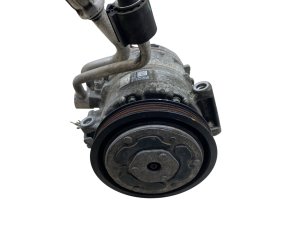
Est. part cost: $400-$900 per strut - Failing Air Suspension Compressor 🟡 Medium Probability → Shop Suspension Self-Leveling Pump Compressors often fail prematurely from being overworked trying to compensate for a leak elsewhere in the system. Moisture can also get past the dryer and cause internal corrosion.
How to confirm: Listen for a compressor that runs excessively long or is very loud. If the compressor does not run at all, check the associated relay and fuse first. A scan tool can check for compressor-specific fault codes.
Typical fix: Replace the air suspension compressor and the compressor relay. It is critical to find and fix any air leaks in the system before replacing the compressor, or the new one will fail as well.
Est. part cost: $500-$1200 - Damaged Wiring or Connector ⚪ Low Probability Wiring in the wheel well area is susceptible to damage from road debris, moisture, and corrosion, which can cause a short or open circuit, directly aligning with the 'Short to Vbat' definition of C1717.
How to confirm: Visually inspect the wiring harness and connector going to the front left ride height sensor and the main compressor harness. Check for chafing, breaks, or green/white corrosion on the connector pins.
Typical fix: Repair the damaged section of wiring or clean/replace the corroded connector. Apply dielectric grease to protect the connection.
Est. part cost: $20-$100
Rare But Worth Checking
- Failed Suspension Control Module (J775) or Compressor Control Unit (J1135): → Shop Air Suspension Control Module While less common, the control module itself can fail. The Drivetrain Control Module (J775), which manages the suspension, is located under the A/C unit. Audi TSB 2059363/5 specifically addresses a faulty compressor control unit (J1135) causing communication errors (DTC C1260F0) on 2017-2024 Q7s, which can present with similar symptoms.
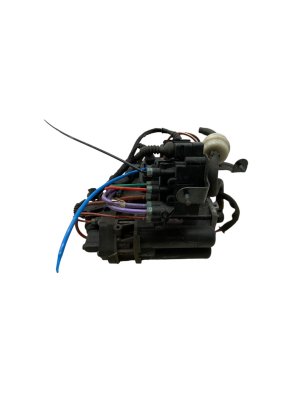
- Failed Valve Block: The valve block (NX7) that distributes air to each corner can fail, causing leaks between circuits or an inability to inflate/deflate a specific spring. The individual valves within the block are not separately replaceable.
Diagnosis Steps
- Scan the Chassis Control Module (Address 74) with an Audi-specific diagnostic tool (like VCDS or ODIS) to confirm C1717 and check for any other stored codes.
- Observe the vehicle's ride height. Note if any corner is sitting noticeably lower than the others after being parked for a few hours.
- Visually inspect the front left ride height sensor (G78), its electrical connector, and the plastic linkage arm for any signs of physical damage, corrosion, or disconnection.
- If a corner is low, raise the vehicle and spray the corresponding air spring with a soapy water solution. Look for bubbles, which indicate a leak.
- Listen for the sound of the air compressor when the vehicle is started. Note if it runs continuously, is excessively loud, or doesn't run at all.
- If the compressor is silent, check the fuse and relay for the air suspension system before condemning the compressor itself. The main 40A fuse is often located in an oversized holder near the battery under the driver's seat.
- Using a scan tool like VCDS, go to module 34-Level Control and enter Security Access code 20103. Then go to Adaptation or Measuring Blocks to view the live data from all four ride height sensors while gently pushing down on each corner of the car. The readings should change smoothly. A sensor that is stuck or provides erratic readings is faulty.
- If a sensor is suspected, inspect its wiring harness for damage back to the main loom. Check for continuity and shorts in the wiring to the J775 module.
Parts You'll Likely Need
- Ride Height Level Sensor
(OEM #4M0941285 (Front Left - verify with VIN))— This is a likely cause for a sensor circuit fault code and is a common failure item. The front left sensor (G78) corresponds to the likely definition of C1717.
Trusted brands: Bosch, URO Parts, Arnott Industries
OEM price range: $200-$300
Aftermarket price range: $80-$180 - Air Suspension Compressor
(OEM #4M0616005F, 4M0616005G, 4M0616005H)— Often fails as a secondary result of an air leak. If the compressor is burned out, it must be replaced along with its relay.
Trusted brands: WABCO (OEM supplier), Aerosus, Arnott Industries
OEM price range: $800-$1300
Aftermarket price range: $400-$700 - Front Air Spring / Strut Assembly
(OEM #4M0616039AC (verify with VIN))— The rubber bladder is a common point of failure due to age and environmental exposure, causing leaks that trigger suspension faults.
Trusted brands: Audi Genuine, Arnott Industries, Aerosus
OEM price range: $900-$1500
Aftermarket price range: $400-$800
Related Codes That Often Appear With This One
- 01400 — This code indicates the suspension is not at its calibrated level, often appearing alongside sensor or leak faults.
- C1046 — Indicates that the axle load determination has not been performed, which can occur after component replacement or if a system fault prevents proper calibration.
- C1260F0 — This TSB-documented code points to a communication failure with the compressor control unit, which could be related to the same wiring harness or power supply issue triggering C1717.
- U112100 — Another TSB-documented code for 'data bus, missing message', often stored alongside C1260F0, pointing to a communication issue with the compressor control unit.
Technical Service Bulletins (TSBs) & Recalls
- TSB 43 24 85 (2059363/5): Addresses an air suspension malfunction warning with DTC C1260F0 or U112100 on 2017-2024 Q7s, pointing to a potential fault with the compressor control unit or its wiring.
Mechanic-Grade Diagnostic Values
- Ride Height Sensor Supply Voltage — expected: Approx. 5.0V. Failure: A reading significantly lower than 5.0V (e.g., 2.79V) on one sensor's supply wire points to a wiring or module issue.
- Standard Suspension Height (1BK Suspension) — expected: Front: 442mm, Rear: 454mm (measured from wheel center to fender edge). Failure: Values that cannot be achieved or calibrated within a reasonable tolerance (e.g., +/- 3mm) after component replacement.
- Sport Suspension Height (2MA Suspension) — expected: Front: 427mm, Rear: 439mm (measured from wheel center to fender edge). Failure: Values that cannot be achieved or calibrated within a reasonable tolerance (e.g., +/- 3mm) after component replacement.
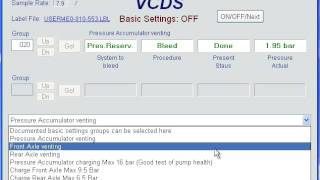
- System Pressure Sensor (G291) Reading at Normal Height — expected: Approx. 1.95 bar (can vary). Failure: Pressure that is excessively high or low, or fails to build when the compressor is active.
Scan Tool Commands That Help
- VCDS/ODIS: Security Access Login — Required before performing calibrations or adaptations in the Level Control Module (34 or 74). The code 20103 is commonly used for the 4M chassis.
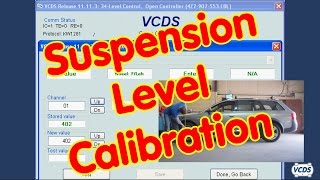
- VCDS/ODIS: Basic Settings: Delete calibration for level control — This is a necessary first step in the calibration sequence after replacing a sensor or strut. It erases the old stored height values.
- VCDS/ODIS: Basic Settings: Start up to reference level — After deleting the old calibration, this command moves the suspension to a default position to begin measurements.
- VCDS/ODIS: Adaptation: Channels 01-04 (Body height) — Used to input the manually measured height values (in mm) for each corner of the vehicle during the calibration process.
- VCDS/ODIS: Basic Settings: Calibrate level control — The final step after entering all new height values. This command saves the new calibration to the control module.
Wiring & Ground Locations
- J775 — Under the A/C unit in the center console area.. This is the Drivetrain/Chassis Control Module that receives signals from all ride height sensors. A fault in the module or its wiring can trigger sensor codes.
- G78 — Front left wheel well, attached to a control arm via a plastic linkage.. This is the Front Left Vehicle Level Sender. C1717's generic definition points directly to a fault in this sensor's circuit.
- T81a — This is the 81-pin main connector for the Drivetrain Control Module (J775).. All sensor signals and power supplies route through this connector. A pin corrosion or connection issue here could cause a sensor fault.
- 602 / 675 — Ground connection in the left front footwell (602) and right luggage compartment (675).. A poor ground connection for the suspension control module or its related components can cause erratic electrical behavior and trigger fault codes.
Real Owner Repair Stories
- YouTube video (Audi Q7 (older 4L model, but demonstrates identical failure mode)) — One side of the vehicle was sitting low, air suspension fault on dash.
❌ Tried (didn't work) Initial assumption was a leaking air spring or bad compressor.
✅ What actually fixed it Upon inspection, the wiring going to the level sensor was found to be broken/corroded right at the connector in the wheel well. Repairing the broken wire and re-securing the connector resolved the issue and allowed the suspension to function normally.
"I Checked Everything" — The Actual Cause
- In some cases, a soapy water test will not reveal a leak, especially if the leak is very small or occurs at the top seal of the air strut where it meets the chassis. One technician noted that aftermarket air springs sometimes come with undersized O-rings for this top seal, which are prone to leaking. Filling the entire cavity on top of the strut with soapy water may be necessary to find such a leak.
- A system can lose air without an external leak if the valve block is faulty and allows air to bleed back through the compressor's exhaust valve. This can be difficult to diagnose as there is no audible leak at the wheels. Unplugging the compressor's intake line to check for escaping air can help identify this issue.
OEM Part Supersession History
4M0616005F, 4M0616005G→4M0616005H— Likely internal revisions for improved reliability or manufacturing process changes by the OEM supplier (WABCO).
Heads up: The parts are generally interchangeable, but it is always recommended to use the latest revision (H) when replacing the compressor.
Model Year Variations Within This Range
- 2020-2024 (Facelift models): The 2020 facelift brought significant interior and exterior updates. While the core air suspension system remained, air suspension became standard on all seven-seat models. Optional electromechanical active roll stabilization, powered by a 48V mild-hybrid system, also became available, adding another layer of complexity to the chassis electronics.
Diagnostic Flowchart
Other Known Issues on This Vehicle
Issues unrelated to this code that are worth knowing about as an owner of this generation:
- PCV / Oil Separator Failure (3.0T) 🔴 High — Can fail as early as 50,000 miles. The part is inexpensive (~$150), but replacement is extremely labor-intensive (7-10+ hours) as it is located under the supercharger, leading to repair bills of $2,500-$4,500.
- Sunroof Drainage Leaks 🔴 High — Common across all model years. The sunroof drain tubes can clog or become disconnected, causing water to leak into the cabin, often damaging sensitive electronics in the headliner, A-pillars, or footwells.
- MMI Infotainment System Failures 🟠 Medium — Widespread reports of screens failing to raise, black screens, random reboots, or loss of audio. Causes range from software glitches fixed by a reset to failed control modules or broken screen-lift gears.
- Water Pump & Thermostat Failure (3.0T) 🟠 Medium — The water pump, often with a plastic housing, is prone to leaking coolant, which can lead to overheating. It's often replaced preventatively during other major services. (Ref: Some earlier generations had extended warranties, but less formal for the 4M.)
- Oil Consumption / Leaks 🟠 Medium — Some owners report notable oil consumption between changes. Oil leaks are also common, often from valve cover gaskets or oil filter housing seals.
- Premature Brake Wear and Squeal 🟡 Low — A very common complaint, particularly on 2017-2019 models. Owners report persistent and loud brake squeal at low speeds. While Audi has sometimes stated this is a characteristic of the pad material, it is a significant source of owner annoyance. (Ref: Various TSBs have been issued for different brake pad compositions to address noise.)
Used vs. New Parts: Buying Guide for This Vehicle
When a used part is the smart pick: Control modules (J775, J1135) can be a good candidate for used purchase, provided they come from a reputable dismantler with a warranty and are from a vehicle with similar options and no flood damage. A used valve block could also be considered if the price is significantly lower than new.
Donor-vehicle mileage cap: roughly under 60000 miles for the part to have meaningful remaining life.
What to inspect on the donor part:
- For control modules, ensure no signs of water intrusion or corrosion on the case or pins.
- For valve blocks, check that all air line fittings are clean and undamaged.
- Verify the part number exactly matches the one being replaced.
- Ask for the VIN of the donor car to check its history if possible.
OEM-only on this vehicle (don't cheap out):
- Air Suspension Compressor: While aftermarket options exist, the OEM supplier (WABCO) is highly recommended for longevity. Some forum users report learning this lesson after a cheaper aftermarket unit failed prematurely.
- Ride Height Sensors: Given the electrical precision required and exposure to the elements, OEM or a high-quality OE supplier like Bosch is recommended to avoid calibration issues and premature failure.
Aftermarket brands forum-validated for this vehicle:
- Arnott Industries: A well-regarded brand for air suspension components, including compressors and air springs. They often sell genuine WABCO compressors under their own brand.
- WABCO: The original equipment manufacturer for the compressor. Buying a WABCO-branded part is equivalent to getting a genuine Audi part without the dealer markup.
Brands owners have reported issues with on this vehicle:
- Unbranded 'Chinese' compressors from online marketplaces like Amazon or eBay. While very inexpensive, forum users report a high failure rate and short lifespan.
Real Owner Stories
Aggregated from forums and TSBs cited above. Mileages and costs reflect what owners reported in those sources.
2019 Audi Q7 3.0T — 50000 miles
Symptoms: Owner reported a PCV failure, which is a known high-severity issue for this engine range.
What fixed it: Replacement of the PCV / Oil Separator located under the supercharger.
Cost: $3,400
Source hint: Reddit r/Audi - PCV issues 2017-2019 Q7 3.0 - testimonies wanted
2017 Audi Q7
Symptoms: The front suspension dropped completely while the rear remained at normal height.
What fixed it: Investigation of a major leak or valve block issue in the front axle circuit.
Source hint: Audi Q7 Club (UK) - Q7 air suspension
2017 Audi Q7
Symptoms: Owner noted the air suspension felt 'floaty' compared to platform mates like the Porsche Cayenne.
What fixed it: No repair performed; owner described the system as 'flawless' but noted the specific tuning difference of the VAG 3-chamber system.
Source hint: Rennlist - 9YA Air springs/ any suspension issues or any major technical issues?
Related OBD-II Codes
Frequently Asked Questions
My 2017 Audi Q7 is showing an air suspension warning; does TSB 43 24 85 apply to my vehicle?
The front of my Q7 is sagging while the rear stays at normal height. What is the likely cause?
Where is the air suspension fuse located on the 2016-2024 Audi Q7?
I have a C1717 code indicating a 'Short to Vbat' for the front left sensor. Is this a common wiring issue?
Do I need to perform any special procedures after replacing a ride height sensor on my Q7?
My air compressor is running constantly and is very loud. Should I just replace the compressor?
Helpful Videos
We Have This Part in Stock

The information in this article is provided for general reference and educational purposes only. Vehicle specifications, procedures, and part compatibility can vary by production date, trim level, and region. Always consult your vehicle's factory service manual and verify part numbers before purchasing or performing repairs. Safety-critical components such as airbags, seat belts, and braking systems should be installed by a qualified professional.
- Audi Q7:
- 🧭 Diagnostic Flowchart
- 🎬 Helpful Videos
- 🛍️ Shop This Part
- What's Unique About the 2016-2024 Audi Q7
- Symptoms You May Notice
- Most Likely Causes
- Rare But Worth Checking
- Diagnosis Steps
- Parts You'll Likely Need
- Related Codes That Often Appear With This One
- Technical Service Bulletins (TSBs) & Recalls
- Mechanic-Grade Diagnostic Values
- Scan Tool Commands That Help
- Wiring & Ground Locations
- Real Owner Repair Stories
- "I Checked Everything" — The Actual Cause
- OEM Part Supersession History
- Model Year Variations Within This Range
- Other Known Issues on This Vehicle
- Used vs. New Parts: Buying Guide for This Vehicle
- Real Owner Stories
- 2019 Audi Q7 3.0T — 50000 miles
- 2017 Audi Q7
- 2017 Audi Q7
- Related OBD-II Codes
- Frequently Asked Questions
- 🎟️ Get 5% Off