

C1717 on 2007-2013 BMW X5: Why This Is Likely a Phantom Code
C1717 is not a recognized fault code for the 2007-2013 (E70) BMW X5. It almost always appears when using a generic OBD-II scanner that cannot interpret BMW's specific chassis codes. The first step is to have the vehicle scanned with a BMW-compatible tool to find the true fault, which is likely related to the rear air suspension system.
- Do not trust code C1717 on a 2007-2013 BMW X5; it is almost certainly an error from a generic scanner.
- The first and most important step is to get the vehicle scanned with a BMW-compatible diagnostic tool to find the true fault code.
- The underlying problem is most likely a failure in the rear air suspension system, with leaking air springs being the most common culprit.
- Never replace parts based on the C1717 code. You will be wasting time and money trying to fix a problem that isn't defined.
What's Unique About the 2007-2013 BMW X5
The BMW E70 X5 uses a sophisticated network of control modules that communicate using proprietary protocols. A standard code reader can only access generic powertrain codes, but for chassis systems like Dynamic Stability Control (DSC) or the optional self-leveling air suspension, it often fails. It might display a 'phantom' code like C1717 when it encounters a BMW-specific fault it can't understand. While a similar code on the next-generation X5 (F15) or the 5-Series GT (F07) points to an air suspension issue, this definition cannot be reliably applied to the E70. Owners with proper diagnostic tools report specific BMW codes like '5F9B' or '5FB4' for air suspension problems on the E70.
Symptoms You May Notice
- A 'Chassis Stabilization Malfunction' or 'Self-Leveling Suspension Inactive' warning message on the iDrive screen.
- Rear of the vehicle is sagging or sitting lower than normal, especially on one side.
- Vehicle is low after being parked overnight but may rise after starting.
- Air suspension compressor is heard running constantly, loudly, or not at all.
- A harsh, bouncy ride quality.
- A hissing sound coming from the rear of the vehicle, indicating an air leak.
- A blown 40-amp fuse for the air suspension compressor, located in the glove box fuse panel.
- Replacing any part based on the C1717 code without first getting a proper BMW-specific scan.
- Confusing the chassis code C1717 with the powertrain code P1717, which on some BMWs relates to a crankshaft position sensor fault.
- Replacing only the air compressor when the root cause was a leak in the air springs, leading to premature failure of the new compressor.
Most Likely Causes
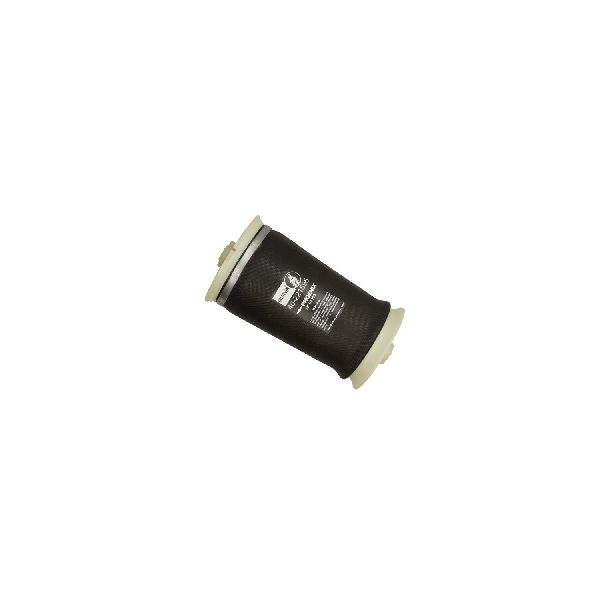
- Leaking Rear Air Spring(s) 🔴 High Probability → Shop Air Suspension Spring The rubber air springs are a common wear item. Over time, they dry rot, develop cracks, and leak, especially in colder climates or after 80,000-100,000 miles. This is the most frequent failure point in the E70's air suspension system.
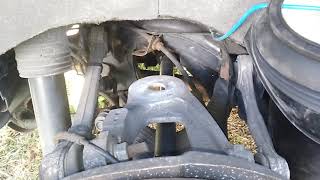
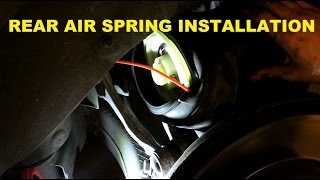
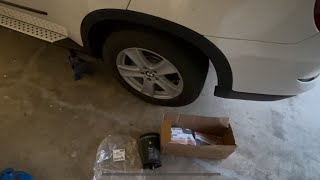
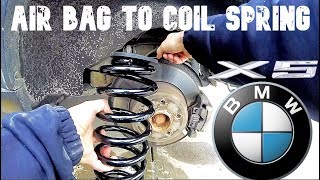
How to confirm: With the system pressurized, spray the air springs (especially the rolling lobe area) with soapy water and look for bubbles forming, which indicates a leak. The vehicle may be visibly sagging in one or both rear corners, often after sitting overnight. A DIY replacement is considered relatively easy by many owners. 🎬 Watch this step-by-step DIY air spring replacement guide.
Typical fix: Replacement of the failed air spring(s). It is highly recommended to replace them in pairs to ensure even ride height and prevent premature failure of the older spring.
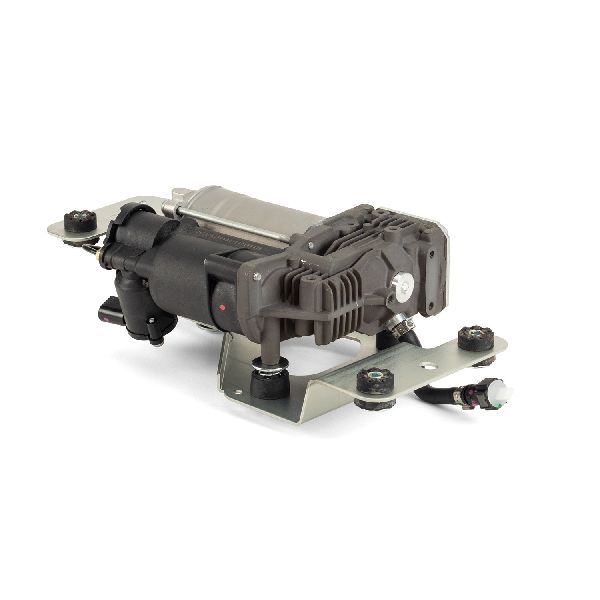
Est. part cost: $150-$400 for a pair of aftermarket air springs. - Failed Air Suspension Compressor 🟡 Medium Probability → Shop Suspension Self-Leveling Pump The compressor often burns out from running constantly to compensate for a leak in the system. The internal dryer can also become saturated, leading to moisture damage and failure in freezing temperatures.
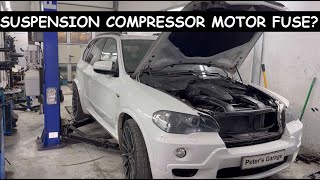
How to confirm: Listen for the compressor when the vehicle is started. If it runs excessively long or makes loud grinding noises, it may be failing. If it never turns on, check the dedicated 40A fuse (F32) and relay (R2) first, then test for power at the compressor connector. A blown fuse is a strong indicator that the compressor has seized or is drawing too much current and has failed.
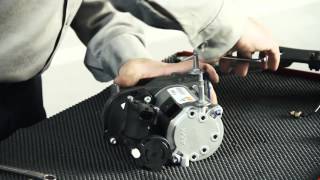
Typical fix: Replace the air suspension compressor and its associated relay. This should only be done after fixing any leaks in the system to prevent the new compressor from burning out. 🎬 See how to replace the air suspension compressor.
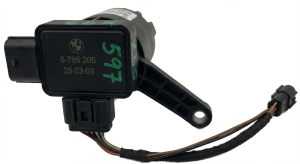
Est. part cost: $250-$600 for an aftermarket compressor assembly. - Faulty Ride Height Sensor ⚪ Low Probability Located on the rear control arms, these sensors are exposed to road debris and moisture, which can cause mechanical failure of the plastic arms or electrical connection issues.
How to confirm: A BMW-specific scan tool can read the live data from each sensor to see if it's providing a plausible signal. A visual inspection may reveal a broken sensor arm or corroded connector.
Typical fix: Replacement of the faulty ride height sensor.
Est. part cost: $50-$150 per sensor.
Rare But Worth Checking
- Leaking Air Line or Valve Block: Less common than air spring failure, but a leak can occur at the fittings on the compressor/valve block assembly or from a crack in an air line itself. The soapy water test can be used on fittings to check for leaks. The brass collet on the air line fitting at the top of the air spring can also be a point of failure during replacement if not handled carefully.
- Failed Electronic Height Control (EHC) Module: In rare cases, the control module itself can fail, often due to water ingress from clogged panoramic sunroof drains or voltage issues. This typically results in a total loss of communication that would be identified by a professional scan tool.
Diagnosis Steps
- STOP. Do not replace any parts based on the C1717 code alone.
- Obtain a proper diagnosis using a BMW-specific scan tool (e.g., ISTA, Foxwell NT510/NT710, Autel MaxiSys, or similar). This is the most critical step.
- Analyze the true BMW fault codes found. These will point to the specific part of the chassis system that is failing (e.g., 'pressure accumulator charging', 'ride height sensor signal implausible', etc.).
- If the compressor is not running, check the air suspension compressor fuse and relay. The primary fuse is a 40A fuse (often orange) at position F32 in the fuse panel located behind the glove box. The relay is typically R2 in the same panel.
- If a leak is suspected, perform a visual inspection of the rear ride height. Note if one or both sides are sagging, especially after being parked for several hours.
- Start the vehicle and listen for the air compressor. It is located near the passenger side rear wheel well, under a protective cover. Note if it runs, if it's loud, or if it runs continuously.
- With the system running (or after manually activating the compressor with a scan tool), spray the rear air springs and the air line connections at the valve block with soapy water. Look for the formation of bubbles, which confirms a leak.
- If a sensor is suspected by the BMW-specific codes, inspect the sensor and its wiring for physical damage or corrosion.
Parts You'll Likely Need
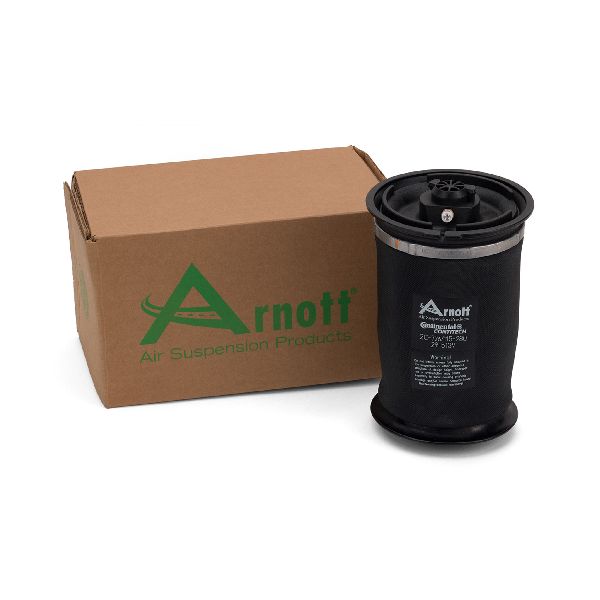
- Rear Air Spring
(OEM #37126790078, 37126790079, 37126790080, 37126790081 (varies by model options))— This is the most common failure point in the E70 air suspension system, leading to leaks and sagging.
Trusted brands: Arnott, Bilstein, Suncore
OEM price range: $350-$450 per side
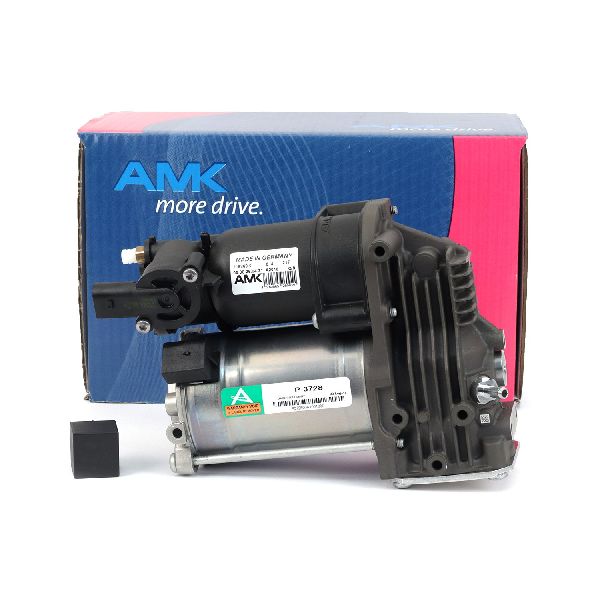
Aftermarket price range: $75-$200 per side - Air Suspension Compressor
(OEM #37206799419, 37206859714)— Typically fails due to being overworked from a system leak, or from internal moisture damage. Always replace the relay when replacing the compressor.
Trusted brands: WABCO (OEM supplier), Arnott, Hitachi
OEM price range: $700-$900
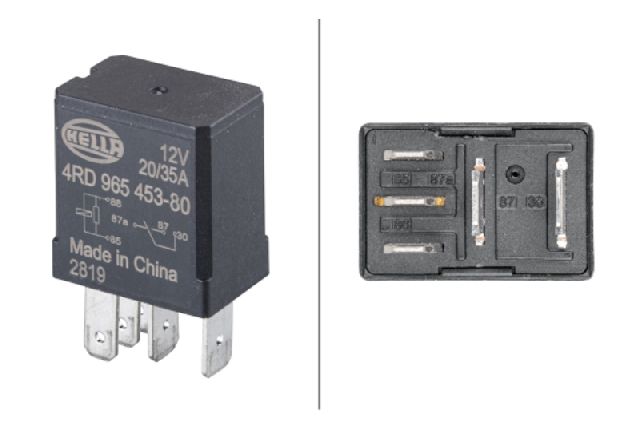
Aftermarket price range: $250-$600 - Air Suspension Compressor Relay
(OEM #61368373700)— A worn or stuck relay can cause the compressor to run continuously and burn out. It is considered mandatory to replace this cheap part whenever the compressor is replaced.
Trusted brands: Tyco (OEM), Bosch, Hella
OEM price range: $15-$25
Aftermarket price range: $5-$15
Related Codes That Often Appear With This One
- 5F9B, 5FB4, or other BMW-specific codes — These are examples of the true, proprietary fault codes related to the air suspension system that a proper BMW scan tool will find. The C1717 code is a generic misreading of these real codes.
Platform-Specific Known Issues
- The E70 X5 models equipped with the optional third-row seat came standard with rear self-leveling air suspension, making them prone to these issues. On models without the third row, it was an option.
- A faulty alternator or battery can cause low voltage conditions that may trigger spurious chassis and suspension warnings. It's always wise to ensure the vehicle's electrical system is healthy before diagnosing complex modules.
- Clogged panoramic sunroof drains are a notorious issue on the E70. Water can leak into the cabin and trunk area, potentially damaging various electronic modules, including the EHC (air suspension) module.
Mechanic-Grade Diagnostic Values
- Ride Height Sensor Voltage Output — expected: A linear voltage signal between approximately 0.5V and 4.5V, corresponding to suspension travel.. Failure: A voltage drop below ~0.3V or a signal that is stuck/does not change with suspension movement can trigger a fault. A BMW-specific scan tool can read this value directly from the EHC module.
- Compressor Motor Power Supply — expected: Battery voltage (~12V with engine off, ~14V with engine running) at the compressor's main power connector when activated.. Failure: No voltage when the system commands the compressor on points to a failed relay, blown fuse (40A), or wiring issue. The power wire is typically green/red (positive) and the ground is brown (negative).
- Ride Height Calibration Target (20" wheels) — expected: Approximately 736mm, measured from the bottom edge of the wheel rim to the bottom of the wheel arch.. Failure: Significant deviation from the specified height for the vehicle's wheel size indicates a calibration issue or a physical fault (sensor, leak) preventing the system from reaching its target.
Hidden / Shadow Codes Worth Checking
- 5F9B: Indicates a lowering fault. The system is unable to vent or lower the vehicle as expected. This can be caused by a stuck valve, crossed air lines, or a faulty EHC module. (see via BMW-specific scan tool like ISTA or a high-end aftermarket scanner (Autel, Foxwell for BMW).)
- 5FB4: Indicates an internal fault in the Electronic Height Control (EHC) module or that the system is stuck in 'transport mode'. This can sometimes be triggered by severe voltage drops, such as those caused by a failing alternator. (see via BMW-specific scan tool like ISTA or a high-end aftermarket scanner.)
- 5F9A: A general control time fault, often related to the compressor running too long to achieve target pressure, usually because of a leak in the system. (see via BMW-specific scan tool like ISTA or a high-end aftermarket scanner.)
Scan Tool Commands That Help
- ISTA (Rheingold): Ride-Height Adjustment (Service Function) — This is required after replacing air springs, ride height sensors, or the EHC module. The procedure (ABL) guides the user to measure current heights and enter correction values to recalibrate the system to its target specifications.
- ISTA (Rheingold): Component Activation (EHC Control Unit Diagnosis) — To manually test individual components. A technician can use this to activate the compressor, or open and close the left, right, and exhaust solenoid valves independently. This is crucial for isolating a failed compressor, a sticking valve, or testing for leaks without the system's automated logic interfering.
- NCS Expert / Carly: VO (Vehicle Order) Coding / Module Coding — For owners who convert from air suspension to traditional coil springs, the self-leveling system must be coded out of the vehicle's configuration. This involves removing the option code for air suspension (e.g., S220A) from the VO and recoding the instrument cluster (KOMBI) and other relevant modules to prevent the 'Self-Leveling Suspension Inactive' error message from appearing.
Wiring & Ground Locations
- EHC Control Unit — Located in a module carrier in the luggage compartment, on the right-hand side, often behind a removable panel.. This is the brain of the air suspension system. Water ingress from clogged sunroof drains or failed tailgate seals can damage this module, leading to total system failure. All sensor inputs and component outputs route through here.
- Air Supply Unit (Compressor Assembly) — Mounted to the underbody of the vehicle, beneath a plastic shield, roughly below the front passenger door area.. The compressor, dryer, and valve block are a single assembly. Its location exposes it to road spray and debris. The main power and ground connections are here, as are the air line connections, which can be misrouted.
- Compressor Power/Ground Wires — At the main electrical connector for the air compressor assembly. The positive wire is typically Green/Red, and the ground wire is Brown.. When diagnosing a compressor that won't run, testing for voltage between these two wires is a key step after checking the fuse and relay. Corrosion at this connector is possible due to its under-vehicle location.
Real Owner Repair Stories
- XBimmers.com forum user (2008 BMW X5 (E70)) — Car would not sit level; one side would raise much higher than the other, and the issue would randomly switch sides. Threw code 5F9A.
❌ Tried (didn't work) Replacing the air compressor and filter., Replacing the level sensors., Replacing the valve body., Recalibrating with ISTA at the dealer.
✅ What actually fixed it A previous mechanic had switched the left and right air lines at the compressor's valve block. The passenger side line was connected to the driver's side port on the compressor, and vice-versa. Correcting the line routing resolved the issue. - r/BmwTech on Reddit (2013 BMW X5 35i (E70)) — After an alternator failure and replacement, the air suspension stopped working entirely. The vehicle was 'slammed' on both sides, and the compressor would not turn on automatically. Scan tool showed codes 5FB4 and 5F9B.
❌ Tried (didn't work) Replacing air bags., Replacing ride height sensors., Replacing air compressor., Attempting to delete transport mode and recalibrate with a Snap-on scanner.
✅ What actually fixed it The final resolution posted by another user with identical symptoms was a broken wire at the connector for one of the rear ride height sensors. The wiring had become brittle and cracked from exposure to the elements. - Xoutpost.com forum user (BMW X5 (E53, but principle applies to E70)) — Persistent 'Self level suspension inactive' warning on the dash.
❌ Tried (didn't work) Clearing codes, which would return shortly after.
✅ What actually fixed it The root cause was an old, weak battery providing insufficient voltage. Replacing the battery and registering it to the vehicle permanently cleared the fault message. A weak battery or failing alternator can cause low-voltage conditions that trigger spurious warnings in various modules, including the EHC.
OEM Part Supersession History
37206789938, 37206799419, 37226775479, 37226785506→37206859714— Standard part evolution and supplier updates for the air supply unit (compressor assembly).
Heads up: All listed part numbers are generally interchangeable for the E70 X5, but using the latest revision (37206859714) or a quality aftermarket equivalent (like Arnott P-3221) is recommended.
Diagnostic Flowchart
Other Known Issues on This Vehicle
Issues unrelated to this code that are worth knowing about as an owner of this generation:
- Electric Water Pump & Thermostat Failure (All Gasoline Engines) 🔴 High — Extremely common, typically fails between 60,000-100,000 miles, often without warning. Failure can cause rapid overheating and lead to catastrophic engine damage if not addressed immediately.
- Oil Leaks from Valve Cover & Oil Filter Housing Gaskets (N52/N55) 🟠 Medium — Almost guaranteed to occur. Gaskets become hard and brittle from heat, typically leaking after 60,000-80,000 miles. Leaks can drip onto hot exhaust components, causing a burning smell, or damage the serpentine belt.
- Excessive Oil Consumption & Timing Chain Stretch (N63 V8) 🔴 High — Very common on early N63 engines (2008-2013). Issues with valve stem seals, piston rings, and timing chains are well-documented. BMW issued a 'Customer Care Package' (N63B) to address some problems, but the engine remains high-maintenance. (Ref: N63 Customer Care Package (Service Campaign))
- Carbon Buildup & Swirl Flap Failure (M57 Diesel) 🔴 High — Carbon buildup (CBU) in the intake manifold is inevitable and restricts airflow, reducing performance. Swirl flaps can break and fall into the engine, causing catastrophic damage. Many owners proactively delete the swirl flaps.
- Clogged Panoramic Sunroof Drains 🟠 Medium — Common across all E70 models. The four drain tubes can clog with debris, causing water to back up and leak into the cabin, often damaging sensitive electronic modules located in the trunk floor and behind the dashboard.
- Plastic Charge Pipe Failure (N55 Turbo) 🟠 Medium — The original plastic charge pipe becomes brittle with heat and age and can crack or shatter under boost pressure, causing a sudden loss of power. This is especially common on tuned vehicles but happens on stock cars as well.
Used vs. New Parts: Buying Guide for This Vehicle
When a used part is the smart pick: A used Electronic Height Control (EHC) module can be a cost-effective option if the original has failed due to water damage or internal faults, provided the donor vehicle has a clean history. Used ride height sensors are also generally reliable. Buying used wear items like air springs or compressors is highly risky and not recommended.
Donor-vehicle mileage cap: roughly under 80000 miles for the part to have meaningful remaining life.
What to inspect on the donor part:
- For an EHC module, ensure there are no signs of water damage or corrosion on the casing or pins.
- For a ride height sensor, check that the plastic arm is not cracked and moves freely without binding. Ensure the connector pins are clean and straight.
- Avoid any used air springs; the rubber is a wear item and likely has micro-cracks even if it looks okay.
- Avoid used compressors; their remaining lifespan is impossible to determine and they likely have a saturated internal dryer.
OEM-only on this vehicle (don't cheap out):
- Air Suspension Compressor Relay: This part is inexpensive and critical for the longevity of the compressor. Using a cheap, unreliable relay is not worth the risk. The OEM Tyco relay is the standard.
Aftermarket brands forum-validated for this vehicle:
- Air Springs: Arnott and Bilstein are the most frequently recommended and trusted aftermarket brands by owners. Arnott is often cited as a go-to choice.
- Compressor: WABCO is the original equipment manufacturer (OEM), so a WABCO-branded part is equivalent to dealer quality. Arnott also produces well-regarded replacement compressors, often using AMK or similar quality pumps.
Brands owners have reported issues with on this vehicle:
- Unbranded, generic air springs and compressors from online marketplaces. While the initial cost is low, forum users frequently report premature failures, poor fitment, and noisy operation, leading to repeated repairs.
Real Owner Stories
Aggregated from forums and TSBs cited above. Mileages and costs reflect what owners reported in those sources.
2007-2013 BMW X5 (E70) — ~90000 miles
Symptoms: Rear of the vehicle is sagging or sitting lower than normal, especially on one side; vehicle is low after being parked overnight but may rise after starting.
What fixed it: Replacement of the failed air spring(s).
Cost: $150-$400
Source hint: common_causes section regarding Leaking Rear Air Spring(s) in E70 models
2008-2014 BMW X6 (E71)
Symptoms: Actual E70/E71 chassis stabilization malfunction and air suspension failure modes including leaking air springs and compressor burnout.
What fixed it: Fixing leaks in the system and replacing the air suspension compressor and its associated relay.
Source hint: r/BmwTech on Reddit and platform_mates section
Related OBD-II Codes
Frequently Asked Questions
My 2011 X5 with the third-row seat is sagging; is this a known issue?
Can I just replace one air spring to save money on my E70?
My air suspension warning came on, but my battery is also weak. Could they be related?
I hear a hissing sound from the rear of my X5 after parking. What is that?
Is there a specific fuse I should check if my air compressor won't turn on?
Could my leaking panoramic sunroof be causing my suspension codes?
Helpful Videos
Used OEM Parts in Stock
New Aftermarket Parts Available


The information in this article is provided for general reference and educational purposes only. Vehicle specifications, procedures, and part compatibility can vary by production date, trim level, and region. Always consult your vehicle's factory service manual and verify part numbers before purchasing or performing repairs. Safety-critical components such as airbags, seat belts, and braking systems should be installed by a qualified professional.
- BMW X5:
- 🧭 Diagnostic Flowchart
- 🎬 Helpful Videos
- 🛍️ Shop This Part
- What's Unique About the 2007-2013 BMW X5
- Symptoms You May Notice
- Most Likely Causes
- Rare But Worth Checking
- Diagnosis Steps
- Parts You'll Likely Need
- Related Codes That Often Appear With This One
- Platform-Specific Known Issues
- Mechanic-Grade Diagnostic Values
- Hidden / Shadow Codes Worth Checking
- Scan Tool Commands That Help
- Wiring & Ground Locations
- Real Owner Repair Stories
- OEM Part Supersession History
- Other Known Issues on This Vehicle
- Used vs. New Parts: Buying Guide for This Vehicle
- Real Owner Stories
- 2007-2013 BMW X5 (E70) — ~90000 miles
- 2008-2014 BMW X6 (E71)
- Related OBD-II Codes
- Frequently Asked Questions
- 🎟️ Get 5% Off