

OBD-II Code C1843: Differential Fluid Pressure Deviation
The Ultimate 2026 Guide to What C1843 Means, Why It Triggers, and How to Fix It
- Code C1843 indicates a hydraulic pressure failure in the rear differential, immediately disabling the All-Wheel Drive (AWD) system.
- On 2019-2020 Acura RDX and modern Honda AWD models, internal corrosion of the rear differential solenoids causes 90% of C1843 codes, documented in TSB B20-032.
- Drivers will experience an immediate 'AWD System Problem' dashboard warning and a forced downgrade to Front-Wheel Drive (FWD) only.
- Replacing both rear differential solenoids and flushing the DPSF-II fluid permanently resolves the issue for $375 to $550 at a dealership.
- You can safely drive with C1843 active for short trips, but reduced traction and disabled AWD require repair within 30 days to ensure vehicle stability.
What Does C1843 Mean?
Code C1843 indicates the All-Wheel Drive (AWD) control module detected incorrect hydraulic pressure in the rear differential. On affected Honda and Acura vehicles, it specifically points to a pressure deviation in the left rear clutch pack of the SH-AWD or i-VTM4 system. The vehicle's computer shuts down the AWD system as a fail-safe to prevent mechanical damage.
Technical definition: The official SAE/ISO definition of C1843 is manufacturer-specific. For Acura/Honda, C1843-62 is defined as "Left Rear Differential Fluid Pressure Deviation". The '-62' suffix is a Failure Mode Identifier (FMI) specifying a 'Signal Compare Failure', confirming the sensor's pressure reading does not match the control module's commanded pressure.
Can I Drive With C1843?
Yes, But With Caution. You can continue to drive, but the All-Wheel Drive (AWD) system is disabled, reducing traction and handling. The vehicle operates in Front-Wheel Drive only. Prolonged driving with a malfunctioning AWD system risks overheating the differential fluid, escalating repair costs.
Common Causes
- Corroded Rear Differential Solenoid Valves (Very Common) — On affected Acura and Honda models, internal corrosion inside the electronic linear solenoids prevents them from regulating hydraulic fluid pressure. This is a widely known manufacturing defect covered by Acura Technical Service Bulletin (TSB) B20-032.
- Low or Degraded Rear Differential Fluid (Common) — The AWD system requires pristine hydraulic fluid (DPSF-II). Low, old, or moisture-contaminated fluid causes pressure regulation failures and immediately triggers the code.
- Weak or Failing Battery (Common) — Low system voltage from an aging battery causes erroneous electronic fault codes, including AWD system warnings. Always verify battery health before replacing expensive drivetrain components. 🎬 See how a weak battery triggers the SH-AWD warning light.
- Faulty Rear Differential Fluid Pressure Sensor (Less Common) — The sensor reading the hydraulic pressure fails and sends incorrect voltage signals to the control module, tricking the computer into detecting a pressure problem when the mechanical parts are fine.
- Wiring or Connector Issues (Less Common) — Damaged wires, loose connections, or corrosion in the electrical harness leading to the differential solenoids interrupt the signal and trigger the code.
- Clogged Rear Differential Breather Vent (Rare) — A clogged breather vent traps heat and builds internal pressure inside the differential housing, skewing sensor readings and forcing fluid past the seals.
- Internal Rear Differential Failure (Rare) — If replacing solenoids and sensors fails to clear the code, the differential assembly has suffered a catastrophic internal mechanical or hydraulic failure requiring complete unit replacement.
Symptoms
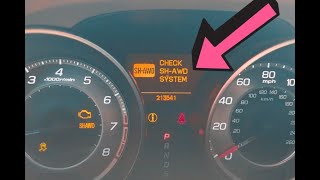
- AWD Warning Light and Dash Message — The AWD or SH-AWD indicator light illuminates alongside a multi-information display message reading: "All Wheel Drive System Problem. Only Front Wheels May Be Powered." 🎬 Watch this quick fix for the Acura SH-AWD system warning.
- Vehicle Operates in Front-Wheel Drive Only — The AWD system disables itself as a fail-safe. The vehicle sends zero power to the rear wheels, noticeably reducing traction during acceleration or in slippery conditions.
- Intermittent Warning on Cold Starts — In the early stages of failure, the AWD light triggers during cold weather drives but turns off after restarting the vehicle. As corrosion worsens, the light becomes permanent.
- Hesitation During Acceleration — Drivers experience a brief hesitation or slow roll when accelerating from a stop, typically right before the transmission shifts from 1st to 2nd gear.
Diagnostic Flowchart
Tap your situation to follow the diagnostic path that matches what you're seeing on this code.
Common Fixes & Costs
- Replace Both Rear Differential Solenoids
— Parts: $150-$250, Labor: $125-$275, ~0.8 hr book time
(Intermediate)
Acura RDX / Honda Pilot / Honda Passport: OEM - Change Rear Differential Fluid
— Parts: $30-$60, Labor: $50-$125, ~0.6 hr book time
(DIY)
Acura RDX / Honda Pilot / Honda Passport: OEM - Replace Rear Differential Fluid Pressure Sensor
— Parts: $80-$150, Labor: $100-$200, ~0.8 hr book time
(Intermediate)
Acura RDX / Honda Pilot / Honda Passport: OEM - Repair Wiring Harness — Parts: $20-$50, Labor: $150-$300, ~1.5 hr book time (Professional)
- Replace Rear Differential Assembly — Parts: $2500-$4500, Labor: $400-$800, ~4.0 hr book time (Professional)
DIY vs Professional
- Change Rear Differential Fluid — Beginner: Yes
Tools: Jack, jack stands, socket set, fluid pump, drain pan, torque wrench. - Replace Both Rear Differential Solenoids — Beginner: No
Tools: Jack, jack stands, socket set, torque wrench, pick tool, new DPSF-II fluid. - Replace Rear Differential Fluid Pressure Sensor — Beginner: No
Tools: Jack, jack stands, socket set, torque wrench, new crush washers.
Used vs. New Parts: Buying Guide
When a used part is worth it: Never buy used solenoids for this repair. The failure stems from a design flaw in the original parts. Used solenoids are guaranteed to be the old, failure-prone version.
Donor-vehicle mileage cap: roughly under 10000 miles for the part to have meaningful remaining life.
Donor quality checklist:
- Avoid used solenoids entirely.
- If buying a complete used differential assembly, verify the donor vehicle's mileage and ensure it was not in a rear-end collision.
- Always verify you are purchasing the superseded, updated OEM part numbers (ending in -013).
Decision logic:
- If You need rear differential solenoids for an affected Acura/Honda. → Buy new OEM only. The labor cost of a repeat failure negates any savings from used parts.
- If The entire rear differential assembly requires replacement and the quote exceeds $4,000. → Source a used assembly from a low-mileage donor vehicle to cut parts costs by 60%.
Warranty tradeoff: New OEM parts installed by a dealer carry a 12-month/12,000-mile warranty. Used parts offer 30 days at best.
Worst-case if a used part fails: $400
What Happens If You Wait — Timeline
- 0-3 months: Intermittent AWD warning light triggers during acceleration but turns off after restarting the vehicle. AWD is disabled only when the light is on. (MPG impact: 0%% · Added cost: $0)
- 1-6 months: Persistent AWD warning light. The fault becomes hard, and the light stays on continuously. The AWD system is permanently disabled, forcing Front-Wheel Drive. (MPG impact: 0-1%% · Added cost: $0)
- 6-12+ months: Continued operation in FWD. Vehicle stability is noticeably reduced in poor weather. No additional component damage occurs if the root cause is a solenoid. (MPG impact: 0-1%% · Added cost: $0)
- Undefined (Rare Event): Internal differential failure. If the root cause was severely degraded fluid, prolonged driving destroys the internal clutch packs, requiring a full assembly replacement. (MPG impact: N/A% · Added cost: $4500)
Cost of Not Fixing It
- Short-Term (0-3 months): Total loss of All-Wheel Drive functionality. The vehicle operates in Front-Wheel Drive only, resulting in reduced traction and stability in slippery conditions. (Added cost: $0)
- Medium-Term (3-12 months): Continued operation with a disabled AWD system. If the root cause is severely degraded fluid, prolonged driving increases wear on the internal clutch packs. (Added cost: $0)
- Long-Term (12+ months): Potential for secondary issues. Overheated differential fluid degrades seals and internal components, escalating a simple solenoid fix into a full differential replacement. (Added cost: $4500)
Diagnosis Steps
- Scan Codes and Verify TSB B20-032
Use an advanced scanner to read chassis ('C') codes. If you pull C1843-62 on a 2019-2020 Acura RDX or similar Honda, stop diagnosing and reference TSB B20-032. The FMI '-62' confirms the known solenoid corrosion defect.
Tools: Advanced OBD-II Scanner (Beginner) - Test Battery and Charging System
Test the battery voltage. It must read above 12.4V at rest and 13.5V-14.5V while running. A weak battery causes spurious AWD faults. Replace the battery if it fails a load test before touching the differential.
Tools: Multimeter or Battery Tester (Beginner) - Inspect Rear Differential Fluid
Raise the vehicle level and remove the differential fill plug. Fluid must sit level with the bottom of the hole. If the fluid is low, black, or milky, drain and refill it with genuine DPSF-II fluid.
Tools: Jack, Jack Stands, Socket Set, Drain Pan (Intermediate) - Inspect Wiring Harness
Visually inspect the wiring harness and connectors at the rear differential solenoids and pressure sensors. Look for rodent damage, chafing, or green corrosion inside the pins. Reseat all connectors.
Tools: Flashlight (Intermediate) - Swap Fluid Pressure Sensors (Advanced)
Swap the left and right differential pressure sensors, clear the codes, and test drive. If the code changes from C1843 (left) to C1844 (right), the sensor is faulty. If it remains C1843, the sensor is fine.
Tools: Socket Set, Torque Wrench (Advanced) - Analyze Live Data PIDs (Advanced)
Monitor live data from the AWD control module. Compare 'Left Rear Clutch Pressure Command' against 'Actual Pressure'. A persistent discrepancy confirms a hydraulic failure, pointing back to the solenoids or internal clutch packs.
Tools: Professional OBD-II Scan Tool (Advanced)
When This Code Triggers (Freeze-Frame Conditions)
- Vehicle Speed: 0-15 mph (Triggers during initial acceleration from a dead stop.)
- Engine RPM: 1200-2200 RPM (Occurs under light to moderate throttle application.)
- Ambient Temperature: 30-50°F (Cold weather thickens the differential fluid, exacerbating pressure deviation faults.)
- System Voltage: Under 12.2V (Triggers during a cold start if the battery is weak and voltage drops significantly.)
Related Codes
- C1844 — Indicates 'Right Rear Differential Fluid Pressure Deviation'. TSB B20-032 mandates replacing both left and right solenoids even if only one code is present.
- C1859-73 / C185A-73 — Indicates 'Left/Right Differential Fluid Pressure Deviation High'. The root cause and diagnostic path (fluid, solenoids, sensors) are identical to C1843.
- P1843 — An unrelated Powertrain code for a '1-2 Shift Solenoid Circuit' fault in the transmission. Ensure your scanner is reading 'C' (Chassis) codes, not 'P' codes.
- U0415 — An 'Invalid Data Received From ABS Control Module' network code. ABS faults automatically disable the AWD system, meaning the C1843 code is a secondary symptom of an ABS failure.
Climate & Environmental Factors
- High Humidity and Rain: Moisture accelerates the internal corrosion of the original differential solenoids, making failures more common in coastal or high-humidity regions.
- Cold Climates and Road Salt: Extreme cold thickens differential fluid, exacerbating pressure regulation issues on startup. Road salt destroys the wiring harness connectors leading to the differential.
How to Talk to a Mechanic About This Code
Say this: "I have an AWD warning light on and a C1843-62 code. I'd like to schedule a diagnostic. Based on my research, this is a common issue related to Acura TSB B20-032. Please confirm the rear differential fluid level and inspect the solenoids before recommending a full differential replacement."
This signals you are an informed customer. It anchors the conversation to a documented repair procedure, protecting you from being upsold on a $4,000 differential replacement.
Avoid saying:
- 'My AWD light is on, can you just fix it?' (Invites the shop to run up diagnostic time.)
- 'I think I need a new rear differential.' (Never diagnose the part yourself; describe the symptom and let them confirm the failure.)
- 'Just do whatever you think is best.' (Removes you from the decision-making process and leads to unapproved repairs.)
Questions to ask before authorizing the repair:
- Does your diagnosis follow the procedure in TSB B20-032?
- Will you use the updated OEM part numbers for the solenoids (48360-5YP-013 and 48350-5YP-013)?
- If the solenoids don't fix it, will you swap the pressure sensors to rule them out before condemning the whole differential?
- Will you return my old parts to me?
- What is the warranty on the parts and labor for this specific repair?
Where to Take It: Dealer vs Independent vs Chain
- Dealer:
Highly Recommended. They have direct access to the TSB and are intimately familiar with this specific failure.
Best for: Vehicles still under the 5-year/60,000-mile powertrain warranty., First-time diagnosis where TSB B20-032 can be directly applied.
Downsides: Higher labor rates if out of warranty., Some service advisors attempt to deny powertrain warranty coverage for external solenoids. (Typical cost: +40% vs. baseline) - Independent Shop:
Recommended with caution. Only use an independent mechanic who specializes in Honda/Acura and show them TSB B20-032.
Best for: Out-of-warranty vehicles where cost is a primary concern., Shops specializing exclusively in Honda/Acura vehicles.
Downsides: Generalist shops are unaware of the TSB and waste diagnostic time or recommend unnecessary differential replacements. (Typical cost: +0% vs. baseline) - Chain Shop:
Not Recommended. The risk of misdiagnosis on the complex SH-AWD system is extremely high.
Best for: Simple fluid changes, provided you supply the genuine Honda/Acura DPSF-II fluid.
Downsides: Technician diagnostic capability for chassis codes is highly variable., High pressure to upsell unnecessary fluid flushes. (Typical cost: -15% vs. baseline)
When to Walk Away From the Repair
If the estimated repair cost exceeds 40% of the car's private-party value, pause and consider your options. The common solenoid fix is cheap, but a worst-case differential replacement triggers this rule.
- Car worth $21500, fix is $550: Fix it. The solenoid replacement is only 2.5% of the vehicle's value and is a standard repair.
- Car worth $21500, fix is $4500: Borderline. A $4,500 quote for a full differential replacement is 21% of the car's value. Get a second opinion immediately.
- Car worth $8000, fix is $4500: Walk away. A repair cost of 56% of the car's value is not economical. Sell the vehicle as-is.
What Scan Tool You Need for This Code
Minimum: A scanner capable of reading and clearing Chassis ('C') codes. Basic $20 engine code readers cannot see C1843.
Generic OBD-II readers only access the engine control unit and will report 'No Codes Found'. C1843 is stored in the AWD control module.
Budget: Autel AP200 / BlueDriver Pro (~$60) — These Bluetooth dongles read and clear codes from all vehicle modules, including Chassis (AWD), ABS, and SRS, allowing you to confirm C1843-62.
Mid-range: Foxwell NT510 Elite for Honda/Acura (~$180) — A handheld tool with brand-specific software. It reads C1843, views live data from the AWD module, and performs bi-directional tests to command the solenoids directly.
Professional: Autel MaxiCOM MK808 / MaxiSYS MS906BT (~$500-1200) — Provides professional-level diagnostics, robust live data graphing, and all OEM-level functions required to definitively diagnose internal hydraulic failures.
Rent vs buy: Buy. Spending $60 on a tool like the Autel AP200 that reads all system modules provides significantly more value than a basic $20 engine reader.
How to Clear the Code After You Fix It
- Use an advanced OBD-II scan tool to clear the chassis (C) fault codes.
- Perform the manufacturer-specific drive cycle to allow the AWD module to run its self-tests.
Drive cycle (~30 minutes): From a cold start, idle for 2.5 minutes with AC on. Turn AC off, accelerate to 55 mph and hold for 3 minutes. Coast without braking to below 20 mph. Accelerate again to 55 mph and hold for 5 minutes. Coast again without braking to below 20 mph.
Readiness monitors affected: Chassis codes do not affect emissions readiness monitors. However, clearing the codes resets all monitors simultaneously.
Before emissions retest: drive at least 50 miles to fully set monitors.
Watch out for:
- Disconnecting the battery clears the code temporarily, but it returns immediately upon driving if the mechanical fault remains.
- Basic $20 code readers cannot see or clear 'C' codes. You must use a scanner capable of reading ABS/SRS/Chassis modules.
Will This Fail Emissions / State Inspection?
No — by itself this code doesn't fail OBD inspection (but it can keep readiness monitors from setting, which causes a separate fail).
- California: An illuminated AWD light is a chassis fault and does not cause a smog inspection failure, which strictly checks emissions monitors.
- New York: The AWD light passes the emissions inspection but causes an automatic failure of the mandatory annual safety inspection.
- Texas: Chassis codes like C1843 do not cause a failure during the OBD-II emissions scan. Annual safety inspections are no longer required for non-commercial vehicles as of 2025.
Most Commonly Affected Vehicles
- Acura RDX (AWD) (2019-2020) — The primary subject of TSB B20-032. The fix requires replacing both rear differential solenoids.
- Honda Pilot (AWD) (2016-2022) — Uses the identical i-VTM4 AWD system and suffers from the exact same solenoid corrosion defect.
- Honda Passport (AWD) (2019-2023) — Shares the i-VTM4 torque-vectoring AWD system, making it highly susceptible to solenoid and pressure sensor failures.
- Honda Ridgeline (AWD) (2017-2023) — Equipped with the i-VTM4 AWD system and logs identical pressure codes related to fluid and solenoids.
- Acura TLX (SH-AWD) (2021-2023) — Experiences AWD faults, though total loss of AWD due to failing transmission splines is a more prominent issue for this generation.
- Honda CR-V (AWD) (2012-2016) — Older models set related pressure sensor codes (C1840-14) indicating similar failure points in the hydraulic system.
- Ford Escape / Edge (AWD) (2019-2023) — Owners report generic 'AWD Fault' messages caused by poor ground connections or Power Transfer Unit (PTU) failures, not differential solenoids.
- Chevrolet Equinox (AWD) (2018-2024) — AWD system faults are typically related to the rear differential control module or its wiring harness connectors.
Manufacturer-Specific Notes
- Acura / Honda: Code C1843-62 is almost exclusively caused by internal corrosion of the original rear differential solenoids. Acura issued TSB B20-032 with updated part numbers (Left: 48360-5YP-013, Right: 48350-5YP-013). There is no recall; repairs are only covered under the standard 5-year/60,000-mile powertrain warranty.
- Ford: Ford vehicles display a generic 'AWD Fault' message rather than a specific C-code. The root cause is usually a poor ground connection under the passenger seat or a Power Transfer Unit (PTU) failure.
- General Motors (GM): On GM vehicles, C1843 refers to a 'Front Axle Lock/Unlock Mechanism Failure' in the 4WD transfer case, highlighting that 'C' codes are strictly manufacturer-specific.
Real Owner Stories
2019 Acura RDX with 45,000 miles
AWD warning light stayed on permanently. Message on dash read 'All Wheel Drive System Problem.' Vehicle drove fine but only in FWD.
What they tried:
- Took vehicle to the Acura dealership. The dealer scanned the code and found C1843-62.
Outcome: The dealer followed TSB B20-032, replacing both rear differential solenoids and changing the fluid. The total cost was $480. The code was cleared and did not return.
Lesson: For a 2019-2020 RDX, code C1843-62 guarantees you need new solenoids per the TSB. Do not let a shop replace the entire differential without performing this $480 fix first.
2016 Honda Pilot with 80,000 miles
AWD light triggered periodically in cold weather. Restarting the car cleared it, but it became permanent over six months.
What they tried:
- Mechanic changed the rear differential fluid.
- Mechanic inspected wiring at the differential and found no issues.
- Owner tested the battery, which passed.
Outcome: The owner discovered Acura TSB B20-032 online and instructed the mechanic to replace the solenoids. The $450 repair permanently fixed the issue.
Lesson: A fluid change is good maintenance but will not fix a pressure deviation code if the solenoid has already corroded. Intermittent warnings on cold starts are the classic early symptom.
2023 Acura TLX SH-AWD with 15,000 miles
Intermittent 'AWD System Problem' warning light appeared when accelerating from a stop, disabling AWD.
What they tried:
- Dealer pulled stored code C1844-62.
- Dealer swapped left and right pressure sensors to see if the code would move. It did not.
Outcome: Because swapping the sensors failed to move the fault, the dealer determined the differential suffered an internal hydraulic failure. The entire rear differential assembly was replaced under warranty.
Lesson: While solenoids are the most common culprit, swapping sensors is the definitive professional diagnostic step to isolate internal differential failures.
How to Prevent This Code From Triggering
- Change the rear differential fluid (Acura/Honda DPSF-II). (Every 30,000 miles for normal use, or 15,000 miles for severe duty (towing).) — Clean fluid with fresh additives is essential for the hydraulic function of the clutch packs and solenoids. Old fluid accelerates wear and causes pressure regulation issues.
- Test battery health annually. (Once per year, especially before winter.) — The SH-AWD control modules are highly sensitive to low voltage. A failing battery triggers erroneous C1843 fault codes.
- Inspect and clean the differential breather vent. (Every 30,000 miles.) — A clogged breather vent traps heat and builds internal pressure, skewing sensor readings and forcing fluid past seals.
- Wash the vehicle's undercarriage. (Seasonally, especially after winter in salt-belt regions.) — Washing away road salt prevents corrosion of the wiring harnesses, connectors, and the solenoid bodies.
Frequently Asked Questions
Can I fix code C1843 myself?
Yes, if you have intermediate DIY skills. Replacing the solenoids requires lifting the vehicle, removing differential covers, and using a torque wrench. Topping off low fluid is a beginner-friendly task.
Will clearing the code fix the problem?
No. Clearing the code only turns the warning light off temporarily. The physical fault remains, and the code returns within minutes of driving.
How much does it cost to fix C1843?
Dealerships charge $375 to $550 to replace the solenoids and fluid per the official TSB. A standalone differential fluid service costs $130 to $150.
Is the C1843 repair covered by warranty or recall?
There is no active recall. However, the repair is covered if your vehicle is within its factory powertrain warranty (e.g., 5 years/60,000 miles for Honda). Out-of-warranty owners must pay out of pocket.
Why replace both solenoids if only one code is present?
Internal corrosion is a known manufacturing flaw affecting both original solenoids equally. Replacing both simultaneously prevents a guaranteed repeat failure and saves on future labor costs.
What fluid should I use for the rear differential?
You must use genuine Honda/Acura Dual Pump System Fluid II (DPSF-II), part number 08200-9007A. Aftermarket fluids cause clutch pack damage and void warranties.
Can a weak battery cause code C1843?
Yes. Modern AWD control modules are highly sensitive to voltage drops. A failing battery causes unpredictable electronic glitches, making a battery test the mandatory first diagnostic step.
Key Takeaways
- Code C1843 indicates a hydraulic pressure failure in the rear differential, immediately disabling the All-Wheel Drive (AWD) system.
- On 2019-2020 Acura RDX and modern Honda AWD models, internal corrosion of the rear differential solenoids causes 90% of C1843 codes, documented in TSB B20-032.
- Drivers will experience an immediate 'AWD System Problem' dashboard warning and a forced downgrade to Front-Wheel Drive (FWD) only.
- Replacing both rear differential solenoids and flushing the DPSF-II fluid permanently resolves the issue for $375 to $550 at a dealership.
- You can safely drive with C1843 active for short trips, but reduced traction and disabled AWD require repair within 30 days to ensure vehicle stability.
Helpful Videos

Shop the Parts Behind C1843
Below are the parts most often responsible for code C1843, ranked by how frequently each one is the actual culprit (per the diagnosis above). Tap any to see what we have for your vehicle.



The information in this article is provided for general reference and educational purposes only. Vehicle specifications, procedures, and part compatibility can vary by production date, trim level, and region. Always consult your vehicle's factory service manual and verify part numbers before purchasing or performing repairs. Safety-critical components such as airbags, seat belts, and braking systems should be installed by a qualified professional.
- 🧭 Diagnostic Flowchart
- 🎬 Helpful Videos
- 🛍️ Shop This Part
- What Does C1843 Mean?
- Can I Drive With C1843?
- Common Causes
- Symptoms
- Common Fixes & Costs
- DIY vs Professional
- Used vs. New Parts: Buying Guide
- What Happens If You Wait — Timeline
- Cost of Not Fixing It
- Diagnosis Steps
- When This Code Triggers (Freeze-Frame Conditions)
- Related Codes
- Climate & Environmental Factors
- How to Talk to a Mechanic About This Code
- Where to Take It: Dealer vs Independent vs Chain
- When to Walk Away From the Repair
- What Scan Tool You Need for This Code
- How to Clear the Code After You Fix It
- Will This Fail Emissions / State Inspection?
- Most Commonly Affected Vehicles
- Manufacturer-Specific Notes
- Real Owner Stories
- 2019 Acura RDX with 45,000 miles
- 2016 Honda Pilot with 80,000 miles
- 2023 Acura TLX SH-AWD with 15,000 miles
- How to Prevent This Code From Triggering
- Frequently Asked Questions
- Can I fix code C1843 myself?
- Will clearing the code fix the problem?
- How much does it cost to fix C1843?
- Is the C1843 repair covered by warranty or recall?
- Why replace both solenoids if only one code is present?
- What fluid should I use for the rear differential?
- Can a weak battery cause code C1843?
- Key Takeaways
- 🎟️ Get 5% Off