

OBD-II Code C1941: Comprehensive Guide to TPMS & Airbag Faults
What C1941 means, why it triggers, and how to fix it on Ford, Mitsubishi, and more
- Code C1941 indicates a disabled passenger airbag on Ford vehicles or a failed tire pressure sensor (Tire #4) on Mitsubishi vehicles.
- Clear all objects from under the Ford passenger seat before paying for diagnostics, as a trapped water bottle or floor mat causes the weight sensor calibration to fail.
- Check Mitsubishi Technical Service Bulletins (like TIN-19-31-001REV) before replacing a TPMS sensor, as the root cause is frequently a faulty receiver module requiring a $150-$500 replacement.
- Fixing C1941 requires a bidirectional scan tool costing over $400 to perform the mandatory Ford Occupant Classification System reset or the Mitsubishi TPMS OBD-II relearn procedure.
What Does C1941 Mean?
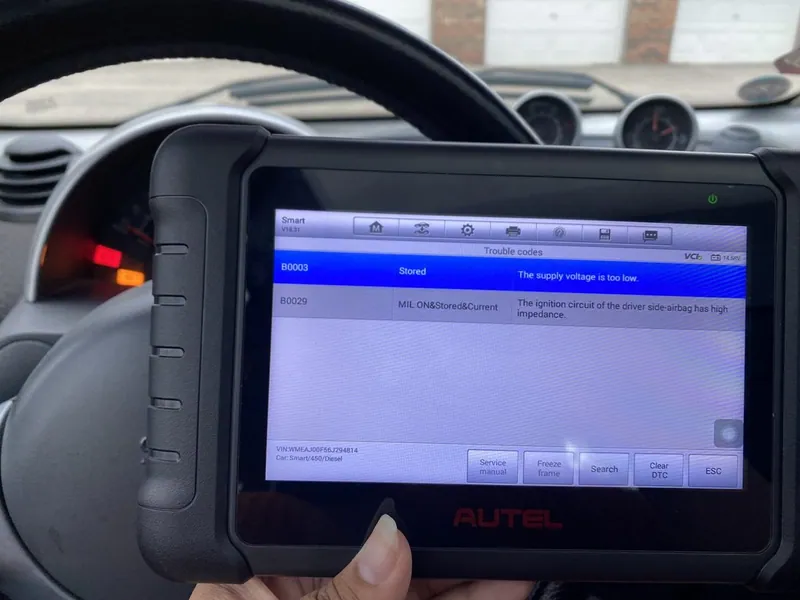
C1941 is a manufacturer-specific code. For Mitsubishi, it signals a communication failure with the Tire Pressure Monitoring System (TPMS) sensor for tire #4 ('Tire ID Reception Fail'). For Ford, it indicates a 'Zero Seat Weight Test Failure' in the passenger's Occupant Classification System (OCS), disabling the airbag. For Peugeot and Citroën, it points to a chassis control module (ABS/ESP) fault, often due to water ingress.
Technical definition: The Society of Automotive Engineers (SAE) assigns the meaning of C1941 by vehicle manufacturer. Common definitions include 'Tire ID Reception Fail' (Mitsubishi) and 'Zero Seat Weight Test Failure' (Ford). The code is stored in a chassis (C) or body (B) control module and requires an advanced bidirectional scanner to read and clear.
Can I Drive With C1941?
Yes, But With Caution. Driving is mechanically possible, but critical safety systems are disabled. A Ford airbag fault prevents passenger airbag deployment in a collision, drastically increasing injury risk. A Mitsubishi TPMS fault removes low-tire warnings, increasing blowout risk. An active airbag or TPMS light causes an automatic safety inspection failure in most jurisdictions.
Common Causes
- Dead TPMS Sensor Battery (Mitsubishi) (Very Common) — The integrated 3-volt lithium-ion battery inside the tire pressure sensor has a finite lifespan of 5-10 years. Once it dies, the sensor stops transmitting, triggering the code.
- Failed OCS Calibration or Obstruction (Ford) (Very Common) — The passenger seat weight sensor failed its self-test (zeroing procedure). This happens when an object (like a water bottle) is wedged under the seat, or if the seat was removed and reinstalled improperly, throwing off the calibration.
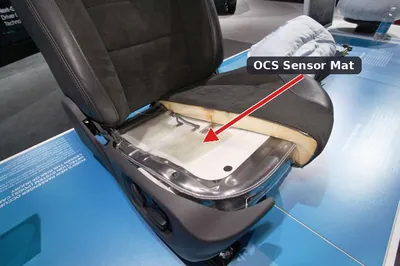
- Faulty Occupant Classification System (OCS) Sensor Mat (Ford) (Common) — The fluid-filled bladder or pressure sensor grid inside the passenger seat cushion has leaked or failed internally, making it permanently unable to measure weight or pass the self-test.
- Faulty TPMS Receiver or ECU (Mitsubishi) (Common) — On models like the Mirage, the control module (KOS/OSS-ECU) that receives the TPMS signal fails. Mitsubishi issued Technical Service Bulletins (TSBs) for this exact issue, noting sensors are often replaced needlessly.
- Wiring Damage or Water Ingress (All Makes) (Less Common) — Corrosion or a loose connection in the wiring harness interrupts the signal. This affects the under-seat OCS wiring on Fords, the TPMS receiver antenna on Mitsubishis, and the ABS pump connectors on Peugeots/Citroëns (often due to sunroof leaks).
- Radio Frequency (RF) Interference (Mitsubishi) (Rare) — Cheap aftermarket electronic devices, like phone chargers or dash cams plugged into a 12V outlet, emit radio frequencies that block the 315MHz or 433MHz TPMS sensor signal.
Symptoms

- Airbag Warning Light On (Ford) — A solid or flashing airbag warning light on the dashboard indicates the entire supplemental restraint system is disabled. 🎬 Watch: Troubleshooting Ford airbag light codes and common faults.
- TPMS Warning Light Flashing, Then Solid (Mitsubishi) — The TPMS light flashes for 60-90 seconds at startup and then stays on continuously. This specific sequence indicates a system fault, not just low tire pressure.
- Passenger Airbag Off Light Illuminated (Ford) — The 'Passenger Airbag Off' indicator stays lit regardless of whether someone is in the seat, confirming the system defaulted to a safe (off) state.
- ABS/ESP Warning Lights (Peugeot/Citroën) — The Anti-lock Brake System (ABS) or Electronic Stability Program (ESP) warning lights illuminate, pointing to a chassis system fault.
Diagnostic Flowchart

Tap your situation to follow the diagnostic path that matches what you're seeing on this code.
Common Fixes & Costs
- Perform OCS System Reset/Calibration (Ford) — Parts: $0, Labor: $100-$200, ~1.0 hr book time (Professional)
- Replace TPMS Sensor (Mitsubishi) — Parts: $30-$80, Labor: $50-$150, ~1.0 hr book time (Professional)
- Update or Replace TPMS Control Module (Mitsubishi) — Parts: $150-$500, Labor: $100-$200, ~1.5 hr book time (Professional)
- Replace Passenger Seat OCS Sensor (Ford) — Parts: $450-$800, Labor: $150-$300, ~2.5 hr book time (Professional)
- Repair Wiring or Clean Connectors — Parts: $10-$30, Labor: $150-$400, ~2.0 hr book time (Professional)
Used vs. New Parts: Buying Guide
When a used part is worth it: For a Mitsubishi TPMS sensor, a used OEM sensor from a low-mileage vehicle is a budget option, though battery life is unknown. For a Ford OCS sensor, using a used part is strictly prohibited due to extreme safety risks.
Donor-vehicle mileage cap: roughly under 30000 miles for the part to have meaningful remaining life.
Donor quality checklist:
- Verify the TPMS frequency (315MHz vs 433MHz) is an exact match.
- Avoid parts from vehicles with salvage titles or accident history.
- Check for physical damage or corrosion.
Decision logic:
- If The part is a Ford Occupant Classification System (OCS) sensor → Always buy new OEM. The safety risk and potential for calibration failure with a used part are too high.
- If The part is a Mitsubishi TPMS sensor and budget is tight → A used sensor is possible, but a new aftermarket sensor is inexpensive and provides a full lifespan.
- If The part is a control module (ECU) → Favor a new OEM part, as a used module requires reprogramming and may be locked to a different VIN.
Warranty tradeoff: Used parts offer a 30-90 day warranty. New aftermarket parts offer 1-year to lifetime warranties. New OEM parts carry a 1-2 year warranty.
Worst-case if a used part fails: $200-$500 if a used part fails, requiring repeat labor. For a safety component, the worst-case cost is severe injury in a collision.
What Happens If You Wait — Timeline
- Immediate: Ford: Passenger airbag is disabled. Mitsubishi: TPMS system is disabled. (MPG impact: 0%% · Added cost: $0)
- 1-3 months: Ford: Sustained high risk of passenger injury. Mitsubishi: An undetected slow leak lowers tire pressure, increasing rolling resistance. (MPG impact: 1-3% (Mitsubishi only)% · Added cost: $20-$60 in wasted fuel (Mitsubishi only).)
- 3-6 months: Ford: No change. Mitsubishi: Driving on underinflated tires causes accelerated, uneven tread wear. (MPG impact: 3-5% (Mitsubishi only)% · Added cost: $150-$300 (Cost of one prematurely worn tire).)
- 6+ months: Ford: Fails mandatory state safety inspection. Mitsubishi: Risk of a sudden tire blowout becomes critical, potentially causing an accident. (MPG impact: 5%+ (Mitsubishi only)% · Added cost: $500-$3000+ (Cost of accident repairs from a blowout).)
Cost of Not Fixing It
- Immediate: Ford: Passenger airbag is disabled, drastically increasing injury risk. Mitsubishi: TPMS is disabled, removing low tire pressure warnings. (Added cost: N/A)
- 0-6 months: Mitsubishi: Increased risk of a tire blowout from an undetected slow leak, leading to premature tire wear and reduced fuel economy. (Added cost: $150-$300 (Cost of a prematurely worn tire and wasted fuel).)
- At Next Inspection: Vehicle automatically fails state safety inspections due to an illuminated airbag or TPMS warning light. (Added cost: $50-$200 (Fines and re-inspection fees).)
Diagnosis Steps
- Identify Your Vehicle's System
Confirm the code's meaning for your specific make and model. Search your vehicle year/make/model and 'C1941' to verify if it relates to TPMS (Mitsubishi), Airbag/OCS (Ford), or Chassis (Peugeot/Citroën).
Tools: Internet access (Beginner) - Read Full Diagnostic Codes
Use an advanced OBD-II scanner to read manufacturer-specific codes from the Chassis (C) and Body (B) modules. Note all codes present in the Restraints Control Module (RCM) or Body Control Module (BCM).
Tools: Advanced OBD-II Scanner (Beginner) - Perform Physical Inspection
For Ford: Remove all objects from under the passenger seat, smooth out the floor mat, and check for pinched wires. For Mitsubishi: Unplug all aftermarket 12V accessories to eliminate RF interference. For Peugeot: Check the under-hood fuse box for water damage.
Tools: Flashlight (Beginner) - Check for Technical Service Bulletins (TSBs)
For Mitsubishi, search for TSBs (like TIN-19-31-001REV). These bulletins often direct technicians to update software or replace the receiver module instead of the tire sensor.
Tools: Internet access (Intermediate) - Test the TPMS Sensor (Mitsubishi)
Use a TPMS diagnostic tool to 'ping' the sensor in tire #4. If the tool gets no response, the sensor battery is dead. If it responds with pressure and battery data, the fault lies in the vehicle's receiver or wiring.
Tools: TPMS Diagnostic Tool (Intermediate) - Attempt an OCS System Reset (Ford)
Using a bidirectional scan tool, perform the 'OCS System Reset' or 'Zero Seat Weight Test'. The passenger seat must be completely empty, and system voltage must be 8V-18V. If this fails, you have a hard fault in the sensor or wiring.
Tools: Advanced OBD-II Scanner (Advanced) - Verify OCS Sensor Inputs (Ford)
Monitor the OCSM live data with a scan tool. With the seat empty, the sensor must show a stable value under 11 lbs. Place a 50lb weight on the seat. If the reading is erratic or stuck, the sensor mat is faulty.
Tools: Advanced OBD-II Scanner (Advanced) - OCS Sensor Resistance Test (Ford)
Disconnect the battery. Disconnect the OCS pressure sensor connector. Using a multimeter set to Ohms, measure resistance between the specified pins per the service manual. An open circuit (infinite resistance) or short (near zero) confirms a failed sensor.
Tools: Multimeter, Service Manual (Advanced)
When This Code Triggers (Freeze-Frame Conditions)
- System Voltage: 11.5-14.5V (Code sets during the module's power-on self-test; low voltage causes failure.)
- Vehicle Speed: 0 mph (Ford's OCS 'Zero Seat Weight Test' runs at startup when the vehicle is stationary.)
- Ambient Temperature: 42-97°F (6-36°C) (Ford's OCS calibration test fails if the cabin is too hot or cold.)
- Passenger Seat Status: Empty (Ford's OCS self-test requires the seat to be completely empty. An object on the seat causes it to fail.)
Related Codes
- C1911, C1921, C1931 (Mitsubishi) — These indicate 'Tire ID Reception Fail' for tires 1, 2, and 3. Seeing one of these confirms a TPMS issue. C1941 is specific to tire #4.
- B2290 (Ford) — Indicates a general 'Occupant Classification System Fault'. B2290 must be resolved before the C1941 calibration error can be cleared.
- C1940 (Mitsubishi) — Indicates 'Transmitter Battery Voltage Low' for tire #4. It appears before C1941, serving as a warning before complete communication failure.
- B00A0 (Ford) — A general OCS fault stored in the main Restraints Control Module (RCM). It is a secondary code confirming the primary C1941 issue.
Climate & Environmental Factors
- High Humidity / Water Exposure: Moisture ingress into electrical connectors causes corrosion and short circuits. This directly causes wiring failures in Ford's OCS, Mitsubishi's TPMS, and Peugeot's chassis modules.
- Extreme Heat: High temperatures accelerate the chemical degradation of the lithium-ion battery inside Mitsubishi TPMS sensors, causing premature failure.
How to Talk to a Mechanic About This Code
Say this: "I have a C1941 code. If it's a Ford: 'I have an airbag light with code C1941. Please check for obstructions under the passenger seat and attempt an OCS reset before quoting a sensor replacement.' If it's a Mitsubishi: 'I have a flashing TPMS light with code C1941. Please check for TSBs related to the KOS/OSS-ECU before replacing the tire sensor.'"
This steers the mechanic toward the cheapest fixes first for Ford, and flags a common misdiagnosis for Mitsubishi, preventing you from paying for unneeded parts.
Avoid saying:
- 'My airbag/TPMS light is on, can you fix it?'
- 'Just do whatever it takes to turn the light off.'
- 'I read online it's the sensor, just replace that.'
Questions to ask before authorizing the repair:
- For Ford: Did you confirm there are no obstructions and that the 'OCS System Reset' procedure fails before determining the sensor is bad?
- For Mitsubishi: Did you use a TPMS tool to confirm the sensor battery is dead? Did you check for TSBs regarding the receiver module?
- What is the warranty on this specific repair, covering both parts and labor?
Where to Take It: Dealer vs Independent vs Chain
- Dealer:
Recommended for Mitsubishi ECU issues and major Ford OCS part replacements.
Best for: Mitsubishi vehicles, due to TSBs pointing to ECU issues requiring factory software., Ford vehicles requiring OCS sensor mat replacement, as it demands mandatory calibration., Vehicles under warranty.
Downsides: Highest labor rates., May push for full part replacement rather than attempting a simple calibration. (Typical cost: +50% vs. baseline) - Independent Shop:
Excellent choice for Ford diagnosis and calibration-only fixes. Viable for Mitsubishi sensor swaps.
Best for: Ford vehicles, for attempting the 'OCS System Reset' if the shop has a bidirectional scanner., Diagnosing a dead TPMS sensor on a Mitsubishi.
Downsides: Shop must be equipped with modern, bidirectional scan tools., May not be aware of specific Mitsubishi TSBs. (Typical cost: +0% vs. baseline) - Chain Shop:
AVOID for initial diagnosis. Only use for a pre-diagnosed TPMS sensor swap.
Best for: Replacing a Mitsubishi TPMS sensor after you have independently confirmed it is the cause.
Downsides: Unlikely to have diagnostic capability for airbag systems or manufacturer-specific TSBs., Technicians lack training for complex electronic diagnosis. (Typical cost: -10% vs. baseline)
When to Walk Away From the Repair
If the estimated repair cost exceeds 40-50% of the car's private-party value, consider selling or trading it in as-is.
- Car worth $4000, fix is $1600: Walk away. The repair for a Ford OCS sensor mat is 40% of the car's value. Put this money toward a replacement vehicle.
- Car worth $12000, fix is $700: Fix it. A Mitsubishi ECU replacement at $700 is only 6% of the vehicle's value and restores a critical safety system.
- Car worth $5000, fix is $150: Fix it. A simple TPMS sensor replacement or Ford OCS calibration is well below the threshold.
What Scan Tool You Need for This Code
Minimum: A scanner that reads and clears SRS (Airbag) and Body/Chassis codes. Basic engine code readers will not see code C1941.
A standard $20 OBD-II reader only accesses Powertrain (P) codes. C1941 is a Chassis (C) code. Fixing a Ford requires a bidirectional scanner to perform the OCS reset, which basic readers lack.
Budget: BlueDriver Pro Scan Tool (~$100) — Reads and clears the C1941 code from the airbag/TPMS module. It CANNOT perform the Ford OCS reset procedure. Good for initial diagnosis only.
Mid-range: Foxwell NT510 Elite (~$150) — Reads/clears SRS/TPMS codes and shows live sensor data. With the correct vehicle software pack, it offers the 'OCS System Reset' bidirectional function for Ford.
Professional: Autel MaxiCOM MK808S (~$450) — Full bidirectional control. Guaranteed to perform the Ford 'OCS System Reset' and the Mitsubishi TPMS OBD-II relearn procedure. Provides comprehensive live data graphing.
Rent vs buy: Buy. Free loaner tools from auto parts stores are basic code readers that cannot access this code or perform the necessary reset functions.
How to Clear the Code After You Fix It
- For Ford, use a bidirectional scan tool to perform the 'OCS System Reset' function.
- For Mitsubishi, use a TPMS tool to perform the OBD-II relearn procedure to register the new sensor ID.
- Clear all related codes from the RCM, OCSM, and BCM.
- Cycle the ignition off and then on, and verify the warning light remains off.
Drive cycle (~15 minutes): For Mitsubishi, drive the vehicle for 15 minutes at speeds over 15 mph after a successful relearn. For Ford, a drive cycle is not required; the code clears immediately upon a successful scan tool reset.
Readiness monitors affected: Supplemental Restraint System (SRS), Tire Pressure Monitoring System (TPMS)
Watch out for:
- Assuming a Mitsubishi will 'auto-learn' a new TPMS sensor without a manual relearn procedure.
- Attempting the Ford OCS reset before fixing underlying faults (like code B2290), causing the reset to fail.
- Clearing the code with a scanner without performing the physical repair or calibration.
Will This Fail Emissions / State Inspection?
Yes — this code typically fails an OBD-II emissions inspection.
- California: An illuminated airbag or TPMS warning light is an automatic failure of the state safety inspection.
- New York: The NYVIP3 inspection checks for illuminated malfunction indicator lamps. An active airbag (SRS) light causes an automatic failure.
- Texas: An illuminated airbag warning light causes a safety inspection failure. Inspectors are also required to check the TPMS system.
Most Commonly Affected Vehicles
- Mitsubishi Mirage / Mirage G4 (2014-2021) — Notorious for C1941 due to a systemic issue with the TPMS receiver (KOS/OSS-ECU). TSBs TIN-19-31-001REVII and TIN-18-31-002 address this directly. North American models require a 315MHz sensor.
- Ford Escape (2008-2012) — The Occupant Classification System frequently fails the zero-weight calibration test. The reset procedure requires a specific scan tool command.
- Ford F-150 (2004-2018) — The passenger seat weight sensor (OCS mat) is a known failure point, triggering C1941. Replacement is a common and costly repair.
- Mitsubishi Outlander / Outlander Sport (2007-2020) — Frequently experience TPMS communication failures due to dead sensor batteries or ECU faults.
- Peugeot 3008 / 5008 (2009-2016) — C1941 relates to a chassis system fault, often pointing to a faulty yaw rate sensor or water ingress in the engine bay fuse box.
- Ford Focus (2012-2018) — Suffers from OCS sensor and calibration faults, requiring the same diagnostic process as the Escape and F-150.
Manufacturer-Specific Notes
- Mitsubishi: Do not immediately replace the TPMS sensor. TSBs (TIN-19-31-001REV) state the fault is frequently in the vehicle's receiver ECU (KOS/OSS-ECU), requiring a software update or module replacement.
- Ford: C1941 specifically flags a FAILED calibration test. The OCS System Reset procedure will fail if ambient temperature is outside 42°F-97°F (6°C-36°C) or if module voltage is outside 8V-18V.
- Mitsubishi: North American models generally require a 315MHz TPMS sensor, while some global parts are 433MHz. Installing the wrong frequency guarantees a C19xx code.
Real Owner Stories
2015 Mitsubishi Mirage at 75,000 miles - A Misdiagnosis Story
The TPMS light flashed then stayed solid. A tire shop scanned C1941 and replaced the sensor for tire #4 twice, but the light returned.
What they tried:
- Replaced the TPMS sensor with aftermarket parts.
- Took the car to a Mitsubishi dealer after finding TSBs online.
Outcome: The dealer followed TSB TIN-18-31-002 and determined the KOS/OSS-ECU (receiver) was faulty. Replacing and programming the ECU solved the problem. The sensor replacements were unnecessary.
Lesson: Do not automatically replace the sensor on a Mitsubishi with a C19xx code. The root cause is frequently the receiver ECU, as documented in service bulletins.
2011 Ford Escape at 110,000 miles - The Easy Fix
Airbag light came on intermittently. A mechanic pulled codes C1941 and B2290.
What they tried:
- Checked under the passenger seat and found a water bottle wedged against the OCS wiring harness.
Outcome: The owner removed the bottle. The mechanic cleared the codes and performed the 'OCS System Reset' with a scan tool. The light stayed off. Total cost was a $100 diagnostic fee.
Lesson: Always clear obstructions from under the Ford passenger seat before paying for diagnostic work or parts.
2016 Ford F-150 at 80,000 miles - An Expensive Repair
The airbag light and 'Passenger Airbag Off' light stayed illuminated. Diagnostics confirmed codes B00A0 and C1941.
What they tried:
- Took the truck to the dealership, who diagnosed a faulty OCS sensor mat inside the seat cushion.
Outcome: The dealer removed the seat, replaced the entire lower cushion containing the sensor, and performed the mandatory calibration. The final cost was $1,600.
Lesson: A hard fault in the Ford OCS sensor mat is an expensive, complex repair requiring a specific scan tool for recalibration. It is not a DIY job.
How to Prevent This Code From Triggering
- Keep the area under the passenger seat clear (Ford) (Monthly) — Prevents objects from pinching or damaging the sensitive OCS sensor wiring, which causes calibration failures.
- Apply dielectric grease to at-risk connectors (During related service) — Applying dielectric grease to connector seals blocks moisture, preventing the corrosion that leads to high resistance and fault codes.
- Avoid prolonged exposure to extreme heat (Mitsubishi) (Daily) — High temperatures dramatically shorten the life of the lithium-ion batteries inside TPMS sensors. Parking in the shade extends their lifespan.
- Proactively replace all TPMS sensors at once (Mitsubishi) (Every 7-10 years) — Sensor batteries have a similar lifespan. Replacing all four during a tire change saves on future labor costs and prevents repeat visits.
Frequently Asked Questions
Can I just ignore the C1941 code?
No. Ignoring it leaves a critical safety system disabled. On a Ford, the passenger airbag will not deploy in a crash. On a Mitsubishi, you lose low-tire warnings, increasing blowout risk.
Why did the C1941 code appear on my Ford after I detailed my car?
An object was likely left under the passenger seat, or the seat was moved in a way that pinched a wire. The system is highly sensitive, and any obstruction causes the weight sensor calibration to fail.
A tire shop replaced my TPMS sensor on my Mitsubishi, but the C1941 light came back. Why?
The shop likely failed to perform the mandatory OBD-II relearn procedure, or the root cause is the vehicle's receiver module (KOS/OSS-ECU) per Mitsubishi TSBs. Mitsubishi vehicles do not auto-learn new sensors.
What is the most common misdiagnosis for C1941?
For Mitsubishi, it is replacing the TPMS sensor when the receiver ECU is actually faulty. For Ford, it is replacing the expensive OCS sensor mat when the issue was merely an object wedged under the seat.
Can I use a used OCS sensor from a junkyard to fix my Ford?
Do not use a junkyard OCS sensor. Airbag components are safety-critical, and a used sensor risks calibration failure or non-deployment in a crash. Always install a new, specified OEM service kit.
Can a basic OBD-II scanner from an auto parts store read and clear this code?
No. C1941 is a chassis (C) code. Basic scanners only read powertrain (P) codes. You need an advanced scan tool that accesses the Body Control Module (BCM) or Restraints Control Module (RCM).
Why did my airbag light come on after a battery change?
Airbag modules are highly sensitive to voltage fluctuations. A weak battery or the process of disconnecting power causes the module to fail its self-test and store a fault code.
Key Takeaways
- Code C1941 indicates a disabled passenger airbag on Ford vehicles or a failed tire pressure sensor (Tire #4) on Mitsubishi vehicles.
- Clear all objects from under the Ford passenger seat before paying for diagnostics, as a trapped water bottle or floor mat causes the weight sensor calibration to fail.
- Check Mitsubishi Technical Service Bulletins (like TIN-19-31-001REV) before replacing a TPMS sensor, as the root cause is frequently a faulty receiver module requiring a $150-$500 replacement.
- Fixing C1941 requires a bidirectional scan tool costing over $400 to perform the mandatory Ford Occupant Classification System reset or the Mitsubishi TPMS OBD-II relearn procedure.
Helpful Videos
Shop the Parts Behind C1941
Below are the parts most often responsible for code C1941, ranked by how frequently each one is the actual culprit (per the diagnosis above). Tap any to see what we have for your vehicle.



The information in this article is provided for general reference and educational purposes only. Vehicle specifications, procedures, and part compatibility can vary by production date, trim level, and region. Always consult your vehicle's factory service manual and verify part numbers before purchasing or performing repairs. Safety-critical components such as airbags, seat belts, and braking systems should be installed by a qualified professional.
- 🧭 Diagnostic Flowchart
- 🎬 Helpful Videos
- 🛍️ Shop This Part
- What Does C1941 Mean?
- Can I Drive With C1941?
- Common Causes
- Symptoms
- Common Fixes & Costs
- Used vs. New Parts: Buying Guide
- What Happens If You Wait — Timeline
- Cost of Not Fixing It
- Diagnosis Steps
- When This Code Triggers (Freeze-Frame Conditions)
- Related Codes
- Climate & Environmental Factors
- How to Talk to a Mechanic About This Code
- Where to Take It: Dealer vs Independent vs Chain
- When to Walk Away From the Repair
- What Scan Tool You Need for This Code
- How to Clear the Code After You Fix It
- Will This Fail Emissions / State Inspection?
- Most Commonly Affected Vehicles
- Manufacturer-Specific Notes
- Real Owner Stories
- 2015 Mitsubishi Mirage at 75,000 miles - A Misdiagnosis Story
- 2011 Ford Escape at 110,000 miles - The Easy Fix
- 2016 Ford F-150 at 80,000 miles - An Expensive Repair
- How to Prevent This Code From Triggering
- Frequently Asked Questions
- Can I just ignore the C1941 code?
- Why did the C1941 code appear on my Ford after I detailed my car?
- A tire shop replaced my TPMS sensor on my Mitsubishi, but the C1941 light came back. Why?
- What is the most common misdiagnosis for C1941?
- Can I use a used OCS sensor from a junkyard to fix my Ford?
- Can a basic OBD-II scanner from an auto parts store read and clear this code?
- Why did my airbag light come on after a battery change?
- Key Takeaways
- 🎟️ Get 5% Off