

OBD-II Code C2020: ECU Internal Fault / Wheel Speed Sensor Circuit Performance
The Ultimate Guide to Diagnosing and Fixing Fault Code C2020
- Identify your vehicle's specific C2020 definition immediately; it means a generic 'Front Right Wheel Speed Sensor' fault on most cars, but signals a critical 'ECU Internal Fault' in the Drivetrain Control Module (DTCM) on Jeep and Fiat models.
- Fix 2015-2018 Jeep Renegade and Fiat 500X models by requesting a dealer software update per TSB 08-027-21, which costs $150-$250 and prevents unnecessary $1,000+ module replacements.
- Perform a 12V battery load test before buying any parts, as a voltage drop below 9.6V during engine cranking triggers false C2020 codes across multiple control modules.
- Diagnose generic C2020 codes by reading live scanner data to isolate the wheel reading 0 MPH, then visually inspect the sensor, wiring harness, and tone ring for physical damage.
What Does C2020 Mean?
Code C2020 has two distinct meanings depending on the manufacturer. The generic SAE definition indicates a performance issue in the front right wheel speed sensor circuit. However, for FCA vehicles (specifically Jeep and Fiat), this code—often appearing as C2020-01—flags an 'ECU Internal Fault' within the Drivetrain Control Module (DTCM). This means the computer controlling the 4x4/AWD system has detected an internal software or hardware error.
Technical definition: The generic SAE/OBD-II definition is "Front Right Wheel Speed Sensor Circuit — Range/Performance". Manufacturer-specific definitions override this. For Jeep, Fiat, and Chrysler, C2020-01 is defined as "ECU Internal Fault - General Electrical Failure". Another Jeep-specific definition, C2020-47, is "A or T Transmission Relay Circuit Malfunction". Always use a scan tool capable of reading manufacturer-specific sub-codes.
Can I Drive With C2020?
Yes, But With Caution. Driving is possible, but critical safety systems like ABS, traction control, and stability control are disabled. On specific vehicles like the Jeep Renegade, the All-Wheel Drive (AWD) system shuts down completely. Exercise extreme caution, as your vehicle's ability to prevent wheel lock-up and skids during hard braking is compromised, increasing stopping distances on wet or slippery surfaces. Continued driving is not recommended.
Common Causes
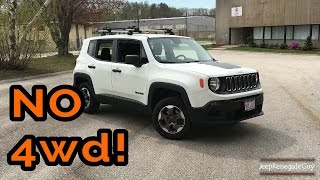
- Drivetrain Control Module (DTCM) software glitch (Jeep/Fiat) (Very Common) — On 2015-2018 Jeep Renegades and 2016-2018 Fiat 500X models, a software error within the DTCM incorrectly flags an internal fault, disabling the 4x4 system. This is a known issue addressed by Technical Service Bulletin (TSB) 08-027-21. 🎬 Watch: A Jeep owner's experience with the Service 4WD fix.
- Weak or failing 12V battery (Common) — Low system voltage during engine cranking triggers false electronic faults. Sensitive modules like the DTCM or ABS controller misinterpret the voltage drop as an internal failure or communication error, setting ghost codes like C2020.
- Failed wheel speed sensor (Common) — For non-FCA vehicles, the sensor measuring the front right wheel's rotational speed fails internally. This prevents it from sending a correct signal to the ABS module, disabling safety systems.
- Damaged or contaminated ABS tone ring (Common) — The toothed or magnetic ring read by the wheel speed sensor cracks, rusts, or accumulates metallic debris from brake wear. This disrupts the signal and causes erratic readings.
- Worn or failed wheel bearing/hub assembly (Less Common) — A worn wheel bearing introduces excessive play in the hub. This alters the critical air gap between the sensor and the tone ring, causing signal loss.
- Wiring or connector issues (Less Common) — The wiring harness leading to the wheel speed sensor frays, or connectors corrode and disconnect, leading to a lost or intermittent signal.
- Failing ABS or Drivetrain Control Module (Hardware) (Rare) — The DTCM or ABS module suffers an internal hardware failure from voltage spikes or water intrusion. This requires expensive module replacement and programming.
- Faulty Transfer Case Control Module (TCCM) (Rare) — On some 4WD vehicles, the module responsible for engaging the transfer case fails, triggering a 'Service 4WD' light and storing communication fault codes.
Symptoms
- 'Service 4WD' or 'AWD OFF' message — On affected Jeep and Fiat models, the all-wheel-drive system is disabled due to the DTCM fault.
- ABS light is on — The Anti-lock Braking System warning light illuminates, indicating the system is inactive. This is the primary symptom for a generic wheel speed sensor fault.
- Traction Control/Stability Control light is on — The warning light for the traction or stability control system (ESC, VSC) illuminates, as these systems rely on wheel speed sensor data.
- Cruise control disabled — Cruise control systems require accurate wheel speed data to maintain a set speed and shut down when a fault is present.
- Brake pedal pulsates at low speeds — A faulty sensor sends erratic data, causing the ABS module to activate unnecessarily at low speeds, resulting in a pulsating brake pedal.
Diagnostic Flowchart
Tap your situation to follow the diagnostic path that matches what you're seeing on this code.
Common Fixes & Costs
- Reprogram Drivetrain Control Module (DTCM) — Parts: $0, Labor: $150-$250, ~1.0 hr book time (Professional)
- Replace Battery — Parts: $150-$300, Labor: $0-$50, ~0.5 hr book time (DIY)
- Replace Wheel Speed Sensor — Parts: $40-$150, Labor: $100-$150, ~1.0 hr book time (DIY)
- Replace Wheel Hub Assembly — Parts: $100-$400, Labor: $150-$300, ~2.0 hr book time (Intermediate)
- Replace ABS/DTCM Control Module — Parts: $650-$1,200, Labor: $150-$250, ~2.0 hr book time (Professional)
Used vs. New Parts: Buying Guide
When a used part is worth it: For an expensive ABS or DTCM control module on an older, out-of-warranty vehicle, a used part from a reputable salvage yard offers significant savings. For a wheel speed sensor, buy new.
Donor-vehicle mileage cap: roughly under 100000 miles for the part to have meaningful remaining life.
Donor quality checklist:
- Part number must be an exact match to the original module.
- Verify the seller has a return policy or warranty (typically 30-90 days).
- Ensure the donor vehicle was not scrapped due to flood or fire damage.
- Confirm the used module can be reprogrammed; some are permanently VIN-locked.
Decision logic:
- If Part is a wheel speed sensor → Buy a new aftermarket part. Savings from a used part are minimal and not worth the risk.
- If Part is an ABS/DTCM module and vehicle is >10 years old → A used part from a trusted source with a warranty is a reasonable choice to save money.
- If Part is an ABS/DTCM module and vehicle is newer or under warranty → Buy a new OEM part to ensure compatibility and longevity.
Warranty tradeoff: Used parts typically offer a 30-90 day functional warranty. New aftermarket parts range from 1 year to a limited lifetime warranty. New OEM parts carry a 1-2 year warranty.
Worst-case if a used part fails: $500-$1000 if a used control module is faulty or cannot be programmed, requiring repeat labor and another replacement part.
What Happens If You Wait — Timeline
- 0-2 weeks: ABS and/or 'Service 4WD' light illuminates. Safety systems (ABS, traction control) are disabled. No other physical symptoms are noticeable. (MPG impact: 0%% · Added cost: $0)
- 1-3 months (if caused by a bad bearing): A faint humming or grinding noise begins, noticeable at certain speeds or when turning. The steering feels slightly looser. (MPG impact: 1-3%% · Added cost: $50-$150 in potential damage to the integrated hub if the bearing continues to wear.)
- 3-6 months (if caused by a bad bearing): The grinding noise becomes constant and loud, increasing with speed. A noticeable vibration is felt in the steering wheel. Tires show uneven wear. (MPG impact: 3-8%% · Added cost: $250-$700 as a simple sensor issue escalates to requiring a full hub assembly replacement.)
- 6+ months (if ignored completely): Catastrophic failure of the wheel bearing. The wheel seizes or separates from the vehicle, leading to a complete loss of control. (MPG impact: N/A% · Added cost: $2,000+ for repairs to the axle, suspension, and brakes.)
Cost of Not Fixing It
- Immediate: Loss of ABS, traction control, and stability control, resulting in a significantly higher risk of skidding and loss of control during emergency braking. (Added cost: Negligible parts cost, but immeasurable potential cost from an accident.)
- 1-6 months: If caused by a failing wheel bearing, continued driving causes further wear. A grinding noise develops, and the hub eventually fails completely. (Added cost: $250-$700 as a sensor-only repair escalates to a full hub assembly replacement.)
- 6+ months: Catastrophic failure of a neglected wheel bearing leads to the wheel separating from the vehicle while driving, causing a total loss of control. (Added cost: $2000+ for suspension repairs, plus potential for total vehicle loss.)
Diagnosis Steps
- Check for Manufacturer-Specific Definitions & TSBs
Use a scanner to pull the exact code with its suffix (e.g., C2020-01). For a 2015-2018 Jeep Renegade or Fiat 500X, TSB 08-027-21 confirms C2020-01 is a software issue fixed by a dealer reflash. Skipping this step leads to expensive, unnecessary part replacements.
Tools: Advanced OBD-II Scanner, Internet access (Beginner) - Test the Battery and Charging System
Ensure the battery is healthy before diagnosing any module. Resting voltage must be above 12.4V. Engine running voltage must be 13.7V-14.7V. A voltage drop below 9.6V during engine cranking triggers false faults in sensitive modules.
Tools: Multimeter or professional battery tester (Beginner) - Read Live Data with a Scan Tool
If not a known TSB issue, use a scanner to read live chassis data. Monitor the speed of all four wheels while driving slowly in a straight line. A sensor that shows 0 MPH, lags, or has an erratic reading is the culprit.
Tools: Advanced OBD-II Scanner (Intermediate) - Visual Inspection of Sensor, Wiring, and Tone Ring
Raise the vehicle and remove the wheel at the suspect corner. Inspect the sensor for physical damage. Follow the wiring harness to check for breaks, chafing, or corrosion. Examine the tone ring for cracks, rust buildup, or metallic debris.
Tools: Jack, jack stands, basic hand tools, flashlight (Intermediate) - Check Wheel Bearing Play
With the vehicle raised, grasp the tire at the 12 and 6 o'clock positions and rock it back and forth. Significant play or a grinding noise indicates a worn wheel bearing, which alters the sensor-to-ring air gap and causes signal loss.
Tools: Jack, jack stands (Intermediate) - PRO TIP: Test Active Sensor with a Multimeter (Voltage)
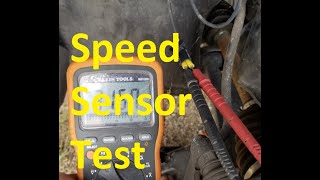
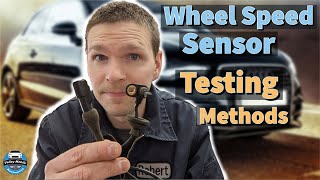
For modern 2-wire or 3-wire 'active' sensors: With the ignition ON, back-probe the power supply wire to verify reference voltage (typically 5V or >10.5V). Switch to AC voltage, back-probe the signal wire, and spin the wheel. You must see a fluctuating AC voltage (over 100mV) that increases with wheel speed. No voltage indicates a bad sensor or wiring.
Tools: Multimeter with back-probe pins (Advanced) - PRO TIP: Test Passive Sensor with a Multimeter (Resistance)
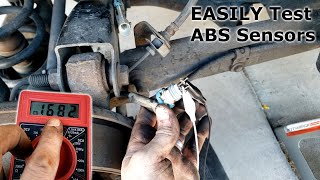
For older 'passive' sensors: Disconnect the sensor and measure resistance (Ohms). A good sensor reads between 800 and 1,700 Ohms (check service manual for exact specs). Infinite resistance (open) or near zero Ohms (short) confirms a failed sensor.
Tools: Multimeter, vehicle-specific service manual (Advanced) - PRO TIP: Analyze the Waveform with an Oscilloscope
Connect a lab scope to the sensor's signal and ground wires. A good active sensor produces a clean square wave pattern that increases in frequency as the wheel spins. Dropouts or inconsistent amplitude indicate a failing sensor or damaged tone ring.
Tools: Automotive Oscilloscope (Advanced) - Check CAN Bus Network Integrity
If multiple communication codes (U-codes) are present, disconnect the battery and measure resistance between CAN High (Pin 6) and CAN Low (Pin 14) at the OBD-II port. A healthy network reads 60 ohms. A reading of 120 ohms indicates a missing termination resistor or broken wire.
Tools: Multimeter, vehicle-specific wiring diagram (Advanced)
When This Code Triggers (Freeze-Frame Conditions)
- Vehicle Speed: 25-55 mph (The fault registers during steady-state driving when the ABS module compares signals from all four wheels and detects a discrepancy.)
- System Voltage: 9.5V - 15V (Triggered by low voltage (<10V) during engine crank, causing a false internal fault, or during normal operation (>12V) if a sensor signal is lost.)
- Engine RPM: 1500-2500 RPM (Corresponds to normal cruising speeds where sensor data is actively monitored.)
- Engine Coolant Temp: 175-215°F (Occurs when the vehicle is at normal operating temperature.)
Related Codes
- C2210-92 — On Jeep/Fiat models, this code for 'ETM Hall Sensor Performance' is frequently stored with C2020. Both are fixed by the DTCM software update (TSB 08-027-21).
- C2220-54 — Seen with C2020 on Jeeps, this 'ETM Calibration Error' points to the identical software issue in the 4x4 system requiring a DTCM reflash.
- C2502-64 — This 'Signal Plausibility Failure' code is another companion to C2020 in the relevant Jeep/Fiat TSBs, confirming a cluster of software-related drivetrain faults.
- C0037 — A generic code for a rear wheel speed sensor circuit fault. The diagnostic process is identical to the generic version of C2020.
- C2202 — This 'Original VIN Mismatch/Missing' code appears if you replace an ABS or DTCM module on FCA vehicles without reprogramming it to the new VIN.
Climate & Environmental Factors
- Cold Weather / Snow / Ice: Snow and ice pack around the wheel hub, physically blocking the sensor's view of the tone ring or infiltrating connectors, causing a temporary loss of signal.
- Humidity / Rain / Salt: Moisture and road salt accelerate corrosion on the sensor, wiring connectors, and tone ring. A rusted tone ring swells and cracks, interrupting the electrical signal.
How to Talk to a Mechanic About This Code
Say this: "I have an ABS/4WD light on and my scanner shows code C2020. If it's a Jeep/Fiat, I'd like you to first check for TSB 08-027-21 regarding a DTCM software update before replacing parts. For any other make, please start by testing the battery and checking live wheel speed sensor data to confirm the faulty corner."
This separates the two main causes of C2020. For Jeep/Fiat, it directs the shop to the cheapest fix, preventing unnecessary module replacement. For other cars, it establishes a logical diagnostic path.
Avoid saying:
- 'My ABS light is on, just fix it.' (Too vague, invites expensive guesses)
- 'I think I need a new ABS module.' (Don't suggest the most expensive fix first)
- 'Just do whatever you think is best.' (Cedes all control over the repair process)
Questions to ask before authorizing the repair:
- For a Jeep/Fiat: Did you confirm TSB 08-027-21 applies to this VIN, and can your shop perform the reflash?
- For a sensor replacement: Did you see the sensor fail in the live data? Did you inspect the tone ring and wiring for that corner?
- Can you show me the failed part?
- What is the warranty on this specific repair, covering both parts and labor?
Where to Take It: Dealer vs Independent vs Chain
- Dealer:
Required for the Jeep/Fiat software fix. For other vehicles, a good independent shop is more cost-effective.
Best for: 2015-2018 Jeep Renegade or Fiat 500X with code C2020-01, as they have the required wiTECH software for the TSB reflash., Vehicles still under warranty., Complex electrical issues where manufacturer-specific tools are required.
Downsides: Highest labor rates., May be unaware of the specific TSB and initially recommend a more expensive module replacement. (Typical cost: +50% vs. baseline) - Independent Shop:
Best choice for the generic wheel speed sensor version of the code. Not suitable for the specific Jeep/Fiat software issue unless they specialize in FCA and have a wiTECH subscription.
Best for: Diagnosing and replacing a faulty wheel speed sensor, wiring, or wheel hub on non-FCA vehicles., Out-of-warranty vehicles where cost is a major factor.
Downsides: Quality and diagnostic capabilities vary widely., Unlikely to have the subscribed wiTECH software needed for the specific Jeep/Fiat DTCM reflash. (Typical cost: +0% vs. baseline) - Chain Shop:
AVOID for diagnosis. Acceptable only for a simple battery swap after you confirm it is the root cause. Do not let them attempt sensor or module repairs.
Best for: Free or low-cost initial code scan., Simple battery replacement if a weak battery is diagnosed as the cause.
Downsides: Technician skill varies dramatically., Often lack the advanced diagnostic tools to read chassis codes or view live ABS data accurately., May not be able to source or replace wheel hub assemblies. (Typical cost: -10% vs. baseline)
When to Walk Away From the Repair
If the estimated repair cost exceeds 50% of the car's private-party value, seriously consider selling or trading in the vehicle.
- Car worth $8000, fix is $400: Fix it. This repair is a small fraction of the car's value.
- Car worth $4000, fix is $1500: Borderline. The repair is approaching the 50% threshold. Get a second opinion before proceeding.
- Car worth $2500, fix is $1800: Walk away. The repair cost is over 70% of the vehicle's value. It is not economically sensible to proceed.
What Scan Tool You Need for This Code
Minimum: A scanner that reads and clears ABS/Chassis ('C') codes and displays live data for individual wheel speed sensors.
A basic $20 engine-only code reader will not see ABS, traction control, or 4WD system codes like C2020. You need a tool that accesses the chassis control module.
Budget: BlueDriver Pro (~$100) — Reads and clears ABS codes, displays freeze-frame data, and graphs live wheel speed sensor data on your smartphone. Enough to diagnose the generic version of the fault.
Mid-range: Foxwell NT510 Elite (with FCA software) (~$180) — Provides deeper manufacturer-specific code details for Jeep/Fiat. Offers bi-directional control to perform active tests on the ABS system, confirming a diagnosis before buying parts.
Professional: Autel MaxiCOM MK808 / MK808S (~$500) — Offers full bi-directional control, including automated ABS brake bleeding. Performs deeper system diagnostics and resets helpful after a module or major component replacement.
Rent vs buy: Most auto parts stores offer free code scanning, but their tools may not read ABS codes. If you plan to do your own repairs, buying a tool like the BlueDriver is a worthwhile investment.
How to Clear the Code After You Fix It
- Fix the underlying mechanical or electrical issue.
- Use an OBD-II scan tool to erase the C-prefix trouble code from the ABS/DTCM module.
- Perform a complete drive cycle to allow the system to self-test and confirm the repair.
Drive cycle (~30 minutes): 1) Cold start and idle for 2-3 minutes. 2) Drive a mix of city speeds (25-45 mph) with several slow, complete stops. 3) Accelerate to highway speed (55-60 mph) and maintain for 5-10 minutes. 4) Safely decelerate to a stop and idle for 1-2 minutes before shutting down.
Readiness monitors affected: Catalyst Monitor, Evaporative System Monitor, Oxygen Sensor Monitor
Before emissions retest: drive at least 100 miles to fully set monitors.
Watch out for:
- Clearing the code without a repair results in the code returning immediately.
- Disconnecting the battery clears the code but resets all emissions readiness monitors, causing an automatic smog test failure.
Will This Fail Emissions / State Inspection?
No — by itself this code doesn't fail OBD inspection (but it can keep readiness monitors from setting, which causes a separate fail).
- California: An illuminated ABS light will NOT fail a smog check. The inspection only checks the Check Engine Light and powertrain-related codes ('P' codes).
- New York: An illuminated ABS light causes the vehicle to fail the annual safety inspection, which is required to keep the vehicle registration valid.
- Texas: An illuminated ABS warning light is an automatic failure of the annual safety inspection.
Most Commonly Affected Vehicles
- Jeep Renegade (2015-2018) — Extremely common for C2020-01 to signify a DTCM software glitch. The fix is a dealer reflash per TSB 08-027-21.
- Fiat 500X (2016-2018) — Shares the same platform and DTCM as the Jeep Renegade and suffers from the identical software fault addressed by TSB 08-027-21.
- Chrysler Pacifica (2017-2021) — Known for sensitive electronics where ABS/stability control faults arise from module communication issues or wiring problems.
- Dodge Grand Caravan (2012-2020) — Prone to ABS module failures due to water intrusion from a specific ground wire, highlighting the electrical vulnerability of FCA ABS systems.
- Ram 1500 (2019-2022) — Frequent 'Service 4WD' messages caused by faulty shift actuators or control modules, similar in effect to the C2020 issue on Jeeps.
- Hyundai Santa Fe (2019-2022) — Noted for wheel speed sensor and wheel bearing failures that trigger ABS and traction control warnings.
- Honda CR-V (2017-2020) — Prone to a cascade of warning lights traced back to a failing battery rather than a specific sensor failure.
- Ford F-150 (2015-2020) — Experiences multiple communication errors along with ABS faults, triggered by low battery voltage during engine start.
Manufacturer-Specific Notes
- Jeep / Fiat: For 2015-2018 Renegade and 2016-2018 500X models, code C2020-01 is a software bug in the Drivetrain Control Module (DTCM). The fix is a dealer-only software reflash with wiTECH (TSB 08-027-21). This is a repair directive, not a recall, so owners pay for labor if out of warranty.
- Chrysler / Dodge / Ram: Control modules, including the ABS and DTCM, are VIN-locked. Installing a used module without reprogramming sets a C2202 'VIN Mismatch' code and disables the system.
- Land Rover: Uses the C2- series of chassis codes for highly specific faults. For example, C2003 indicates an implausible signal from a wheel speed sensor, differing from generic definitions.
- General (Modern Vehicles): A weak battery causes a momentary voltage drop during engine start-up that triggers a cascade of communication and internal fault codes across ABS, Airbag, and Power Steering modules.
Real Owner Stories
2017 Jeep Renegade with 'Service 4WD' light
At 50,000 miles, the 'Service 4WD' light stayed on. Scan showed code C2020-01, plus C2210-92 and C2220-54.
What they tried:
- Took the vehicle to an independent shop that recommended replacing the DTCM module for over $1,000.
- Owner declined the repair and went to a Jeep dealership for a second opinion.
Outcome: The Jeep dealer recognized the cluster of codes, referenced TSB 08-027-21, and performed a software reflash of the DTCM. The total cost was $180 for one hour of labor. The codes did not return.
Lesson: For 2015-2018 Jeep Renegades or Fiat 500X models, C2020-01 with other C22xx codes is almost certainly the software glitch described in TSB 08-027-21. Do not replace the module before getting a dealer software update.
2012 Ford Fusion with ABS and Traction Control lights
At 110,000 miles, the ABS and traction control lights illuminated after hitting a pothole. The brake pedal pulsated at very low speeds.
What they tried:
- An advanced scanner identified a code for the front right wheel speed sensor circuit.
- The owner replaced the front right wheel speed sensor ($50 part), but the lights remained on.
Outcome: The owner removed the wheel again and closely inspected the hub. The ABS tone ring, integrated into the wheel bearing, was cracked. Replacing the entire front wheel hub assembly ($150 part + $200 labor) resolved the issue.
Lesson: A wheel speed sensor code doesn't always mean the sensor itself is bad. Always inspect the tone ring for cracks, rust, or debris before replacing parts. Physical impacts damage the ring or bearing.
2018 Honda CR-V with multiple warning lights
A cascade of warning lights appeared at 65,000 miles, including 'Brake System Problem,' ABS, traction control, and power steering warnings. The vehicle hesitated to start.
What they tried:
- Took the vehicle to an auto parts store for a free battery test as a first step.
Outcome: The original 4-year-old battery failed the load test, dropping under 9.0V. After replacing the battery ($220), all warning lights disappeared. Low voltage during cranking caused multiple control modules to report false internal errors.
Lesson: Before diagnosing any complex electronic fault, always test the battery. A weak battery is a very common cause of 'ghost' codes in modern vehicles.
How to Prevent This Code From Triggering
- Periodically clean battery terminals and ensure connections are tight. (Every 6-12 months or during oil changes.) — Prevents corrosion that causes poor connections, leading to low system voltage and triggering false electronic fault codes in sensitive modules.
- Inspect and clean ABS tone rings during brake service. (Whenever wheels are off for brake replacement or tire rotation.) — Metallic brake dust and road grime accumulate on magnetic tone rings, disrupting the sensor's signal. Cleaning the ring prevents false ABS faults.
- Inspect wheel speed sensor wiring for security and condition. (During brake service or underbody inspection.) — Ensuring the harness is properly secured and insulation is intact prevents chafing or breaks that cause an open or shorted circuit.
- Replace your 12V battery proactively. (Every 4-5 years, regardless of symptoms.) — An aging battery fails load tests, causing voltage drops that create a cascade of difficult-to-diagnose electronic errors.
- Drive the vehicle regularly for at least 20-30 minutes. (At least once a week.) — Short trips prevent the alternator from fully recharging the battery, leading to a gradual decline in charge and increasing voltage-related fault codes.
Frequently Asked Questions
Why does my Jeep say 'Service 4WD' with code C2020?
On affected Jeep models, C2020 indicates the Drivetrain Control Module (DTCM) detected an internal fault and disabled the 4WD system. For 2015-2018 models, this is a known software glitch fixed by a dealer update.
Is it safe to drive with the ABS and traction control lights on?
You can drive, but your anti-lock braking and traction control systems are disabled. Your wheels will lock up during a hard stop, increasing the risk of skidding and losing steering control. It is highly discouraged in poor weather.
Can I fix a C2020 code myself?
If it is a bad wheel speed sensor or dirty tone ring, it is a manageable DIY repair with basic tools. However, if your Jeep or Fiat has the specific DTCM fault, it requires a software update only a dealer or equipped shop can perform.
My mechanic replaced the wheel speed sensor, but the light is still on. What now?
First, test the battery, as low voltage causes persistent electronic codes. Second, inspect the ABS tone ring on the wheel hub for damage or debris. Finally, check the wiring between the sensor and the module for breaks.
Can a weak battery really cause my 'Service 4WD' and ABS lights to come on?
Yes. Modern vehicles have interconnected electronic modules highly sensitive to voltage. A voltage drop during engine start triggers false internal fault codes in modules like the DTCM and ABS controller.
How much does it cost to fix code C2020?
Costs vary by cause. A Jeep/Fiat software update is $150-$250, while replacing a wheel speed sensor costs $140-$300. Wheel hub assemblies range from $250-$700, and full module replacements exceed $1,000.
Will clearing the code make it go away?
Clearing the code with a scanner only provides a temporary fix. If the underlying hardware or software fault remains, the module re-runs its self-test and the code returns within a single drive cycle.
What is a tone ring and how does it cause an ABS light?
A tone ring is a notched or magnetic ring mounted on the axle or wheel hub. The wheel speed sensor reads it to calculate wheel speed. If the ring cracks or rusts, the sensor sends an erratic signal, triggering the ABS warning light.
Key Takeaways
- Identify your vehicle's specific C2020 definition immediately; it means a generic 'Front Right Wheel Speed Sensor' fault on most cars, but signals a critical 'ECU Internal Fault' in the Drivetrain Control Module (DTCM) on Jeep and Fiat models.
- Fix 2015-2018 Jeep Renegade and Fiat 500X models by requesting a dealer software update per TSB 08-027-21, which costs $150-$250 and prevents unnecessary $1,000+ module replacements.
- Perform a 12V battery load test before buying any parts, as a voltage drop below 9.6V during engine cranking triggers false C2020 codes across multiple control modules.
- Diagnose generic C2020 codes by reading live scanner data to isolate the wheel reading 0 MPH, then visually inspect the sensor, wiring harness, and tone ring for physical damage.
Helpful Videos

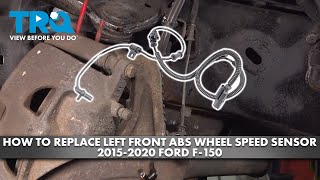
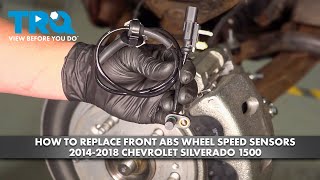
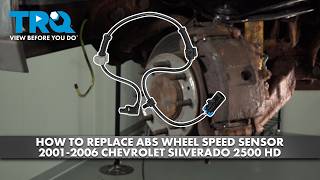
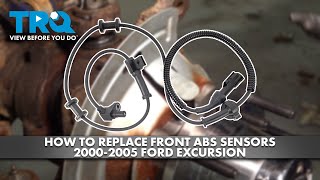
Shop the Parts Behind C2020
Below are the parts most often responsible for code C2020, ranked by how frequently each one is the actual culprit (per the diagnosis above). Tap any to see what we have for your vehicle.



The information in this article is provided for general reference and educational purposes only. Vehicle specifications, procedures, and part compatibility can vary by production date, trim level, and region. Always consult your vehicle's factory service manual and verify part numbers before purchasing or performing repairs. Safety-critical components such as airbags, seat belts, and braking systems should be installed by a qualified professional.
- 🧭 Diagnostic Flowchart
- 🎬 Helpful Videos
- 🛍️ Shop This Part
- What Does C2020 Mean?
- Can I Drive With C2020?
- Common Causes
- Symptoms
- Common Fixes & Costs
- Used vs. New Parts: Buying Guide
- What Happens If You Wait — Timeline
- Cost of Not Fixing It
- Diagnosis Steps
- When This Code Triggers (Freeze-Frame Conditions)
- Related Codes
- Climate & Environmental Factors
- How to Talk to a Mechanic About This Code
- Where to Take It: Dealer vs Independent vs Chain
- When to Walk Away From the Repair
- What Scan Tool You Need for This Code
- How to Clear the Code After You Fix It
- Will This Fail Emissions / State Inspection?
- Most Commonly Affected Vehicles
- Manufacturer-Specific Notes
- Real Owner Stories
- 2017 Jeep Renegade with 'Service 4WD' light
- 2012 Ford Fusion with ABS and Traction Control lights
- 2018 Honda CR-V with multiple warning lights
- How to Prevent This Code From Triggering
- Frequently Asked Questions
- Why does my Jeep say 'Service 4WD' with code C2020?
- Is it safe to drive with the ABS and traction control lights on?
- Can I fix a C2020 code myself?
- My mechanic replaced the wheel speed sensor, but the light is still on. What now?
- Can a weak battery really cause my 'Service 4WD' and ABS lights to come on?
- How much does it cost to fix code C2020?
- Will clearing the code make it go away?
- What is a tone ring and how does it cause an ABS light?
- Key Takeaways
- 🎟️ Get 5% Off