

OBD-II Code C2374: ABS Hydraulic Valve Fault
The Ultimate Guide to What C2374 Means, Why It Triggers, and How to Fix It
- Stop driving immediately; C2374 disables your ABS and stability control, and on 2007-2019 Hyundai/Kia models, indicates a severe engine fire risk.
- Check your VIN for free dealer repairs before spending money; Hyundai/Kia have active fire recalls (23V-651/652) and Mercedes offers a 25-year unlimited mileage warranty on SBC units.
- Test the ABS module's ground connection and verify resistance is under 0.5 ohms before condemning the $1,500+ hydraulic unit.
- Choose a $150-$600 remanufacturing service for your original ABS module instead of buying a new OEM part to avoid expensive VIN-programming fees.
What Does C2374 Mean?
C2374 is a manufacturer-specific Chassis ('C') code indicating a severe electrical or hydraulic fault within the vehicle's anti-lock brake control module assembly. The system's computer, known as the Hydraulic Electronic Control Unit (HECU) or ABS module, performs a self-test and detects that a specific internal solenoid valve is not responding to commands. This failure immediately disables crucial safety features like ABS, traction control, and stability control, triggering warning lights on your dashboard.
Technical definition: While the exact definition varies by manufacturer, C2374 universally points to an internal ABS module failure. For Hyundai and Kia, it is defined as 'Electronic Shuttle Valve Secondary (HSV2) Error,' indicating the electrical feedback from a valve does not match the actuation signal sent by the controller. For Mercedes-Benz with Sensotronic Brake Control (SBC), the code is commonly 'Hydraulic Fault: Rear Left Outlet Control Valve (A7/3y11),' pinpointing a specific valve within the high-pressure SBC unit. In all cases, the module condemns itself during a self-diagnostic routine.
Can I Drive With C2374?
No — Do Not Drive. Do not drive. A C2374 code signifies a critical fault in your braking system. Your Anti-lock Braking System (ABS) and stability/traction control are disabled, dramatically increasing the risk of skidding and losing control. On Hyundai/Kia models, this fault links directly to a recall for engine compartment fires that ignite even when the vehicle is parked. On Mercedes-Benz models with SBC, a severe fault triggers a red 'Stop Vehicle' warning and a near-total loss of braking power. Continued driving is a severe safety risk.
Common Causes
- Internal failure of the ABS hydraulic control unit (HECU/SBC) (Very Common) — This is the primary cause. The electronic module or the hydraulic valve block fails internally due to worn components, cracked solder joints, or a burnt-out pump motor. On Hyundai/Kia models, internal seals degrade, allowing brake fluid to leak onto the circuit board, causing a short and creating a severe fire risk.
- Blown ABS fuse or faulty relay (Common) — A blown fuse or a bad relay cuts power to the ABS pump or module, preventing operation and triggering a fault code. This is the easiest and cheapest component to check during initial diagnosis.
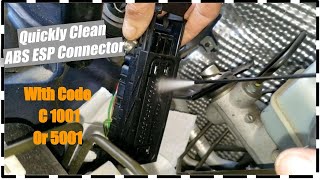
- Poor Ground Connection for the ABS Module (Common) — The ABS module requires a perfect ground to operate. Corrosion, looseness, or damage at the main chassis ground point causes voltage drops that disrupt the module's sensitive self-diagnostics, forcing it to incorrectly log internal fault codes like C2374. 🎬 See how to properly clean a corroded ABS ground connection.
- Rusted and Leaking Brake Lines (Common) — Particularly on Mercedes-Benz models in rust-prone areas, a corroded brake line develops a pinhole leak, causing a loss of hydraulic pressure to a specific brake caliper. The SBC control module detects this inability to build pressure as a valve fault, triggering C2374.
- Corroded or damaged wiring harness (Less Common) — The wiring harness connected to the ABS module sits in a harsh environment. Heat, moisture, and road debris cause corrosion on the connector pins or physical damage to the wires, leading to a loss of signal.
- Contaminated or incorrect brake fluid (Less Common) — Moisture-contaminated brake fluid causes internal corrosion of the delicate solenoid valves within the hydraulic unit. Using a fluid without the specified low viscosity (e.g., standard DOT 4 vs DOT 4 LV) slows valve response time, failing the module's self-test.
Symptoms
- ABS, Traction Control, and Brake Warning Lights On — The car's computer detects a critical fault and disables these safety systems, illuminating the corresponding warning lights on the dashboard immediately.
- Brake Pedal Feels Abnormal (Spongy, Hard, or Low) — Internal hydraulic issues change the feel of the brake pedal. It feels soft and 'spongy' due to air or internal leaks, or excessively hard if there is a blockage. On Mercedes SBC systems, a hard pedal with reduced braking is a primary symptom.
- Wheels Lock Up or Brakes Pull During Hard Braking — Without a functioning Anti-lock Braking System, applying heavy brake pressure causes wheels to lock completely, resulting in a loss of steering control. A malfunctioning valve also causes the vehicle to pull sharply to one side during braking.
- Audible Buzzing or Pump Noise from Engine Bay — The ABS pump motor runs continuously or makes a buzzing sound even when the car is off. This indicates a stuck relay or an internal short in the control module, which quickly drains the vehicle's battery.
Diagnostic Flowchart
Tap your situation to follow the diagnostic path that matches what you're seeing on this code.
Common Fixes & Costs
- Remanufacture/Repair Existing ABS Module — Parts: $150-$400, Labor: $200-$400, ~2.5 hr book time (Professional)
- Replace ABS Hydraulic Control Unit/Module with New OEM Part — Parts: $1200-$2800, Labor: $250-$500, ~2.5 hr book time (Professional)
- Clean and Secure ABS Module Ground Connection — Parts: $1-$10, Labor: $75-$150, ~1 hr book time (Beginner)
- Replace Blown ABS Fuses or Relays — Parts: $5-$30, Labor: $50-$100, ~0.5 hr book time (Beginner)
- Replace Rusted/Leaking Brake Line(s) — Parts: $50-$200, Labor: $200-$500, ~3.5 hr book time (Intermediate)
Used vs. New Parts: Buying Guide
When a used part is worth it: A used ABS module is a budget-friendly option for older vehicles where a new part is cost-prohibitive. It makes sense only if sourced from a reputable seller providing a warranty and confirming the donor vehicle's non-faulty status.
Donor-vehicle mileage cap: roughly under 100000 miles for the part to have meaningful remaining life.
Donor quality checklist:
- Match the part number exactly. Do not rely on make and model alone.
- Source from a dry, salt-free climate to avoid units with corrosion.
- Avoid parts from flood-damaged or fire-damaged cars.
- Be prepared for programming. Most used modules are VIN-locked and require professional reprogramming.
Decision logic:
- If Vehicle is a Hyundai/Kia under recall or a Mercedes with the 25-year SBC warranty → Go to the dealer first. The repair is likely free.
- If Budget allows and you want a long-term, hassle-free solution → Buy a new OEM part or have your original unit professionally remanufactured.
- If Vehicle is over 10 years old and budget is the primary concern → A used part is viable, but factor in the cost of programming ($100-$300) and the risk of premature failure.
Warranty tradeoff: Used parts typically come with a 30-90 day warranty. Remanufactured units often carry a 1-year to lifetime warranty. New OEM parts installed by a dealer usually have a 1-2 year warranty.
Worst-case if a used part fails: $300-$600 if a used part is dead on arrival, covering repeat labor for removal/reinstallation and bleeding.
What Happens If You Wait — Timeline
- 0-1 week: ABS, ESC, and Brake warning lights illuminate. The C2374 code is stored. The ABS and stability control systems are fully disabled. (MPG impact: 0%% · Added cost: $0)
- 1 week - 2 months: High risk of collision. The driver experiences a wheel lock-up or skid during an emergency stop. For Hyundai/Kia, the internal short-circuit begins, causing an intermittent parasitic battery drain. (MPG impact: 0%% · Added cost: $200 (new battery) to $5,000+ (accident deductible))
- 2-6 months: For Hyundai/Kia, the risk of an engine compartment fire becomes severe. The internal short overheats and ignites, even when parked. For Mercedes SBC, the warning transitions to a red 'Stop Vehicle' warning, severely reducing braking power. (MPG impact: 0%% · Added cost: $2,500 (cost of module replacement) to $25,000+ (total loss of vehicle due to fire))
- 6+ months: Catastrophic failure. A vehicle fire occurs, or a complete failure results in near-total loss of braking ability. The continuously running pump motor burns itself out. (MPG impact: 0%% · Added cost: Total vehicle loss or cost of a major collision.)
Cost of Not Fixing It
- Immediate: Loss of ABS, traction control, and stability control. This significantly increases the risk of skidding and losing control in an emergency stop. (Added cost: Varies (Cost of an accident))
- 0-3 Months: For Hyundai/Kia models, continued driving carries a severe risk of the ABS module short-circuiting and causing an engine compartment fire, even when parked. (Added cost: Total loss of vehicle ($5,000 - $25,000+))
- 3+ Months: On Mercedes SBC systems, ignoring the warning leads to a red 'Stop Vehicle' warning and severely reduced stopping power. A continuously running ABS pump motor drains the battery and burns out the pump. (Added cost: $200 (new battery) to $2800+ (full module replacement))
Diagnosis Steps
- Scan for All Codes with a Professional Scan Tool
Use an advanced scan tool capable of reading manufacturer-specific 'C' (Chassis) codes. Confirm C2374 is present and document any other codes (e.g., U0121 for communication loss), as they dictate the diagnostic path.
Tools: Advanced Bidirectional Scan Tool (Intermediate) - Inspect ABS Fuses and Relays
Locate the fuse box using the owner's manual. Find all fuses related to the ABS and ESC systems, including large-amperage fuses for the pump motor. Visually inspect and test each fuse for continuity. A blown fuse indicates an electrical short.
Tools: Fuse puller, Multimeter (Beginner) - Test ABS Module Power and Ground Circuits
Disconnect the ABS module connector. With a multimeter, check for battery voltage (12.0-12.6V) at all power supply pins. Check for resistance between each ground pin and a clean chassis ground. A perfect ground reads less than 0.5 ohms. Higher resistance requires immediate repair of the ground connection.
Tools: Multimeter, Vehicle-specific wiring diagram, Back-probe kit (Advanced) - Inspect Brake Fluid and Check for Leaks
Ensure the brake fluid is clean and at the correct level. Thoroughly inspect all four wheels, the master cylinder, the ABS module, and the full length of the underbody for fluid leaks. A leak prevents the module from holding pressure, mimicking an internal fault.
Tools: Flashlight, Jack, Jack Stands (Beginner) - Perform an ABS Pump Activation Test
Using a bidirectional scan tool, command the ABS pump motor to activate. If the pump does not run, and you have confirmed good power and ground in Step 3, the ABS module/pump assembly is internally faulty.
Tools: Advanced Bidirectional Scan Tool (Advanced) - [PRO TIP] Perform a Parasitic Draw Test on the HECU Fuse
For suspected internal shorts on Hyundai/Kia models, disconnect the battery and set a multimeter to read amperage in series. Wait 5 minutes for modules to sleep. If the total draw exceeds 50mA, remove the main ABS/HECU fuse. If the draw drops significantly, the HECU is internally shorted and requires replacement.
Tools: Multimeter with milliamp/microamp function, Fuse puller (Professional) - [ADVANCED] Analyze Live Data from Pressure Sensors
For Mercedes-Benz models with SBC, monitor live data from the pressure sensors within the SBC unit. With the engine running, reservoir pressure holds steady between 90 and 110 bar. If pressure cannot build or drops rapidly, it confirms an internal hydraulic leak or failing pump.
Tools: Advanced Bidirectional Scan Tool (e.g., STAR/Xentry) (Advanced)
When This Code Triggers (Freeze-Frame Conditions)
- Vehicle Speed: 5-15 mph (The fault logs during the ABS module's low-speed self-test, occurring the first time the vehicle reaches a slow speed after startup.)
- System Voltage: 12.0-14.5V (The code sets during normal operating voltage; a stable voltage is required for the self-test to run.)
- Brake Pedal Status: Off (The initial self-test that flags this internal fault runs without any driver input to the brake pedal.)
- Engine State: Running (The code sets while the engine is running and the vehicle is in motion as part of active diagnostic checks.)
Related Codes
- C0110 — Means 'ABS Pump Motor Circuit Failure.' It often appears alongside C2374. If a bidirectional pump test fails but valve tests pass, C0110 is the primary issue. If both fail, the entire module assembly is faulty.
- U0121 — Means 'Lost Communication With ABS Control Module.' If you have U0121, the module is completely offline. Diagnosis must focus on checking power, grounds, and CAN bus wiring. With C2374, the module is online and reporting its own fault.
- C233D — A Mercedes-Benz specific code for a fault in the rear left inlet control valve. Seeing this alongside C2374 (outlet valve fault) strongly indicates a general failure in that specific hydraulic circuit within the SBC unit.
- C1095 — A common Ford code for 'ABS Hydraulic Pump Motor Circuit Failure'. While Ford does not use C2374, this code points to the same type of failure: a faulty ABS module assembly requiring identical diagnostic steps.
Climate & Environmental Factors
- High Humidity / Moisture: Brake fluid absorbs moisture from the air. High humidity accelerates this process, introducing water that corrodes internal ABS valve components from the inside out.
- Road Salt (Winter Climates): Road salt creates a highly corrosive brine that attacks steel brake lines, causing pinhole leaks that trigger hydraulic faults. It also corrodes the ABS module's chassis ground connection, leading to high electrical resistance.
- Extreme Cold: In very cold temperatures, aged brake fluid becomes more viscous. This slows the mechanical reaction time of the solenoid valves inside the ABS module, causing the self-test to fail and log a fault code.
How to Talk to a Mechanic About This Code
Say this: "I have an ABS light on and a C2374 code. Before replacing the module, please verify good power and a clean ground (under 0.5 ohms) at the module connector and perform a visual inspection for brake fluid leaks. For my Hyundai/Kia, please check for the HECU fire recall. For my Mercedes, please check if this is covered under the 25-year SBC warranty."
This signals you are an informed customer. It directs them to perform critical, inexpensive diagnostic steps first, preventing immediate costly module replacement. It holds them accountable for checking free recall repairs.
Avoid saying:
- 'My ABS light is on, can you fix it?'
- 'The car is braking funny.'
- 'Just do whatever it takes to get the light off.'
Questions to ask before authorizing the repair:
- What was the specific resistance reading on the ABS module's ground circuit?
- Did you find any evidence of external fluid leaks or a parasitic battery draw from the ABS fuse?
- If the module needs replacement, is it a new, used, or remanufactured part, and what is the warranty?
- Does the replacement module require programming to my car's VIN, and is that included in the quote?
- Have you confirmed with the dealer that this repair is not covered by the Hyundai/Kia fire recall or the Mercedes SBC warranty?
Where to Take It: Dealer vs Independent vs Chain
- Dealer:
First stop for Hyundai/Kia and affected Mercedes models to check for free repairs. If not covered, get their quote and compare with an independent specialist.
Best for: Hyundai/Kia vehicles to check for HECU fire recall coverage., Mercedes-Benz W211/R230/W219 vehicles to check for 25-year SBC warranty coverage., Complex programming of a new module.
Downsides: Highest labor rates and part costs if not covered by warranty/recall., Defaults to expensive full-assembly replacement over targeted repairs. (Typical cost: +60% vs. baseline) - Independent Shop:
Best choice for out-of-warranty repairs, especially if using a remanufactured module. Ensure they have a bidirectional scan tool for the ABS bleed procedure.
Best for: Out-of-warranty vehicles where cost is a major factor., Diagnosing external causes like bad grounds or leaking brake lines., Installing customer-supplied remanufactured parts.
Downsides: Quality varies; seek a shop specializing in electrical diagnostics., May lack proprietary tools for programming new modules on recent models. (Typical cost: +0% vs. baseline) - Chain Shop:
AVOID. This is not a simple parts-swap repair. The risk of misdiagnosis is extremely high.
Best for: Simple brake jobs like pads and rotors (unrelated to this code).
Downsides: Technicians lack advanced diagnostic training for complex electrical faults., Not equipped with bidirectional scan tools needed for ABS bleeding., High pressure to sell parts leads to misdiagnosis. (Typical cost: -10% vs. baseline)
When to Walk Away From the Repair
If the estimated repair cost exceeds 50% of the car's private-party market value, seriously consider selling the car as-is or trading it in.
- Car worth $4500, fix is $2800: Walk away. The repair cost is over 60% of the car's value. The financial risk is too high.
- Car worth $12000, fix is $850: Fix it. A remanufactured module repair at less than 10% of the vehicle's value is a sound investment.
- Car worth $7000, fix is $2800: Borderline. The repair is 40% of the car's value. Get a second opinion and explore the cost of a remanufactured unit before deciding.
What Scan Tool You Need for This Code
Minimum: A scanner that reads and clears manufacturer-specific Anti-lock Braking System (ABS) codes. A basic engine-only code reader will NOT see the C2374 code.
A standard $20 OBD-II reader only communicates with the Engine Control Module for emissions codes. C2374 is a Chassis code stored in the ABS module.
Budget: BlueDriver Pro (~$100) — Reads and clears ABS codes, allowing you to confirm C2374 is present. Lacks the bidirectional control needed for advanced testing and bleeding.
Mid-range: Foxwell NT630 Plus / Autel MaxiCheck Pro (~$150) — The sweet spot for DIY. Has full ABS code reading and the essential bidirectional control to perform an 'Automated Bleed' procedure required after replacing the hydraulic unit.
Professional: Autel MaxiCOM MK808 / Launch X431 series (~$450-600) — Provides full bidirectional control to activate individual pumps and solenoids. Supports module programming and coding necessary when installing a new OEM module.
Rent vs buy: Rent for reading the code, but BUY for the repair. A free rental scanner from an auto parts store will NOT have the bidirectional ABS bleed function required to complete the repair.
How to Clear the Code After You Fix It
- Reconnect the battery if it was disconnected for the repair.
- Use an advanced OBD-II scan tool to navigate to the Chassis/ABS menu and clear the C2374 fault code.
- Perform the automated brake bleed procedure with the scan tool if the hydraulic unit was replaced or opened.
- Perform a verification drive cycle to confirm the fix.
Drive cycle (~20 minutes): Start the vehicle and idle for 1 minute. Drive forward, accelerating to at least 15-20 mph to allow the ABS module to complete its self-test. Drive for 10-15 minutes, incorporating both city and steady-speed driving. The ABS light remains off if the repair is successful.
Readiness monitors affected: This is a Chassis code and does not directly affect emissions readiness monitors.
Before emissions retest: drive at least 50 miles to fully set monitors.
Watch out for:
- Disconnecting the battery does not clear a hard fault like C2374 and will not fix the underlying issue.
- Forgetting to perform the scan tool-activated brake bleed procedure leaves air in the system, leading to a spongy pedal.
- The code returns immediately upon the first self-test if the mechanical or electrical fault is not repaired.
Will This Fail Emissions / State Inspection?
No — by itself this code doesn't fail OBD inspection (but it can keep readiness monitors from setting, which causes a separate fail).
- California: An ABS light will NOT cause a failure of the California Smog Check, which is only concerned with emissions.
- New York: An illuminated ABS warning light is currently an advisory and not cause for rejection during the safety inspection, though legislation may change this.
- Texas: An illuminated ABS warning light is explicitly listed as NOT a cause for rejection in the state's safety inspection procedure.
Most Commonly Affected Vehicles
- Hyundai Various (Elantra, Santa Fe, Tucson, Genesis) (2007-2018) — Numerous Hyundai models are affected by recalls (NHTSA 23V-651) for ABS modules that internally short circuit, posing a fire risk even when parked. Owners must park outside until the recall fix is performed.
- Kia Various (Sorento, Sportage, Optima, Soul) (2010-2019) — Kia recalled millions of vehicles (NHTSA 23V-652) for HECU modules that leak internally, short circuit, and cause fires. Park away from structures until the recall is completed.
- Mercedes-Benz E-Class (W211) (2003-2009) — These models use the Sensotronic Brake Control (SBC) system. Mercedes extended the warranty on the SBC hydraulic unit to 25 years/unlimited miles in the US, which covers internal valve faults.
- Mercedes-Benz SL-Class (R230) (2003-2012) — Equipped with the SBC system and covered by the 25-year extended warranty on the hydraulic unit.
- Mercedes-Benz CLS-Class (W219) (2006-2011) — Based on the W211 E-Class platform, using the same problematic SBC brake system. Included in the 25-year SBC warranty extension.
- Hyundai Genesis (BH, DH) (2009-2016) — Subject to recalls where internal corrosion of the HECU leads to an electrical short. The 2015-2016 models were part of a major class-action lawsuit.
- Kia Sorento (XM) (2011-2015) — Specifically named in major safety recalls for HECU modules that short circuit and cause fires.
- Kia K900 (2016-2018) — Recalled for HECU internal short circuits. The recall fix involves replacing the original 40A fuses with lower-amperage fuses to prevent overcurrent.
Manufacturer-Specific Notes
- Hyundai / Kia: The C2374 code links directly to massive safety recalls for fire risk (NHTSA 23V-651 and 23V-652). The HECU develops an internal brake fluid leak that shorts the circuit board, causing a fire even with the ignition off. Owners must park outside until the dealer performs the recall service.
- Mercedes-Benz: On W211, R230, and W219 models with SBC, the hydraulic unit is covered by a 25-year, unlimited mileage warranty in the U.S. If a dealer confirms an internal SBC fault code like C2374, the unit is replaced free of charge. Service on these high-pressure systems requires a specialized scan tool to deactivate.
- General Motors (Chevrolet / GMC): GM vehicles do not use the C2374 code but suffer from an extremely common failure of the Electronic Brake Control Module (EBCM) with identical symptoms. The equivalent GM codes are C0265 or C0110.
- Ford: Ford vehicles do not use code C2374. Their equivalent ABS module failures generate codes like C1095 or U0121. Diagnosis follows the same principles: check fuses, power, and grounds before condemning the unit.
Real Owner Stories
2005 Mercedes E55 AMG - The 'Best Case' Scenario
The owner received a red 'Brake - Visit Workshop' warning on the dashboard. A scan revealed SBC internal fault codes.
Outcome: The dealership replaced the entire SBC hydraulic unit free of charge under the 25-year unlimited mileage warranty.
Lesson: If you own an affected Mercedes model (W211, R230, W219), your first step for an SBC fault is contacting a dealer with your VIN. The repair is highly likely to be free.
2013 Hyundai Elantra - The Parasitic Draw Misdiagnosis
ABS and ESC lights came on, and the battery died if the car sat for more than a day. The C2374 code was present.
Outcome: A specialized shop performed a parasitic draw test and isolated a 300mA draw to the ABS module fuse. Pulling the fuse stopped the drain, confirming an internal short in the HECU. The module was remanufactured for $250, solving both the lights and the battery drain.
Lesson: A parasitic battery drain appearing with a C2374 code is a classic sign of an internally shorted HECU on Hyundai/Kia models. Insist on a parasitic draw test focused on the ABS fuse before replacing batteries or alternators.
2004 Mercedes E-Class - An External Cause
Owner experienced a soft brake pedal and an SBC warning light. A scan showed code C2374 related to the rear left hydraulic circuit.
Outcome: The mechanic found a heavily corroded rear brake line with a pinhole leak. The SBC unit was functioning perfectly but logged a fault because it could not build pressure. The brake line was replaced, fixing the issue for a fraction of the cost of a new module.
Lesson: Do not automatically assume C2374 is a failed module. A thorough visual inspection of all brake lines for leaks is a critical first step.
How to Prevent This Code From Triggering
- Flush brake fluid every 2 years or 30,000 miles (Every 2 years) — Brake fluid absorbs moisture from the air. This water contamination causes internal corrosion of the ABS module's delicate solenoid valves, leading to seizure and faults like C2374.
- Use the correct specification brake fluid (e.g., DOT 4 LV) (Every brake fluid service) — Modern ESC/ABS systems require low-viscosity (LV) fluids. Using a standard, thicker fluid slows valve response times in cold weather, causing the module's self-test to fail.
- Perform an automated ABS bleed procedure during fluid flushes (Every 2 years (with flush)) — A standard bleed leaves old, contaminated fluid trapped in the ABS module. Using a scan tool to cycle the pump and valves during the flush purges all old fluid, ensuring the longevity of internal components.
- Wash the vehicle's undercarriage regularly in winter (Monthly in winter climates) — Road salt creates a corrosive brine that attacks steel brake lines and electrical ground points. Washing the undercarriage prevents brake line leaks and poor ground connections that trigger ABS faults.
Frequently Asked Questions
Is it safe to drive with code C2374?
No, it is not safe. Your primary safety systems (ABS, traction control) are offline, and Hyundai/Kia models face a documented engine fire risk even when parked. Mercedes owners risk a dangerous loss of braking power, requiring immediate inspection.
What is the most common mistake when diagnosing C2374?
The most expensive mistake is replacing the ABS module without ruling out external electrical faults. Technicians must verify the module has a stable 12V power supply and a solid ground connection under 0.5 ohms resistance. A corroded ground wire frequently mimics an internal module failure.
Can I just reset the C2374 code?
You can clear the code with a scan tool, but it will return immediately upon the next self-test. C2374 indicates a 'hard fault' detected by the module's internal diagnostics, not a temporary glitch. You must repair the underlying mechanical or electrical failure.
My Mercedes has a C2374, is the repair free?
It is often free for affected Mercedes models (E-Class W211, SL-Class R230, CLS-Class W219). Mercedes-Benz USA extended the warranty on the SBC hydraulic unit to 25 years with unlimited mileage. However, this warranty does not cover external triggers like rusted brake lines.
How much does it cost to fix code C2374?
If not covered by a recall or warranty, replacing the ABS module with a new OEM part costs $1,800 to $3,000 at a dealership. A more affordable option is remanufacturing your original module for $400 to $800 including labor. Simple fixes like repairing a ground wire cost $75 to $150.
What is a HECU?
HECU stands for Hydraulic Electronic Control Unit, the computer and valve block that controls anti-lock brakes and stability control. It consists of an electronic control board, an electric pump, and hydraulic solenoid valves. These components work together to modulate brake pressure to each wheel during an emergency.
Why do Hyundai and Kia say to park outside due to this issue?
The defect in millions of Hyundai and Kia ABS/HECU modules causes an electrical short that ignites engine compartment fires. Because the module receives constant battery power, this fire can start hours or days after the vehicle is parked. Parking outside prevents a potential vehicle fire from burning down your home.
What brake fluid should I use?
Always consult your owner's manual, but most modern cars with electronic stability control require DOT 4 Low Viscosity (LV) brake fluid. Using standard, thicker DOT 4 fluid slows the reaction time of the ABS module's internal valves. This delayed response triggers self-test failures and logs fault codes, especially in cold weather.
Key Takeaways
- Stop driving immediately; C2374 disables your ABS and stability control, and on 2007-2019 Hyundai/Kia models, indicates a severe engine fire risk.
- Check your VIN for free dealer repairs before spending money; Hyundai/Kia have active fire recalls (23V-651/652) and Mercedes offers a 25-year unlimited mileage warranty on SBC units.
- Test the ABS module's ground connection and verify resistance is under 0.5 ohms before condemning the $1,500+ hydraulic unit.
- Choose a $150-$600 remanufacturing service for your original ABS module instead of buying a new OEM part to avoid expensive VIN-programming fees.
Helpful Videos


Shop the Parts Behind C2374
Below are the parts most often responsible for code C2374, ranked by how frequently each one is the actual culprit (per the diagnosis above). Tap any to see what we have for your vehicle.


The information in this article is provided for general reference and educational purposes only. Vehicle specifications, procedures, and part compatibility can vary by production date, trim level, and region. Always consult your vehicle's factory service manual and verify part numbers before purchasing or performing repairs. Safety-critical components such as airbags, seat belts, and braking systems should be installed by a qualified professional.
- 🧭 Diagnostic Flowchart
- 🎬 Helpful Videos
- 🛍️ Shop This Part
- What Does C2374 Mean?
- Can I Drive With C2374?
- Common Causes
- Symptoms
- Common Fixes & Costs
- Used vs. New Parts: Buying Guide
- What Happens If You Wait — Timeline
- Cost of Not Fixing It
- Diagnosis Steps
- When This Code Triggers (Freeze-Frame Conditions)
- Related Codes
- Climate & Environmental Factors
- How to Talk to a Mechanic About This Code
- Where to Take It: Dealer vs Independent vs Chain
- When to Walk Away From the Repair
- What Scan Tool You Need for This Code
- How to Clear the Code After You Fix It
- Will This Fail Emissions / State Inspection?
- Most Commonly Affected Vehicles
- Manufacturer-Specific Notes
- Real Owner Stories
- 2005 Mercedes E55 AMG - The 'Best Case' Scenario
- 2013 Hyundai Elantra - The Parasitic Draw Misdiagnosis
- 2004 Mercedes E-Class - An External Cause
- How to Prevent This Code From Triggering
- Frequently Asked Questions
- Is it safe to drive with code C2374?
- What is the most common mistake when diagnosing C2374?
- Can I just reset the C2374 code?
- My Mercedes has a C2374, is the repair free?
- How much does it cost to fix code C2374?
- What is a HECU?
- Why do Hyundai and Kia say to park outside due to this issue?
- What brake fluid should I use?
- Key Takeaways
- 🎟️ Get 5% Off