

C3239 on 2018-2024 Lincoln Navigator: Not a Trouble Code (FPCM Connector Explained)
C3239 is not a fault code for the Lincoln Navigator; it is a connector part number for other Ford vehicles. If your Navigator has a no-start or stalling issue, the problem is likely a poor connection at the Fuel Pump Control Module (FPCM), which is a known issue covered by manufacturer TSBs.
- C3239 is not a trouble code for a Lincoln Navigator. It is a part number for a connector on a Ford Explorer.
- Stalling or no-start issues on a 2018-2024 Navigator are very likely caused by a poor electrical connection at the Fuel Pump Control Module (FPCM), located on the driver's side frame rail.
- Before replacing any parts like the fuel pump or the module itself, always inspect, clean, and securely reseat the FPCM connector (C433/C4033) and check its grounds (G403/G406) as per multiple Ford TSBs.
- This is a well-documented issue across several Ford T3 platform vehicles, including the Ford Expedition, F-150, and Transit.
What's Unique About the 2018-2024 Lincoln NAVIGATOR
While the Lincoln Navigator does not use the 'C3239' designator, it is built on the Ford T3 platform and shares a similar FPCM electrical system design with other Ford vehicles, making it susceptible to the exact same problem: a poor connection at the Fuel Pump Control Module. Ford TSBs identify the equivalent FPCM connectors on the Navigator as C433 or C4033. The underlying issue of intermittent power to the fuel pump due to a faulty connector is a known problem across this platform, affecting a range of Ford trucks and SUVs.
Diagnostic Flowchart
Tap your situation to follow the diagnostic path that matches what you're seeing on this vehicle.
Symptoms You May Notice
- Engine cranks but does not start
- Sudden engine stalling, especially while driving
- Intermittent loss of power or hesitation during acceleration
- Check engine light with fuel-related codes (e.g., P0627, P008A, U0109)
- Long crank time before the engine starts.
- Failure of the Auto Start-Stop feature to restart the engine after a stop.
- Replacing the Fuel Pump Control Module (FPCM) without first inspecting its connector and ground. The TSBs explicitly advise checking the connections before replacing any components.
- Replacing the in-tank fuel pump. While a fuel pump can fail, the symptoms of an intermittent FPCM connection are often identical, and the connector issue is a more common and cheaper initial diagnostic step.
Most Likely Causes
- Loose or Improperly Seated FPCM Connector 🔴 High Probability The FPCM is located on the frame rail, exposing its connector to significant vibration and potential moisture, which can cause it to become loose or not fully seated over time. This is the primary issue highlighted in multiple manufacturer TSBs.
How to confirm: Locate the FPCM on the driver's side frame rail, often above the spare tire. Visually inspect and physically check if the main electrical connector (C433/C4033) is fully seated and locked. A click should be heard when it is properly connected.
Typical fix: Disconnect the battery, then un-plug and re-plug the connector several times to clean the contacts. Ensure it clicks firmly into place. Applying dielectric grease can help prevent future moisture intrusion.
Est. part cost: $0-$10 for dielectric grease. - Damaged or Corroded Pins in FPCM Connector 🟡 Medium Probability Due to its exposed location under the vehicle, the connector is susceptible to water intrusion and road salt, leading to corrosion (often green or white) on the electrical pins and terminals, causing intermittent connectivity.
How to confirm: With the connector unplugged, inspect the male and female pins for any signs of green or white corrosion, black marks from arcing, or physical damage like bent or pushed-out pins.
Typical fix: If corrosion is minor, it can be cleaned with an electrical contact cleaner and a small brush. If pins are damaged or corrosion is severe, the connector pigtail must be replaced. This involves cutting the old connector off and splicing the new one in, using heat-shrink butt connectors for a durable repair.
Est. part cost: $30-$80 for a pigtail connector kit. - Loose or Corroded FPCM Ground Connection ⚪ Low Probability The ground wire for the FPCM is bolted directly to the steel frame. Over time, rust and corrosion can form at this connection point, creating high resistance and preventing the module from functioning correctly. TSB SSM 52483 specifically calls out grounds G403 and G406 for inspection on the Navigator.
How to confirm: Follow the wiring from the FPCM to locate its ground points on the frame (G403/G406). Check if the connection is tight and free of rust.
Typical fix: Remove the ground bolt, clean the terminal and the frame mounting point to bare metal with a wire brush, apply dielectric grease to prevent future corrosion, and securely re-fasten the bolt.
Est. part cost: $0-$5 for cleaning supplies.
Rare But Worth Checking
- BCM Software Issue:
Diagnosis Steps
- Confirm the symptoms: Crank/no-start, stalling, or intermittent power loss.
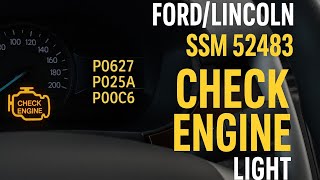
- Scan for DTCs. Look for codes like U0109, P0627, P025A, P00C6, or P008A, as mentioned in TSB SSM 52483.
- Safely raise the rear of the vehicle and locate the Fuel Pump Control Module (FPCM) on the driver's side frame rail, typically above the spare tire.
- Disconnect the negative battery terminal.
- Inspect the main FPCM electrical connector (Navigator uses C433/C4033). Check if it is fully seated. Unplug it and inspect all pins and terminals for corrosion (green/white powder), moisture, or damage (bent/pushed-out pins).
- Trace the wiring from the FPCM to its ground points on the frame (G403/G406). Ensure the ground bolts are tight and the connections are clean and free of rust.
- If the connector appears clean and undamaged, reseat it firmly until it clicks. Consider applying dielectric grease to the seal 🎬 Watch: How to fix common Ford and Lincoln fuel connector issues to prevent future water intrusion.
- If the connector or pins are damaged, the pigtail will need to be replaced. This requires cutting and splicing wires.
- Reconnect the battery and re-test. If the problem persists after confirming the connector and grounds are perfect, the FPCM itself may be faulty and require testing with a multimeter for power 🎬 See how to check the fuel module when there's no power and ground signals before replacement.
Parts You'll Likely Need
- Fuel Pump Control Module Connector Pigtail
(OEM #GU5Z-14S411-TA (Motorcraft WPT-1293))— Required if the original connector or its pins are corroded or damaged beyond cleaning. This part number appears to be a common service pigtail for this application, but always verify with VIN.
Trusted brands: Motorcraft, Dorman, Standard Motor Products
OEM price range: $40-$80
Aftermarket price range: $30-$60 - Fuel Pump Control Module (FPCM)
(OEM #JL1Z-9D370-B)— This part should only be replaced after confirming the connector and ground connections are in perfect condition. It is often misdiagnosed as the primary failure. Verify part number with VIN before ordering.
Trusted brands: Motorcraft
OEM price range: $100-$180
Aftermarket price range: $70-$120
Related Codes That Often Appear With This One
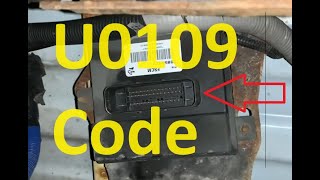
- U0109 — This code means 'Lost Communication With Fuel Pump Control Module,' which directly points to the electrical connection issue between the PCM and the FPCM. 🎬 Watch: Diagnosing and fixing the U0109 lost communication code
- P0627 — This code means 'Fuel Pump 'A' Control Circuit Open,' indicating a break in the electrical circuit powering the fuel pump, often caused by a loose or corroded connector pin.
- P008A — This code means 'Low Pressure Fuel System Pressure - Too Low,' which is a direct symptom of the fuel pump not receiving consistent power from the FPCM.
- P025A — This code, 'Fuel Pump Module Control Circuit/Open', is also explicitly mentioned in TSBs related to this issue.
Technical Service Bulletins (TSBs) & Recalls
- SSM 52483: The most comprehensive bulletin. Advises checking the FPCM connector (C433/C4033 on Navigator) and grounds (G403/G406) before replacing parts for a list of fuel system DTCs including U0109 and P0627.
- SSM 51306: Recommends confirming the FPCM connector is fully seated prior to diagnostics for similar issues.
- SSM 49618: Similar to SSM 51306, emphasizes checking the FPCM connector seating for DTCs P025A and U0109.
- SSM 50661: Repeats the guidance to check the FPCM connector before performing diagnostics or replacing any components.
Platform-Specific Known Issues
- Ford has issued multiple Technical Service Bulletins (SSM 52483, SSM 51306, etc.) acknowledging that a poor connection at the FPCM connector is a common cause of no-start, stalling, and various fuel system DTCs on 2018-2024 Navigators and other models.
- Owners on forums for the Navigator and its platform-mate, the Ford Expedition, frequently discuss stalling and no-start issues that are ultimately traced back to this FPCM connector, validating the TSBs.
Mechanic-Grade Diagnostic Values
- FPCM Power Supply Voltage — expected: 10-12 Volts (or battery voltage) with key in 'ON' position. Failure: 0 Volts indicates a problem with the fuse, relay, or wiring supplying power to the module.
- FPCM Ground Circuit Continuity — expected: Near zero ohms of resistance between the ground pin on the connector and a clean spot on the vehicle frame.. Failure: High or infinite resistance (OL) indicates a broken or corroded ground wire or a poor connection at the ground point (G403/G406).
- PCM to FPCM Control Signal (FPC) — expected: A duty cycle percentage signal, not a simple on/off voltage.. Failure: An absent or incorrect duty cycle signal can indicate a wiring or PCM issue.
Scan Tool Commands That Help
- Ford IDS (or equivalent professional scan tool): CAN Bus Monitor / Bi-directional Controls — A scan tool with bidirectional capability is needed to command the fuel pump on/off manually, which helps isolate the problem. It can confirm if the FPCM is capable of receiving commands from the PCM and activating the fuel pump, separating a module/pump failure from a wiring or PCM command issue.
Wiring & Ground Locations
- FPCM (Fuel Pump Control Module) — On the driver's side (LH) rear frame rail, located above the spare tire.. This is the central component in question. Its exposed location makes its connector and grounds susceptible to corrosion and vibration, which is the root cause of the issue.
- C433 / C4033 — The main electrical connector that plugs into the FPCM.. This is the primary point of failure identified in TSB SSM 52483. Intermittent connection, pushed-out pins, or corrosion here directly causes codes like U0109.
- G403 / G406 — The primary ground points for the FPCM, bolted to the vehicle's frame near the module.. TSB SSM 52483 specifically instructs technicians to inspect these grounds. A loose or corroded ground connection at these points will prevent the FPCM from operating correctly, mimicking a failed module.
- Fuel Pump Fuse — In the engine compartment fuse box (Power Distribution Box). The exact fuse number can vary by year.. A blown fuse will cut all power to the FPCM, leading to a no-start and communication codes like U0109. This should be checked before replacing any components.
Real Owner Repair Stories
- Ford Expedition Forum user @kbrad12 (2018 Ford Expedition Max) — Stalling while driving, particularly upon acceleration after cruising for over 30 minutes. The dash would go into accessory mode. It would restart after waiting about 5 minutes.
❌ Tried (didn't work) Replaced the fuel rail pressure sensor., Wiring was resealed and cleaned.
✅ What actually fixed it The issue was finally resolved after the dealer replaced the fuel pump module (FPCM). - Carly forum user @robinschwarz5 (2020 Ford Expedition) — Check engine light on, engine randomly stalls at idle, and fuel level sensor fault codes stored.
❌ Tried (didn't work) Initial diagnosis focused on a faulty fuel level sensor and its connections.
✅ What actually fixed it The problem was a simple blown fuse. Replacing the fuse resolved all symptoms.
OEM Part Supersession History
GU5Z-14S411-TA (Motorcraft WPT-1293)→No specific supersession found.
Heads up: WPT-1293 is a generic Motorcraft connector pigtail used for various applications like throttle position sensors and MAP sensors on many Ford vehicles. While commonly used by technicians for this FPCM repair, it is not officially listed in parts catalogs for this specific application, so visual confirmation of the connector style is crucial before ordering.
Model Year Variations Within This Range
- 2018-2024: The TSBs list the FPCM connector for the Navigator/Expedition as 'C433/C4033'. It is not specified which model years use which connector, suggesting they may be visually similar but have slight differences. Technicians should visually inspect the existing connector before ordering a replacement pigtail.
Helpful Videos
Used OEM Parts in Stock
New Aftermarket Parts Available


The information in this article is provided for general reference and educational purposes only. Vehicle specifications, procedures, and part compatibility can vary by production date, trim level, and region. Always consult your vehicle's factory service manual and verify part numbers before purchasing or performing repairs. Safety-critical components such as airbags, seat belts, and braking systems should be installed by a qualified professional.
- Lincoln NAVIGATOR:
- 🧭 Diagnostic Flowchart
- 🎬 Helpful Videos
- 🛍️ Shop This Part
- What's Unique About the 2018-2024 Lincoln NAVIGATOR
- Symptoms You May Notice
- Most Likely Causes
- Rare But Worth Checking
- Diagnosis Steps
- Parts You'll Likely Need
- Related Codes That Often Appear With This One
- Technical Service Bulletins (TSBs) & Recalls
- Platform-Specific Known Issues
- Mechanic-Grade Diagnostic Values
- Scan Tool Commands That Help
- Wiring & Ground Locations
- Real Owner Repair Stories
- OEM Part Supersession History
- Model Year Variations Within This Range
- 🎟️ Get 5% Off