

C3613 Connector Fault on 2017-2021 Ford F-350 SD: DEF System Failures and Fixes
On 2017-2021 Ford F-350s, 'C3613' refers to an electrical connector, not a trouble code. Its failure, caused by water intrusion, triggers DEF system warnings and codes like P21CD or U02A2. The fix is to inspect for corrosion and replace the reductant wiring harness (HC3Z-14407-A) and potentially the DEF pump/heater assembly, as outlined in Ford TSB 23-2161.
- C3613 is a connector name, not a fault code. Its failure is a well-documented weak point on 2017-2022 Ford Super Duty trucks.
- The root cause is water intrusion leading to corrosion, which triggers various DEF system warnings and DTCs.
- The official fix, per Ford TSB 23-2161, is to replace the reductant wiring harness (HC3Z-14407-A) and inspect the DEF pump, not just clean the connector.
- Do not use dielectric grease on the connector, as Ford warns against it for this specific repair.
- The issue will put the truck into a speed-limited limp mode, requiring an urgent repair.
What's Unique About the 2017-2021 Ford F-350 SD

The 2017-2021 Super Duty platform places the C3613 connector in a location on the chassis that is vulnerable to road spray and moisture. This design flaw is well-documented by Ford in multiple Technical Service Bulletins (TSBs), which note that water can get past the connector seals. The issue is so common that Ford has issued specific repair procedures that often involve replacing the entire reductant wiring harness, rather than just cleaning the connector, to ensure a permanent fix.
Diagnostic Flowchart
Tap your situation to follow the diagnostic path that matches what you're seeing on this vehicle.
Symptoms You May Notice

- Check Engine Light (Malfunction Indicator Lamp - MIL) is on
- "DEF System Fault" or similar warning message on the dashboard information center.
- Vehicle enters a speed-limited limp mode, sometimes starting with a 50-mile countdown.
- "Exhaust Fluid Range" or "Exhaust Fluid Empty" messages even with a full tank.
- Audible chimes or alerts accompanying the dashboard warnings.
- Replacing only the DEF Pump/Heater Assembly: If the wiring harness is corroded, replacing just the pump will not solve the problem, and the new pump's connector may be damaged by the faulty harness.
- Cleaning the Connector: Simply cleaning the corrosion from the pins is often a temporary fix that fails again, especially in wet climates. The TSBs specifically recommend replacing the harness to ensure a proper, weather-tight seal and prevent a recurrence.
- Adding Dielectric Grease: Ford explicitly warns against adding dielectric grease to these connectors during this repair, as it can trap moisture if not applied perfectly, worsening the problem.
Most Likely Causes

- Water Intrusion and Corrosion in Connector C3613 🔴 High Probability The connector's location on the chassis, near the DEF tank, exposes it to road spray, car washes, and rain, leading to moisture seeping past the seals and causing pin corrosion. This is officially recognized by Ford in TSBs.
How to confirm: Visually inspect the 16-pin C3613 connector at the DEF pump/heater assembly for signs of water entry or green/white corrosion on the pins and terminals. The connector is often located on the frame rail. Also check the smaller 4-pin connector (C4851) which is part of the same harness.
Typical fix: Replace the reductant tank wiring harness (Part No. HC3Z-14407-A). If corrosion is found on the component side (the pump itself), the DEF pump/heater assembly must also be replaced.
Est. part cost: $150-$250 for the harness. - Terminal Fretting/Movement in Harness Connectors 🟡 Medium Probability Vibrations can cause the wiring harness to move, leading to microscopic wear ('fretting') on the connector terminals, which degrades the electrical connection. This is a secondary cause cited in TSB 23-2161.
How to confirm: After ruling out corrosion, check for loose-fitting connectors or signs of movement where the harness is secured. The TSB fix involves adding a zip tie to secure the harness and prevent this movement.
Typical fix: If caught early, securing the harness may solve it. If codes are already present, the harness likely needs replacement as per the TSB.
Est. part cost: $1 for a zip tie, or $150-$250 for a harness if damage is done.
Diagnosis Steps
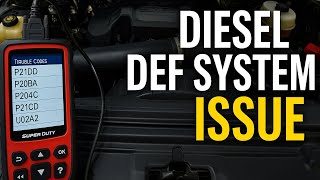
- Confirm the presence of DEF-related DTCs (e.g., U02A2, P21CD, P204C) using an OBD-II scanner.
- Locate the reductant (DEF) tank, which is typically near the fuel tank. It may be necessary to lower the spare tire for better access.
- Find and disconnect the 16-pin connector C3613 at the reductant pump/heater assembly. Also inspect the smaller 4-pin connector (C4851) at the reductant level sensor/quality module for the same issues.
- Thoroughly inspect both the harness side and the pump side of the connectors for any signs of moisture, green or white corrosion, or discolored/damaged pins.
- Based on TSB 23-2161: If corrosion is found on the harness side only, replace the reductant tank harness.
- Based on TSB 23-2161: If corrosion is found on the component side (the pump/heater assembly itself), you must replace both the harness and the pump/heater assembly.
- After replacing parts, secure the new harness with a cable tie as instructed by the TSB to prevent movement and fretting.
- Clear all DTCs. A professional scan tool may be required to reset the DEF system warnings and exit limp mode after the repair.
Parts You'll Likely Need

- Reductant Tank Harness
(OEM #HC3Z-14407-A)— This is the primary part that fails due to water intrusion at the C3613 connector. Ford's official fix per TSB 23-2161 is to replace, not repair, this harness.
Trusted brands: Motorcraft
OEM price range: $150-$250
Aftermarket price range: $100-$200 - Reductant (DEF) Pump and Heater Assembly
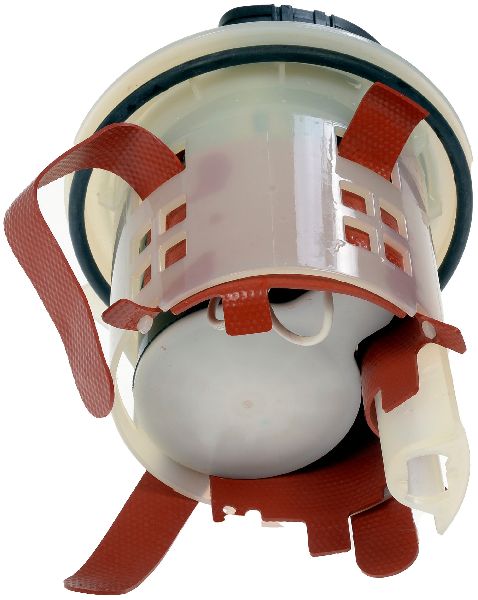
(OEM #HC3Z5H297A (Varies by model/year))— This part must be replaced if corrosion is found on its connector pins, as the damage is often internal and cannot be cleaned. The faulty harness allows water to damage this expensive component.
Trusted brands: Motorcraft, Bosch
OEM price range: $400-$600
Aftermarket price range: $300-$500
Related Codes That Often Appear With This One
- U02A2 — Indicates 'Lost Communication With Reductant Control Module,' a direct result of the corroded C3613 or C4851 connector.
- P21CD — A general code for 'Reductant Control Module Communication Fault,' often pointing to a concern with connector C4851, which is part of the same harness.
- P204C — Indicates 'Reductant Pressure Sensor Circuit Low,' which can be caused by a bad connection at connector C3613.
- P21DD — Indicates 'Reductant Heater A Control Circuit Low,' directly related to the heater circuits that pass through the C3613 connector.
- P208A, P208B, P208C — These codes relate to the reductant pump control circuit performance, which is compromised by a bad connection at C3613.
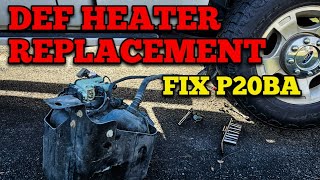
- P20BA, P20B9 — These codes for reductant heater performance are also listed in TSB 23-2161 as being related to this connector issue.
Technical Service Bulletins (TSBs) & Recalls
- TSB 23-2161: '3.0L/6.7L - Illuminated MIL With Various Reductant System Related DTCs'. This is the most current bulletin, identifying water intrusion at connectors C3613 and C4851/C3610 as the cause and providing the updated repair procedure. It supersedes TSB 22-2191.
- TSB 19-2315: An earlier version of the bulletin for 2017-2019 models that also identified water intrusion at connector C3613 as the root cause for DEF system codes.
Platform-Specific Known Issues
- The issue of water intrusion in the DEF harness connectors is so prevalent on these trucks that Ford has superseded its own service bulletins multiple times, most recently with TSB 23-2161, to update the parts list and procedures.
- The problem affects 2017-2022 Super Duty trucks with the 6.7L Power Stroke diesel engine built on or before March 8, 2022.
- Owner experiences shared online frequently mention the check engine light appearing after heavy rain or a car wash, corroborating the water intrusion diagnosis.
Mechanic-Grade Diagnostic Values
- Reductant Pressure Sensor Signal Voltage (related to code P204C) — expected: Approximately 0.5V with key on, engine off (KOEO).. Failure: A reading of 0V or an unstable voltage that fluctuates wildly when wiggling the harness indicates a broken wire or bad connection. A repaired circuit may show around 3.5V - 3.9V KOEO.
Scan Tool Commands That Help
- Ford IDS (Integrated Diagnostic System): SCR Parameter Reset — This function is required to reset SCR system data and clear the speed-limited limp mode after replacing components like the DEF pump or harness. A simple code clear will often not restore full vehicle operation.
- Ford IDS (Integrated Diagnostic System): SCR Visual Leak Check — This command pressurizes the DEF lines for approximately 5 minutes, allowing a technician to visually inspect for physical leaks in the system after a repair.
- Ford IDS (Integrated Diagnostic System): SCR System Emptying / Refill Activation — Used to depressurize and empty DEF from the lines to put the system in a known state for service or testing.
- Forscan: PCM Module Reset / SCR Parameter Reset — Forscan is a powerful aftermarket tool that owners and independent shops use to perform many dealer-level functions, including the critical SCR Parameter Reset needed to clear DEF system faults and limp mode after a repair.
Wiring & Ground Locations
- C3613 — A 16-pin connector located at the reductant (DEF) pump/heater assembly, typically on the DEF tank mounted to the frame rail.. This is the primary connector identified in Ford TSBs as being susceptible to water intrusion, leading to corrosion and numerous DEF system fault codes.
- C4851 — A 4-pin connector at the reductant level sensor/quality module, part of the same harness as C3613.. This connector is also cited in TSBs for water intrusion issues, specifically causing communication codes like U02A2 and P21CD.
- G403 — For 6.7L Diesel models, this ground is located on the left side of the frame, near the middle of the vehicle.. A poor ground connection can cause erratic behavior and low voltage issues in various modules, including the DEF system components. Ensuring this ground is clean and tight is a valid diagnostic step for any electrical fault in the area.
- Wiring Diagram Cell 27 — In the official Ford Workshop Manual.. TSB 19-2315 and others explicitly reference 'Wiring Diagram, Cell 27' for detailed schematics of the C3613 and C4851 connectors, which a technician would use for pin-point testing.
Real Owner Repair Stories
- Ford Truck Enthusiasts Forum (2015 F-250 6.7L) — After replacing a bad DEF tank heater, the user had the DEF sender harness unplugged and turned the key on, which immediately triggered a "Exhaust Fluid System Fault" and a 50 mph speed limit countdown.
❌ Tried (didn't work) Plugging the harness back in and clearing the DTCs with a standard scan tool (Forscan). The fault message and limp mode warning remained even though no active codes were present.
✅ What actually fixed it The user learned that a simple code clear is insufficient. The fix required performing a specific SCR system reset procedure, which involves a complex drive cycle with specific acceleration and deceleration events to prove to the PCM that the system is functional before it will clear the limp mode warning.
OEM Part Supersession History
TSB 19-2315→TSB 23-2161 (via TSB 22-2191 and others)— Ford has repeatedly updated the service bulletin to expand the range of affected vehicles, add more related DTCs, and refine the repair procedure. The latest version (23-2161) provides the most current parts list and instructions.
Model Year Variations Within This Range
- 2017-2022: The TSB for this issue, 23-2161, specifically applies to F-Super Duty vehicles built on or before March 8, 2022. Vehicles built after this date may have an updated harness or connector design.
- 2020-2021 vs 2017-2019: The 2020 model year introduced an updated 6.7L Power Stroke engine with higher horsepower and torque, along with a 10-speed transmission. Owners report that these 2020+ trucks consume significantly more DEF than the 2017-2019 models, making DEF system health even more critical.
Helpful Videos

We Have This Part in Stock


The information in this article is provided for general reference and educational purposes only. Vehicle specifications, procedures, and part compatibility can vary by production date, trim level, and region. Always consult your vehicle's factory service manual and verify part numbers before purchasing or performing repairs. Safety-critical components such as airbags, seat belts, and braking systems should be installed by a qualified professional.
- Ford F-350 SD:
- 🧭 Diagnostic Flowchart
- 🎬 Helpful Videos
- 🛍️ Shop This Part
- What's Unique About the 2017-2021 Ford F-350 SD
- Symptoms You May Notice
- Most Likely Causes
- Diagnosis Steps
- Parts You'll Likely Need
- Related Codes That Often Appear With This One
- Technical Service Bulletins (TSBs) & Recalls
- Platform-Specific Known Issues
- Mechanic-Grade Diagnostic Values
- Scan Tool Commands That Help
- Wiring & Ground Locations
- Real Owner Repair Stories
- OEM Part Supersession History
- Model Year Variations Within This Range
- 🎟️ Get 5% Off