

OBD-II Code P0007: Fuel Shutoff Valve 'A' Control Circuit High
The Ultimate Expert Guide to P0007: Meaning, Diagnosis, and Repair
- The most common cause of a P0007 code is a short to power in the wiring harness or electrical connector, not a failed fuel shutoff valve.
- A P0007 code creates a severe safety hazard by causing unexpected engine stalling at highway speeds or preventing the vehicle from starting.
- Never replace the fuel shutoff solenoid without first using a multimeter to confirm its internal resistance falls outside the typical 10-50 Ohm range.
- This code predominantly affects diesel pickup trucks from Ford, GM, and Ram due to the high-pressure fuel systems required for those engines.
What Does P0007 Mean?
The Powertrain Control Module (PCM) detects a problem in the electrical circuit for the fuel shutoff valve. This valve acts as a gatekeeper, precisely controlling fuel flow to the engine for starting and stopping. The 'Circuit High' designation means the PCM reads a voltage above the normal operational range, indicating a short to a power source.
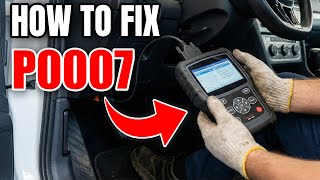
🎬 Watch: A detailed breakdown of P0007 causes and symptoms.Technical definition: The SAE/OBD-II definition is "Fuel Shutoff Valve 'A' Control Circuit High." The Powertrain Control Module (PCM) detects voltage in the fuel shutoff valve control circuit exceeding the manufacturer-specified threshold. This valve is typically a solenoid mounted on the high-pressure fuel pump or fuel rail—common in diesel engines—that stops fuel flow when the ignition turns off.
Can I Drive With P0007?
Yes, But With Caution. Driving is not recommended. The engine stalls unpredictably, creating a severe safety hazard at highway speeds or in intersections. While mechanically possible to drive short distances to a repair shop, the risk of causing an accident outweighs any convenience.
Common Causes
- Wiring or Connector Issues (Very Common) — The most frequent cause. Wires in the harness fray, break, short to a power source, or suffer rodent damage. Connectors corrode or loosen, leading to abnormally high voltage readings.
- Faulty Fuel Shutoff Valve (Solenoid) (Common) — The electronic solenoid operating the valve fails internally. A short circuit in its windings or a mechanical bind prevents correct movement, which the PCM interprets as a circuit fault.
- Faulty Fuel Shutoff Relay (Less Common) — The relay supplying power to the circuit sticks in the 'on' position or fails internally. This forces circuit voltage to remain high when it should be low.
- Poor Ground Connection (Less Common) — An inadequate or corroded ground path shifts the PCM's voltage reference. This makes normal valve voltage appear high to the computer, triggering the code.
- Blown Fuse (Rare) — A fuse related to the fuel system circuit blows. While counterintuitive for a 'high' voltage code, electrical faults cause unpredictable readings as circuits search for a path to ground.
- Faulty Powertrain Control Module (PCM) (Very Rare) — An internal failure in the PCM's driver circuit causes it to send or read incorrect voltage. Always suspect this last after ruling out all other possibilities. 🎬 Watch: Step-by-step solutions for fixing the P0007 code.
Symptoms
- Engine Stalls or Won't Start — The engine stalls unexpectedly while driving, especially at idle or low speeds. The engine also cranks but refuses to start due to fuel starvation.
- Check Engine Light is On — The Malfunction Indicator Lamp (MIL) illuminates immediately upon detecting the fault.
- Rough Idle and Reduced Performance — The engine runs erratically, hesitates, or loses power during acceleration due to inconsistent fuel flow.
- Engine 'Dieseling' — In older diesel engines, the engine continues running for a few seconds after turning the ignition off because the valve fails to stop the fuel supply.
Diagnostic Flowchart
Tap your situation to follow the diagnostic path that matches what you're seeing on this code.
Common Fixes & Costs
- Repairing or Replacing Wiring Harness/Connectors — Parts: $10-$50, Labor: $150-$300, ~1.5 hr book time (Intermediate)
- Replacing the Fuel Shutoff Valve/Solenoid — Parts: $50-$250, Labor: $130-$300, ~1.5 hr book time (DIY)
- Replacing a Blown Fuse or Faulty Relay — Parts: $10-$40, Labor: $0-$50, ~0.2 hr book time (DIY)
- Replacing the Powertrain Control Module (PCM) — Parts: $600-$1200, Labor: $200-$300, ~2 hr book time (Professional)
Used vs. New Parts: Buying Guide
When a used part is worth it: Buying used is not recommended due to the part's critical safety function. Consider it only for an older vehicle (over 150k miles) where a new OEM part is cost-prohibitive.
Donor-vehicle mileage cap: roughly under 60000 miles for the part to have meaningful remaining life.
Donor quality checklist:
- Source the part from a reputable auto recycler offering a warranty.
- Visually inspect the part for corrosion, physical damage, or brittle wiring.
- Match the part number exactly; solenoids are not interchangeable.
Decision logic:
- If Vehicle is essential for daily driving or is under 100k miles → Buy a new OEM or high-quality aftermarket part (e.g., Bosch, Delphi). The reliability is worth the cost.
- If The cost of a new solenoid is more than 25% of the vehicle's value → A tested, used part from a low-mileage donor is a reasonable compromise.
- If The part is for a high-performance or heavy-duty diesel application → Always buy new. The stress on these components is higher, and failure is more critical.
Warranty tradeoff: Used parts typically come with a 30-90 day functional warranty. New aftermarket parts offer a 1-year to limited lifetime warranty. New OEM parts carry a 12-month/12,000-mile warranty.
Worst-case if a used part fails: $200-$400 if a used part fails prematurely, including repeat labor and sourcing another part.
What Happens If You Wait — Timeline
- 0-2 weeks: Check Engine Light illuminates. The vehicle experiences intermittent stalling at idle or difficulty starting. (MPG impact: 0-5%% · Added cost: $0)
- 2 weeks - 2 months: Stalling becomes frequent and occurs while driving at low speeds. The no-start condition leaves you stranded. (MPG impact: 3-8%% · Added cost: $50-150 in wasted fuel and potential tow.)
- 2-6 months: Stalling at highway speeds poses a significant safety hazard. Erratic voltage degrades the fuel pump relay or the solenoid itself. (MPG impact: 5-10%% · Added cost: $200-400 (relay or solenoid replacement becomes likely).)
- 6+ months: The persistent high voltage short damages the driver circuit inside the Powertrain Control Module (PCM). (MPG impact: 5-10%% · Added cost: $800-1500+ if the PCM is damaged.)
Cost of Not Fixing It
- Immediate: High risk of engine stalling unexpectedly, creating a severe safety hazard. The vehicle also fails to start, leaving you stranded. (Added cost: $100-$300+ for a tow.)
- 1-3 Months: Continued stress on the fuel system from erratic electrical signals shortens the life of the fuel pump or related relays. (Added cost: High indirect costs from being stranded or causing an accident.)
- 6+ Months: A persistent electrical short damages the driver circuit within the Powertrain Control Module (PCM), requiring an expensive replacement. (Added cost: $800-$1500+ if the PCM is damaged.)
Diagnosis Steps
- Read the Codes and Freeze Frame Data
Use an advanced OBD-II scanner to confirm P0007 and check for related codes (like P0005, P0006, or P0230). Note the freeze frame data to understand engine conditions at the time the fault triggered.
Tools: OBD-II Scanner (Beginner) - Visually Inspect the Wiring and Connectors
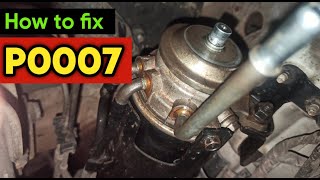
Locate the fuel shutoff valve near the high-pressure fuel pump. Inspect the wiring harness and electrical connector for broken wires, melted plastic, rodent damage, or green/white corrosion. Ensure the connector plugs in securely.
Tools: Flashlight (Beginner) - Test the Circuit Voltage
Set a digital multimeter to DC volts. With the ignition on (engine off), touch the black probe to a good ground and the red probe to the power wire at the valve's connector. A 'Circuit High' code means you will see voltage higher than the manufacturer's specification (often full battery voltage when there should be none).
Tools: Digital Multimeter, Vehicle-specific Repair Manual (Intermediate) - Test the Fuel Shutoff Solenoid Resistance
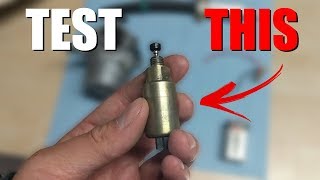
Disconnect the valve's electrical connector. Set the multimeter to Ohms (Ω). Touch the probes to the two pins on the solenoid. Compare the reading to the repair manual specification (typically 10-50 ohms). A near-zero reading indicates an internal short; an 'OL' reading indicates an open circuit.
Tools: Digital Multimeter, Vehicle-specific Repair Manual (Intermediate) - Check the Fuse and Relay
Locate the fuse and relay associated with the fuel pump or fuel shutoff circuit. Pull the fuse and check for a broken metal strip. Swap the fuel shutoff relay with an identical one from a non-essential circuit (like the horn) to test for a stuck relay.
Tools: Owner's Manual, Fuse Puller (Beginner) - Check for a Short to Power
With the valve disconnected, turn the ignition on (engine off). Set the multimeter to DC volts. Connect the black probe to ground and the red probe to the signal wire in the harness connector. Reading battery voltage confirms a short to power in the wiring harness between the PCM and the valve.
Tools: Digital Multimeter (Advanced) - [PRO TIP] Perform a Functional Test with a Scan Tool
Using a bi-directional scan tool, command the fuel shutoff valve ON and OFF. Listen for an audible 'click' from the solenoid. No click confirms a faulty solenoid or a complete lack of power/ground.
Tools: Bi-directional Scan Tool (Advanced) - [PRO TIP] Conduct a 'Wiggle Test' for Intermittent Faults
Connect the scan tool and monitor the voltage PID for the fuel shutoff valve circuit. With the key on, gently wiggle the wiring harness and connector. A spiking or dropping voltage reading pinpoints the exact location of an intermittent short. Stop DIY diagnosis and take the vehicle to an electrical specialist if you cannot locate the short.
Tools: OBD-II Scanner (with live data) (Advanced)
When This Code Triggers (Freeze-Frame Conditions)
- Engine Coolant Temp: 175-205°F (80-96°C) (The fault often occurs when the engine is fully warmed up and running.)
- RPM: 0 or < 800 RPM (The code frequently triggers during a no-start condition (cranking at 0-300 RPM) or when the engine stalls at idle.)
- Engine Load: Varies (often low) (Common during low-load situations like idling or deceleration when fuel demand changes abruptly.)
- Vehicle Speed: 0 mph (A common condition is a stall while stopped or an engine that cranks but will not start, resulting in 0 mph speed.)
Related Codes
- P0005 — P0005 is 'Fuel Shutoff Valve 'A' Control Circuit/Open'. The PCM sees no signal. A P0007 'High' fault shows battery voltage on the signal wire, while P0005 shows 0 volts.
- P0006 — P0006 is 'Fuel Shutoff Valve 'A' Control Circuit Low', the opposite of P0007. A 'Low' code points to a short to ground. A 'High' code points to a short to power.
- P0008 — P0008 indicates an 'Engine Position System Performance' issue. Seen with P0007, it points to a wider electrical problem, but the primary fuel control fault often triggers the engine position error.
- P0230 — P0230 is 'Fuel Pump Primary Circuit Malfunction.' If present with P0007, check the fuel pump relay and Fuel Pump Control Module (FPCM), as a single fault affects both circuits.
Climate & Environmental Factors
- Cold & Humid Climates: P0007 appears frequently in regions with cold winters, high humidity, or road salt usage. Moisture and salt accelerate corrosion on wiring connectors, creating alternative electrical paths that the PCM detects as a high voltage fault.
- Extreme Cold Weather (Potential Misdiagnosis): In temperatures below 20°F (-7°C), diesel fuel gels as paraffin waxes crystallize. This clogs the fuel filter, causing symptoms identical to P0007 (no-start, stalling). Differentiate between an electrical fault and fuel gelling, which does not set a circuit code.
How to Talk to a Mechanic About This Code
Say this: "I have a P0007 code, and the vehicle stalls intermittently. I need a diagnostic appointment. Since this is a 'Circuit High' code, please test the wiring, connector, and relay for the fuel shutoff valve for a short to power before recommending a solenoid replacement."
This signals you understand the code relates to an electrical fault. It directs the technician to perform proper electrical diagnostics first, preventing you from paying for a new solenoid when the real problem is a $20 wire repair.
Avoid saying:
- 'My check engine light is on, can you just fix it?'
- 'I think I need a new fuel shutoff valve.'
- 'Just do whatever you think is best.'
Questions to ask before authorizing the repair:
- Did you test the voltage and resistance at the solenoid's connector and compare it to the spec?
- Were you able to find a short to power in the wiring harness?
- Did the fuel shutoff relay test okay?
- Can you show me the damaged wire or the failed part before I approve the repair?
Where to Take It: Dealer vs Independent vs Chain
- Dealer:
A strong option if the vehicle is under warranty or has known manufacturer-specific issues. For out-of-warranty vehicles, an independent specialist is more cost-effective.
Best for: Vehicles still under a powertrain or emissions warranty., Complex, manufacturer-specific electrical issues or required software updates., When a Technical Service Bulletin (TSB) or recall exists for the P0007 code.
Downsides: Highest labor rates., Defaults to replacing larger assemblies (like a full wiring harness) instead of repairing a specific wire. (Typical cost: +50% vs. baseline) - Independent Shop:
Best fit for most out-of-warranty scenarios. An independent shop with strong electrical diagnostic skills pinpoints common wiring faults without dealership overhead.
Best for: Out-of-warranty vehicles, especially diesel trucks., Shops specializing in electrical diagnostics or a specific vehicle make., Getting a second opinion on a high dealer quote.
Downsides: Quality and expertise vary widely. Vet the shop by checking for ASE certifications. (Typical cost: +0% vs. baseline) - Chain Shop:
AVOID for diagnosis. They are generally not equipped for the in-depth wiring and circuit testing required to accurately solve a P0007 code.
Best for: Simple, unrelated maintenance like oil changes or tire rotations.
Downsides: Technician skill for complex electrical diagnostics is inconsistent., Lacks the advanced, bi-directional scan tools needed for proper testing., Higher pressure to sell parts rather than perform detailed diagnostic labor. (Typical cost: -10% vs. baseline)
When to Walk Away From the Repair
If the total estimated repair cost for the P0007 fault exceeds 40-50% of your vehicle's current private-party value, consider selling or trading it in.
- Car worth $7000, fix is $3500: Walk away. A repair cost at 50% of the vehicle's value is a poor investment, especially if other major components are aged.
- Car worth $15000, fix is $800: Fix it. The repair cost is well below the threshold and resolves a critical safety issue.
- Car worth $3000, fix is $1800: Walk away. The repair cost is over 50% of the car's value. Put that money toward a more reliable vehicle.
What Scan Tool You Need for This Code
Minimum: An OBD-II scanner that reads live data streams for the fuel system circuit.
A basic $20 code reader only shows the P0007 code. It cannot show the live voltage data that confirms the 'Circuit High' condition, nor can it command the valve to open or close.
Budget: BlueDriver Pro (~$100) — Connects to your smartphone and provides live data graphing for the fuel shutoff valve circuit. You watch the voltage in real-time to see if it sticks high.
Mid-range: Foxwell NT510 Elite (~$180) — Offers bi-directional control, allowing you to run actuator tests to command the fuel shutoff valve on and off. Hearing the solenoid 'click' quickly confirms if the solenoid works.
Professional: Autel MaxiCOM MK808 / MK808BT (~$500) — Provides full bi-directional control for actuator tests, reads manufacturer-specific codes, and offers advanced data graphing. This tool quickly and accurately diagnoses the electrical fault.
Rent vs buy: For a one-time fix, auto parts stores read codes for free, but their basic readers won't help with diagnosis. Buying a mid-range scanner with bi-directional control pays for itself by helping you avoid replacing the wrong part.
How to Clear the Code After You Fix It
- Use an OBD-II scan tool to clear the P0007 trouble code.
- Reconnect the battery if disconnected for the repair.
- Perform a complete OBD-II drive cycle to allow readiness monitors to run self-tests.
Drive cycle (~30 minutes): 1) Cold start and idle for 2-3 minutes with electrical loads on. 2) Drive in city traffic (25-40 mph) for 5-10 minutes with several complete stops. 3) Drive at steady highway speed (55-60 mph) for 10-15 minutes. 4) Safely decelerate to a stop and idle for 1-2 minutes before shutting off the engine.
Readiness monitors affected: Comprehensive Component Monitor, Misfire Monitor, Fuel System Monitor
Before emissions retest: drive at least 50 miles to fully set monitors.
Watch out for:
- Clearing the code with a scanner does not reset readiness monitors; a complete drive cycle is required.
- The code returns immediately if the underlying short to power was not properly repaired.
- Failing to meet specific drive cycle conditions (e.g., fuel level between 15-85%) prevents monitors from running.
Will This Fail Emissions / State Inspection?
Yes — this code typically fails an OBD-II emissions inspection.
- California: An active P0007 code results in an automatic smog check failure. All required readiness monitors must be complete before a re-test.
- New York: A vehicle with an illuminated Check Engine Light for P0007 fails the mandatory OBD-II portion of the state inspection.
- Texas: In counties requiring emissions testing, a P0007 code causes inspection failure. The Check Engine Light must be off and readiness monitors set.
Most Commonly Affected Vehicles
- Ford F-250/F-350 with Power Stroke (2011-2019) — The wiring harness routes near hot or vibrating components, making it a common area for chafing and shorts. Rodent damage is also frequently reported.
- Chevrolet / GMC Silverado/Sierra with Duramax (2011-2019) — These diesel trucks have complex fuel systems where electrical faults are common. Fleets reported issues with batches of faulty OEM solenoids in the 2019 model year.
- Dodge / Ram 2500/3500 with Cummins (2010-2020) — Intermittent stalling triggering P0007 frequently traces back to a loose or corroded main engine harness connector rather than the valve itself.
- Volkswagen Golf, Passat, Jetta with TDI (2010-2015) — The fuel shutoff valve on the injection pump (N109 valve) is a known failure point causing P0007 and no-start issues.
- BMW 3 Series, 5 Series, X3, X5 (Diesel Models) (2011-2021) — This code appears due to faults in the fuel shut-off valve circuit, exacerbated by age and heat cycles in the engine bay.
- Hyundai Tucson, Elantra (FFV/GDI) (2012-2019) — In Flexible Fuel (FFV) or early GDI systems, the code points to a fault in the cold start solenoid valve circuit.
- Maruti Suzuki Wagon R (2010-2018) — On models equipped with an LPG system, P0007 triggers due to a fault in the shut-off valve for the LPG pressure regulator.
- Subaru Outback, Forester (2005-2014) — Some models experience this code due to corroded connectors or wiring issues in the moisture-exposed fuel pump assembly area.
Manufacturer-Specific Notes
- General Motors (GM): On Duramax diesel engines, the factory specification for voltage in the off state is a maximum of 2.8 volts. A reading higher than this triggers P0007, pointing to a short to power or faulty solenoid.
- Ford: On Power Stroke engines, the wiring harness routes near hot or vibrating components, causing chafing and shorts. Check with a dealer for vehicle-specific Technical Service Bulletins (TSBs).
- Ram (Dodge): Intermittent stalling on Cummins engines triggering P0007 frequently traces to a loose or corroded main engine harness connector, not the valve itself.
- Volkswagen / Audi: On TDI diesel engines, the fuel shutoff valve integrates into the injection pump (N109 valve). Failure is common and results in a no-start condition along with P0007.
Real Owner Stories
2018 Ford F-250 Power Stroke with intermittent stalling
Engine stalled unexpectedly and the check engine light illuminated. The owner suspected a fuel filter issue.
Outcome: Rodent damage created a short circuit. Replacing the damaged wiring harness section resolved the P0007 code and stalling.
Lesson: Perform a thorough visual inspection of the wiring harness before replacing expensive components.
Ram 2500 with Cummins engine showing P0007
The truck experienced sporadic engine stalling. The issue was intermittent and hard to replicate.
Outcome: The problem traced to a loose main engine harness connector. Replacing the $50 connector fixed the issue completely.
Lesson: For intermittent electrical faults, checking major harness connections and grounds saves money on unnecessary parts.
2012 VW Jetta TDI with a no-start condition
The car cranked but would not start, storing a P0007 code.
Outcome: The N109 valve failed internally. Replacing the valve restored fuel flow and cleared the code.
Lesson: On VW TDI models, the fuel shutoff valve is a known failure point. Testing the valve itself is a top priority for a no-start condition.
Chevy Silverado HD Duramax fleet with recurring P0007
A fleet of 50 work trucks (2019 model year) experienced reduced power and P0007 codes.
Outcome: Investigation revealed a batch of faulty OEM fuel shutoff solenoids, leading to free replacements under a settlement.
Lesson: A sudden spike in a specific code for a certain model year indicates a widespread component issue. Check for Technical Service Bulletins (TSBs).
How to Prevent This Code From Triggering
- Apply Dielectric Grease to Connectors (During any related service or every 30,000 miles) — Dielectric grease seals electrical connectors from moisture and oxygen, preventing corrosion that causes high resistance and voltage faults.
- Inspect and Secure Wiring Harnesses (During every oil change) — Ensures the engine wiring harness is secured and not rubbing against hot or vibrating components. High-temperature harness tape protects wires from chafing.
- Use High-Quality Fuel and Filters (Every fill-up and at recommended service intervals) — Clean fuel prevents debris from physically jamming the solenoid valve, which causes mechanical failure misinterpreted as an electrical fault.
- Check and Clean Main Ground Straps (Annually or every 15,000 miles) — A clean engine-to-chassis ground strap ensures a stable voltage reference for the PCM. Corrosion causes floating grounds, leading to false 'high circuit' codes.
Frequently Asked Questions
What is the most common misdiagnosis for P0007?
The most common mistake is replacing the fuel shutoff valve without performing electrical tests first. The actual problem is usually a short in the wiring harness or a bad connector. Always test the circuit with a multimeter before buying parts.
Can a bad ground cause a P0007 code?
Yes. A compromised chassis ground strap or poor ground connection shifts the PCM's voltage reference. This makes a normal voltage reading appear 'high' to the computer, falsely triggering the code.
Can a bad battery cause a P0007 code?
Yes, although less common. A failing battery causes unpredictable voltage spikes throughout the electrical system. The PCM interprets these voltage anomalies as a 'Circuit High' fault.
Is the Fuel Shutoff Valve the same as the Fuel Pressure Regulator?
No. The Fuel Shutoff Valve completely stops fuel flow when the engine turns off. The Fuel Pressure Regulator manages and maintains specific pressure within the fuel rail while the engine runs.
Why is this code more common on diesel engines?
Diesel engines use high-pressure fuel systems and rely on this electronic valve to abruptly shut off fuel flow to stop the engine. This makes the valve and its circuit a critical component compared to gasoline engines.
I replaced the fuel shutoff valve, but the code came back. What now?
If a new valve didn't fix the problem, the issue is in the wiring or the PCM. Focus on finding a short or break in the wire between the valve and the PCM.
What does 'Circuit A' mean?
Modern vehicles have multiple fuel control circuits. The designation 'A' identifies a specific circuit or location when there might be a 'B' or 'C'. For this code, it refers to the primary fuel shutoff valve circuit.
What's the difference between Circuit High (P0007), Low (P0006), and Open (P0005)?
Circuit High (P0007) indicates a short to a power source. Circuit Low (P0006) indicates a short to ground. Circuit Open (P0005) means the PCM detects no connection, such as a broken wire or unplugged component.
Key Takeaways
- The most common cause of a P0007 code is a short to power in the wiring harness or electrical connector, not a failed fuel shutoff valve.
- A P0007 code creates a severe safety hazard by causing unexpected engine stalling at highway speeds or preventing the vehicle from starting.
- Never replace the fuel shutoff solenoid without first using a multimeter to confirm its internal resistance falls outside the typical 10-50 Ohm range.
- This code predominantly affects diesel pickup trucks from Ford, GM, and Ram due to the high-pressure fuel systems required for those engines.
Helpful Videos
Shop the Parts Behind P0007
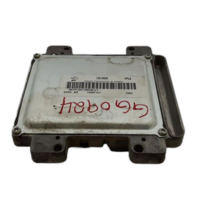
Below are the parts most often responsible for code P0007, ranked by how frequently each one is the actual culprit (per the diagnosis above). Tap any to see what we have for your vehicle.



The information in this article is provided for general reference and educational purposes only. Vehicle specifications, procedures, and part compatibility can vary by production date, trim level, and region. Always consult your vehicle's factory service manual and verify part numbers before purchasing or performing repairs. Safety-critical components such as airbags, seat belts, and braking systems should be installed by a qualified professional.
- 🧭 Diagnostic Flowchart
- 🎬 Helpful Videos
- 🛍️ Shop This Part
- What Does P0007 Mean?
- Can I Drive With P0007?
- Common Causes
- Symptoms
- Common Fixes & Costs
- Used vs. New Parts: Buying Guide
- What Happens If You Wait — Timeline
- Cost of Not Fixing It
- Diagnosis Steps
- When This Code Triggers (Freeze-Frame Conditions)
- Related Codes
- Climate & Environmental Factors
- How to Talk to a Mechanic About This Code
- Where to Take It: Dealer vs Independent vs Chain
- When to Walk Away From the Repair
- What Scan Tool You Need for This Code
- How to Clear the Code After You Fix It
- Will This Fail Emissions / State Inspection?
- Most Commonly Affected Vehicles
- Manufacturer-Specific Notes
- Real Owner Stories
- 2018 Ford F-250 Power Stroke with intermittent stalling
- Ram 2500 with Cummins engine showing P0007
- 2012 VW Jetta TDI with a no-start condition
- Chevy Silverado HD Duramax fleet with recurring P0007
- How to Prevent This Code From Triggering
- Frequently Asked Questions
- What is the most common misdiagnosis for P0007?
- Can a bad ground cause a P0007 code?
- Can a bad battery cause a P0007 code?
- Is the Fuel Shutoff Valve the same as the Fuel Pressure Regulator?
- Why is this code more common on diesel engines?
- I replaced the fuel shutoff valve, but the code came back. What now?
- What does 'Circuit A' mean?
- What's the difference between Circuit High (P0007), Low (P0006), and Open (P0005)?
- Key Takeaways
- 🎟️ Get 5% Off