

P0008 on 2013-2017 Chevrolet Equinox 3.6L: Timing Chain Causes and Fixes
On a 2013-2017 Equinox with the 3.6L V6, code P0008 almost always means the timing chains have stretched. This is a serious, complex repair costing $2,000-$4,000; do not continue driving as engine failure can occur. This is a well-documented design flaw acknowledged by GM through service bulletins and a special warranty extension.
- P0008 on a 2013-2017 Equinox 3.6L V6 is a serious code that almost always indicates stretched timing chains.
- Do not continue to drive the vehicle. A timing chain failure can cause catastrophic engine damage, turning an expensive repair into a total engine replacement.
- The correct fix is a complete timing chain job, replacing all chains, tensioners, and guides. This is a complex and costly repair (typically $2,000-$3,500).
- Replacing sensors will not fix this code. The problem is mechanical.
- Check with a GM dealer to see if your vehicle's VIN falls under any special coverage or extended warranty for this known issue.
What's Unique About the 2013-2017 Chevrolet Equinox
The GM 3.6L 'High Feature' V6 engine (RPO code LFX) used in this Equinox is notorious for premature timing chain stretching. The issue is so common that GM issued multiple Technical Service Bulletins (TSBs) and a special warranty coverage extension for this exact problem. The failure is widely attributed to an original chain design that was prone to wear, specifically in the chain link pin holes, causing the chains to elongate. This problem was accelerated by an Oil Life Monitor (OLM) system that often encouraged oil change intervals that were too long, leading to oil breakdown, loss of lubricity, and accelerated wear on the chains, guides, and hydraulic tensioners.
Symptoms You May Notice
- Check Engine Light is on, often with codes P0009, P0016, P0017, P0018, or P0019 as well.
- Engine running rough, especially at idle or under acceleration.
- Reduced engine power and hesitation.
- Lower than normal fuel economy.
- Rattling, whirring, or buzzing noise from the engine, particularly from the passenger side where the timing cover is located. This may be more noticeable on a cold start.
- Replacing the camshaft or crankshaft position sensors. These sensors are simply reporting the problem; they are almost never the cause of P0008 on this engine. Technicians confirm the sensors are working by viewing their signal on a scan tool or oscilloscope.
Most Likely Causes
- Stretched Timing Chains 🔴 High Probability → Shop Engine Timing Chain The original timing chains on the GM 3.6L V6 engine family were susceptible to premature wear and stretching, a design issue acknowledged by GM through multiple TSBs like #12-06-01-009F. The wear occurs in the joints of the chain, causing it to elongate over time.
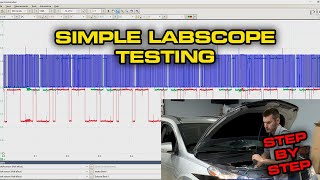
How to confirm: Use a professional scan tool to monitor the camshaft position angle variance for Bank 1. A consistent deviation greater than 4-5 degrees at idle indicates a mechanical timing problem. Advanced diagnosis involves using an oscilloscope to graph the cam and crank sensor signals to visually confirm the timing relationship is off. 🎬 Watch: How to test GM 3.6L timing chains with a labscope
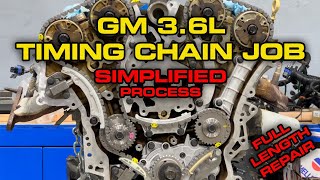
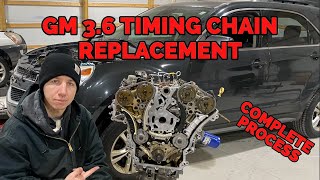
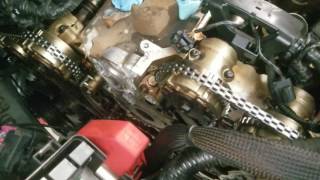
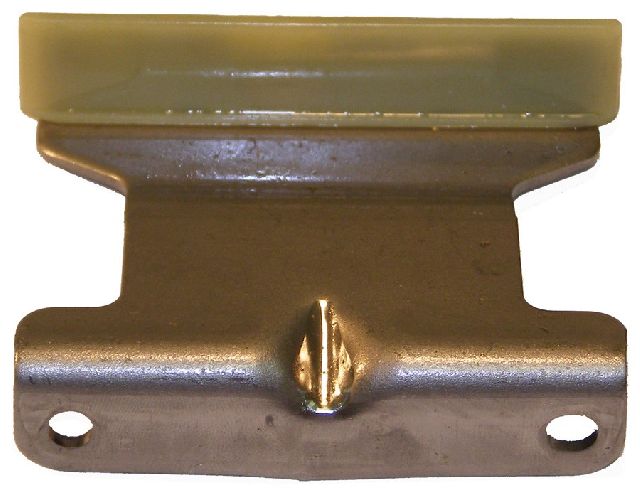
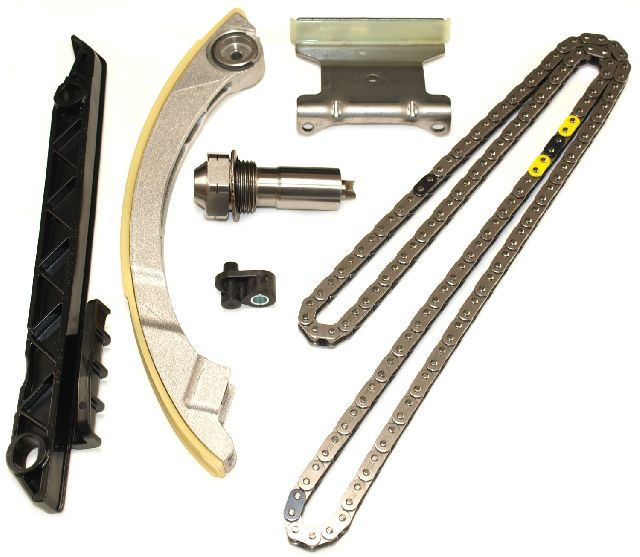
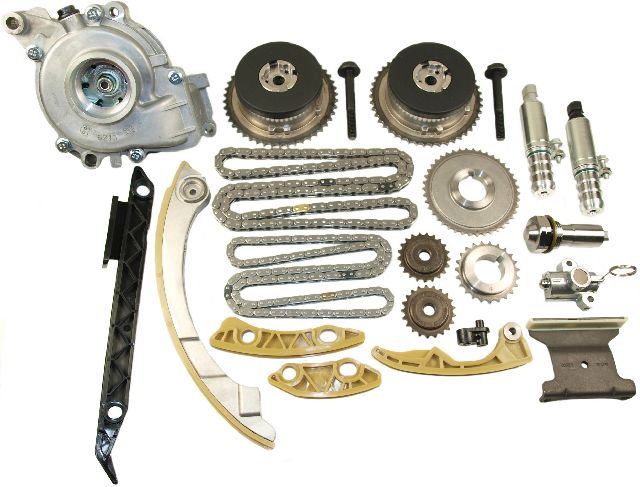
Typical fix: Replace all three timing chains (one primary, two secondary), all tensioners, and all guides with an updated, complete kit. It is critical to use the newest part revisions. This is a major, labor-intensive repair. 🎬 See this step-by-step timing chain replacement walkthrough
Est. part cost: $300-$700 - Low or Degraded Engine Oil 🟡 Medium Probability The factory Oil Life Monitor (OLM) allowed for long change intervals (sometimes over 10,000 miles), which can lead to oil breakdown and sludging. The timing chain tensioners are hydraulic and rely on clean oil and proper pressure to function; degraded oil accelerates wear on the entire system.
How to confirm: Check the oil level on the dipstick and inspect its condition. If the oil is low, very dark, or sludgy, this is a major contributing factor.
Typical fix: Change the oil and filter using a full synthetic 5W-30 oil that meets the GM dexos1 specification. This is a critical maintenance step but will not fix an already stretched chain. After a timing chain replacement, many shops recommend 5,000-mile oil change intervals regardless of the OLM.
Est. part cost: $40-$80 - Failed Timing Chain Tensioners or Guides 🟡 Medium Probability → Shop Engine Timing Chain The tensioners can weaken or fail due to dirty oil or low oil pressure, allowing the chain to become loose. The plastic guides can then wear out, become brittle, and break, sometimes leaving pieces in the oil pan. Manufacturer Bulletin #PIP3423P explicitly instructs technicians that when P0008 is set, they must inspect for loose timing chains or tensioners.
How to confirm: A rattling noise that quiets down after the engine warms up is a classic sign of a failing hydraulic tensioner. Definitive diagnosis requires visual inspection when the timing cover is removed.
Typical fix: Tensioners and guides are always replaced as part of a complete timing chain kit replacement. They should never be replaced in isolation.
Est. part cost: $0 (included in timing chain kit)
Rare But Worth Checking
- Slipped Crankshaft Reluctor Wheel: → Shop Engine Crankshaft GM Preliminary Information bulletin PIP3423P notes this as a rare possibility. If the timing chains are inspected and found to be tight and in good condition, the reluctor wheel on the crankshaft may have slipped, altering the signal sent to the ECM. This requires crankshaft replacement.
- Faulty VVT Components (Actuators/Phasers): While less common than chain stretch for causing P0008 specifically, a stuck or failing camshaft phaser (actuator) can cause a timing correlation error. This is more likely to set codes like P0011/P0014 but can contribute to P0008 in some cases.
Diagnosis Steps
- Verify the Check Engine Light is on and scan for codes. Confirm P0008 is present and note any other related codes (P0009, P0016-P0019).
- Check the engine oil level and condition. Low or dirty oil is a major contributing factor and can cause the code on its own if the level is critically low. If low or dirty, perform an oil change with full synthetic 5W-30 oil meeting the dexos1 specification, clear the codes, and see if the code returns.
- Using a professional scan tool, access live engine data. Monitor the 'Camshaft Position Variance' or 'Cam Angle Deviation' PIDs for Bank 1. A reading consistently greater than +/- 4 degrees at a steady idle strongly indicates a mechanical timing problem.
- For advanced diagnosis, use a multi-channel oscilloscope to compare the crankshaft position sensor signal with the camshaft position sensor signals for Bank 1. A stretched chain will cause a 'retarded' cam signal, shifting its waveform to the right relative to the crank signal.
- If cam deviation is confirmed, do not replace sensors. The issue is mechanical.
- The next step is to prepare for a timing chain replacement. This involves significant disassembly to remove the timing cover for a full inspection and replacement of the chains, guides, and tensioners.
Parts You'll Likely Need
- Engine Timing Chain Kit
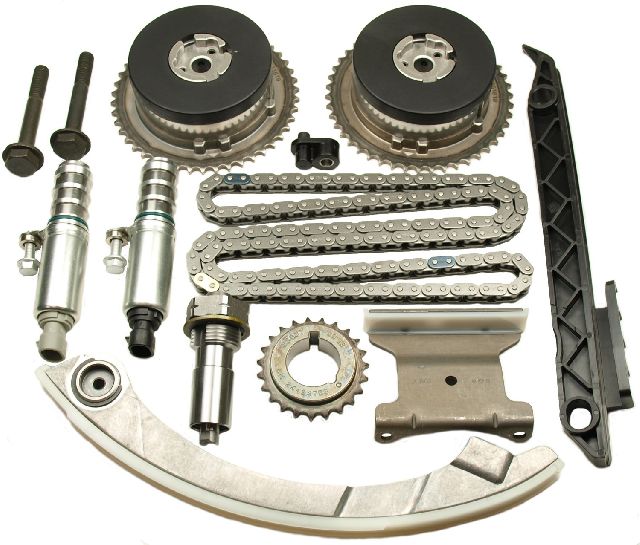
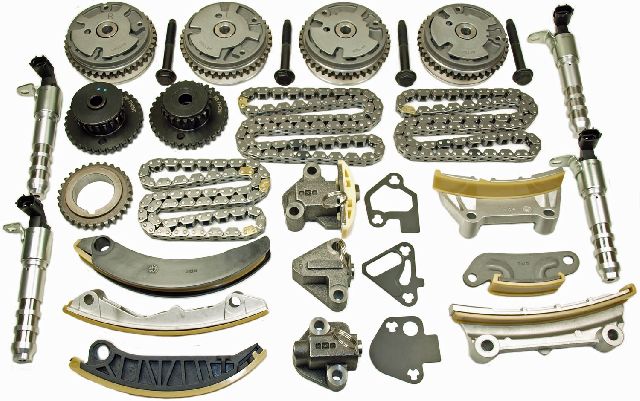
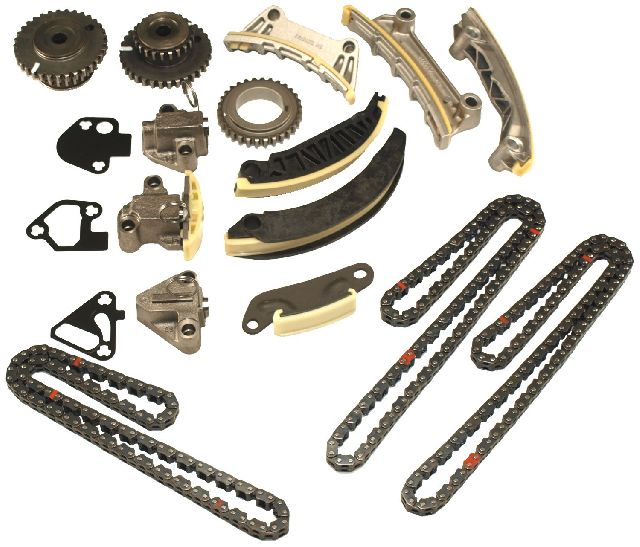
(OEM #12690388 (supersedes 12651450))— This is the definitive fix for a stretched timing chain, which is the overwhelming cause of P0008 on this engine. The kit should include all three chains, tensioners, guides, and new bolts.
Trusted brands: ACDelco (OEM), Cloyes (9-0753S), Melling
OEM price range: $400-$600
Aftermarket price range: $250-$450
Related Codes That Often Appear With This One
- P0009 — This is the identical code for Bank 2 (the radiator side). Seeing P0008 and P0009 together strongly indicates a stretched primary timing chain affecting both banks, as the primary chain drives both camshaft banks.
- P0016, P0017, P0018, P0019 — These are more specific correlation codes for the intake and exhaust camshafts on both banks. Their presence further confirms a widespread mechanical timing issue and almost guarantees the timing chains have stretched.
Technical Service Bulletins (TSBs) & Recalls
- 12-06-01-009F: Provides information on diagnosing and repairing stretched timing chains with updated kits for various GM models with the High Feature V6, including the Equinox. It advises against replacing sprockets or actuators unless they are visibly damaged.
- PIP3423P: A Preliminary Information bulletin that instructs technicians to inspect for loose timing chains first, but also mentions the rare possibility of a slipped crankshaft reluctor wheel if chains are okay. This bulletin specifically links P0008 with other correlation codes like P0016 and P0017.
Platform-Specific Known Issues
- The GM 3.6L LFX V6 is widely known for premature timing chain stretch, a problem acknowledged by GM with multiple TSBs (e.g., 12-06-01-009F).
- GM issued Special Coverage Adjustment #14582 for some vehicles with these engines, which addressed the timing chain issue. This was an extension of a previous program (#11340C). Owners should check with a dealer using their VIN to see if their specific vehicle was covered, though this program has likely expired for most vehicles by now.
- The factory Oil Life Monitor (OLM) system often encouraged oil change intervals that were too long (sometimes over 10,000 miles), leading to oil breakdown that accelerated chain wear. Post-repair, many experts recommend ignoring the OLM and sticking to a 5,000-mile interval with full synthetic oil.
Mechanic-Grade Diagnostic Values
- Camshaft Position Actuator (VVT) Solenoid Resistance — expected: 8 to 12 Ohms. Failure: A reading of 0 Ohms (short) or infinite/OL (open circuit) indicates a failed solenoid.
- Camshaft Position Sensor Power Supply (3-wire Hall Effect) — expected: ~5V or ~12V DC (vehicle dependent) with key on, engine off.. Failure: Significantly lower or no voltage points to a wiring or ECM problem, not a sensor failure.
- Cam/Crank Correlation Angle (Scan Tool Live Data) — expected: Near 0 degrees at idle.. Failure: A consistent deviation of more than 4-5 degrees that the ECM cannot correct indicates chain slack. The ECM may set P0008 when the deviation exceeds 6-10 degrees.
- Crankshaft Reluctor Wheel Position — expected: 25 to 26 mm from the machined surface of the crankshaft throw to the edge of the open space in the reluctor wheel.. Failure: Any measurement outside this range indicates the reluctor has slipped, requiring crankshaft replacement.
Scan Tool Commands That Help
- GDS2 / Tech2: Camshaft Position Variance (Live Data PID) — This is the primary data point to monitor. It shows the real-time difference in degrees between the desired and actual camshaft position, directly indicating a timing correlation problem without disassembly.
- GDS2 / Tech2: Camshaft Position Actuator Solenoid Test — This bidirectional command allows a technician to manually activate the VVT solenoid. A functioning solenoid and phaser will cause the engine to stumble or stall. This helps rule out a faulty VVT actuator before condemning the timing chains.
- GDS2 / Tech2: Crankshaft Position Variation Learn — This procedure is required after replacing the timing chains, crankshaft, or crankshaft position sensor. It allows the ECM to learn the profile of the reluctor wheel for accurate misfire detection. It will not fix P0008 on its own.
Wiring & Ground Locations
- G103 / G104 — Key ground connections on the cylinder heads. One is typically on the passenger side head (from the negative battery cable) and another on the driver's side head connected to the body.. The ECM and its sensors, including the crankshaft and camshaft position sensors, depend on clean, solid ground connections. A corroded or loose engine ground can introduce noise or voltage offsets, causing erratic sensor readings that could, in rare cases, contribute to or mimic timing correlation faults.
- ECM Connectors (X1, X2, X3) — Located on the Engine Control Module, typically near the firewall or inner fender.. Technicians performing advanced diagnostics may need to test for voltage, ground, and signal at the ECM pins for the cam and crank sensors to rule out a wiring harness issue between the sensor and the computer. Pinout diagrams are required for this.
- G101 — Located behind the front bumper clip, on the frame rail.. While not a primary engine ground, this ground point is known to become loose or corroded on the Equinox platform and grounds several components. While unlikely to cause P0008 directly, poor grounding can cause bizarre electrical issues, and checking major grounds is good practice.
Real Owner Repair Stories
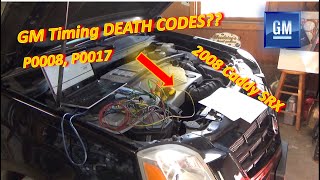
- GMC Chevy 3.6L P0008 P0009... "Extended Warranty" YouTube Video (Multiple GM vehicles with 3.6L V6, including Equinox) — Check Engine Light with codes P0008, P0017, P0018.
❌ Tried (didn't work) Unplugging mass airflow sensor during diagnosis (which set another code).
✅ What actually fixed it The video confirms that these codes are almost always caused by stretched timing chains or failed tensioners. The definitive fix is a complete timing chain job. The video also highlights the GM Special Policy (#11340C) that extended the warranty to 10 years/120,000 miles for this specific issue.
OEM Part Supersession History
12651450→12690388— The original timing chain design was prone to premature stretching. The updated kit (12690388) contains chains made with improved materials and manufacturing processes to increase durability and wear resistance.
Model Year Variations Within This Range
- 2013-2017: Within this range, the LFX engine remained largely consistent. The primary variations are in software and ECM calibration. GM may have released updates to the ECM software to adjust the Oil Life Monitor (OLM) calculations to encourage shorter oil change intervals in later years or as part of service campaigns. However, the core mechanical issue and the required repair are the same across all years.
Diagnostic Flowchart
Other Known Issues on This Vehicle
Issues unrelated to this code that are worth knowing about as an owner of this generation:
- Excessive Oil Consumption 🔴 High — Common across the 3.6L LFX engine line, though less severe than the 2.4L. Owners report needing to add oil between changes. Can be caused by worn piston rings. (Ref: GM has acknowledged oil consumption issues on other engines but no specific recall for the LFX in this platform.)
- Service Stabilitrak / Reduced Engine Power 🟠 Medium — A common complaint where the vehicle enters a limp mode. Can be caused by various issues, including a faulty throttle body, wheel speed sensors, or as a symptom of other engine problems. (Ref: No specific recall, but numerous owner complaints exist.)
- Faulty Camshaft Position Actuator Solenoids (VVT Solenoids) 🟠 Medium → Shop Engine Camshaft — A relatively common failure item causing rough idle, poor performance, and codes like P0011, P0014, P0021, P0024. Much more frequent and cheaper to fix than timing chains. (Ref: TSB PIP5096C)
- Cracked Exhaust Manifold 🟡 Low — The integrated exhaust manifold can develop cracks, leading to an exhaust leak noise, especially on cold starts, and potentially allowing fumes into the cabin.
- Faulty Wheel Bearings / Hubs 🟠 Medium — Failure of the wheel bearing or the integrated magnetic tone ring for the ABS sensor is common, leading to ABS and Stabilitrak warnings.
Used vs. New Parts: Buying Guide for This Vehicle
When a used part is the smart pick: For this specific P0008 repair, using used parts is strongly discouraged. The primary failure components—timing chains, tensioners, and guides—are all wear items. Installing used timing components is asking for the same failure to occur again in a very short time.
What to inspect on the donor part:
- Not applicable. Do not use salvaged timing components for this repair.
OEM-only on this vehicle (don't cheap out):
- While not strictly 'OEM-only', it is critical to use a high-quality, complete timing chain kit from a reputable manufacturer. Cheap, unbranded kits from online marketplaces are known to fail quickly, sometimes catastrophically. Stick to ACDelco (OEM) or top-tier aftermarket brands.
Aftermarket brands forum-validated for this vehicle:
- Cloyes (specifically kit 9-0753S) is a highly regarded aftermarket supplier, often considered equivalent to OEM quality for this application.
- Melling is another reputable brand for timing components.
Brands owners have reported issues with on this vehicle:
- Any unbranded or 'white box' timing kits sold on platforms like Amazon or eBay at a significantly lower price point. These often use inferior materials that lead to rapid stretching and failure.
Real Owner Stories
Aggregated from forums and TSBs cited above. Mileages and costs reflect what owners reported in those sources.
2011 GMC Terrain 3.0L V6
Symptoms: Owner experienced the classic timing chain codes P0008, P0017, and P0018.
What fixed it: A full timing chain replacement resolved the codes.
Source hint: terrainforum.com - P0008, P0017, P0018 on 2011 3.0L
Related OBD-II Codes
Frequently Asked Questions
Is there a TSB for the timing chain issue on my 2013-2017 Chevrolet Equinox with the 3.6L V6?
I heard GM extended the warranty for timing chains; does my Equinox qualify?
Can I just change the oil to fix the P0008 code on my LFX engine?
My Equinox is making a rattling noise on the passenger side during cold starts. Is this related to P0008?
The shop says I need to replace my sprockets and actuators too. Is that necessary according to GM?
How often should I change my oil to avoid timing chain stretch on the 3.6L V6?
Helpful Videos
We Have This Part in Stock

The information in this article is provided for general reference and educational purposes only. Vehicle specifications, procedures, and part compatibility can vary by production date, trim level, and region. Always consult your vehicle's factory service manual and verify part numbers before purchasing or performing repairs. Safety-critical components such as airbags, seat belts, and braking systems should be installed by a qualified professional.
- Chevrolet Equinox:
- 🧭 Diagnostic Flowchart
- 🎬 Helpful Videos
- 🛍️ Shop This Part
- What's Unique About the 2013-2017 Chevrolet Equinox
- Symptoms You May Notice
- Most Likely Causes
- Rare But Worth Checking
- Diagnosis Steps
- Parts You'll Likely Need
- Related Codes That Often Appear With This One
- Technical Service Bulletins (TSBs) & Recalls
- Platform-Specific Known Issues
- Mechanic-Grade Diagnostic Values
- Scan Tool Commands That Help
- Wiring & Ground Locations
- Real Owner Repair Stories
- OEM Part Supersession History
- Model Year Variations Within This Range
- Other Known Issues on This Vehicle
- Used vs. New Parts: Buying Guide for This Vehicle
- Real Owner Stories
- 2011 GMC Terrain 3.0L V6
- Related OBD-II Codes
- Frequently Asked Questions
- 🎟️ Get 5% Off