

P0008 on 2012-2013 Chevrolet Impala 3.6L V6: Stretched Timing Chain Causes and Fixes
On a 2012-2013 Impala with the 3.6L V6, code P0008 almost always means the timing chains have stretched. This is a serious and expensive repair costing $1,800-$3,000+ that requires replacing the chains, tensioners, and guides to prevent catastrophic engine failure. Do not waste money on sensors; the problem is mechanical.
- P0008 on your 2012-2013 Impala almost certainly means you need a timing chain replacement.
- This is a serious issue; do not continue to drive the car, as you risk complete engine failure.
- The repair is very expensive ($1800+) and is not a DIY job for most people.
- Do not waste money replacing sensors; the problem is mechanical.
- To prevent future issues, use only high-quality full synthetic 5W-30 oil and change it every 5,000 miles.
What's Unique About the 2012-2013 Chevrolet Impala
The 2012-2013 Chevrolet Impala with the 3.6L V6 LFX engine has a well-documented history of premature timing chain stretch. While the LFX engine was an update to the previous LLT V6 and included features like an improved chain design to address the issue, problems can still occur. The issue is so prevalent that General Motors issued multiple technical service bulletins (TSBs), such as 12-06-01-009F, with updated timing chain kits to address the problem. Owners should be aware that this code is rarely a simple sensor issue and almost always points to this specific, significant mechanical failure.
Symptoms You May Notice
- Check Engine Light is on
- Reduced engine power and poor acceleration
- Rough or unstable idle
- Rattling or scraping noise from the passenger side of the engine, especially on cold starts
- Decreased fuel economy
- Engine may enter a reduced power or 'limp mode'
- Replacing only the camshaft or crankshaft position sensors. This is almost never the fix for a P0008 on this engine and will be a waste of money.
- Replacing only one of the three timing chains. All chains and components should be replaced as a set, as the majority of the cost is labor.
- Replacing timing chain guides, sprockets, or phasers unnecessarily. TSB 12-06-01-009 states these parts are not typically worn and should only be replaced if visual inspection confirms damage, not as a default part of the P0008 repair.
Most Likely Causes
- Stretched Timing Chains 🔴 High Probability → Shop Engine Timing Chain The primary timing chains on the GM 3.6L V6 engine family are known to wear and stretch prematurely. This is a widely documented design issue, acknowledged by GM through multiple TSBs. Wear in the chain link pin holes is a primary factor.
How to confirm: Use an advanced scan tool to monitor cam/crank correlation data. A consistent deviation beyond +/- 4 degrees on Bank 1 strongly indicates a timing issue. An oscilloscope can also be used to visualize the sensor waveforms and confirm the lag. The ultimate confirmation is a visual inspection of chain slack with the timing cover removed.
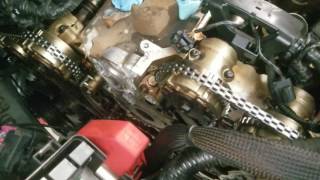
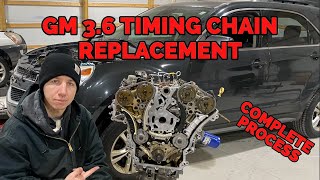
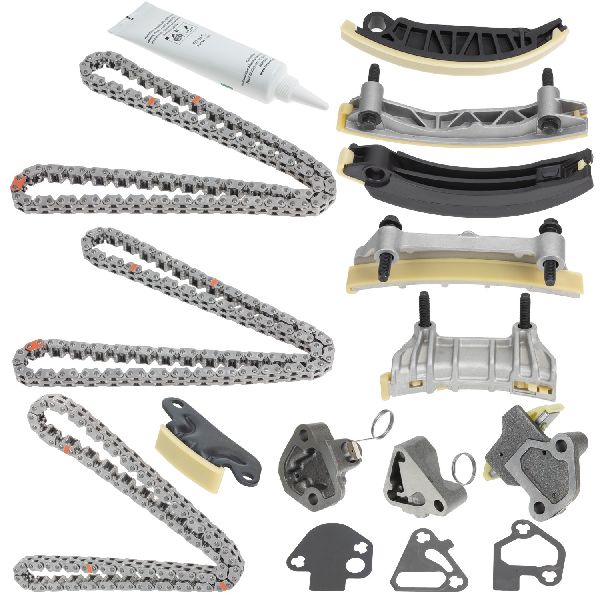
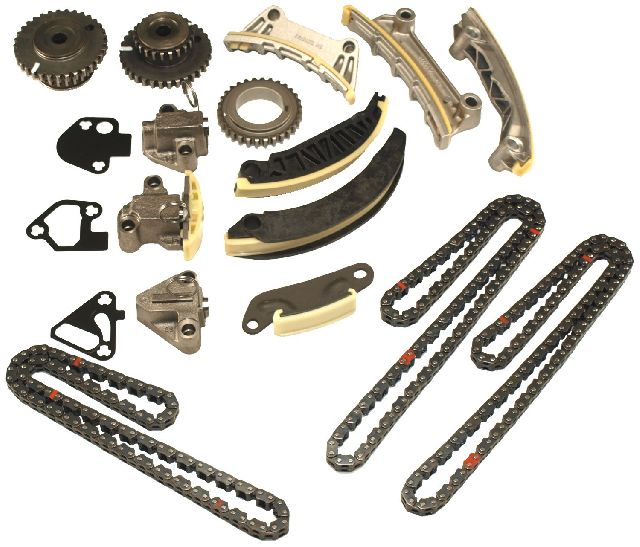
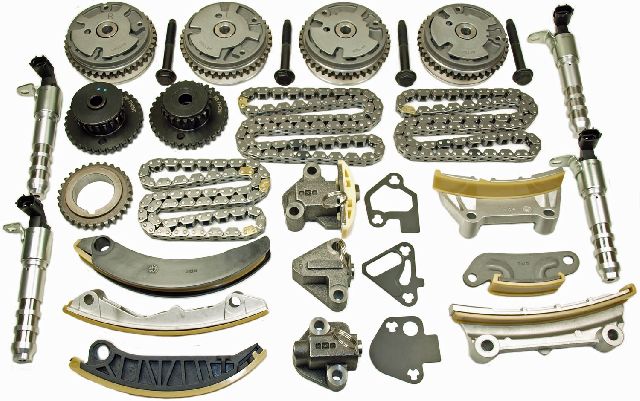
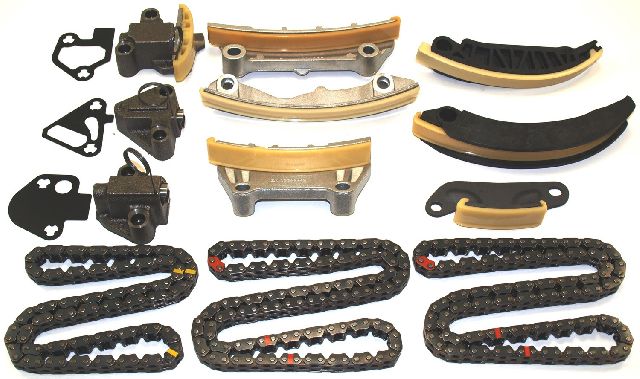
Typical fix: Replace all three timing chains (primary and two secondary), all timing chain tensioners, and all timing chain guides. This is typically done as a complete kit using the latest OEM-spec parts. 🎬 Watch: Full step-by-step GM 3.6L timing chain replacement guide
Est. part cost: $300-$600 - Failed Timing Chain Tensioners 🟡 Medium Probability → Shop Engine Timing Chain The hydraulic tensioners rely on clean oil and proper pressure. If they fail, become weak, or get clogged with sludge, they can't keep the chains tight. This leads to slack that causes timing correlation codes and accelerates chain wear.
How to confirm: During a visual inspection with the timing cover removed, a loose or fully extended tensioner is a clear sign of failure. Often diagnosed during the timing chain replacement.
Typical fix: Replace all timing chain tensioners. This is always done as part of a complete timing chain service.
Est. part cost: $50-$150 - Low or Degraded Engine Oil 🟡 Medium Probability The timing chain tensioners and camshaft phasers are hydraulically operated. Inadequate lubrication from old, dirty, or low oil accelerates wear on all timing components. GM's own oil life monitor calibration on earlier models was criticized for allowing excessive mileage between changes, contributing to the problem.
How to confirm: Check the dipstick for oil level and inspect the oil's condition. Note that changing the oil will not fix an already stretched chain, but is critical for prevention and required for the repair.
Typical fix: Change the oil and filter using a high-quality full synthetic 5W-30 oil meeting GM's Dexos specification. This is a preventative measure and a required step during the timing chain replacement, not a fix on its own.
Est. part cost: $50-$100
Rare But Worth Checking
- Slipped Crankshaft Reluctor Wheel: → Shop Engine Crankshaft A GM Technical Service Bulletin (PIP3423L) notes that the reluctor wheel, which the crankshaft position sensor reads, can move on the crankshaft due to an insufficient press fit. This will cause timing codes even with good chains. Diagnosis can be done by removing the oil pan and visually inspecting the wheel's position; one forum user noted it should be '1.5 teeth' away from the crank's edge. Remanufacturers like Jasper install a set screw to prevent this, and some mechanics may tack weld it in place as a permanent fix.
- Faulty Camshaft or Crankshaft Position Sensor: → Shop Engine Crankshaft Position Sensor While possible, it is very rare for a sensor itself to be the root cause of P0008 on this engine. The system is very effective at identifying a true mechanical timing issue. Do not replace sensors without first confirming the mechanical timing is correct via scan tool data or oscilloscope.
Diagnosis Steps
- Verify the code: Use an OBD-II scanner to confirm P0008 is present and check for other related codes like P0009, P0016-P0019.
- Check Engine Oil: Inspect the engine oil level and condition. Low or dirty oil is a major contributing factor. An oil change with full synthetic 5W-30 oil is recommended, but will not fix the code if the chain is already stretched.
- Listen to the Engine: Listen for a rattling or scraping noise from the front (passenger side) of the engine, especially on a cold start. This is a classic sign of a loose timing chain slapping against the guides.
- Scan Tool Data Analysis: Use an advanced scan tool to view live data for cam/crank correlation. A consistent deviation value greater than +/- 4 degrees on Bank 1 is a strong indicator of a stretched chain.
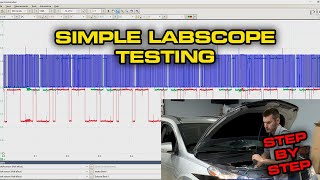
- Professional Confirmation: If you do not have an advanced scan tool, take the vehicle to a qualified technician. They can use an oscilloscope to definitively confirm a timing lag by graphing the sensor waveforms, which is the most accurate non-invasive diagnostic method. 🎬 Watch: How to use a labscope to test for timing chain stretch
- Visual Inspection: The final confirmation involves removing the engine timing cover to visually inspect the chains, guides, and tensioners for slack, wear, or damage. This is a labor-intensive step and is usually only done when performing the repair.
Parts You'll Likely Need
- Timing Chain Kit
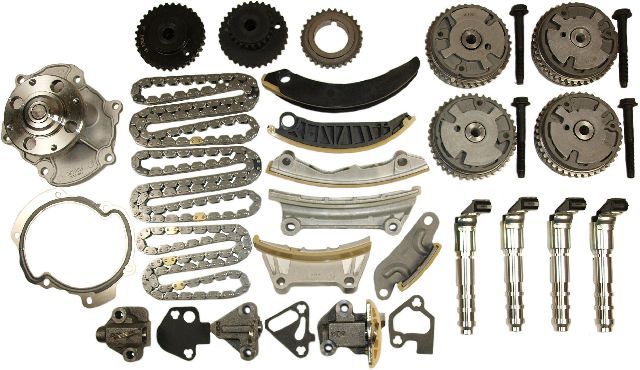
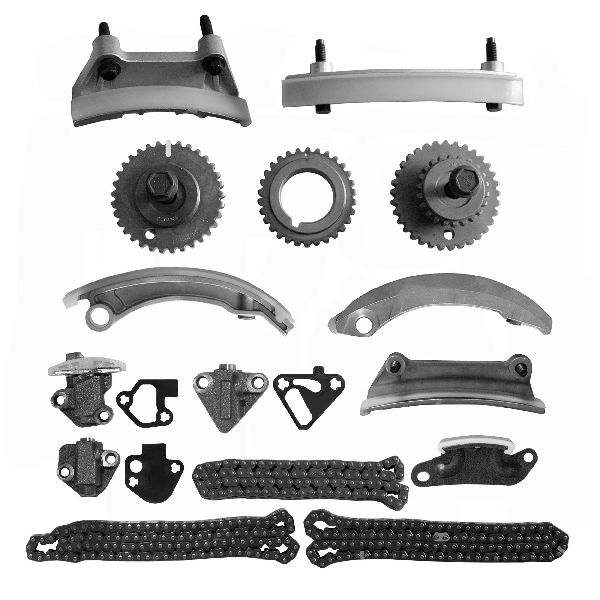
(OEM #12693218 (or superseded numbers like 12651450, 12700436))— This is the definitive fix. The kit includes all three chains, tensioners, and guides needed to correct the stretched chain issue. Using an updated OEM kit is critical. Part numbers have been updated several times; verify the latest part number with a GM dealer using your VIN.
Trusted brands: ACDelco, Cloyes
OEM price range: $350-$500
Aftermarket price range: $250-$400 - Full Synthetic 5W-30 Engine Oil and Filter — Required for the repair and crucial for preventing a repeat failure. Clean, high-quality oil is essential for the hydraulic tensioners' function.
Trusted brands: ACDelco, Mobil 1, Pennzoil
OEM price range: $60-$90
Aftermarket price range: $50-$80 - RTV Sealant (Gray) — Required to re-seal the timing cover and other components like the oil pan that must be removed during the repair.
Trusted brands: Permatex, ACDelco
OEM price range: $15-$25
Aftermarket price range: $10-$20
Related Codes That Often Appear With This One
- P0009 — This is the identical code for Bank 2 (the bank closer to the radiator). Seeing P0008 and P0009 together strongly indicates a stretched primary timing chain affecting both banks, making the diagnosis almost certain.
- P0016, P0017, P0018, P0019 — These are more specific crankshaft/camshaft correlation codes for intake and exhaust cams on both banks. Their presence alongside P0008/P0009 further confirms a significant mechanical timing issue, as noted in GM's service bulletins.
Technical Service Bulletins (TSBs) & Recalls
- 12-06-01-009F: The most relevant TSB, which announces updated timing chain kits. Importantly, it advises technicians *not* to replace idler gears, camshaft actuators, or chain guides unless they are found to be worn. This bulletin specifically addresses stretched timing chains that set DTCs P0008, P0009, P0016, P0017, P0018 and/or P0019.
- Bulletin #PIP3423P: This manufacturer communication notes that P0008 and P0009 may be set alongside other correlation codes, and technicians should specifically inspect for loose timing chains or tensioners.
Platform-Specific Known Issues
- General Motors issued a special coverage adjustment (SCA) for some earlier vehicles with this engine family for timing chain issues, extending the warranty to 10 years or 120,000 miles. While a 2012-2013 model is now outside this time window, it highlights the manufacturer's acknowledgment of the problem.
- The LFX engine design requires significant labor to access the timing components, making this a very expensive repair relative to the vehicle's value. Some mechanics prefer to remove the entire engine to perform the service.
Mechanic-Grade Diagnostic Values
- Camshaft Position Actuator Solenoid Resistance — expected: 6.9 to 7.9 ohms at 68°F (20°C). Some sources give a wider range of 6-13 ohms.. Failure: A reading of 0 ohms (short), infinite/OL (open), or significantly outside the expected range indicates a faulty solenoid.
- Engine Oil Pressure (Warm Idle) — expected: 20-25 psi or higher.. Failure: Pressure consistently below 20 psi at warm idle can starve the hydraulic tensioners and phasers, accelerating wear and causing timing codes.
- Camshaft Position Sensor 5V Reference Circuit — expected: 4.8 to 5.2 Volts (Key On, Engine Off).. Failure: Voltage below this range suggests a short to ground or an open/high resistance in the reference circuit from the ECM.
Scan Tool Commands That Help
- GDS2 (GM Global Diagnostic System): Crankshaft Position Variation Learn — This procedure is mandatory after replacing the timing chains, crankshaft position sensor, or ECM. It allows the ECM to learn the minor variations in the crankshaft reluctor wheel for accurate misfire detection. Failure to perform this can lead to other codes or rough running after the repair.
- GDS2 (GM Global Diagnostic System): Camshaft Position Actuator Solenoid Test — This bidirectional test allows a technician to command the VVT solenoids on and off to see if they are mechanically stuck or responding correctly. This helps rule out a solenoid issue, though solenoids typically set their own specific codes (P0010-P0025) rather than P0008.
Wiring & Ground Locations
- G103 / G104 — Primary engine grounds typically located on the cylinder heads. G103 is often on the front of the passenger side (Bank 1) head, and G104 on the rear of the driver's side (Bank 2) head.. The ECM and all its sensors, including the crank and cam sensors, rely on these grounds for a stable reference. A loose or corroded ground can cause erratic signals and phantom codes, though it's an unlikely cause for a persistent P0008.
- ECM Connector X1 — The main connector for the Engine Control Module (ECM), located in the engine bay near the firewall or airbox.. The camshaft and crankshaft position sensor signals terminate here. Probing the specific pins at this connector is the ultimate way to test the integrity of the sensor wiring harness from end to end.
Real Owner Repair Stories
- Camaro5 Chevy Camaro Forum (2011 Camaro V6 (LLT Engine, similar architecture to LFX), 55,000 miles) — Check Engine Light with P0008 and P0009, sluggish performance, extreme power loss.
❌ Tried (didn't work) Replaced all timing chains with a Cloyes kit., Replaced all four VVT sprockets (cam phasers).
✅ What actually fixed it The crankshaft reluctor wheel had slipped by 1.5 teeth. A mechanic was able to carefully force the wheel back into its correct position without full crankshaft replacement, which resolved the codes.
OEM Part Supersession History
12651450→12693218, then 12700436, then 12700437 (for LFX)— GM released multiple revisions of the timing chain kits to incorporate more durable chains and improved tensioner designs to combat premature wear and stretching.
Heads up: It is critical to use the latest available part number specified for the vehicle's VIN. While earlier kits may fit, they contain the older, less durable chain designs that are prone to the original failure.
Model Year Variations Within This Range
- 2012-2013: The 2012 model year was the first to feature the 300-hp LFX V6 and 6-speed automatic in the Impala, a significant powertrain upgrade from the 2011 model's 3.5L/3.9L V6s with a 4-speed automatic. There are no major documented differences in the timing components or engine design between the 2012 and 2013 Impala LFX engines themselves.
Diagnostic Flowchart
Other Known Issues on This Vehicle
Issues unrelated to this code that are worth knowing about as an owner of this generation:
- HVAC Blend Door Actuator Failure 🟡 Low — Very common. Owners report a loud clicking or knocking sound from the dashboard, which can occur even with the car off. Failure can happen as early as 35,000 miles.
- 6T70 Transmission Shudder/Harsh Shifting 🟠 Medium — Common issue. Owners report rough shifting, delayed engagement into drive, or a shudder like driving over rumble strips. Often caused by failed pressure switches or worn accumulator pistons in the valve body.
- Intake Valve Carbon Buildup 🟠 Medium — Inherent to the LFX Direct Injection engine. Over time, oil vapor from the PCV system bakes onto the intake valves, as they are not cleaned by fuel spray. Can cause rough idle and reduced performance. Manual cleaning (walnut blasting or scraping) is often required by 100,000 miles.
- Transmission Pressure Control Solenoid Failure 🔴 High — A frequent problem in the 6T70 transmission, causing erratic shifting and potential transmission damage if not addressed.
- Faulty PCV System / Excessive Oil Consumption 🟠 Medium — The PCV orifice in the camshaft cover can clog, leading to pressure issues and oil being forced into the intake manifold. This contributes to carbon buildup and can be mistaken for other engine problems. (Ref: TSB 12-06-01-009F includes instructions for cleaning the PCV orifice during timing chain service.)
Used vs. New Parts: Buying Guide for This Vehicle
When a used part is the smart pick: Given the high labor cost of the timing chain job ($1800+), if the vehicle is high mileage (>150,000 miles), replacing the entire engine with a guaranteed, low-mileage used unit from a reputable salvage yard can be a financially sound alternative. This can sometimes be comparable in cost to the timing chain repair alone but provides a fresher engine altogether.
Donor-vehicle mileage cap: roughly under 80000 miles for the part to have meaningful remaining life.
What to inspect on the donor part:
- Verify the donor vehicle's mileage through its VIN.
- Remove the oil fill cap and look for heavy, dark sludge, which indicates poor maintenance and potential timing chain wear.
- Ask for a warranty from the salvage yard (typically 30-90 days) that covers the engine against defects like a P0008 code.
- Ensure the donor engine is also an LFX from a compatible vehicle.
OEM-only on this vehicle (don't cheap out):
- Timing Chain Kit: This is a wear item with a known design flaw. Only the latest OEM (ACDelco) or a reputable OEM-supplier kit (like Cloyes) should be used to get the updated, more durable parts. Never install a used timing chain, tensioner, or guide.
Aftermarket brands forum-validated for this vehicle:
- Cloyes (for Timing Chain Kit)
Brands owners have reported issues with on this vehicle:
- Unknown or unbranded 'white box' timing chain kits from online marketplaces. The quality of the chain steel and tensioner manufacturing is critical, and failure of a cheap kit will lead to catastrophic engine damage.
Real Owner Stories
Aggregated from forums and TSBs cited above. Mileages and costs reflect what owners reported in those sources.
2012 Chevy Impala LT 3.6L V6
Symptoms: A mechanic advised against purchasing the vehicle due to the known timing chain issues, describing the repair as a 'pain in the butt'.
What fixed it: The recommended fix was a full timing chain replacement.
Cost: $2,000-$3,000
Source hint: Reddit - r/MechanicAdvice - 2012 Chevy Impala LT
2012 Chevrolet Impala 3.6L LFX
Symptoms: The owner tackled the job as a DIY project after receiving high quotes from shops. The job was estimated to take 15-20 hours for a first-timer with the engine still in the vehicle.
What fixed it: In-vehicle timing chain replacement.
Cost: $1,900-$2,500
Source hint: YouTube - In-vehicle GM 3.6L VVT timing chain replacement
2012-2015 Chevrolet Camaro 3.6L LFX
Symptoms: The owner diagnosed a timing-related issue that was actually a slipped reluctor wheel on the crankshaft.
What fixed it: Checking the tooth position relative to the crankshaft edge after removing the oil pan and performing a tack weld to secure the reluctor wheel.
Source hint: Camaro5 Forums - Slipped Reluctor Wheel Check
Related OBD-II Codes
Frequently Asked Questions
Does TSB 12-06-01-009F apply to my 2012-2013 Chevrolet Impala with the 3.6L LFX engine?
Is there a warranty extension for the timing chain issues on my 2012 Impala?
Can I just change the oil to fix the P0008 code on my LFX engine?
Why is the repair for P0008 so expensive on the 2012-2013 Impala?
What parts should I actually replace to fix P0008 permanently?
Helpful Videos
We Have This Part in Stock

The information in this article is provided for general reference and educational purposes only. Vehicle specifications, procedures, and part compatibility can vary by production date, trim level, and region. Always consult your vehicle's factory service manual and verify part numbers before purchasing or performing repairs. Safety-critical components such as airbags, seat belts, and braking systems should be installed by a qualified professional.
- Chevrolet Impala:
- 🧭 Diagnostic Flowchart
- 🎬 Helpful Videos
- 🛍️ Shop This Part
- What's Unique About the 2012-2013 Chevrolet Impala
- Symptoms You May Notice
- Most Likely Causes
- Rare But Worth Checking
- Diagnosis Steps
- Parts You'll Likely Need
- Related Codes That Often Appear With This One
- Technical Service Bulletins (TSBs) & Recalls
- Platform-Specific Known Issues
- Mechanic-Grade Diagnostic Values
- Scan Tool Commands That Help
- Wiring & Ground Locations
- Real Owner Repair Stories
- OEM Part Supersession History
- Model Year Variations Within This Range
- Other Known Issues on This Vehicle
- Used vs. New Parts: Buying Guide for This Vehicle
- Real Owner Stories
- 2012 Chevy Impala LT 3.6L V6
- 2012 Chevrolet Impala 3.6L LFX
- 2012-2015 Chevrolet Camaro 3.6L LFX
- Related OBD-II Codes
- Frequently Asked Questions
- 🎟️ Get 5% Off