

P0008 on 2009-2016 Chevrolet Traverse: Timing Chain Causes and Fixes
P0008 on a 2009-2016 Traverse almost always means the timing chains have stretched. This is a common, well-documented issue with the 3.6L V6 engine. The repair is labor-intensive and expensive, often costing between $2,500 and $4,000, and involves replacing the timing chains, tensioners, and guides. The issue was so common GM issued a special warranty extension, which has since expired for all these models.
- P0008 on a 2009-2016 Traverse is a strong indicator of stretched timing chains, a very common issue for this engine.
- Do not waste money replacing camshaft or crankshaft sensors first; they are rarely the cause.
- The repair is serious, expensive, and not a DIY-friendly job. Expect a repair bill of $2,000 to $3,500.
- Maintaining a strict oil change schedule with high-quality full-synthetic oil is the best preventative measure for a replacement chain's longevity.
- If the code appears immediately after a timing chain replacement, the crankshaft reluctor wheel may have shifted, or the new timing may have been set incorrectly.
What's Unique About the 2009-2016 Chevrolet TRAVERSE

The 3.6L V6 engine (both LLT and LFX versions) used in the first-generation Traverse and many other GM vehicles of this era is notorious for premature timing chain wear. This issue is so prevalent that GM issued a special coverage adjustment (#11340A, which superseded #10287) extending the warranty for this specific problem to 10 years or 120,000 miles. However, this coverage is now expired for all 2009-2016 models. The root causes are often attributed to a combination of the original timing chain design, and an overly optimistic oil life monitoring system (OLM) that could suggest intervals of 10,000 miles or more. This extended interval leads to oil degradation and sludge, causing poor lubrication and accelerated wear of the chains and tensioners.
Diagnostic Flowchart

Tap your situation to follow the diagnostic path that matches what you're seeing on this vehicle.
Symptoms You May Notice
- Check Engine Light illuminated.
- Loss of engine power, especially during acceleration.
- Rough or unstable idle.
- Rattling or clattering noise from the engine, particularly on a cold start, that may last for a few seconds.
- Warning messages such as "Service StabiliTrak" or "AWD Disabled" appearing on the dash along with the check engine light. [NHTSA ODI #11399127]
- Increased fuel consumption.
- Engine may have a long crank time before starting.
- Replacing only the camshaft position sensors.
- Replacing only the crankshaft position sensor.
- Replacing a single VVT solenoid.
- Performing an oil change and assuming it's a permanent fix.
Most Likely Causes

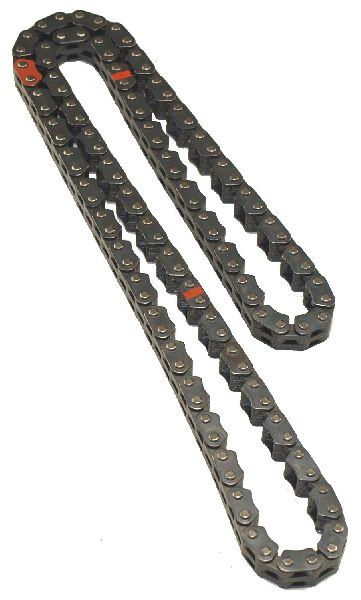
- Stretched Timing Chains 🔴 High Probability → Shop Engine Timing Chain The original timing chains on the 3.6L V6 engines were prone to premature stretching due to their design and wear in the chain link pin holes. This is the most common cause for P0008. GM later released updated, more robust chains to remedy the issue.
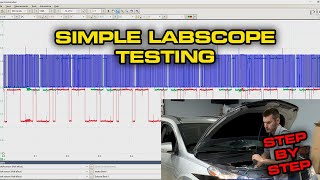
How to confirm: A technician can use a scan tool to monitor camshaft/crankshaft correlation data. Advanced diagnosis involves using an oscilloscope to compare the crank and cam sensor waveforms against a known-good pattern; a stretched chain 🎬 Watch: How to use a labscope to confirm timing chain stretch. will show a retarded timing signal. Physical inspection is the ultimate confirmation but requires significant engine disassembly.
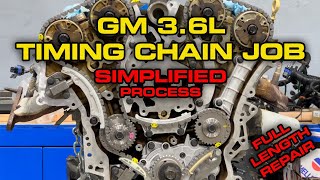
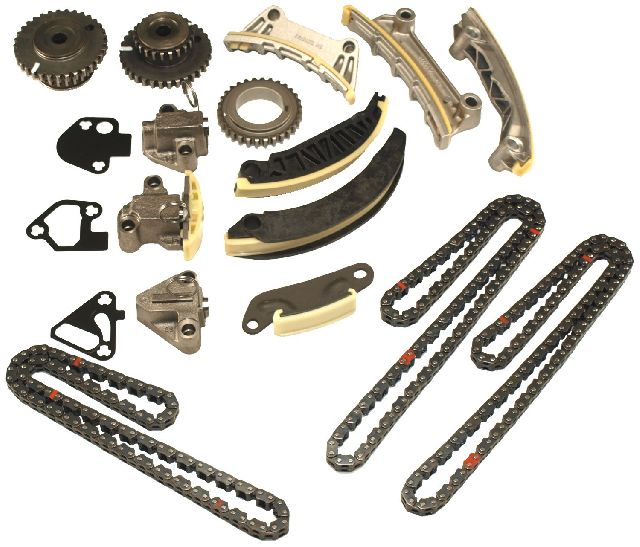
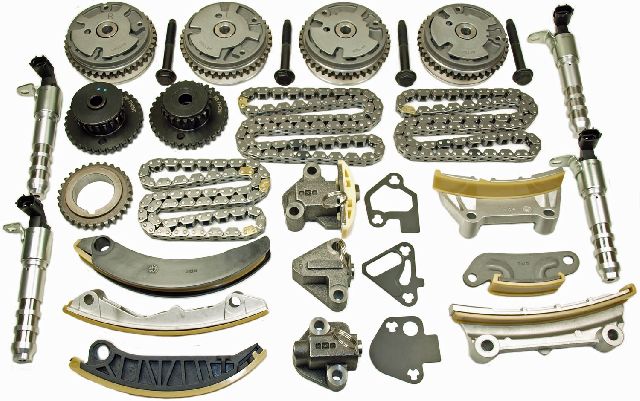
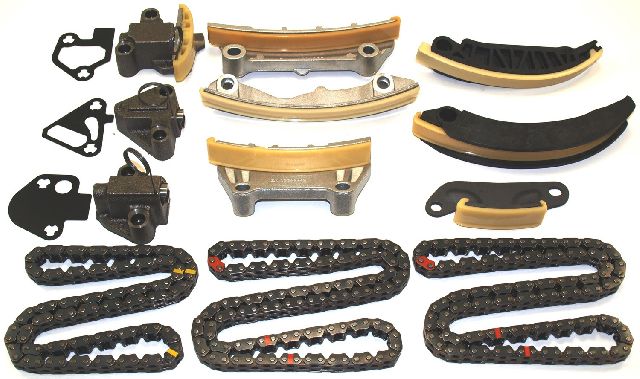
Typical fix: Replace all three timing chains, all tensioners, and all guides with an updated parts kit. It is highly recommended to use a complete kit from a reputable brand.
Est. part cost: $300-$700 - Failed Timing Chain Tensioners or Worn Guides 🔴 High Probability → Shop Engine Timing Chain The tensioners, which use oil pressure to keep the chains tight, can fail or weaken. The plastic guides can also wear down or break, creating slack in the chains which leads to noise and timing correlation errors.
How to confirm: These are typically diagnosed during a physical inspection when investigating a stretched chain. A rattling noise on startup is a strong indicator of a tensioner failing to hold pressure. 🎬 Listen: This is what a 3.6L engine rattle sounds like.
Typical fix: Always replaced as part of a complete timing chain service. It is considered poor practice to replace only a failed tensioner without replacing the chains.
Est. part cost: $50-$150 (included in most kits) - Low Engine Oil Level or Degraded Oil 🟡 Medium Probability The timing chain tensioners are hydraulic and rely on clean oil at the proper pressure to function. GM's original oil life monitor calibration allowed for extended oil change intervals, which could lead to oil breakdown and sludge, starving the tensioners and accelerating chain wear. Many owners and technicians recommend ignoring the OLM and changing the oil with full-synthetic every 5,000 miles to prevent this issue.
How to confirm: Check the oil level and condition on the dipstick. Review vehicle service history for oil change frequency. An engine flush may be attempted as a last-ditch effort before a teardown.
Typical fix: If caught very early, an oil change might temporarily resolve the issue, but it usually indicates that wear has already begun and a full timing job will be needed soon. Regular, shorter oil change intervals are the best preventative measure.
Est. part cost: $50-$100 - Shifted Crankshaft Reluctor Wheel ⚪ Low Probability → Shop Engine Crankshaft GM issued a technical service bulletin (PIP3423P) indicating the reluctor wheel, which the crankshaft position sensor reads, can move slightly on the crankshaft. This causes the ECM to receive incorrect crankshaft position data, triggering timing codes even if the chains are perfectly fine. This is often discovered after a timing chain replacement fails to fix the code.
How to confirm: This is difficult to diagnose. Per TSB PIP3423P, it may be possible to inspect the wheel's position through the crankshaft sensor mounting hole with a borescope. A forum user reported a mechanic could see it by removing the oil pan. The TSB shows a measurement of 25-26mm from the crank throw to the edge of the reluctor opening on a good part.
Typical fix: The TSB recommends replacing the crankshaft, as the reluctor wheel is press-fit. Some mechanics have reportedly been able to reposition and tack-weld the wheel in place without removing the crank, but this is a high-risk repair.
Est. part cost: $400-$800 for a new crankshaft, plus extensive labor.
Rare But Worth Checking
- Faulty Camshaft or Crankshaft Position Sensor: → Shop Engine Crankshaft Position Sensor While these sensors can fail, it is very uncommon for them to be the root cause of a P0008 code on this engine. The code indicates a correlation error between sensors, not a failure of a single sensor. People often replace these first, but it rarely fixes the problem.
- Faulty Camshaft Actuator Solenoid (VVT Solenoid): → Shop Engine Camshaft A single failed solenoid will typically set a different code specific to that solenoid or actuator's performance (like P0010-P0014), not a P0008. The diagnostic criteria for P0008 require both camshafts on one bank to be out of sync, which points away from a single solenoid failure.
Diagnosis Steps
- Verify the code with an OBD-II scanner. Note any other codes present, especially P0016, P0017, or P0009.
- Check the engine oil level and condition. If low or dirty, perform an oil and filter change with the correct viscosity full-synthetic oil, clear the codes, and see if the code returns. This is a cheap first step but unlikely to be a permanent fix.
- Use a professional scan tool to monitor the desired vs. actual camshaft position angles for Bank 1. A significant and consistent variance points to a mechanical timing issue.
- Listen for any rattling or chain slap noises from the engine, especially at the firewall side (Bank 1), on a cold start. The noise may only last a few seconds.
- If a timing issue is suspected, advanced electronic diagnosis with a lab scope can confirm a stretched chain by comparing cam/crank sensor waveforms to a known-good pattern before disassembly.
- If the above steps confirm a timing issue, the next step is physical inspection and replacement. This is a labor-intensive process that involves removing the engine timing cover to replace all chains, guides, and tensioners.
- If timing components are replaced and the code returns, investigate the possibility of a shifted crankshaft reluctor wheel as per GM TSB PIP3423P.
Parts You'll Likely Need
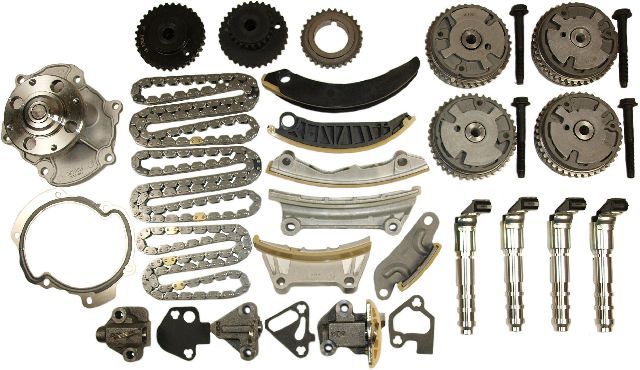
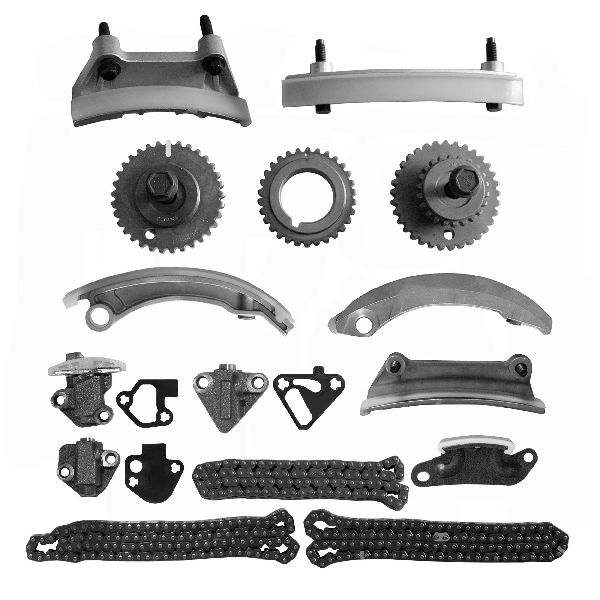
- Timing Chain Kit
(OEM #ACDelco 12651450 (This is one of several kit numbers, verify by VIN. Supersedes older versions))— This is the definitive fix for the most common cause of P0008. A quality kit includes all three chains (1 primary, 2 secondary), all tensioners, guides, and associated hardware.
Related Codes That Often Appear With This One
- P0017 — Crankshaft Position - Camshaft Position Correlation Bank 1 Sensor B. This code is very specific to the exhaust camshaft on Bank 1 being out of sync with the crank. It frequently appears with P0008 as part of the same timing chain problem. [NHTSA ODI #10957359, NHTSA ODI #10863342]
- P0016 — Crankshaft Position - Camshaft Position Correlation Bank 1 Sensor A. This is the companion code to P0017, pointing to the intake camshaft on Bank 1. Seeing P0008, P0016, and P0017 together strongly indicates a base timing issue on Bank 1.
- P0009 — Engine Position System Performance Bank 2. This is the equivalent code for the other engine bank (front/radiator side). If both P0008 and P0009 are present, it indicates a problem with the primary timing chain that connects to the crankshaft or a shifted reluctor wheel. [18, NHTSA ODI #10863342]
Technical Service Bulletins (TSBs) & Recalls
- TSB #12-06-01-009F: Announces the availability of updated timing chain kits to repair stretched chains that cause codes P0008, P0009, P0016, P0017, etc. This bulletin lists the affected vehicles and part numbers for the comprehensive kits.
- TSB #PIP3423P: Addresses the issue of a shifted crankshaft reluctor wheel as a potential cause for timing codes (P0008, P0016, etc.) after timing chain replacement has failed to resolve the issue. It provides diagnostic images and confirms the fix is crankshaft replacement.
- Special Coverage Adjustment #11340A (supersedes #10287): Details the extended warranty coverage of 10 years or 120,000 miles for premature timing chain wear on certain 2009 models, among others. This program is now expired for all vehicles in the 2009-2016 range.
Platform-Specific Known Issues
- GM Special Coverage Adjustment #11340A / #10287: GM acknowledged the premature timing chain wear issue and provided an extended warranty of 10 years or 120,000 miles from the vehicle's in-service date. This covered the cost of timing chain replacement for eligible vehicles. IMPORTANT: As of the current date, this coverage has expired for all 2009-2016 model year vehicles.
- Oil Life Monitor (OLM) System: The factory calibration of the OLM was overly optimistic, often leading to excessively long oil change intervals. This is widely believed to be a primary contributor to the timing chain failures. Owners are strongly advised to use full-synthetic oil and change it every 5,000 miles, regardless of the OLM reading.
Mechanic-Grade Diagnostic Values
- Camshaft Position Sensor 5V Reference Circuit Voltage — expected: > 4.8 V. Failure: Less than 4.8V indicates an open/high resistance in the circuit or a faulty ECM.
- Camshaft Position Sensor Signal Circuit Voltage (Key On, Engine Off) — expected: 4.8 - 5.2 V. Failure: Reading outside this range suggests a short to voltage, short to ground, or an open/high resistance in the signal circuit.
- Camshaft Position Sensor Low Reference Circuit Resistance to Ground — expected: < 5.0 Ohms. Failure: Greater than 5.0 Ohms indicates an open or high resistance in the ground circuit.
- VVT Actuator Solenoid Coil Resistance — expected: 8 - 12 Ohms. Failure: A reading significantly outside this range (e.g., open circuit or megaohms) indicates a failed solenoid coil.
- Scan Tool Cam/Crank Correlation Degrees — expected: Less than 6 degrees of variance. Failure: The ECM will set P0008 if it detects that both camshafts on one bank are misaligned with the crankshaft by more than 6 degrees for a cumulative period.
Scan Tool Commands That Help
- GDS2 (GM Techline): Camshaft Position Actuator Solenoid Test — This bidirectional command allows a technician to manually command the VVT solenoids on and off while monitoring the cam position sensor data. It helps verify if a solenoid is physically responding to ECM commands, isolating a faulty solenoid from a wiring or mechanical phaser issue.
- GDS2 (GM Techline): Camshaft Position Variance Live Data — Monitoring the desired vs. actual camshaft position PIDs while driving or power braking can reveal if the actual cam position deviates significantly from the ECM's target, confirming a timing correlation issue in real-time.
Wiring & Ground Locations
- G110 — Right rear of the engine, mounted to the back of the cylinder head.. This is an engine ground. A poor connection here can cause erratic behavior in various engine sensors and actuators, potentially contributing to false codes or incorrect readings from the cam/crank position sensors.
- G113 — Left side of the engine, at an engine-to-transmission stud.. This is another critical engine ground point. Similar to G110, corrosion or a loose connection can introduce electrical noise and resistance, affecting sensor signals that are crucial for timing calculations.
- Camshaft Position Sensor Connectors (Bank 1) — On the top rear of the engine (firewall side). The intake and exhaust sensors are located on the valve cover for Bank 1.. GM issued a service bulletin (PI0090D) regarding intermittent hesitation that could be caused by poor terminal connections at these specific connectors. Although for a different symptom, it highlights a known weak point in the wiring harness relevant to the sensors that trigger P0008.
Real Owner Repair Stories
- Camaro5 Forums user 'secrethero89' (Chevrolet Camaro 3.6L V6 (LLT engine, similar to Traverse)) — P0008 and P0009 codes present.
❌ Tried (didn't work) Replaced all 4 camshaft position sensors (ACDelco), Replaced all 4 VVT solenoids, Replaced timing chains (Cloyes kit), Replaced VVT sprockets (phasers), Replaced crankshaft position sensor (ACDelco)
✅ What actually fixed it The crankshaft reluctor wheel had slipped by 1.5 teeth. A mechanic was able to fix it by removing the oil pan, carefully repositioning the wheel on the crankshaft without removing the crank from the engine, and applying a small tack weld to prevent future movement.
OEM Part Supersession History
12651450 (ACDelco/GM Timing Chain Kit)→12693218, then 12700436— Successive updates to the timing chain kit to improve durability and address premature wear issues. The kits include updated chains, guides, and tensioners.
Heads up: While the kits are generally interchangeable for the engine family, it is critical to use the latest available part number for a given VIN to ensure you have the most revised and durable components. Using an older stock kit defeats the purpose of the repair.
Model Year Variations Within This Range
- 2009-2012 (LLT Engine): These earlier models are considered more susceptible to timing chain issues. The original Oil Life Monitor (OLM) algorithm was overly optimistic and was later recalibrated via a dealer software update to recommend shorter oil change intervals. The timing chain design in these early years was less robust.
- 2013-2016 (LFX Engine): The LFX engine featured several updates over the LLT, including a revised cylinder head design with integrated exhaust manifolds, lighter components, and an improved timing chain design with a smaller pitch and more sprocket teeth for quieter operation. While still susceptible, the timing chain failure rate is generally considered lower on LFX engines compared to the early LLT.
Helpful Videos
We Have This Part in Stock

The information in this article is provided for general reference and educational purposes only. Vehicle specifications, procedures, and part compatibility can vary by production date, trim level, and region. Always consult your vehicle's factory service manual and verify part numbers before purchasing or performing repairs. Safety-critical components such as airbags, seat belts, and braking systems should be installed by a qualified professional.
- Chevrolet TRAVERSE:
- 🧭 Diagnostic Flowchart
- 🎬 Helpful Videos
- 🛍️ Shop This Part
- What's Unique About the 2009-2016 Chevrolet TRAVERSE
- Symptoms You May Notice
- Most Likely Causes
- Rare But Worth Checking
- Diagnosis Steps
- Parts You'll Likely Need
- Related Codes That Often Appear With This One
- Technical Service Bulletins (TSBs) & Recalls
- Platform-Specific Known Issues
- Mechanic-Grade Diagnostic Values
- Scan Tool Commands That Help
- Wiring & Ground Locations
- Real Owner Repair Stories
- OEM Part Supersession History
- Model Year Variations Within This Range
- 🎟️ Get 5% Off