

P0008 on 2018-2023 Chevrolet Traverse 3.6L V6: Timing Chain Causes and Fixes
On a 2018-2023 Traverse, code P0008 almost always means the timing chains have stretched. This is a serious, labor-intensive repair costing $2,500 to $4,000 and should not be ignored, as it can lead to catastrophic engine failure. This is a well-documented issue across the GM 3.6L V6 engine family.
- P0008 on a 2018-2023 Traverse is a serious code that almost always indicates stretched timing chains.
- Do not waste money replacing sensors; the problem is mechanical and requires a complete timing chain replacement.
- This is an expensive repair ($2,500-$4,000) that should only be done by a professional shop.
- Limit driving to prevent the chain from breaking, which would cause catastrophic engine damage.
- Using high-quality full-synthetic oil and changing it every 5,000 miles can help extend the life of the replacement chains.
What's Unique About the 2018-2023 Chevrolet Traverse
The prompt specified the LFX engine, which was used in the first-generation Traverse (through 2017). The 2018-2023 models actually use the updated LFY 3.6L V6. Both engines are part of the GM High Feature V6 family, which has a long, well-documented history of premature timing chain stretching. The issue is so common that GM issued special coverage adjustments and multiple Technical Service Bulletins (TSBs) for previous generations. While the LFY engine has some updates, the core issue can still occur, often linked to extended oil change intervals and the design of the chains themselves.
Symptoms You May Notice
- Check Engine Light is on
- Rattling or scraping noise from the engine, especially on a cold start
- Reduced engine power and poor acceleration.
- Rough or unstable idle.
- Slightly longer crank time to start the engine.
- Decreased fuel economy.
- Engine vibration felt in the cabin.
- Replacing the camshaft position sensors.
- Replacing the crankshaft position sensor.
- Replacing the variable valve timing (VVT) solenoids. These parts rarely cause P0008 on their own and usually set other specific codes.
Most Likely Causes
- Stretched Timing Chains 🔴 High Probability → Shop Engine Timing Chain The GM 3.6L V6 engine family has a documented history of premature timing chain wear due to the original chain design being susceptible to wear in the chain link pin holes. This is the primary and most common cause for P0008.
How to confirm: A professional technician can use a scan tool to view camshaft angle deviation data; a deviation of over 4-6 degrees confirms a timing issue. An oscilloscope can also be used to compare the cam and crank sensor waveforms directly, which is the most definitive non-invasive test.
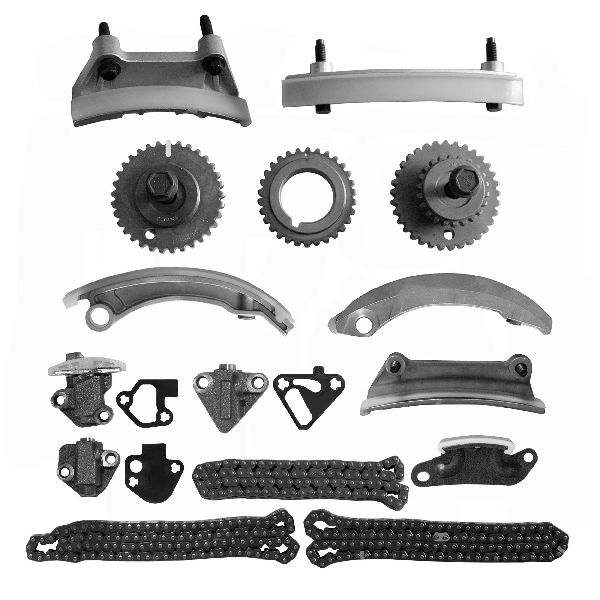
Typical fix: Replace all three timing chains (primary and both secondary), along with the tensioners and guides. This is a major, labor-intensive repair. It is critical to use the updated, more robust chain kits provided by GM to prevent a recurrence.
Est. part cost: $400-$700 - Low or Degraded Engine Oil 🟡 Medium Probability The timing chain tensioners are hydraulic and rely on clean oil at the correct pressure to keep the chains tight. GM's historically long oil change intervals can lead to oil breakdown and sludge, which starves the tensioners and accelerates chain wear.
How to confirm: Check the engine oil level and condition. If it is low or very dirty, this is a likely contributor. An oil change may temporarily resolve the code, but if it returns, the chains are already permanently stretched.
Typical fix: Perform an oil change with a high-quality, full-synthetic oil meeting GM's dexos1 specification. If the code returns, the chains are likely already stretched beyond the tensioners' ability to compensate and require replacement.
Est. part cost: $50-$100 - Failed Timing Chain Tensioner(s) ⚪ Low Probability → Shop Engine Timing Chain The hydraulic tensioners can fail, stick, or weaken, allowing slack in the timing chains even if the chains themselves are not significantly stretched. This is often a consequence of poor oil quality or low oil levels.
How to confirm: This is typically diagnosed during a visual inspection when the engine front cover is removed for a timing chain service. A rattling noise on startup is a strong indicator of a failing tensioner.
Typical fix: Tensioners should always be replaced as part of a complete timing chain service. It is not recommended to replace only the tensioners without also replacing the chains, as the chains are likely worn as well.
Est. part cost: $100-$200 (part of a full kit)
Rare But Worth Checking
- Slipped Crankshaft Reluctor Wheel: → Shop Engine Crankshaft This is a known issue that can occur, sometimes even after a timing chain replacement. If new chains don't fix the code, this is the next thing to investigate. GM issued TSB PIP3423P regarding this specific problem. The fix is to replace the crankshaft.
Diagnosis Steps
- Verify the code with an OBD-II scanner. Note any other codes present, especially P0009, P0016-P0019.
- Check the engine oil level and condition. If low or dirty, perform an oil change with the correct full-synthetic oil and clear the code. See if it returns.
- Listen for a rattling or scraping noise from the passenger side of the engine during a cold start, which indicates loose timing components.
- If available, use an advanced scan tool to monitor the camshaft angle variance PIDs. A consistent deviation greater than 4-6 degrees from the desired angle confirms a mechanical timing issue.
- For definitive diagnosis without disassembly, use a lab scope to compare the crankshaft position sensor and camshaft position sensor waveforms against a known-good pattern.
- If scan data or scope analysis confirms the issue, the fix is a complete timing chain replacement. This is a job for a professional shop.
- If the code persists *after* a timing chain replacement, investigate a slipped crankshaft reluctor wheel per GM TSB PIP3423P.
Parts You'll Likely Need
- Timing Chain Kit
(OEM #12680750)— This is the definitive fix for a stretched timing chain. A complete kit ensures all wearable components (chains, guides, tensioners) are replaced at once. Using the updated OEM kit is crucial for a lasting repair.
Trusted brands: ACDelco (OEM)
OEM price range: $500-$650
Aftermarket price range: $350-$500
Related Codes That Often Appear With This One
- P0009 — This is the identical code for Bank 2 (the radiator side of the engine). Seeing both P0008 and P0009 together strongly points to a stretched primary timing chain that affects both banks.
- P0016, P0017, P0018, P0019 — These are more specific crankshaft-to-camshaft correlation codes. They are triggered by the same root cause (stretched chains) and help confirm the diagnosis. Seeing these codes together with P0008 makes the diagnosis of a timing chain issue almost certain.
Technical Service Bulletins (TSBs) & Recalls
- PIP3423P: Addresses a slipped crankshaft reluctor wheel as a potential cause for timing codes if a chain replacement does not solve the issue. This bulletin specifically notes that P0008 or P0009 may be set and technicians must inspect for loose timing chains or tensioners.
- 12-06-01-009G: Announces updated timing chain kits to repair stretched chains and provides part numbers and procedures for affected vehicles. It also notes that guides and sprockets are often replaced unnecessarily.
- PIP5163H: A comprehensive TSB that covers diagnosis for P0008 and related codes, often leading to timing chain replacement.
- 19-NA-206: This TSB addresses the common 'Shift to Park' message, a separate known issue on these vehicles.
- 20-NA-085: Notes a specific batch of 2019-2020 3.6L engines may be missing an insert on the left primary timing chain guide, leading to rapid chain wear.
Platform-Specific Known Issues
- The GM 3.6L High Feature V6 engine family (LLT, LFX, LFY) is known for premature timing chain wear, making P0008 a very common and well-documented code for this platform.
- GM previously offered a Special Coverage Adjustment (#11340C) that extended the warranty for this issue to 10 years or 120,000 miles on older models, though this has likely expired for most vehicles. It is still worth checking with a dealer for any applicable coverage on a specific VIN.
- The 2018 model year, being the first year of the second generation, has a higher number of general complaints, including some transmission and electrical issues, compared to later years of the same generation.
Mechanic-Grade Diagnostic Values
- Scan Tool Cam/Crank Correlation Variance — expected: Less than 6 degrees of variance at idle or 2000 RPM.. Failure: A consistent deviation greater than 6 degrees will cause the ECM to set the code.
- VVT Actuator Solenoid Coil Resistance — expected: 8 - 12 Ohms.. Failure: A reading of OL (open circuit), zero (short), or significantly outside the expected range indicates a failed solenoid.
- Engine Oil Pressure (3.6L V6 Family) — expected: Minimum 10 psi (69 kPa) at idle; Minimum 20 psi (138 kPa) at 2,000 RPM.. Failure: Pressure below these minimums can starve the hydraulic tensioners and VVT phasers, accelerating wear and causing timing codes.
- Crankshaft Reluctor Wheel Physical Position — expected: 25 to 26 mm from the machined surface of the crankshaft throw to the edge of the open space in the reluctor wheel.. Failure: Any deviation indicates the wheel has slipped, which requires crankshaft replacement. This is a critical measurement if codes return after a timing chain replacement.
Scan Tool Commands That Help
- GDS2 (GM Techline): Camshaft Position Actuator Solenoid Test — This bidirectional command allows a technician to manually cycle the VVT solenoids while monitoring cam position data. It helps rule out a faulty solenoid or blocked oil passage before condemning the timing chains.
- GDS2 (GM Techline): Crankshaft Position Variation Learn (CASE Relearn) — This is a mandatory procedure after replacing timing components, the crankshaft sensor, or the ECM. It calibrates the ECM to the minor physical variations of the reluctor wheel to ensure accurate timing detection. Failure to perform this can cause persistent timing codes.
Wiring & Ground Locations
- G103 — Typically located on the cowl at the left (driver's side) rear of the engine compartment, sometimes above the brake booster.. This is a primary ground point for the Engine Control Module (ECM). A poor connection here can cause erratic ECM behavior and false sensor readings, although it's an unlikely cause for a persistent P0008.
- G110 — On the right rear of the engine, mounted to the back of the cylinder head (Bank 1).. This ground is physically located on Bank 1, the bank referenced by code P0008. A poor connection could potentially affect sensor readings for that bank.
- Engine Harness Grounds — Several smaller ground wires from the main harness are attached directly to the cylinder heads or engine block.. These grounds are essential for providing a clean reference for the camshaft and crankshaft position sensors. A loose or corroded ground can introduce noise into the sensor signals, potentially contributing to correlation issues.
Real Owner Repair Stories
- Camaro5 Forums user 'secrethero89' (Chevrolet Camaro 3.6L V6 (LLT engine, same family as Traverse's LFY)) — P0008 and P0009 codes present.
❌ Tried (didn't work) Replaced all 4 camshaft position sensors (ACDelco), Replaced all 4 VVT solenoids, Replaced timing chains (Cloyes kit), Replaced VVT sprockets (phasers), Replaced crankshaft position sensor (ACDelco)
✅ What actually fixed it The crankshaft reluctor wheel had slipped by 1.5 teeth. A mechanic was able to physically correct the position, but the standard repair is crankshaft replacement. This fixed the codes after all other parts replacements failed. - NHTSA ODI #11204288 — An owner reported a loss of power while driving through an intersection when P0008 set, requiring a full timing chain replacement.
- NHTSA ODI #10819772 — After experiencing codes P0008 and P0017, an owner attempted an oil flush and induction system cleaning to resolve the issue.
- NHTSA ODI #11466949 — A certified mechanic advised an owner that the timing chain had stretched, resulting in a stored P0008 code even without an active Check Engine Light.
- NHTSA ODI #11433973 — One owner reported the engine started making clanging noises before a mechanic confirmed the timing chain was stretching (P0008), resulting in a $3,000 repair.
OEM Part Supersession History
12635447, 12673669, 12675579→12680750— GM has released multiple updated timing chain kits to improve durability and address premature stretching. The new chains use an improved link design.
Model Year Variations Within This Range
- 2019-2020: A specific batch of 3.6L LFY engines manufactured between January 2019 and March 2020 may be missing an insert on the left primary timing chain guide. This defect can lead to accelerated chain wear and the setting of timing codes like P0008. This is documented in TSB 20-NA-085.
- 2018-2023: The entire 2018-2023 range uses the 3.6L LFY V6 engine paired with a 9-speed automatic transmission. This is distinct from the first generation (ending in 2017) which used the LLT/LFX engines and a 6-speed transmission. The third generation, starting in 2024, uses a completely different 2.5L Turbo engine.
Diagnostic Flowchart
Other Known Issues on This Vehicle
Issues unrelated to this code that are worth knowing about as an owner of this generation:
- Transmission Shudder (9T65) 🟠 Medium — Common, especially on 2018-2020 models. Can occur at various mileages. Often presents as a shudder/vibration during light acceleration or between shifts. (Ref: Multiple TSBs exist, including some that recommend a fluid flush with an updated fluid type or torque converter replacement.)
- 'Shift to Park' Message 🟡 Low — Very common, particularly on 2018-2019 models. The message appears when the vehicle is in park, preventing it from shutting down completely and draining the battery. (Ref: TSB 19-NA-206 describes the issue and repair, which involves installing a new wiring harness jumper or replacing a microswitch in the shifter assembly.)
- Cracked Exhaust Y-Pipe 🟠 Medium — A known issue where the front exhaust Y-pipe cracks near a support bracket, causing an exhaust leak and potentially triggering P0420/P0430 codes. (Ref: TSB PIP5681C addresses this specific issue.)
- Electrical System Glitches 🟡 Low — Owners report various electrical issues, including malfunctioning sensors, freezing infotainment screens, and other random electronic faults, with more complaints on earlier 2nd-gen models.
Used vs. New Parts: Buying Guide for This Vehicle
When a used part is the smart pick: For a P0008 repair, using used parts is strongly discouraged. The primary failure components (timing chains, tensioners, guides) are wear items and should always be replaced with new parts. While sensors or solenoids could theoretically be sourced from a low-mileage wreck, the labor cost to access them makes installing a used part a significant gamble.
Donor-vehicle mileage cap: roughly under 30000 miles for the part to have meaningful remaining life.
What to inspect on the donor part:
- For sensors/solenoids, verify the donor vehicle had no check engine light or timing-related codes.
- Ensure the donor vehicle was not in a severe front-end collision that could have damaged engine components.
- Check for signs of oil sludge or poor maintenance on the donor engine.
OEM-only on this vehicle (don't cheap out):
- Timing Chain Kit: This is the most critical part of the repair. Due to the history of premature failures and subsequent part updates by GM, only the latest ACDelco OEM kit (PN 12680750 or its successor) should be used to ensure a lasting repair.
Aftermarket brands forum-validated for this vehicle:
- Cloyes: A well-regarded aftermarket manufacturer of timing components. However, for this specific high-risk repair, OEM is still the safest recommendation.
Brands owners have reported issues with on this vehicle:
- Unbranded or 'white-box' timing kits from online marketplaces. The quality of the chain metallurgy and tensioner manufacturing is critical, and failure of a cheap component can destroy the engine.
Real Owner Stories
Aggregated from forums and TSBs cited above. Mileages and costs reflect what owners reported in those sources.
2010 Buick Enclave 3.6L V6
Symptoms: Owner reported a P0008 code appearing on this platform mate which shares the same engine architecture.
What fixed it: Timing chain replacement.
Cost: $4,500-$4,500
Source hint: CarComplaints.com
2010 Chevrolet Traverse 3.6L V6
Symptoms: The owner experienced a long journey with the P0008 code, including multiple shop visits and misdiagnoses.
What fixed it: Confronting the timing chain reality (replacement).
Source hint: Reddit - r/AskAMechanic
Related OBD-II Codes
Frequently Asked Questions
Is there a TSB for the 2019-2020 Traverse regarding rapid timing chain wear?
What should I do if P0008 returns after I've already replaced my timing chains?
Does GM offer any extended warranty coverage for timing chain issues on the second-generation Traverse?
Can a simple oil change fix the P0008 code on my 3.6L V6?
Are there specific parts I should use to ensure the P0008 code doesn't come back?
Why does my Traverse show a 'Shift to Park' message along with engine issues?
Helpful Videos

We Have This Part in Stock


The information in this article is provided for general reference and educational purposes only. Vehicle specifications, procedures, and part compatibility can vary by production date, trim level, and region. Always consult your vehicle's factory service manual and verify part numbers before purchasing or performing repairs. Safety-critical components such as airbags, seat belts, and braking systems should be installed by a qualified professional.
- Chevrolet Traverse:
- 🧭 Diagnostic Flowchart
- 🎬 Helpful Videos
- 🛍️ Shop This Part
- What's Unique About the 2018-2023 Chevrolet Traverse
- Symptoms You May Notice
- Most Likely Causes
- Rare But Worth Checking
- Diagnosis Steps
- Parts You'll Likely Need
- Related Codes That Often Appear With This One
- Technical Service Bulletins (TSBs) & Recalls
- Platform-Specific Known Issues
- Mechanic-Grade Diagnostic Values
- Scan Tool Commands That Help
- Wiring & Ground Locations
- Real Owner Repair Stories
- OEM Part Supersession History
- Model Year Variations Within This Range
- Other Known Issues on This Vehicle
- Used vs. New Parts: Buying Guide for This Vehicle
- Real Owner Stories
- 2010 Buick Enclave 3.6L V6
- 2010 Chevrolet Traverse 3.6L V6
- Related OBD-II Codes
- Frequently Asked Questions
- 🎟️ Get 5% Off