

P0008 on 2015-2016 GMC Canyon 3.6L: Stretched Timing Chain Causes and Fixes
On a 2015-2016 GMC Canyon with the 3.6L V6 engine, code P0008 almost always means the timing chains have stretched. This is a serious, labor-intensive repair requiring replacement of the chains, tensioners, and guides, with shop costs typically ranging from $1,800 to $3,000+. In rare cases, it can be a slipped crankshaft reluctor wheel, which is an even more severe repair.
- P0008 on your 2015-2016 Canyon 3.6L is a serious code that almost certainly points to stretched timing chains.
- Do not ignore this code. Continued driving risks severe, and much more expensive, engine damage.
- This is not a DIY-friendly repair. It is complex, requires special tools, and should be handled by a qualified technician.
- Using high-quality, preferably OEM, replacement parts is crucial for a lasting repair.
- If the timing chains are confirmed to be in good condition, the crankshaft reluctor wheel must be inspected per TSB PIP3423P.
What's Unique About the 2015-2016 Gmc CANYON
The 3.6L LFX V6 engine in the 2015-2016 GMC Canyon has a well-documented history of premature timing chain wear. While GM made design improvements to the LFX engine to increase durability over the earlier LLT version, the issue can still occur. The problem was so common on previous model years with related engines that GM issued a Special Coverage Adjustment (#11340C) extending the warranty for this specific failure to 10 years or 120,000 miles. Although this specific SCA may not apply to the 2015-2016 model years, it demonstrates the engine family's history. Therefore, a P0008 code on this truck is much more likely to be a major mechanical issue (stretched chains) than a simple sensor failure.
Diagnostic Flowchart
Tap your situation to follow the diagnostic path that matches what you're seeing on this vehicle.
Symptoms You May Notice
- Check Engine Light is on
- Rattling or scraping noise from the front of the engine, especially on a cold startup or that sounds like 'marbles in a can'
- Rough or unstable idle
- Reduced engine power and poor acceleration
- Worse than normal fuel economy
- Difficulty starting the engine
- Replacing the camshaft or crankshaft position sensors. While these sensors can fail, they are not the root cause when the mechanical timing is genuinely off. A proper diagnosis will check the live data from these sensors to confirm a timing correlation issue before replacing parts. Replacing sensors for a P0008 code is almost always a waste of money.
Most Likely Causes
- Stretched Timing Chains 🔴 High Probability → Shop Engine Timing Chain The GM 3.6L V6 engine family has a history of premature timing chain wear, often attributed to chain design and oil quality degradation from extended oil change intervals recommended by the Oil Life Monitor (OLM). 🎬 Watch: Why these GM V6 timing chains fail so often. Even the improved LFX engine is not immune.
How to confirm: A technician will use a scan tool to read camshaft deviation data. Significant deviation (often cited as more than +/- 4 degrees) confirms a correlation error. Definitive diagnosis requires physical inspection of the chain for slack, which involves removing the engine's front timing cover.
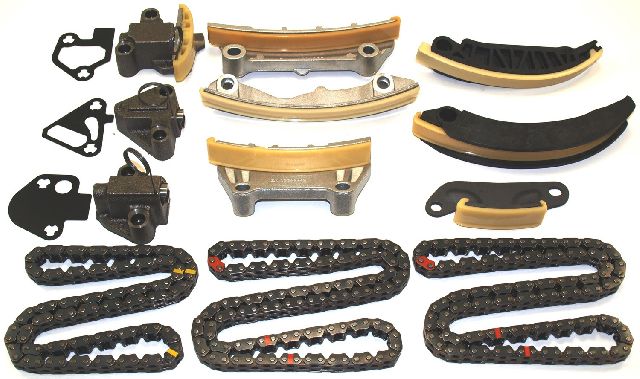
Typical fix: Replace all three timing chains, all tensioners, and all guides with an updated kit. This is a major repair. It is critical to use a high-quality, preferably OEM, kit.
Est. part cost: $250-$500 - Failed Timing Chain Tensioners 🔴 High Probability → Shop Engine Timing Chain The tensioners, which use oil pressure to keep the chains tight, can fail, wear out, or have their gaskets leak, allowing the chains to become slack. This is a common part of the overall timing system failure and is exacerbated by degraded oil.
How to confirm: Usually diagnosed during the physical inspection for a stretched timing chain. A rattling noise that lessens as oil pressure builds is a key symptom. A failed tensioner will allow visible slack in the chain.
Typical fix: Tensioners are always replaced as part of a complete timing chain service.
Est. part cost: $100-$200 (part of kit) - Low or Degraded Engine Oil 🟡 Medium Probability The timing chain tensioners are hydraulic and rely on clean, sufficient oil to function. Long oil change intervals, often promoted by the vehicle's Oil Life Monitor (OLM), can lead to oil breakdown and sludge formation. This reduces the oil's ability to lubricate and operate the tensioners, accelerating chain wear.
How to confirm: Check the oil level on the dipstick and inspect its condition. If it's very low or appears dirty/sludgy, this is a likely contributing factor. Many owners who experience this issue report following the OLM rather than a fixed mileage interval.
Typical fix: Change the oil and filter with high-quality synthetic oil. However, if the timing chains have already stretched and set code P0008, an oil change alone will not fix the problem but is critical to perform with the new parts.
Est. part cost: $50-$100
Rare But Worth Checking
- Slipped Crankshaft Reluctor Wheel: → Shop Engine Crankshaft GM issued TSB #PIP3423P which specifically mentions this possibility for the 2015-2016 Canyon. If the timing chains are inspected and found to be tight, the reluctor wheel (which the crankshaft sensor reads) may have spun slightly on the crankshaft due to an insufficient press fit. This causes a timing correlation error even with perfect chains. Diagnosis involves measuring the wheel's position, possibly with a borescope. The official fix is crankshaft replacement, though some specialists have been known to tack weld it in place.
Diagnosis Steps
- Verify the code is present using an OBD-II scanner.
- Check the engine oil level and condition. If low or dirty, correct this first, clear the codes, and see if they return. This is a critical first step as low/dirty oil is a primary contributor.
- Listen for any rattling or scraping noises from the front of the engine, especially during a cold start.
- Use an advanced scan tool to monitor camshaft deviation PIDs (Parameter IDs). Persistent deviation values exceeding +/- 4 degrees strongly suggest a stretched timing chain.
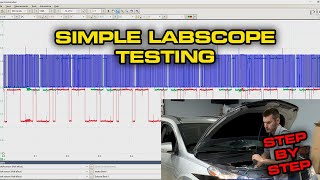
- If scan tool data is inconclusive, use an oscilloscope to compare the patterns of the crankshaft and camshaft position sensors. A stretched chain will show a delayed camshaft signal relative to the crankshaft. 🎬 See how to test timing chain slack with a labscope.
- If a mechanical fault is confirmed, the next step is to remove the front timing cover for a physical inspection of the timing chains, guides, and tensioners for slack and wear.
- If chains appear tight with no visible defects, follow TSB #PIP3423P to inspect the crankshaft reluctor wheel for movement. This can sometimes be done with a borescope through the crankshaft position sensor hole to check its rotational position relative to a crankshaft feature. The TSB provides specific measurements to verify its position.
Parts You'll Likely Need
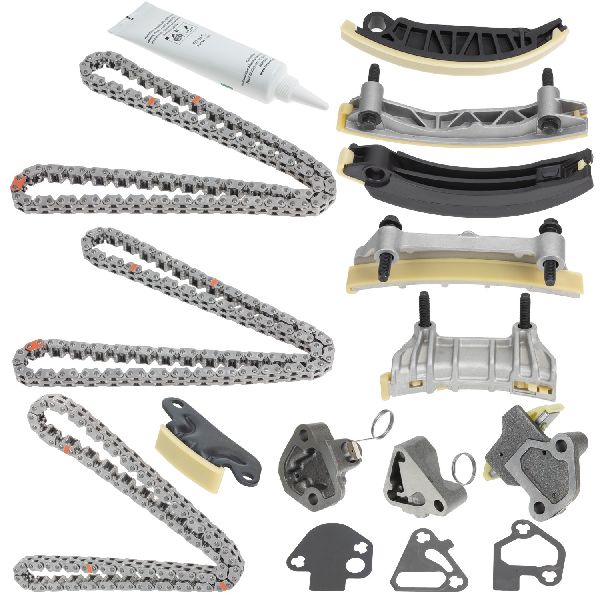
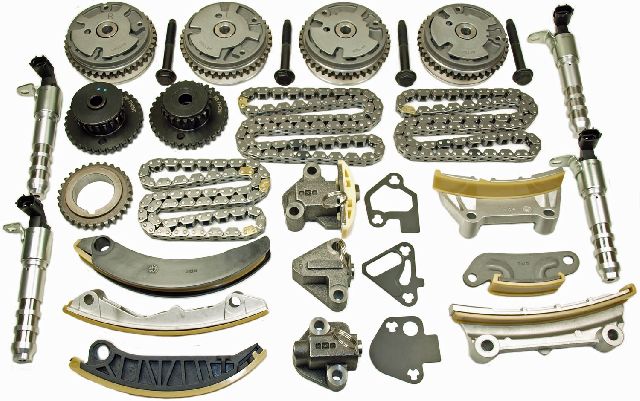
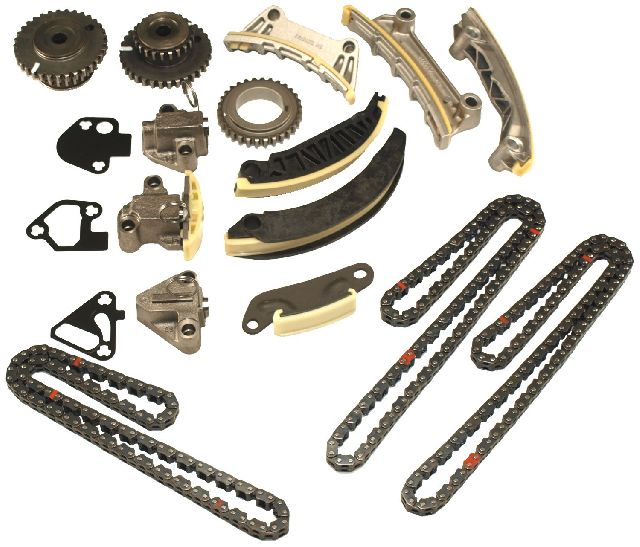
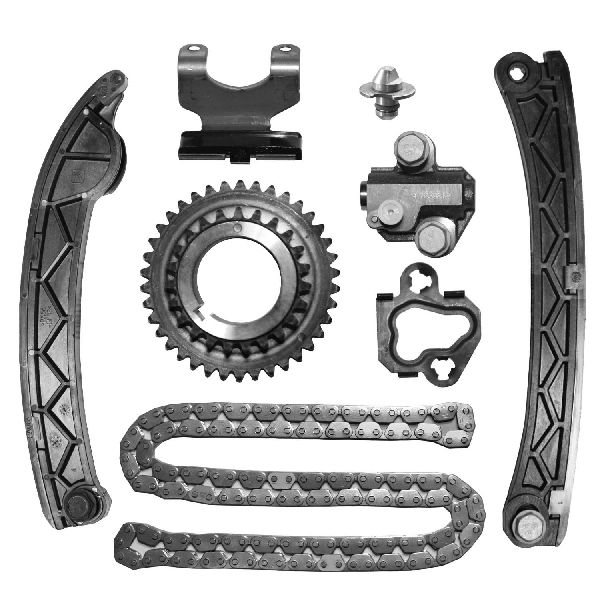
- Timing Chain Kit
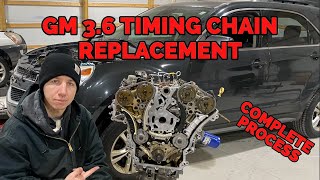
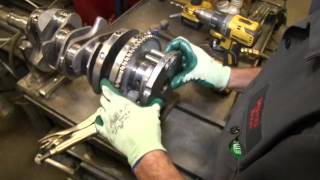
(OEM #ACDelco 12700437)— This is the definitive fix. A complete kit ensures all worn components (chains, tensioners, guides, and sometimes sprockets) are replaced at once to restore proper engine timing. 🎬 Watch this full step-by-step timing chain replacement walkthrough. Using a high-quality OEM kit is highly recommended for durability.
Trusted brands: ACDelco (OEM), Cloyes
OEM price range: $270-$400
Aftermarket price range: $160-$300
Related Codes That Often Appear With This One
- P0009 — This is the equivalent code for Bank 2. It's common to see both P0008 and P0009 if the primary timing chain has stretched, as it affects the timing of both cylinder banks.
- P0016, P0017, P0018, P0019 — These are all more specific crankshaft-to-camshaft correlation codes for different cams and banks. They frequently appear alongside P0008 and P0009 and all point to the same root cause: a mechanical timing problem, as noted in TSB PIP3423P.
Technical Service Bulletins (TSBs) & Recalls
- PIP3423P: Instructs technicians to check for loose timing chains, failed tensioners, or a slipped crankshaft reluctor wheel when DTCs P0008, P0009, P0016, P0017, P0018, or P0019 are set. It covers a wide range of GM vehicles with the HFV6 engine family, including the LFX.
- 11340C: A Special Coverage Adjustment for older GM 3.6L engines (LY7, LLT) that extended the warranty to 10 years/120,000 miles for timing chain wear. While not applicable to the 2015-16 LFX, it provides crucial historical context for the engine family's known weakness.
Platform-Specific Known Issues
- The 3.6L LFX V6 engine has a known history of timing chain issues, which is the primary cause for this code, despite improvements over the prior LLT engine.
- GM Technical Service Bulletin #PIP3423P (and its many revisions) directly addresses code P0008 on the 2015-2016 GMC Canyon and points technicians to inspect for loose timing chains or a slipped crankshaft reluctor wheel.
- Owner forums are filled with accounts of this specific failure. Many owners who experienced the failure report strictly following the Oil Life Monitor (OLM), suggesting that the recommended oil change intervals may be too long to prevent chain wear.
Mechanic-Grade Diagnostic Values
- Camshaft Position (VVT) Actuator Solenoid Resistance — expected: 7-13 Ohms. One source cites a spec of 5-15 Ohms, with new parts measuring around 12.8 Ohms. Another test showed a good solenoid with a calculated resistance of 7.6 Ohms.. Failure: An open circuit (infinite resistance) or a short (near zero resistance). One failed example showed 1.6 Mega Ohms (1,600,000 Ohms).
Scan Tool Commands That Help
- GDS2 / Professional Scan Tool: Camshaft Position Actuator Solenoid Test — To command the VVT solenoids on and off to verify their mechanical operation and check for response in live data. This helps rule out a stuck solenoid before performing major mechanical work, though a failed solenoid typically sets its own codes (e.g., P0010, P0013).
- GDS2 / Professional Scan Tool: Crankshaft Position Variation Learn — This procedure is required after replacing the crankshaft position sensor or the ECM. It allows the ECM to learn the precise profile of the new sensor/reluctor wheel for accurate misfire detection. It will not fix a P0008 code but is a necessary follow-up step if the sensor is replaced during diagnosis.
Wiring & Ground Locations
- G103 — Located on the driver's side of the engine compartment, near the battery or underhood fuse block.. This is a major engine and chassis ground point. A poor connection here can cause erratic behavior in multiple electronic systems, including the ECM and its sensors. While not a direct cause of P0008, verifying this ground is clean and tight is a fundamental step in diagnosing any electronic fault code.
- ECM Pins (Crankshaft/Camshaft Sensors) — At the Engine Control Module (ECM) connectors.. To definitively test for a wiring issue, technicians can check for signal, power, and ground directly at the ECM pins for the crankshaft position sensor and the four camshaft position sensors. This bypasses the entire vehicle harness to confirm if the sensor signals are reaching the module correctly. Pinouts can be found in official service manuals or through resources like AutoZone's repair guides.
Real Owner Repair Stories
- Camaro5 Forums user 'secrethero89' (Chevrolet Camaro 3.6L V6 (LFX Engine Family)) — Persistent P0008 and P0009 codes.
❌ Tried (didn't work) Complete timing chain and phaser replacement.
✅ What actually fixed it The crankshaft reluctor wheel had slipped. The fix involved removing the oil pan, repositioning the wheel correctly on the crankshaft, and applying a tack weld to secure it. The codes were resolved after this repair. - Reddit user in r/MechanicAdvice (2007 Suzuki XL7 (GM 3.6L LY7 Engine Family)) — Code P0009, followed by P0008 six days after repair.
❌ Tried (didn't work) Complete timing chain replacement to fix the initial P0009 code.
✅ What actually fixed it The story is a cautionary tale. After the timing chain job, a new P0008 code appeared. The mechanic diagnosed a 'stuck camshaft actuator' and quoted an additional $2,000. This highlights the possibility of either an incorrect initial diagnosis, a mistake during the timing job, or a subsequent, separate failure.
When the Usual Fixes Don't Work
- While a stretched timing chain is the cause in over 95% of cases, there are documented instances where the code persists after a complete timing chain replacement. The most common reason for this is a slipped crankshaft reluctor wheel, which provides the engine's base timing reference. As confirmed in TSB PIP3423P and by owner repair stories, if the timing chains are confirmed to be tight and correctly installed, the reluctor wheel position must be verified before condemning other parts. Failure to do so can result in a very expensive and ineffective timing chain job.
OEM Part Supersession History
Various older kits (e.g., 12651450 for LLT engines)→Multiple newer kits, including 12700437 for LFX— GM has released several revisions of the timing chain kits over the years to improve the durability of the chains and tensioners.
Heads up: There are different kits for different engine RPO codes (LY7, LLT, LFX) and vehicle platforms (transverse vs. longitudinal). It is absolutely critical to verify the correct kit part number using the vehicle's VIN before ordering.
Model Year Variations Within This Range
- 2015-2016: No significant engine hardware differences are noted for the 3.6L LFX V6 between the 2015 and 2016 GMC Canyon. Both model years use the LFX engine with the E92 engine controller and are susceptible to the same timing chain issues.
Helpful Videos
We Have This Part in Stock


The information in this article is provided for general reference and educational purposes only. Vehicle specifications, procedures, and part compatibility can vary by production date, trim level, and region. Always consult your vehicle's factory service manual and verify part numbers before purchasing or performing repairs. Safety-critical components such as airbags, seat belts, and braking systems should be installed by a qualified professional.
- Gmc CANYON:
- 🧭 Diagnostic Flowchart
- 🎬 Helpful Videos
- 🛍️ Shop This Part
- What's Unique About the 2015-2016 Gmc CANYON
- Symptoms You May Notice
- Most Likely Causes
- Rare But Worth Checking
- Diagnosis Steps
- Parts You'll Likely Need
- Related Codes That Often Appear With This One
- Technical Service Bulletins (TSBs) & Recalls
- Platform-Specific Known Issues
- Mechanic-Grade Diagnostic Values
- Scan Tool Commands That Help
- Wiring & Ground Locations
- Real Owner Repair Stories
- When the Usual Fixes Don't Work
- OEM Part Supersession History
- Model Year Variations Within This Range
- 🎟️ Get 5% Off