

P0009 on 2013-2019 Cadillac XTS: Stretched Timing Chain Causes and Fixes
On a 2013-2019 Cadillac XTS, the P0009 code almost always means the timing chains have stretched. This is a serious and expensive repair requiring the replacement of all timing chains, tensioners, and guides, with shop costs typically ranging from $2,100 to $2,900. The issue is a well-documented problem on the GM 3.6L LFX engine family, often accelerated by degraded oil from extended oil change intervals.
- P0009 on a 2013-2019 XTS is a serious code that almost certainly indicates a stretched timing chain.
- Do not waste money replacing sensors; this is a mechanical problem that requires a full timing chain kit replacement.
- The repair is expensive, costing $2,100-$2,900, due to high labor (10-18 hours).
- Frequent oil changes (every 5,000 miles) with full synthetic dexos-approved oil are critical to prolonging the life of the timing chains.
- Ignoring the code can lead to catastrophic engine failure.
What's Unique About the 2013-2019 Cadillac XTS
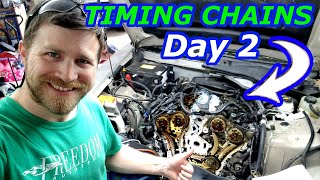
The Cadillac XTS uses the 3.6L LFX V6 engine, a member of GM's High Feature engine family. While GM made improvements to the timing chain design for the LFX engine starting in 2013 compared to its predecessors (the LY7 and LLT), the fundamental design can still be susceptible to premature timing chain wear. A major contributing factor to this wear is often attributed to extended oil change intervals. 🎬 Watch: Why these GM 3.6L timing chains fail prematurely. The original GM Oil Life Monitor (OLM) system could allow oil to degrade significantly over 8,000-12,000 miles, reducing its ability to properly lubricate the chains and hydraulic tensioners. Many owners and experts now recommend ignoring the OLM and changing the oil with a full synthetic dexos-approved 5W-30 every 5,000 miles to prolong chain life.
Diagnostic Flowchart
Tap your situation to follow the diagnostic path that matches what you're seeing on this vehicle.
Symptoms You May Notice
- Check Engine Light illuminated
- Rattling noise from the engine, especially on a cold startup
- Rough or unstable idle
- Reduced engine power and acceleration
- Poor fuel economy
- Engine may stall, especially at low speeds or idle.
- Replacing only the camshaft or crankshaft position sensors. The code P0009 indicates a correlation problem between these sensors, not a failure of the sensors themselves. Replacing them is a common mistake that does not fix the underlying mechanical timing issue.
Most Likely Causes
- Stretched Timing Chains 🔴 High Probability → Shop Engine Timing Chain The GM 3.6L engine family has a known history of premature timing chain wear, often accelerated by oil degradation from extended oil change intervals. Even with the improved LFX engine, the issue persists, though it is considered less frequent than on the earlier LLT versions.
How to confirm: A mechanic can use a scan tool to view camshaft/crankshaft correlation data; a consistent deviation of more than 4-5 degrees indicates a mechanical timing issue. Definitive diagnosis involves physically inspecting the chains for slack by removing the engine's front timing cover, which is a labor-intensive step usually performed during the replacement itself.
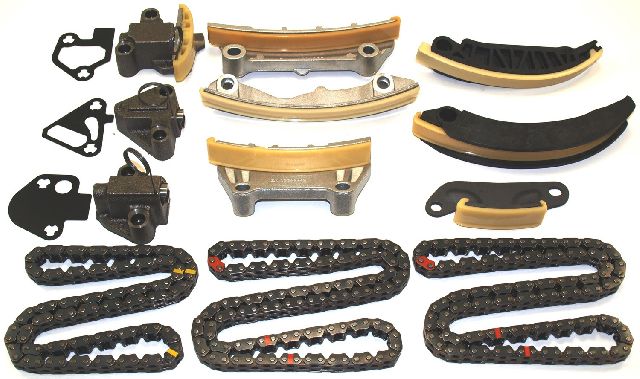
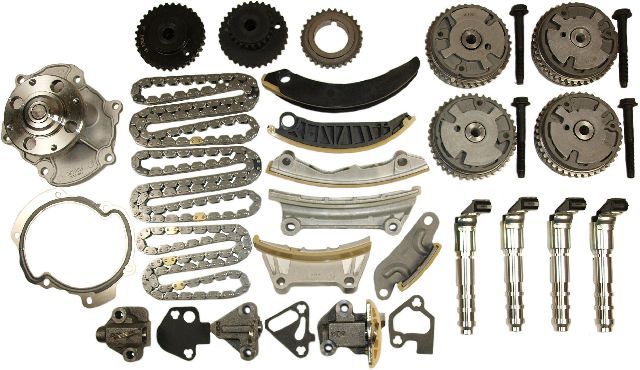
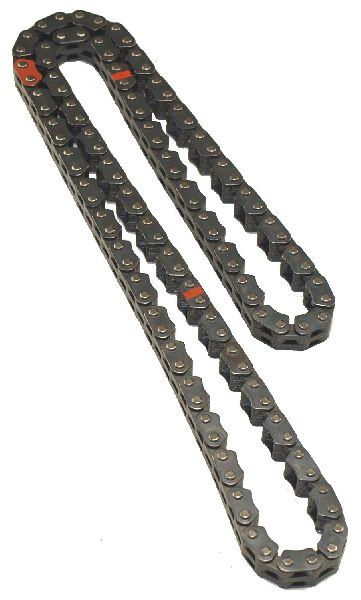
Typical fix: Replace all three timing chains, all tensioners, and all guides as a complete kit. It is critical to use updated OEM parts to prevent a recurrence.
Est. part cost: $300-$650 - Failed Timing Chain Tensioner(s) 🟡 Medium Probability → Shop Engine Timing Chain The hydraulic tensioners rely on clean oil and proper oil pressure. Sludge from infrequent oil changes can cause them to stick or fail, leaving slack in the chains which accelerates wear.
How to confirm: This is diagnosed during a physical inspection when checking the timing chains. A failed tensioner will not hold pressure and will allow the chain guide to retract.
Typical fix: Tensioners are always replaced as part of a complete timing chain service. Replacing only a tensioner without addressing chain stretch is not recommended as the chains are the primary failure point.
Est. part cost: $100-$200 for tensioners alone, but they are included in full kits. - Low or Dirty Engine Oil ⚪ Low Probability The timing system, especially the hydraulic tensioners, is highly sensitive to oil pressure and quality. The LFX engine can also consume oil, up to a quart every 2,000 miles, which GM considers normal. This consumption, combined with long oil change intervals, can lead to low oil levels that starve the timing components, causing rapid wear.
How to confirm: Check the oil level on the dipstick and inspect its condition. If the oil is very dark, gritty, or below the minimum level, it's a strong indicator of neglect that could cause this code.
Typical fix: An immediate oil and filter change with a high-quality full synthetic oil meeting GM's dexos specification. However, if the code is already set, damage (chain stretch) has likely already occurred and an oil change alone will not fix it.
Est. part cost: $50-$100
Rare But Worth Checking
- Shifted Crankshaft Reluctor Wheel: → Shop Engine Crankshaft A known but rare issue documented in GM TSB #PIP3423P. The reluctor wheel that the crankshaft position sensor reads can physically move on the crankshaft, causing a timing correlation error even with good chains. Diagnosis can sometimes be done with a borescope through the crank sensor hole to measure the wheel's position. This requires crankshaft replacement to fix.
- Failed Camshaft Actuator (VVT Solenoid): → Shop Engine Camshaft A solenoid stuck in one position can cause a cam/crank correlation error. While possible, this is much less common than chain stretch and would typically be accompanied by other specific solenoid performance codes (e.g., P0010, P0011, P0020, P0021).
Diagnosis Steps
- Verify the Check Engine Light is on and scan for all DTCs. Note any codes that appear alongside P0009.
- Check the engine oil level and condition. Low or dirty oil is a major red flag and a primary contributor to this failure.
- Using an advanced scan tool, monitor the live data for crankshaft and camshaft position sensor readings. Observe the desired vs. actual cam angles. A consistent deviation greater than 4-5 degrees at idle points to a mechanical timing problem.
- Listen for a rattling or scraping noise from the front of the engine (passenger side), especially during a cold start, which indicates a loose timing chain slapping against the guides.
- If data and symptoms point to a timing issue, the next step is to get a quote for a timing chain replacement. Physical inspection requires significant labor to remove the timing cover, which is usually only done as part of the replacement job itself.
- If a full timing chain replacement has already been performed and the code returns, investigate the rare possibility of a shifted crankshaft reluctor wheel as per TSB #PIP3423P.
Parts You'll Likely Need
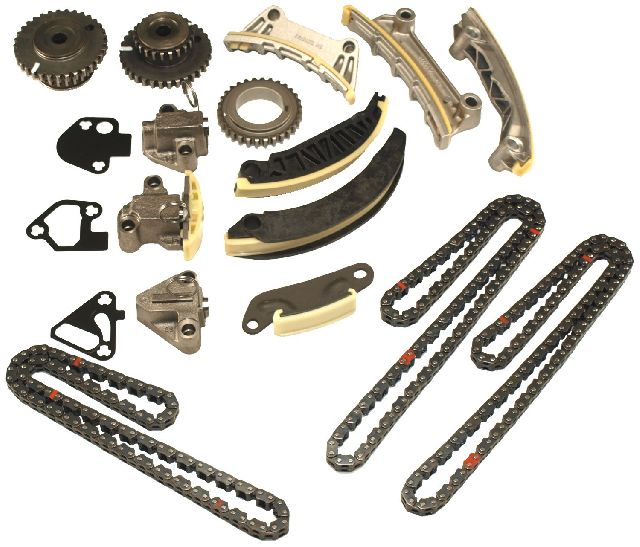
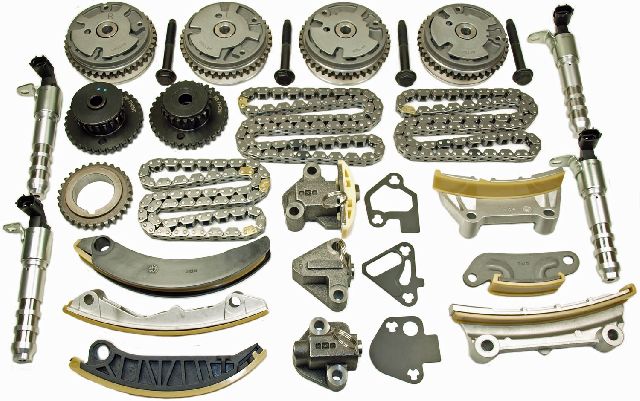
- Engine Timing Chain Kit
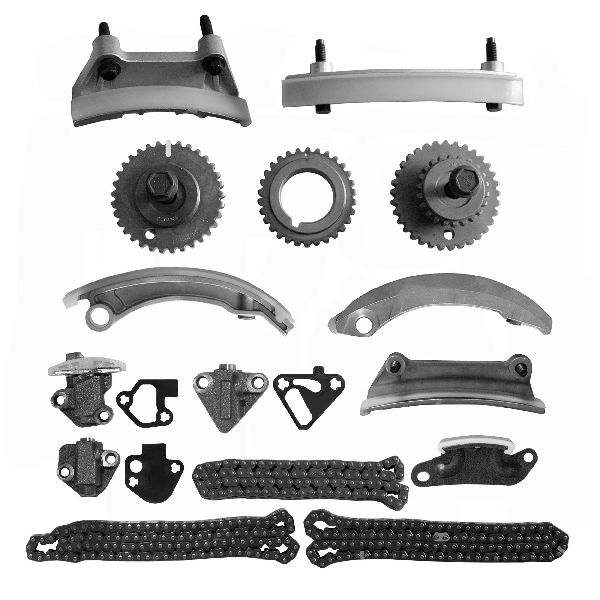
(OEM #12700436)— This is the definitive fix. A complete kit ensures all worn components (chains, guides, tensioners, and sometimes sprockets) are replaced at once to restore proper engine timing. It is critical to use the latest revised parts from GM/ACDelco.
Trusted brands: ACDelco (OEM), Cloyes, Melling
OEM price range: $330-$450
Aftermarket price range: $150-$300
Related Codes That Often Appear With This One
- P0008 — This is the equivalent code for Bank 1. It is very common to see P0008 and P0009 together, indicating a systemic timing chain issue affecting the entire engine, often due to a stretched primary chain.
- P0016, P0017, P0018, P0019 — These are more specific crankshaft/camshaft correlation codes for intake and exhaust cams on both banks. They are all related to the same root cause: stretched timing chains. TSB #PIP3423P lists all these codes as being caused by the same underlying issues.
Technical Service Bulletins (TSBs) & Recalls
- PIP3423P: States that codes P0008, P0009, P0016, P0017, P0018, or P0019 can be caused by loose timing chains, tensioners, or a shifted crankshaft reluctor wheel. It provides diagnostic guidance for the reluctor wheel issue.
- 12-06-01-009F: Announces the availability of updated timing chain kits to address codes like P0009 caused by stretched chains on the High Feature V6 engine family.
Platform-Specific Known Issues
- The 3.6L LFX engine, while an improvement over earlier versions, is known for timing chain stretch that sets codes like P0009.
- GM issued TSB #PIP3423P which directly links P0009 to loose timing chains or tensioners, and in rare cases, a shifted crankshaft reluctor wheel.
- GM's original Oil Life Monitor (OLM) calibration often allowed for excessively long oil change intervals, which is widely cited as a primary contributor to premature chain wear.
Mechanic-Grade Diagnostic Values
- Camshaft/Crankshaft Correlation Deviation — expected: Close to 0 degrees at stable, warm idle.. Failure: A consistent deviation of more than +/- 4-5 degrees at idle strongly suggests a stretched timing chain. The DTC will typically set when deviation exceeds 9 degrees.
- Camshaft Position (CMP) Actuator Solenoid Resistance — expected: 7-12 Ohms at 68°F (20°C).. Failure: A reading significantly outside this range, or an open/infinite reading, indicates a failed solenoid coil.
- Camshaft Position Sensor (CMP) 5V Reference Circuit — expected: 4.8 - 5.2 Volts between the 5V reference circuit and ground.. Failure: Voltage outside this range indicates a wiring or ECM issue.
- Camshaft Position Sensor (CMP) Low Reference Circuit to Ground — expected: Less than 5.0 Ohms.. Failure: A reading greater than 5.0 Ohms indicates high resistance in the sensor's ground circuit, which can cause erratic signals.
Scan Tool Commands That Help
- GDS2 / Tech2: Camshaft Position Actuator Solenoid ON/OFF Command — This bidirectional control allows a technician to command the VVT solenoids on and off while monitoring engine RPM or cam angle data. It helps verify the electrical circuit and mechanical function of a solenoid before suspecting a larger mechanical issue like chain stretch.
- GDS2 / Tech2Win: Crankshaft Position Variation Learn (CASE Relearn) — This is a mandatory service function that must be performed *after* replacing the timing chains, crankshaft sensor, or ECM. It calibrates the system to detect misfires accurately. Failure to perform this relearn can leave other codes (like P1336) and affect engine performance diagnostics.
Wiring & Ground Locations
- G103 — On the front of the passenger side (right) cylinder head.. This is a primary engine ground. A poor connection here can cause erratic behavior in various engine sensors and actuators, including the camshaft and crankshaft position sensors.
- G104 — On the rear of the driver side (left) cylinder head.. This is another critical engine ground point. A loose or corroded G104 can lead to unexplained electrical issues and sensor signal problems that could mimic other failures.
- G101 — Middle of the left radiator support.. Provides a chassis ground for various components in the engine bay. A compromised connection could affect the Engine Control Module (ECM) or its related circuits.
Real Owner Repair Stories
- Reddit r/MechanicAdvice user with a GM 3.6L engine (GM vehicle with 3.6L engine) — Car ran poorly, Check Engine Light on with code P0017 (a related timing code), and the engine oil was found to be very low.
❌ Tried (didn't work) Cleaning and testing the VVT solenoids.
✅ What actually fixed it The timing had jumped two teeth. The comprehensive repair required a full timing job (chains, tensioners, guides), replacement of both VVT sprockets (phasers), and replacement of the exhaust camshaft itself because its alignment dowel pin had broken off. The code remained until a full drive cycle/relearn procedure was completed.
When the Usual Fixes Don't Work
- While P0009 is almost always caused by stretched timing chains, a notable counter-example documented in GM TSB #PIP3423P is a shifted crankshaft reluctor wheel. In this scenario, a technician could perform a complete and correct timing chain replacement, but the P0009 code would persist because the crankshaft's position is being reported incorrectly at its source. This makes it a critical, albeit rare, diagnostic step if the code returns immediately after a timing service.
OEM Part Supersession History
12651450→12700436 (also supersedes 12679117, 12693218)— GM updated the timing chain kits multiple times to improve the durability of the chains and address the premature stretching issue common to the High Feature V6 engine family.
Heads up: It is critical to use the latest complete kit (12700436) when performing the repair. Using newer chains with older sprockets or guides is not recommended.
Model Year Variations Within This Range
- 2014-2019: A twin-turbo 3.6L V6 (LF3) became available in V-Sport models. While it has strengthened internals, the base timing system architecture and its potential for P0009 are the same as the standard LFX engine.
- 2013-2019: The LFX engine used in the XTS was an evolution of the earlier LLT engine and featured improved timing components from the factory. However, later production years (approx. 2016-2019) are considered to have more durable timing components than the early LFX years (2013-2015), making failures less frequent but still possible.
- 2018-2019: The XTS received a mid-cycle styling refresh (new grille, fenders, LED lights), but the LFX and LF3 powertrains remained mechanically unchanged.
Helpful Videos
We Have This Part in Stock

The information in this article is provided for general reference and educational purposes only. Vehicle specifications, procedures, and part compatibility can vary by production date, trim level, and region. Always consult your vehicle's factory service manual and verify part numbers before purchasing or performing repairs. Safety-critical components such as airbags, seat belts, and braking systems should be installed by a qualified professional.
- Cadillac XTS:
- 🧭 Diagnostic Flowchart
- 🎬 Helpful Videos
- 🛍️ Shop This Part
- What's Unique About the 2013-2019 Cadillac XTS
- Symptoms You May Notice
- Most Likely Causes
- Rare But Worth Checking
- Diagnosis Steps
- Parts You'll Likely Need
- Related Codes That Often Appear With This One
- Technical Service Bulletins (TSBs) & Recalls
- Platform-Specific Known Issues
- Mechanic-Grade Diagnostic Values
- Scan Tool Commands That Help
- Wiring & Ground Locations
- Real Owner Repair Stories
- When the Usual Fixes Don't Work
- OEM Part Supersession History
- Model Year Variations Within This Range
- 🎟️ Get 5% Off