

P0009 on 2017-2018 Chevrolet Traverse: Engine Timing and Stretched Chain Guide
On a 2017-2018 Traverse with the 3.6L V6, code P0009 almost always means the timing chains have stretched. This is a serious and expensive repair, typically costing between $2,500 and $4,000, that requires replacing the chains, tensioners, and guides. Do not waste money replacing sensors first.
- P0009 on a 2017-2018 Traverse almost certainly means the timing chains have stretched, a known issue with the 3.6L V6 engine.
- This is a serious, complex, and expensive repair costing thousands of dollars; it is not a DIY job.
- Do not waste money replacing sensors; the problem is mechanical.
- Frequent, high-quality oil changes (e.g., every 5,000 miles with full synthetic Dexos-spec oil) are the best preventative measure.
- The issue is common across many GM vehicles that use the 3.6L V6, including the GMC Acadia and Buick Enclave.
What's Unique About the 2017-2018 Chevrolet TRAVERSE
The GM 'High Feature' 3.6L V6 engine family has a well-documented history of premature timing chain stretching. The earlier version (LLT, used in the 2017 model) was particularly known for this, leading GM to issue a special warranty extension (11340C) for many models, covering chains for 10 years/120,000 miles. The problem was often attributed to long oil change intervals and the original chain design. The updated LGX engine (2018+) features a revised, simpler timing drive system with two chains instead of three, intended to improve durability. However, while seemingly more robust, the LGX is not immune to timing issues, especially if oil maintenance is neglected. Therefore, on both model years, P0009 is overwhelmingly a sign of this specific mechanical failure rather than a simpler sensor issue.
Diagnostic Flowchart
Tap your situation to follow the diagnostic path that matches what you're seeing on this vehicle.
Generation note: The 2017 model is the last year of the first generation, while the 2018 model is the first year of the second generation. Both primarily use a 3.6L V6 engine (LLT for 2017, LFY/LGX for 2018) which shares the known history of timing chain issues that cause a P0009 code. The 2018 model's LGX engine has a revised timing chain design, but the failure mode remains a strong possibility. The 2018 model also offered a 2.0L Turbo engine, which is less commonly associated with this specific code.
Symptoms You May Notice
- Check Engine Light is on
- Reduced engine power or 'limp mode'
- Poor fuel economy.
- Engine rattling, whining, or slapping noise, especially on a cold startup that may quiet down as oil pressure builds.
- Rough or unstable idle.
- Engine hesitation or stalling.
- Replacing only the camshaft position sensors or crankshaft position sensor. This code on the 3.6L V6 is almost always a mechanical fault with the timing chains, not an electrical sensor failure.
Most Likely Causes
- Stretched Timing Chains 🔴 High Probability → Shop Engine Timing Chain This is a widely documented issue on the GM 3.6L V6 engine family due to chain design and wear characteristics, often accelerated by degraded engine oil from extended change intervals.
How to confirm: A mechanic can use a scan tool to view camshaft deviation angles (camshaft position variance PIDs 🎬 Watch: How to test timing chain issues with a labscope). Physical inspection, which requires significant engine disassembly, is the definitive confirmation.
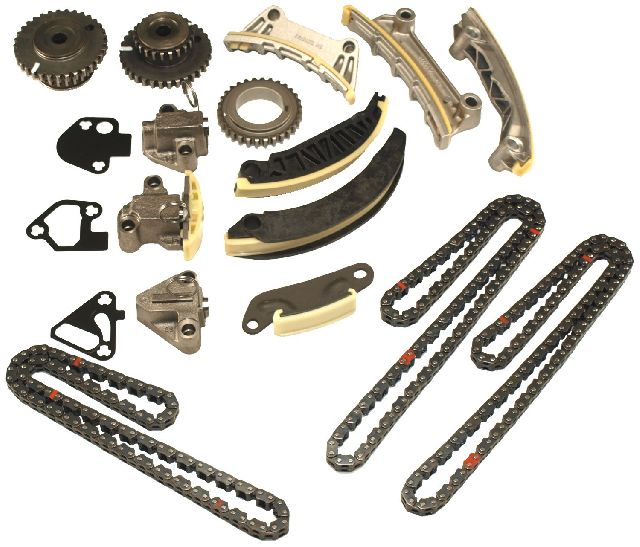
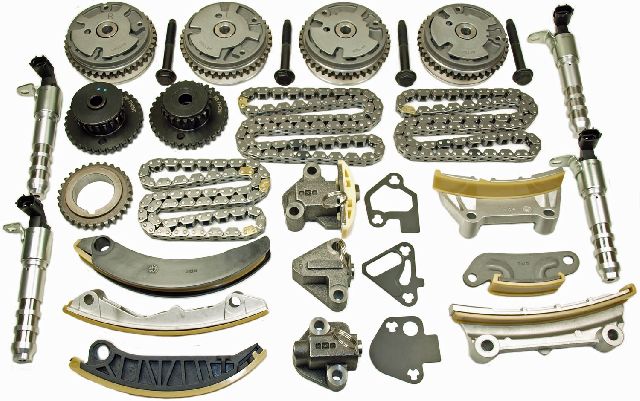
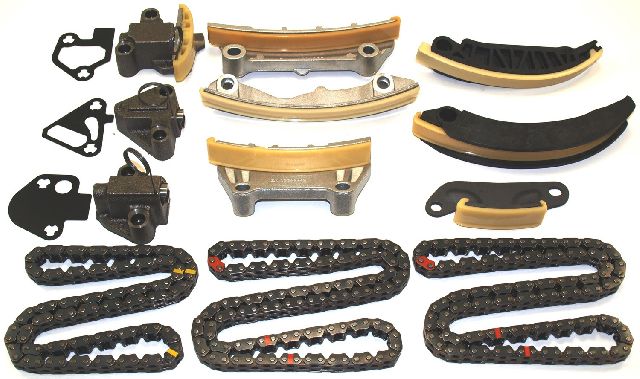
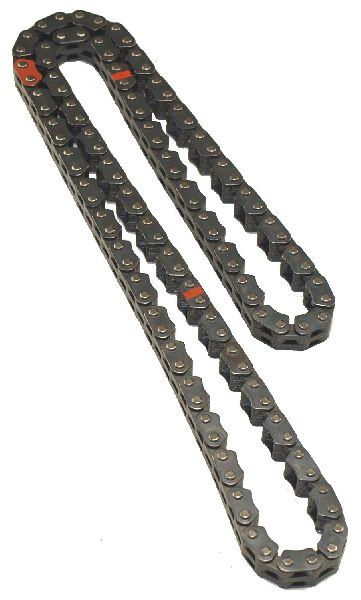
Typical fix: Complete replacement of all timing chains (two or three depending on engine), all tensioners, and all guides. This is a major, labor-intensive repair.
Est. part cost: $400-$800 - Failed Timing Chain Tensioners 🔴 High Probability → Shop Engine Timing Chain The tensioners are hydraulic and rely on clean oil at the proper pressure. They can weaken or fail, allowing slack in the chains. This is often a component of the overall timing system failure and a primary reason for the startup rattle.
How to confirm: Usually diagnosed during the physical inspection for a stretched chain. A rattling noise on startup that goes away after a few seconds is a strong indicator of a failing tensioner bleeding down pressure. 🎬 Watch: How to fix the common 3.6L startup clattering noise
Typical fix: Replaced as part of a complete timing chain kit. It is not recommended to replace only the tensioners.
Est. part cost: $100-$200 (if purchased separately) - Low Engine Oil Level or Degraded Oil 🟡 Medium Probability The timing chain tensioners are hydraulic and rely on clean, full-synthetic oil at the proper pressure to function. GM's own special coverage bulletin for earlier models explicitly links the issue to original oil change intervals, suggesting the Oil Life Monitor (OLM) may allow for intervals that are too long, leading to oil degradation and accelerated wear.
How to confirm: Check the oil level on the dipstick and review vehicle service records for oil change frequency. Many owners and mechanics recommend ignoring the OLM and changing the oil every 5,000 miles.
Typical fix: Correcting the oil level or performing an oil change with the correct specification oil (Dexos1 Gen 2). However, if the P0009 code is already set, this is unlikely to be a fix on its own and indicates that mechanical wear has likely already occurred.
Est. part cost: $40-$80
Rare But Worth Checking
- Faulty Camshaft or Crankshaft Position Sensor: → Shop Engine Crankshaft Position Sensor While possible, this is an uncommon cause for P0009 on this specific vehicle. The code almost always points to a mechanical timing issue. Replacing sensors without verifying timing is a common and costly misdiagnosis.
- Failed Camshaft Actuator (Phaser): → Shop Engine Camshaft A phaser can get stuck in one position due to sludge or internal failure, causing a correlation error. This is less common than chain stretch but is a possible cause that should be investigated during diagnosis.
- Shifted Crankshaft Reluctor Wheel: → Shop Engine Crankshaft GM TSB #PIP3423P explicitly mentions that if timing chains are found to be tight, the crankshaft reluctor wheel may have shifted its position on the crankshaft, causing a false timing reading. This requires inspecting the crank, possibly with a borescope, and is a very involved repair. [⭐ MANUFACTURER TSB — highest authority]
Diagnosis Steps
- Verify the code with a professional OBD-II scanner.
- Check the engine oil level and condition. If low or dirty, correct it, clear the codes, and see if the code returns. Note that this is rarely a permanent fix.
- Using an advanced scan tool, monitor the camshaft position deviation data (e.g., 'Camshaft Position Variance') for Bank 1 and Bank 2. Deviations consistently exceeding 4-5 degrees strongly suggest a mechanical timing issue.
- If sensor data is inconclusive, test the camshaft and crankshaft position sensors and their wiring to rule out an electrical fault.
- If chains are suspected, a technician may use a borescope through the crankshaft position sensor hole to inspect the reluctor wheel for movement, per TSB PIP3423P.
- If all other possibilities are exhausted, perform a physical inspection of the timing chains. This involves partial engine disassembly to check for chain slack and guide wear. This is the definitive diagnostic step.
Parts You'll Likely Need
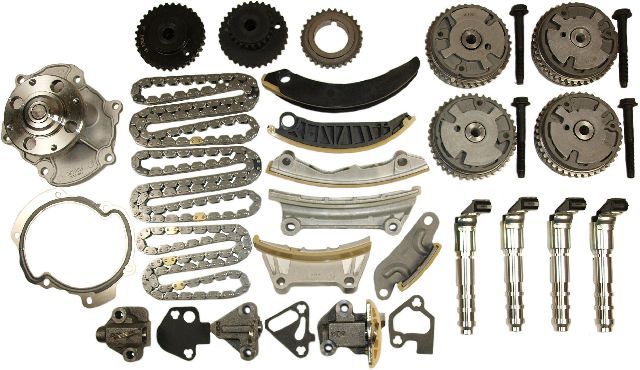
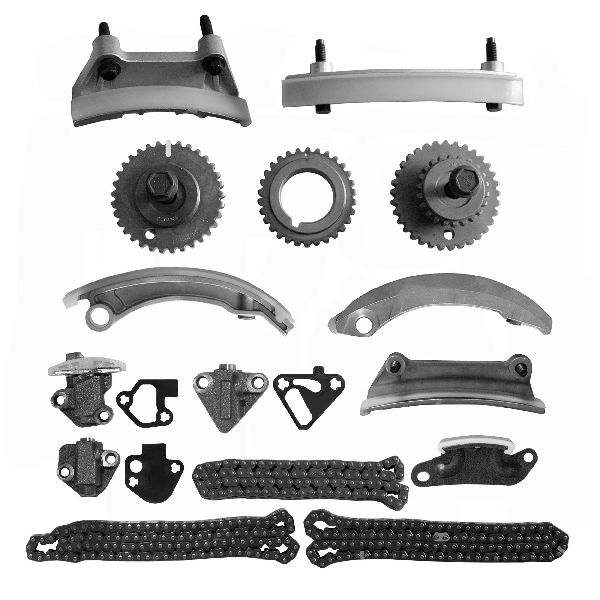
- Engine Timing Chain Kit
(OEM #ACDelco 12651450 (for 2017 LLT) or ACDelco 12693218 / 12713649 (for 2018 LGX))— This is the comprehensive solution, replacing all the common failure points (chains, tensioners, guides) at once. It is the required fix for a stretched timing chain.
Trusted brands: ACDelco, Cloyes, Melling
OEM price range: $500-$900
Aftermarket price range: $350-$600
Related Codes That Often Appear With This One
- P0008 — Indicates an engine position performance error on Bank 1, often set alongside P0009 when the primary timing chain is stretched, affecting both banks.
- P0017 — Indicates Crankshaft Position - Camshaft Position Correlation (Bank 1, Sensor B - Exhaust). This is another code pointing to the same root timing problem.
- P0018 — Indicates Crankshaft Position - Camshaft Position Correlation (Bank 2, Sensor A - Intake). This code is specific to Bank 2 and is frequently seen with P0009.
- P0019 — Indicates Crankshaft Position - Camshaft Position Correlation (Bank 2, Sensor B - Exhaust). Also specific to Bank 2 and points to the same timing misalignment.
Technical Service Bulletins (TSBs) & Recalls
- PIP3423P: Acknowledges that DTCs including P0009 can be set and advises technicians to inspect for loose timing chains, tensioners, or a shifted crankshaft reluctor wheel.
- 11340C: A Special Coverage Adjustment for earlier models that extended the timing chain warranty, confirming GM's awareness of the premature wear issue.
Platform-Specific Known Issues
- GM issued Technical Service Bulletin #PIP3423P for 2017-2018 models, which states that codes like P0009 may be set due to loose timing chains or tensioners, and also advises checking for a shifted crankshaft reluctor wheel. [⭐ MANUFACTURER TSB — highest authority]
- A Reddit user with a 2010 Traverse and code P0009 was quoted over $3,500 by one dealer and $7,100 by another for the timing chain job, illustrating the high and variable cost of this repair. [OWNER EXPERIENCE]
- On TraverseForum.com, a thread titled '2018 Traverse P0008/P0009 at 75k miles' details an owner's experience being quoted $4,500 by a dealer for the timing chain replacement, confirming the issue persists on the second-generation model. [FORUM CITATION]
- GM's Special Coverage Adjustment #11340C for earlier models (up to 2009 Traverse) extended the warranty on timing chains to 10 years/120,000 miles, officially acknowledging the high failure rate of the earlier chain design. [⭐ MANUFACTURER TSB — highest authority]
Mechanic-Grade Diagnostic Values
- VVT Solenoid (Camshaft Position Actuator Solenoid) Resistance — expected: 8 to 12 Ohms. Failure: A reading outside of this range, or an open/short circuit, indicates a failed solenoid coil.
- VVT Solenoid Harness Voltage — expected: Battery Voltage (e.g., ~12V with key on, engine off). Failure: No voltage or low voltage indicates a wiring or ECM driver issue, not a failed solenoid.
Hidden / Shadow Codes Worth Checking
- Mode $06: Mode $06 is not a specific code, but a diagnostic mode on OBD-II scanners that provides access to the results of On-Board Diagnostic monitoring tests for non-continuously monitored systems. A technician can use this to see if a component is close to its failure threshold, even before a DTC is set. For P0009, this could potentially show raw data for cam/crank correlation tests. (see via A professional scan tool that can access Mode $06 data. GM provides documentation for Test IDs (TID) and Component IDs (CID) for its vehicles.)
Scan Tool Commands That Help
- GDS2 (Global Diagnostic System 2): Vehicle DTC Information — This is the initial step to query all modules on the vehicle for both current and history codes, which can provide context to the P0009 code (e.g., are there also ABS or communication codes?).
- GDS2 (Global Diagnostic System 2): Module Diagnostics > Control Functions — This allows for bidirectional control to test individual components. While it can't test the timing chains directly, it can be used to command VVT solenoids or other related components to verify their function and rule them out as the cause.
- GDS2 (Global Diagnostic System 2): Data Bus Diagnostic Tool — If multiple seemingly unrelated codes are present with P0009, or if sensor data appears erratic, this function can be used to diagnose CAN bus communication problems to rule out a wiring harness or module communication fault.
Wiring & Ground Locations
- G110 — Located on the right front of the engine, mounted to the back of the cylinder head.. This is a primary engine ground. A loose or corroded G110 ground can cause erratic behavior or incorrect readings from various engine sensors, including the camshaft and crankshaft position sensors, potentially leading to false diagnostic codes.
- ECM/PCM Connectors — The Engine Control Module (ECM) is the termination point for all sensor wiring.. Technicians may need to test sensor signal wires directly at the ECM connector to rule out a break or short in the harness between the sensor and the module. Accessing pinout diagrams is necessary for this step.
Real Owner Repair Stories
- Reddit user in r/AskMechanics (2010 Chevrolet Traverse) — Check Engine Light with code P0009.
❌ Tried (didn't work) User cleared the code, but it returned after about 50 miles.
✅ What actually fixed it The user suspected the timing chain based on research and was seeking advice on repair costs. A local shop confirmed P0009, and a Chevrolet dealer quoted over $3,500 for the timing chain replacement, which is the accepted fix.
OEM Part Supersession History
12651450→12700436— This is the timing chain kit for the 2017 Traverse with the LLT engine. The original chains were prone to stretching. The part has gone through multiple revisions (including 12693218) to an updated design for improved durability.12693218→12700436— This is the timing chain kit for the 2018 Traverse with the LGX engine. It has also been superseded by the latest part number, suggesting a consolidation of kits or a further design improvement.
Model Year Variations Within This Range
- 2017 (First Generation): Uses the 3.6L LLT V6 engine, which features a three-chain timing system. This design was widely known for premature chain stretch issues, which prompted GM to release updated parts and special coverage warranties.
- 2018 (Second Generation): Uses the redesigned 3.6L LGX V6 engine. The timing system was revised to use two chains instead of three, featuring a quieter and supposedly more durable design. While more reliable than the LLT, timing chain wear is still a potential issue, particularly if oil change intervals are extended or incorrect oil is used.
Helpful Videos
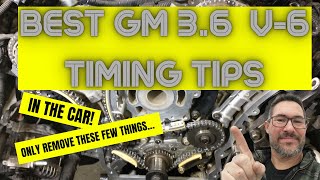

We Have This Part in Stock

The information in this article is provided for general reference and educational purposes only. Vehicle specifications, procedures, and part compatibility can vary by production date, trim level, and region. Always consult your vehicle's factory service manual and verify part numbers before purchasing or performing repairs. Safety-critical components such as airbags, seat belts, and braking systems should be installed by a qualified professional.
- Chevrolet TRAVERSE:
- 🧭 Diagnostic Flowchart
- 🎬 Helpful Videos
- 🛍️ Shop This Part
- What's Unique About the 2017-2018 Chevrolet TRAVERSE
- Symptoms You May Notice
- Most Likely Causes
- Rare But Worth Checking
- Diagnosis Steps
- Parts You'll Likely Need
- Related Codes That Often Appear With This One
- Technical Service Bulletins (TSBs) & Recalls
- Platform-Specific Known Issues
- Mechanic-Grade Diagnostic Values
- Hidden / Shadow Codes Worth Checking
- Scan Tool Commands That Help
- Wiring & Ground Locations
- Real Owner Repair Stories
- OEM Part Supersession History
- Model Year Variations Within This Range
- 🎟️ Get 5% Off