

P0010 on 2017-2024 Chrysler Pacifica Hybrid: 'A' Camshaft Actuator Circuit Causes and Fixes
For the Chrysler Pacifica Hybrid, code P0010 is almost always caused by low or dirty engine oil, or a failed intake VVT solenoid on Bank 1 (rear bank). First, check your oil. If the oil is clean and full, the VVT solenoid likely needs replacement, which is a moderately difficult DIY job due to the need to remove the intake manifold.
- Always check your engine oil level and condition first. A simple oil change is the most common and cheapest fix for P0010.
- This is an electrical circuit code. Do not immediately assume a major mechanical problem like a bad timing chain.
- The most likely failed part is the Bank 1 intake VVT solenoid. On the Pacifica's 3.6L engine, this is on the rear bank and requires removing the intake manifold to access.
- Do NOT replace the camshaft position sensor for this code; it is a common misdiagnosis that will not solve the problem.
What's Unique About the 2017-2024 Chrysler Pacifica
The 3.6L Pentastar V6 engine in the Pacifica Hybrid uses a sophisticated Variable Valve Timing (VVT) and Variable Valve Lift (VVL) system that is highly dependent on oil pressure and cleanliness. As a result, P0010 is frequently triggered by simple oil maintenance issues. While the code itself is for the VVT circuit, this engine platform is also known for potential rocker arm failures ('Pentastar Tick'), which can contaminate the oil with metal debris, leading to P0010 as a secondary symptom when particles clog the fine mesh screens on the VVT solenoids.
Symptoms You May Notice
- Check Engine Light is on
- Rough engine idle
- Reduced engine power and poor acceleration
- Decreased fuel economy
- Engine stalling or difficulty starting
- Rattling or knocking noise from the engine
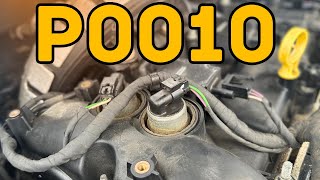
- Replacing the Camshaft Position Sensor. This code is for the actuator circuit (solenoid), not the position sensor. The sensor is doing its job by reporting the fault. Replacing the sensor will not fix P0010. 🎬 Watch: Understanding the P0010 trouble code and its causes
Most Likely Causes
- Low, Dirty, or Incorrect Viscosity Engine Oil 🔴 High Probability The Pentastar's VVT system uses oil pressure to actuate timing components. Sludge from old oil or the wrong viscosity can clog the fine mesh screens on the VVT solenoids, causing them to malfunction. This is the most common cause of P0010.
How to confirm: Check the engine oil dipstick for level and clarity. If the oil is dark, gritty, or below the 'add' line, this is the likely cause.
Typical fix: Perform an engine oil and filter change using the manufacturer-specified oil (full synthetic 0W-20 meeting Chrysler MS-6395 specification). Clear codes and re-test.
Est. part cost: $50-$100 - Faulty Intake VVT Solenoid (Oil Control Valve) 🔴 High Probability The solenoid is an electro-hydraulic part that operates constantly and can fail electrically (internal short/open) or mechanically (sticking) over time.
How to confirm: After confirming oil is good, test the solenoid. A professional scan tool can command the solenoid to activate, and you should hear a click. You can also remove it and test its resistance with a multimeter; it should be between 6.9 and 7.9 ohms for this engine. A reading outside this range indicates failure.
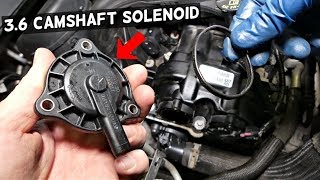
Typical fix: Replace the Bank 1 intake VVT solenoid. This requires removing the upper and lower intake manifolds for access. 🎬 See: How to remove the intake manifold plenum It is recommended to replace the intake gaskets at the same time.
Est. part cost: $40-$150 - Wiring Harness or Connector Issue 🟡 Medium Probability The wiring to the solenoid can become damaged from engine heat and vibration, or the connector's locking tab can break, causing a poor connection.
How to confirm: Visually inspect the wiring harness leading to the Bank 1 intake solenoid. Check for frayed wires, corrosion in the connector, or a loose fit. Test for battery voltage at the connector with the key on.
Typical fix: Repair the damaged section of wiring or replace the connector pigtail. Ensure the connector is securely fastened.
Est. part cost: $15-$50
Rare But Worth Checking
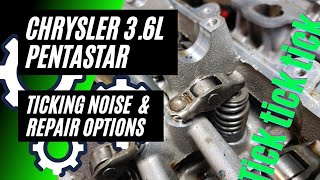
- Failing Rocker Arms ('Pentastar Tick'): This is a known issue on the 3.6L Pentastar engine. Failing rocker arm bearings contaminate the oil with metal particles, which then clog the VVT solenoids. If you hear a distinct ticking noise from the top of the engine, P0010 may be a symptom of this much larger mechanical problem. 🎬 Watch: Diagnosing and repairing the Pentastar ticking noise
- Poor Engine Ground Connection: TSB 08-111-21 was issued for 2021 Jeep models with the 3.6L engine where a faulty ground caused P0010 and other codes. While for a different model, it shows that ground issues on this engine platform can be a root cause.
- Faulty Powertrain Control Module (PCM): This is very rare. The internal driver circuit in the PCM that controls the solenoid can fail. This should only be considered after all other possibilities (oil, solenoid, wiring) have been exhaustively ruled out. Sometimes a PCM software update (reflash) from a dealer can resolve intermittent electrical faults.
Diagnosis Steps
- Check Engine Oil: Verify the oil level is correct and the oil is clean. If low or dirty, perform an oil and filter change, clear the code, and see if it returns. This is the most common and cheapest fix.
- Inspect the Wiring: Visually inspect the wiring harness and connector for the Bank 1 (rear) intake VVT solenoid. Look for any signs of damage, corrosion, or a loose connection.
- Test the Solenoid (Swap Method): On many 3.6L engines, the intake and exhaust solenoids are identical. Swap the Bank 1 intake solenoid with the Bank 1 exhaust solenoid. Clear the codes and drive. If the code changes to P0013, the solenoid is confirmed bad.
- Test the Solenoid (Resistance): Remove the solenoid and test its resistance with a multimeter. A reading outside of 6.9-7.9 ohms indicates failure.
- Test the Circuit: Using a multimeter, check for battery voltage at the solenoid connector with the key on, engine off. Check the resistance of the wiring between the solenoid connector and the PCM.
- Replace the Solenoid: If the circuit is good but the solenoid fails testing, replace the Bank 1 intake VVT solenoid. This requires removing the intake manifolds for access.
- Check for Deeper Issues: If the code persists, investigate rarer causes like engine ground integrity or signs of mechanical wear (e.g., 'Pentastar Tick') that could be contaminating the oil.
Parts You'll Likely Need
- Engine Variable Valve Timing (VVT) Solenoid
(OEM #5047897AC)— This solenoid is the most common part to fail for this code, either due to an internal electrical fault or from becoming clogged with oil debris. Part number 5047897AC is specified for 3.6L PHEV engines built from 03/13/2017.
Trusted brands: Mopar, NTK, Dorman
OEM price range: $90-$150
Aftermarket price range: $40-$90
Related Codes That Often Appear With This One
- P0011 — 'Camshaft Position - Timing Over-Advanced (Bank 1)'. If P0010 (circuit fault) appears with P0011 (performance fault), it strongly points to a failing VVT solenoid that is both electrically faulty and mechanically stuck.
- P0013 — '"B" Camshaft Position Actuator Circuit (Bank 1)'. This code for the exhaust solenoid on the same bank may appear if a technician swaps the intake and exhaust solenoids for diagnosis. If P0010 disappears and P0013 appears, the original intake solenoid is confirmed to be faulty.
- P0020 — This is the identical circuit fault code but for Bank 2 (front bank). If both P0010 and P0020 appear together, it suggests a systemic problem like very low/dirty oil or a wiring harness issue common to both banks.
Technical Service Bulletins (TSBs) & Recalls
- TSB 08-111-21: While for 2021 Jeep models with the 3.6L engine, this bulletin addresses P0010 being caused by a faulty engine ground harness, indicating a possible, though rare, cause on the same engine platform.
- TSB 18-031-17: This bulletin involves a PCM software update for 2017 models with the 5.7L engine to address rough idle and other DTCs. While for a different engine, it shows that PCM reflashes are a common factory solution for various powertrain control issues that could potentially manifest as circuit codes.
- Manufacturer TSB Bulletin #0902223: This bulletin for related Chrysler models notes that a technician may find P0010 (Bank 1 Camshaft 1 Position Actuator Circuit Open) or P0013 set during investigation of Check Engine Light illumination.
Platform-Specific Known Issues
- The 3.6L Pentastar engine can suffer from rocker arm bearing failure, creating a ticking sound. This failure sheds metal debris into the oil, which can clog the VVT solenoid screens and trigger a P0010 code as a secondary symptom.
- Accessing the Bank 1 (rear) VVT solenoids requires the removal of the upper and lower intake manifolds, making the repair significantly more labor-intensive than for the easily accessible Bank 2 solenoids.
Mechanic-Grade Diagnostic Values
- VVT Solenoid Coil Resistance — expected: 6.9 to 7.9 Ohms at 68°F (20°C).. Failure: A reading of infinity (OL) indicates an open circuit; a reading near 0 Ohms indicates a short circuit.
- VVT Solenoid Harness Connector Voltage (Key On, Engine Off) — expected: Approximately 12V (Battery Voltage) on the power supply pin.. Failure: No voltage or significantly low voltage suggests a wiring issue, fuse problem, or a fault in the PCM power supply.
- VVT Solenoid Control Circuit Resistance to PCM — expected: Below 5.0 Ohms.. Failure: Resistance above 5.0 Ohms indicates high resistance or an open in the control wire between the solenoid connector and the PCM.
- VVT Solenoid Mounting Bolt Torque — expected: 35 in-lbs (4 N·m).. Failure: N/A - This is an installation specification.
Scan Tool Commands That Help
- Chrysler wiTECH, Autel, or similar professional scanner: VVT Solenoid Actuator Test (or similar Active Test/Bidirectional Control) — This command manually actuates the solenoid, which should produce an audible click from the engine. It is used to quickly verify if the solenoid is electrically responsive and not mechanically seized, helping to confirm a faulty solenoid without having to remove it first.
Wiring & Ground Locations
- Engine Ground Strap (Mopar P/N 68316197AA) — There are multiple ground straps. One key strap connects the engine block to the vehicle's chassis/body. On vehicles like the Grand Caravan with the same engine, a primary ground is located on an engine mount.. A poor or broken engine ground can cause a variety of electrical faults and codes. TSB 08-111-21 for other 3.6L vehicles specifically links a faulty ground harness to code P0010, making ground integrity a critical check for unexplained electrical circuit codes.
- VVT Solenoid Connector (Bank 1 Intake) — On the rear cylinder head (Bank 1), which is close to the firewall. Access requires removing the upper and lower intake manifolds.. This is the direct connection point for testing the solenoid and the circuit. The connector's plastic locking tab can become brittle and break, leading to a poor connection that triggers P0010.
Real Owner Repair Stories
- Reddit user on r/MechanicAdvice (2014 Dodge Durango 3.6L) — Initial ticking noise, then after a DIY repair, smoke from the engine and multiple new trouble codes.
❌ Tried (didn't work) The owner replaced all 12 rocker arms and lifters on the right side of the engine to fix the ticking noise.
✅ What actually fixed it The post-repair issue was not resolved in the thread, but the critical data point is that a flurry of new codes, including P0010 and P0013, appeared immediately after the rocker arm service. This strongly suggests a mistake during reassembly, such as a disconnected sensor, damaged wiring harness, or incorrect timing alignment, which led to the new circuit codes.
OEM Part Supersession History
Not specified, but 5047897AC is the current part.→5047897AC— This part number is specified for the 3.6L PHEV Hybrid Engine and other updated Pentastar engines manufactured from March 13, 2017, onward.
Heads up: While earlier Pentastar VVT solenoids may physically fit, using the specified part number is critical as it corresponds to the updated Variable Valve Lift (VVL) system introduced in later engine versions.
Model Year Variations Within This Range
- 2017+: The 3.6L Pentastar engine was significantly updated around 2016, introducing a two-step Variable Valve Lift (VVL) system alongside the existing Variable Valve Timing (VVT). The VVT/VVL solenoids (like P/N 5047897AC) used in 2017-2024 models are specific to this updated engine design.
Diagnostic Flowchart
Other Known Issues on This Vehicle
Issues unrelated to this code that are worth knowing about as an owner of this generation:
- Sudden Engine Shutdown (Hybrid Models) 🔴 High — Common enough to trigger a major recall (NHTSA 23V-010) for 67,000+ vehicles from 2017-2023. (Ref: NHTSA Recall 23V-010; Warranty Extension D-23-07. The issue involves an internal transmission wiring short that causes unexpected engine shutdown. The NHTSA reopened an investigation in 2024 over concerns the software-based fix is insufficient.)
- Parasitic 12V Battery Drain 🟠 Medium — Widespread owner complaints of the 12V battery dying unexpectedly, often within days of parking. Affects both hybrid and standard models. (Ref: Multiple TSBs exist to update software for various modules. Common culprits include the Uconnect system failing to enter sleep mode or faulty wiring in the power sliding door harness causing the BCM to stay awake.)
- Engine Stop-Start (ESS) System Faults 🟡 Low — Very common as the vehicle ages; typically occurs after 3-4 years. The 'Start/Stop Unavailable' message is a frequent complaint. (Ref: No recall, but the issue is almost always traced to a failing auxiliary battery, which has a limited lifespan.)
- Premature Paint Bubbling and Peeling 🟡 Low — Frequently reported on 2017 models, often starting around the hood at approximately 34,000 miles.
- Hybrid System Faults / Power Inverter Module (PIM) Failure 🔴 High — Numerous owner complaints of hybrid system warnings and vehicle shutdowns. Can be related to the transmission recall or separate module failures. (Ref: Related to NHTSA Recall 23V-010, but can also be an independent failure of the PIM, which may be on backorder.)
Used vs. New Parts: Buying Guide for This Vehicle
When a used part is the smart pick: A used VVT solenoid is generally not recommended. It is an electro-hydraulic part prone to internal wear and clogging from oil debris. The cost savings are minimal compared to the risk of installing a part with limited remaining life, especially given the significant labor required to access the Bank 1 solenoids.
Donor-vehicle mileage cap: roughly under 50000 miles for the part to have meaningful remaining life.
What to inspect on the donor part:
- Ensure the mesh screens on the solenoid are perfectly clean, intact, and free of any metallic debris.
- Check the plastic connector housing for cracks or brittleness.
- If possible, test the resistance with a multimeter before purchase; it should be within the 6.9-7.9 ohm range.
OEM-only on this vehicle (don't cheap out):
- Powertrain Control Module (PCM): While a used PCM can be sourced, it requires dealer-level programming (wiTECH) to the vehicle's VIN and configuration, making a new Mopar unit a more reliable, albeit more expensive, choice.
Aftermarket brands forum-validated for this vehicle:
- NTK
- Standard Motor Products (SMP)
- SKP
Brands owners have reported issues with on this vehicle:
- Some professional mechanics report a higher-than-average failure rate for Dorman VVT solenoids compared to OEM or other premium aftermarket brands, though they are widely available.
Real Owner Stories
Aggregated from forums and TSBs cited above. Mileages and costs reflect what owners reported in those sources.
2019 Chrysler Pacifica Hybrid
Symptoms: The owner experienced a dead 12V battery and frequent infotainment system reboots.
What fixed it: The source notes these as difficult-to-diagnose 12v battery drain issues common to the platform, though not a direct fix for P0010, it highlights electrical instability.
Source hint: r/pacificahybrid on Reddit
2021 Chrysler Pacifica Hybrid
Symptoms: Recurring no-start condition; the dealer repeatedly tested the battery as 'fine' after charging, but it would die again shortly after.
What fixed it: Identified as a parasitic drain that is difficult to trace, potentially involving modules like Uconnect or the BCM staying awake.
Source hint: Chrysler Forum - PacificaPHEVDeadBatteryWoes
2024 Chrysler Pacifica Hybrid
Symptoms: Sudden vehicle shutdown on the highway with a 'Stop safely' message appearing on the dash.
What fixed it: The dealer suspected a failure of the Power Inverter Module (PIM).
Source hint: Reddit - Cautionary Tale of a 2024 Pacifica Hybrid
Related OBD-II Codes
Frequently Asked Questions
Does TSB 08-111-21 apply to my 2017-2024 Chrysler Pacifica Hybrid?
Why is the repair for P0010 more expensive on the Bank 1 side of my Pacifica?
Could my Pacifica's 12V battery issues be causing this P0010 code?
What specific oil should I use to prevent VVT solenoid failure in my 3.6L Pentastar?
Is there a recall related to engine shutdowns on the Pacifica Hybrid?
What is the 'Pentastar Tick' and can it cause a P0010 code?
Helpful Videos
We Have This Part in Stock


The information in this article is provided for general reference and educational purposes only. Vehicle specifications, procedures, and part compatibility can vary by production date, trim level, and region. Always consult your vehicle's factory service manual and verify part numbers before purchasing or performing repairs. Safety-critical components such as airbags, seat belts, and braking systems should be installed by a qualified professional.
- Chrysler Pacifica:
- 🧭 Diagnostic Flowchart
- 🎬 Helpful Videos
- 🛍️ Shop This Part
- What's Unique About the 2017-2024 Chrysler Pacifica
- Symptoms You May Notice
- Most Likely Causes
- Rare But Worth Checking
- Diagnosis Steps
- Parts You'll Likely Need
- Related Codes That Often Appear With This One
- Technical Service Bulletins (TSBs) & Recalls
- Platform-Specific Known Issues
- Mechanic-Grade Diagnostic Values
- Scan Tool Commands That Help
- Wiring & Ground Locations
- Real Owner Repair Stories
- OEM Part Supersession History
- Model Year Variations Within This Range
- Other Known Issues on This Vehicle
- Used vs. New Parts: Buying Guide for This Vehicle
- Real Owner Stories
- 2019 Chrysler Pacifica Hybrid
- 2021 Chrysler Pacifica Hybrid
- 2024 Chrysler Pacifica Hybrid
- Related OBD-II Codes
- Frequently Asked Questions
- 🎟️ Get 5% Off