

P0010 on 2009-2020 Dodge Journey: "A" Camshaft Actuator Circuit Causes and Fixes
This code indicates an electrical fault in the Bank 1 intake camshaft position actuator circuit. The most common fix is replacing the Variable Valve Timing (VVT) solenoid, often due to dirty oil or internal failure. Expect to pay $30-$80 for the part, which is a relatively easy DIY replacement. On 3.6L engines, this code can also be an early symptom of rocker arm failure.
- P0010 points to an electrical problem with the Bank 1 intake VVT solenoid, not a mechanical timing issue.
- Before buying any parts, check your engine oil. Low or dirty oil is a leading cause of this code.
- The most likely part to fail is the VVT solenoid itself, which is an affordable and accessible part for DIY replacement.
- On the 3.6L V6, Bank 1 is the rear cylinder bank, closer to the firewall.
- Do not confuse the VVT solenoid (actuator) with the camshaft position sensor; they are different parts that cause different codes.
What's Unique About the 2009-2020 Dodge Journey
On the Dodge Journey, this code is common to both the 2.4L 4-cylinder 'World Engine' and the 3.6L V6 Pentastar engines. For the 3.6L V6, 'Bank 1' is the cylinder head closer to the firewall (the rear bank). While the cause is often a simple solenoid failure, both engines are sensitive to oil quality and maintenance. Neglecting oil changes can lead to sludge buildup that clogs the VVT solenoid's small oil passages, triggering this electrical fault code. On the 3.6L Pentastar, P0010 can also be a secondary symptom of the infamous 'Pentastar Tick,' where failing rocker arm bearings shed metal debris into the oil, clogging the VVT solenoids and leading to this circuit code.
Symptoms You May Notice
- Check Engine Light is on
- Rough engine idle
- Decreased engine performance and acceleration
- Worse fuel economy
- Rattling or knocking sounds from the engine bay.
- Engine may hesitate or stall.
- Replacing the camshaft position sensor. P0010 is a code for the actuator *circuit*, not the position sensor. The sensor has its own set of codes (e.g., P0340).
- Replacing the VVT solenoid without first checking engine oil level and condition. If the oil is sludged, the new solenoid may fail quickly.
- On the 3.6L, ignoring a ticking noise. If rocker arms are failing, replacing only the VVT solenoid will not solve the root cause, and the new solenoid will likely fail again.
Most Likely Causes
- Dirty or Low Engine Oil 🔴 High Probability The VVT system is hydraulic and highly dependent on oil pressure and cleanliness. Sludge from delayed oil changes is a very common cause of solenoid malfunction. Using oil that does not meet Chrysler's MS-6395 specification (for the 3.6L) can also cause issues.
How to confirm: Check the engine oil dipstick. Note the oil level and its condition. If the oil is very dark, thick, or below the 'add' line, this is a likely contributor.
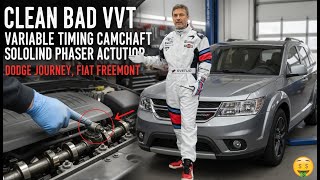
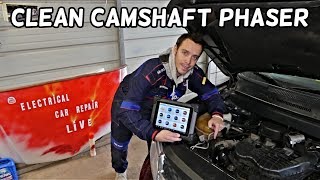
Typical fix: Perform an engine oil and filter change using the manufacturer-specified oil weight (e.g., 5W-20 for the 3.6L, check manual for 2.4L). Consider using an engine flush product before the oil change if sludge is suspected. 🎬 See how to clean a clogged VVT solenoid.
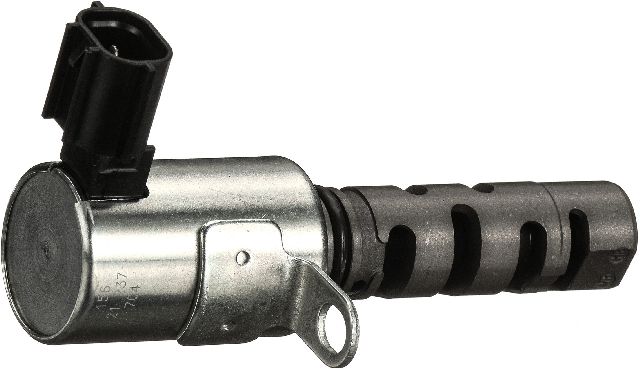
Est. part cost: $30-$60 - Faulty Intake Camshaft VVT Solenoid (Bank 1) 🔴 High Probability → Shop Engine Camshaft This is the most common component to fail for this code. The solenoid can fail electrically internally or become mechanically stuck from oil sludge.
How to confirm: After checking the oil, inspect the solenoid's wiring. You can test the solenoid's internal resistance with a multimeter (check against factory specs). A common diagnostic step is to swap the intake and exhaust solenoids on the same bank (they are identical parts) and see if the code changes to P0013 (Exhaust Actuator Circuit). If it does, the solenoid is confirmed bad.
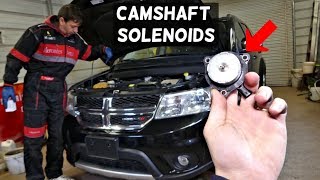
Typical fix: Replace the Bank 1 intake VVT solenoid. 🎬 Watch this step-by-step VVT solenoid replacement guide.
Est. part cost: $30-$80 - Wiring Harness or Connector Issue 🟡 Medium Probability
How to confirm: Visually inspect the wiring and connector going to the VVT solenoid for any signs of damage, corrosion, oil contamination, or loose pins. A broken locking tab on the connector is common. Use a multimeter to check for voltage and ground at the connector with the key on.
Typical fix: Repair the damaged section of wiring or replace the connector pigtail. Clean oil from the connector with electrical contact cleaner.
Est. part cost: $15-$30
Rare But Worth Checking
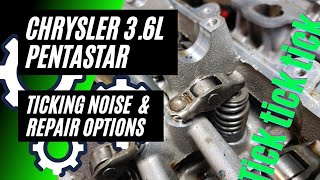
- Failing Rocker Arms (3.6L Pentastar): A significant known issue on the 3.6L V6 is rocker arm bearing failure, which creates a ticking sound. This failure sheds metal debris into the engine oil, which can clog the fine mesh screens on the VVT solenoids, causing them to fail and trigger a P0010 code. If you hear a tick, P0010 is likely a symptom 🎬 Watch this video to diagnose Pentastar ticking noises. of this larger mechanical problem.
- Faulty Powertrain Control Module (PCM): This is very rare. The internal driver circuit for the solenoid can fail. This should only be considered after all other possibilities (oil, solenoid, wiring) have been exhaustively ruled out.
- Stretched Timing Chain: → Shop Engine Timing Chain While this typically sets performance codes like P0011 or P0016, a severely worn timing system could potentially contribute to erratic VVT operation and trigger circuit codes in some cases.
Diagnosis Steps
- Read the code with an OBD-II scanner to confirm P0010 is present.
- Check the engine oil level and condition. If low or dirty, perform an oil and filter change, clear the code, and see if it returns. This is the simplest and most important first step.
- On the 3.6L, listen carefully for a rhythmic ticking sound from the top of the engine. If present, suspect rocker arm failure as the root cause and seek professional diagnosis.
- Locate the Bank 1 intake VVT solenoid. On the 2.4L, it's on the front of the cylinder head. On the 3.6L, it's on the rear cylinder head (closer to the firewall).
- Inspect the electrical connector and wiring to the solenoid for any damage, corrosion, or loose connections. Ensure the connector is fully seated and the locking tab is engaged.
- With the ignition on and engine off, use a multimeter to verify that the connector is receiving power (typically 12V) and has a ground path.
- Unplug the solenoid and measure its internal resistance with a multimeter. Compare the reading to the manufacturer's specification. An open circuit (infinite resistance) or a dead short (near-zero resistance) indicates a failed solenoid.
- If parts are identical, swap the Bank 1 intake solenoid with the Bank 1 exhaust solenoid. Clear the codes and drive the vehicle. If the code changes to P0013, the solenoid is faulty. If P0010 returns, the problem is in the wiring or PCM.
- If the solenoid and wiring seem good, the issue may be a clog within the oil passages or, in rare cases, the PCM itself.
Parts You'll Likely Need
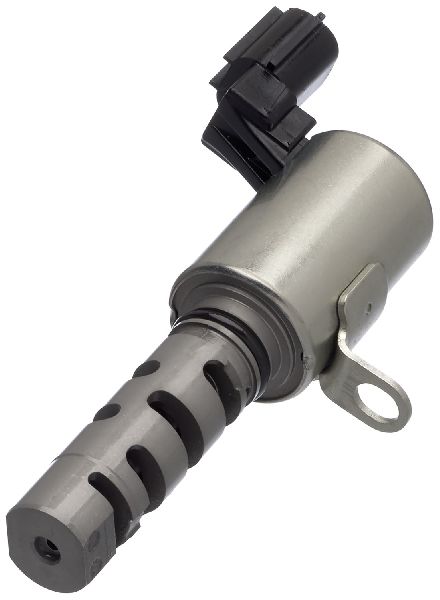
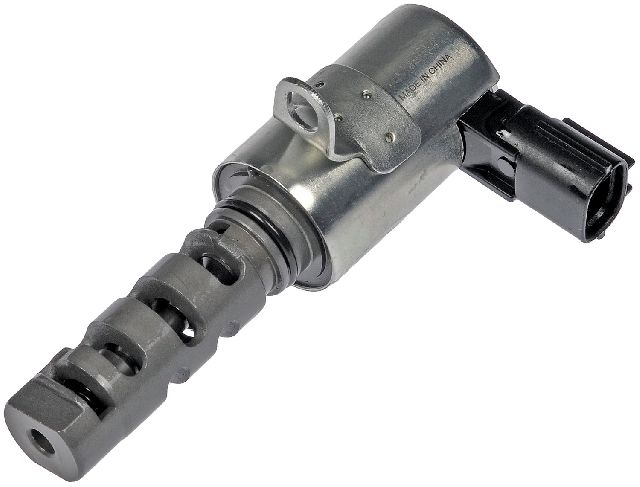
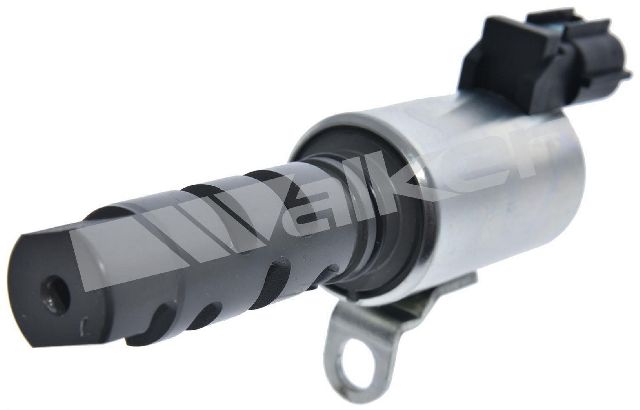
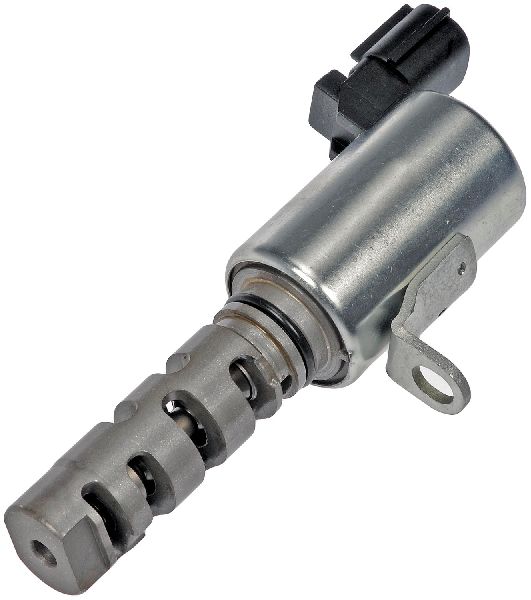
- Intake Variable Valve Timing (VVT) Solenoid / Oil Control Valve (OCV)
(OEM #3.6L V6: 5184101AG / 5184101AH; 2.4L World Engine: 4884483AC / 4884483AA)— This is the component whose electrical circuit is being flagged by the PCM. It is the most frequent point of failure for this code, either electrically or due to clogging.
Trusted brands: Mopar, Dorman, Standard Motor Products (SMP), SKP
OEM price range: $60-$100
Aftermarket price range: $30-$80
Related Codes That Often Appear With This One
- P0011 — If the VVT system is malfunctioning, you might also get P0011 ('A' Camshaft Position - Timing Over-Advanced), which indicates a mechanical timing performance issue in addition to the P0010 electrical circuit fault.
- P0020 — On the 3.6L V6 engine, P0020 is the equivalent code for Bank 2 (the front bank). Seeing both could suggest a systemic issue like severe oil sludging or a poor engine ground connection.
- P0520 — This code for the 'Engine Oil Pressure Sensor Circuit' can appear alongside VVT codes. Since the VVT system is entirely dependent on oil pressure, any fault in the pressure sensing or delivery system can trigger related codes like P0010.
Technical Service Bulletins (TSBs) & Recalls
- While no TSB is directly for P0010, TSB 09-002-14 REV. B and warranty extension X56 for the 2011-2013 3.6L left cylinder head are relevant. This issue can cause engine problems that may indirectly lead to oil contamination and VVT faults.
Platform-Specific Known Issues
- On the 3.6L Pentastar V6, accessing the Bank 1 (rear) solenoid can be slightly more difficult than accessing the Bank 2 (front) solenoid due to tighter space near the firewall. However, it does not require removing the intake manifold, unlike on some other Pentastar applications like the Jeep Wrangler.
- On the 3.6L, a P0010 code accompanied by a ticking noise should be treated with high suspicion for rocker arm failure, a much more involved and expensive repair than just a solenoid.
Mechanic-Grade Diagnostic Values
- VVT Solenoid Internal Resistance (3.6L Pentastar) — expected: 7.0 to 8.0 Ohms at 68°F (20°C).. Failure: A reading of OL (infinity) indicates an open circuit, while near-zero Ohms indicates a shorted coil.
- VVT Solenoid Internal Resistance (2.4L World Engine) — expected: 6.9 to 7.9 Ohms at 68°F (20°C).. Failure: Readings outside this range indicate a faulty solenoid.
- VVT Solenoid Harness Connector Power Supply (Key On, Engine Off) — expected: 12.0 - 12.6 Volts (Battery Voltage) on the power supply pin.. Failure: No voltage or significantly low voltage points to a problem with the fuse, Auto Shutdown (ASD) relay, or the power supply wire.
- VVT Solenoid Control Circuit Resistance to PCM — expected: Less than 5.0 Ohms.. Failure: Resistance higher than 5.0 Ohms indicates an open or high resistance in the control wire between the solenoid connector and the PCM.
Scan Tool Commands That Help
- wiTECH or equivalent professional scan tool: VVT Intake Solenoid Control Actuation Test — This bidirectional command allows a technician to manually command the VVT solenoid on (to 100%) and off with the engine running. This helps verify if the solenoid is mechanically responding to electrical commands and if the wiring and PCM driver are functioning, which can help differentiate a wiring fault from a stuck solenoid.
Wiring & Ground Locations
- S108 — On the 2.4L engine, this ground splice is located at the left rear of the engine. On the 3.5L (and by extension, likely the 3.6L), it is at the rear of the engine.. This is a shared ground point for multiple engine components, including the Oxygen sensors. While not the primary ground for the VVT circuit, a poor connection at this major engine ground can introduce electrical noise and voltage issues that may affect various sensor and actuator readings, potentially contributing to circuit fault codes. Forum users often recommend upgrading the main ground system on the Journey to prevent various electrical gremlins.
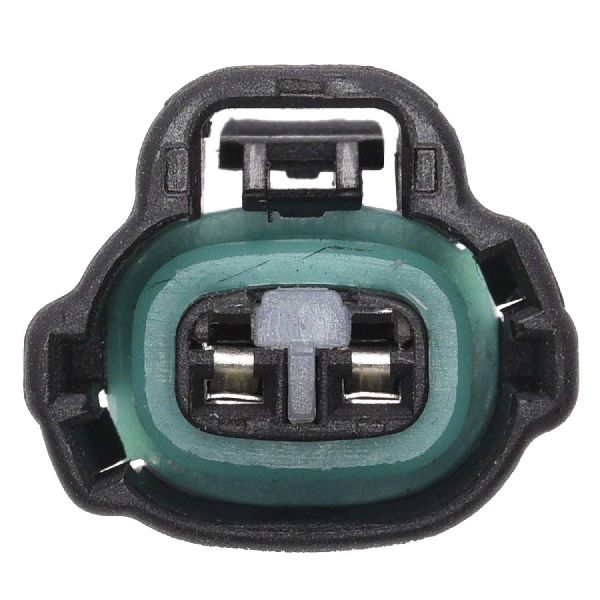
- VVT Solenoid Connector (3.6L) — Bank 1 (rear bank, by firewall). The connector has two pins.. This is the direct connection point for testing. One pin is the 12V power supply from the ASD relay, and the other is the control circuit (ground-side switched) from the PCM. Testing for power and continuity to the PCM happens at this connector.
Real Owner Repair Stories
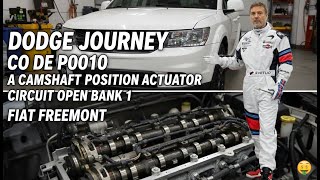
- YouTube Channel 'Electrical Car Repair LIVE' (Dodge Journey (year not specified, but 2009-2019 body style) with P0010.) — Check Engine Light was on.
❌ Tried (didn't work) The video directly proceeds to diagnosis and replacement, not mentioning other failed attempts.
✅ What actually fixed it The P0010 code was resolved by replacing the Bank 1 VVT solenoid (actuator phaser). The video shows locating the solenoid on the rear bank, disconnecting it, replacing it, clearing the code with a scanner, and confirming the Check Engine Light did not return upon restart.
OEM Part Supersession History
5184101AF→5184101AG, which was then superseded by 5184101AH.— Likely internal improvements to reliability and resistance to oil contamination.
Heads up: All revisions (AF, AG, AH) are generally interchangeable for the 3.6L engine.4884483AA→4884483AB, which was then superseded by 4884483AC.— Revisions to improve performance and durability for the 2.4L World Engine.
Heads up: The latest part number, 4884483AC, replaces the previous versions and should be used for replacement.
Model Year Variations Within This Range
- 2011-2014: Early 3.6L Pentastar engines (approx. 2011-2014) are reported to be more susceptible to rocker arm bearing failure. While the issue can still occur on later models, complaints and class-action lawsuits focus heavily on these earlier years. Therefore, a P0010 code on a 2012 Journey 3.6L with a ticking noise has a higher probability of being related to rocker arms than the same code on a 2018 model.
- 2016-2020: Starting in 2016, a second-generation 3.6L Pentastar was introduced in some models (though not all received it at once). This updated engine featured design changes to the VVT system and other components. While the fundamental cause of P0010 remains the same, parts and diagnostic procedures could have minor variations on these later, updated engines.
Diagnostic Flowchart
Other Known Issues on This Vehicle
Issues unrelated to this code that are worth knowing about as an owner of this generation:
- 3.6L Pentastar Rocker Arm Failure ('Pentastar Tick') 🔴 High — Very common, especially on 2011-2016 models. Can occur as early as 50,000 miles. Often presents as a distinct ticking noise from the upper engine. (Ref: No specific recall, but it is a widely documented issue and the subject of class-action lawsuits.)
- 2.4L Engine Throttle Body Failure 🟠 Medium — Common failure item, often occurring around 60,000-100,000 miles. Symptoms include rough idle, stalling, and the electronic throttle control (lightning bolt) warning light.
- 3.6L Left Cylinder Head Defect (2011-2013 models) 🔴 High — Affected early Pentastar engines, causing misfires on cylinders 2, 4, and 6. (Ref: Chrysler issued an extended warranty (X56) for the left cylinder head (10 years/150,000 miles) and TSB 09-002-14 REV. B.)
- Water Leaks into ABS Module 🟠 Medium — Common on 2012-2015 models, where water enters the ABS wiring harness, potentially disabling ABS and ESC systems. (Ref: Recall S46 / NHTSA 16V-543.)
- Power Steering Return Hose Rupture in Cold Weather 🟠 Medium — Affects 2009-2016 models. The hose can rupture at startup in cold temperatures, causing a sudden loss of power steering assist. (Ref: Recall S28 / NHTSA 16V-273.)
- Cracked Oil Filter Housing (3.6L) 🔴 High — Extremely common across all Pentastar applications. The plastic housing becomes brittle and cracks, leading to major oil or coolant leaks in the engine valley.
Used vs. New Parts: Buying Guide for This Vehicle
When a used part is the smart pick: For this repair, buying a used VVT solenoid is generally not recommended. The part is relatively inexpensive new, and a used part carries a high risk of being clogged with sludge or having a compromised electrical coil from its donor vehicle. The labor to replace it a second time would negate any savings.
Donor-vehicle mileage cap: roughly under 40000 miles for the part to have meaningful remaining life.
What to inspect on the donor part:
- If buying used is the only option, insist on a part from a low-mileage, documented front-end collision vehicle (indicating the engine was likely running well at the time of the accident).
- Inspect the mesh screens on the solenoid. They must be perfectly clean, intact, and free of any metallic debris.
- Check the electrical connector for any corrosion, cracks, or broken locking tabs.
OEM-only on this vehicle (don't cheap out):
- While not strictly OEM-only, using a Mopar VVT solenoid is highly recommended, especially for the 3.6L engine, due to the sensitivity of the system and the potential for aftermarket parts to have slightly different flow rates or electrical characteristics that don't resolve the code.
Aftermarket brands forum-validated for this vehicle:
- Dorman
- Standard Motor Products (SMP) / NTK
Brands owners have reported issues with on this vehicle:
- Unbranded, no-name parts from online marketplaces should be avoided as their quality control is unknown and they frequently cause repeat failures.
Real Owner Stories
Aggregated from forums and TSBs cited above. Mileages and costs reflect what owners reported in those sources.
2014 Dodge Journey 2.4L
Symptoms: Check engine light with code P0010; an oil change was performed but did not resolve the issue.
What fixed it: Replacement of the intake VVT solenoid.
Source hint: dodgejourneyforum.net
2018 Jeep Grand Cherokee 3.6L
Symptoms: P0010 code appeared immediately after performing maintenance (spark plug change).
What fixed it: Repairing the VVT solenoid connector which had been broken during the spark plug service.
Source hint: reddit.com/r/MechanicAdvice
2011-2016 Dodge Journey 3.6L — ~50000 miles
Symptoms: Distinct ticking noise from the upper engine ('Pentastar Tick').
What fixed it: Professional diagnosis and repair of failed rocker arms.
Source hint: known_issues: 3.6L Pentastar Rocker Arm Failure
Related OBD-II Codes
Frequently Asked Questions
Is there a TSB or warranty extension for engine issues on my 2011-2013 Dodge Journey 3.6L that might relate to P0010?
I hear a ticking sound from the top of my 3.6L Pentastar engine along with the P0010 code; what should I check?
Do I need to remove the intake manifold to replace the Bank 1 VVT solenoid on my Journey 3.6L?
Can I use any engine oil in my 3.6L Dodge Journey to prevent VVT codes?
Where is the Bank 1 intake VVT solenoid located on the 2.4L engine?
Is there a simple way to confirm the solenoid is bad before I buy a new one?
Helpful Videos
We Have This Part in Stock

The information in this article is provided for general reference and educational purposes only. Vehicle specifications, procedures, and part compatibility can vary by production date, trim level, and region. Always consult your vehicle's factory service manual and verify part numbers before purchasing or performing repairs. Safety-critical components such as airbags, seat belts, and braking systems should be installed by a qualified professional.
- Dodge Journey:
- 🧭 Diagnostic Flowchart
- 🎬 Helpful Videos
- 🛍️ Shop This Part
- What's Unique About the 2009-2020 Dodge Journey
- Symptoms You May Notice
- Most Likely Causes
- Rare But Worth Checking
- Diagnosis Steps
- Parts You'll Likely Need
- Related Codes That Often Appear With This One
- Technical Service Bulletins (TSBs) & Recalls
- Platform-Specific Known Issues
- Mechanic-Grade Diagnostic Values
- Scan Tool Commands That Help
- Wiring & Ground Locations
- Real Owner Repair Stories
- OEM Part Supersession History
- Model Year Variations Within This Range
- Other Known Issues on This Vehicle
- Used vs. New Parts: Buying Guide for This Vehicle
- Real Owner Stories
- 2014 Dodge Journey 2.4L
- 2018 Jeep Grand Cherokee 3.6L
- 2011-2016 Dodge Journey 3.6L — ~50000 miles
- Related OBD-II Codes
- Frequently Asked Questions
- 🎟️ Get 5% Off