

P0010 on 2019-2024 Genesis G70 3.3T: 'A' Camshaft Actuator Circuit Causes and Fixes
On a Genesis G70 3.3T, code P0010 is almost always caused by a faulty Bank 1 (passenger side) intake Oil Control Valve (OCV). This is an electrical circuit code, and replacing the OCV solenoid is the most common fix. An OEM replacement part costs approximately $50-$90. Before replacing, check oil level and condition, as the CVVT system is sensitive to oil quality.
- P0010 on the G70 3.3T points to an electrical fault with the passenger-side intake Oil Control Valve (OCV).
- Before buying parts, always check the engine oil level and condition first.
- The most effective diagnostic step is to swap the intake OCV from the passenger side (Bank 1) to the driver side (Bank 2) and see if the code changes to P0020.
- The correct part is the intake OCV, OEM #24355-3L100; do not confuse it with the camshaft position sensor or the exhaust OCV.
- This is a common, relatively simple, and affordable DIY repair due to the easy accessibility of the OCVs at the front of the engine.
What's Unique About the 2019-2024 Genesis G70
The Genesis G70's Lambda II 3.3T engine features a sophisticated Continuous Variable Valve Timing (CVVT) system that is highly dependent on clean oil and proper oil pressure. While P0010 is an electrical fault, the health of the oil system is paramount. Unlike some repairs on this engine that require extensive labor (like accessing rear spark plugs), the camshaft actuators (OCVs) are conveniently located on the front of the engine and are relatively easy to access, making this a common and straightforward DIY repair. This issue is shared across all platforms using this engine, including the Kia Stinger GT.
🎬 See: Diagnosing a misfire on the 3.3T engineSymptoms You May Notice
- Check Engine Light is on
- Rough or unstable idle
- Reduced engine power and acceleration
- Decreased fuel economy
- Engine hesitation or stumbling
- Difficulty starting the engine
- Replacing the Camshaft Position Sensor. The Camshaft Position Sensor reports the camshaft's speed and position, but P0010 specifically points to a fault in the actuator's *control circuit*, not the sensor's reading. A Reddit user reported this exact misdiagnosis.
Most Likely Causes
- Faulty Bank 1 Intake Oil Control Valve (OCV) 🔴 High Probability The OCV is an electro-mechanical part that operates constantly while the engine is running. Over time, its internal solenoid coil can fail from heat and vibration, creating an open or short in the circuit, which triggers the P0010 code.
How to confirm: Swap the Bank 1 (passenger side) intake OCV with the Bank 2 (driver side) intake OCV. Clear the codes and drive. If the fault code changes to P0020 ('A' Camshaft Position Actuator Circuit Bank 2), the original OCV is confirmed to be bad. You can also test the resistance of the solenoid with a multimeter; it should be between 6.9 and 7.9 ohms at 68°F.
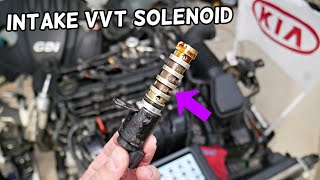
Typical fix: Replace the Bank 1 intake Oil Control Valve. The part is an assembly that includes the center bolt. Ensure you are ordering the INTAKE valve (24355-3L100), not the exhaust valve (24375-3L100). 🎬 Watch: How to locate and replace the intake VVT solenoid
Est. part cost: $50-$90 - Wiring or Connector Issue 🟡 Medium Probability The OCV connector is located at the front of the engine and is exposed to significant heat and vibration. The wiring harness in the G70's engine bay is known to be vulnerable to heat damage from the nearby turbochargers, which can cause wires to become brittle, melt, or for pins to lose connection. Oil can also seep into the connector, disrupting the electrical signal.
How to confirm: Visually inspect the wiring harness and connector going to the Bank 1 intake OCV. Look for any signs of melting, chafing, corrosion, or oil contamination. Unplug the connector and ensure the pins are clean and making good contact. Use a multimeter to check for continuity and proper voltage at the connector with the ignition on.
Typical fix: Clean the connector with electrical contact cleaner. If the wiring is damaged, repair or replace the affected section of the harness. Secure the harness away from direct contact with hot components.
Est. part cost: $5-$20 for cleaning supplies or wiring repair materials. - Low or Dirty Engine Oil ⚪ Low Probability While P0010 is an electrical code, extremely low or sludgy oil can cause the OCV to stick or work improperly, which could potentially stress the circuit or lead to related performance codes. The CVVT system is highly sensitive to oil pressure and cleanliness. More often, oil issues will set performance-related timing codes (like P0011/P0012) rather than a pure circuit code, but it's a crucial first check.
How to confirm: Check the engine oil level and condition using the dipstick. If the oil is below the 'L' mark, very dark, or sludgy, it needs to be changed.
Typical fix: Perform an engine oil and filter change using a high-quality 5W-30 full synthetic oil and a genuine OEM filter. The engine's oil capacity is 7.3 quarts (6.9L).
Est. part cost: $70-$120
Rare But Worth Checking
- Powertrain Control Module (PCM) Fault: This is extremely rare. The PCM is the last thing to suspect after all other possibilities, including wiring, have been thoroughly ruled out. A faulty driver circuit within the PCM can cause a P0010 code.
Diagnosis Steps
- Read the fault codes with an OBD-II scanner to confirm P0010 is the primary code.
- Check the engine oil level and condition. If low or dirty, perform an oil and filter change first, clear the code, and see if it returns.
- Locate the Bank 1 (passenger side) and Bank 2 (driver side) intake OCVs on the front of the valve covers.
- Inspect the electrical connector and wiring for the Bank 1 OCV for any damage, corrosion, or oil contamination. Pay close attention to heat damage from the turbocharger.
- Perform an 'OCV Swap Test': Unplug both intake OCVs. Unbolt and swap the positions of the Bank 1 and Bank 2 solenoids. Clear the codes and drive the vehicle.
- Re-scan for codes. If the code has moved to P0020, the OCV that is now in the Bank 2 position is faulty and must be replaced.
- If the P0010 code returns, the problem is likely in the wiring harness or the PCM itself, and further electrical testing (checking for voltage, ground, and signal continuity) will be required.
- If swapping the OCV does not change the code, test the resistance of the Bank 1 OCV with a multimeter. A reading outside of the 6.9-7.9 ohm range indicates a failed solenoid.
Parts You'll Likely Need
- Intake Oil Control Valve (OCV) / VVT Solenoid
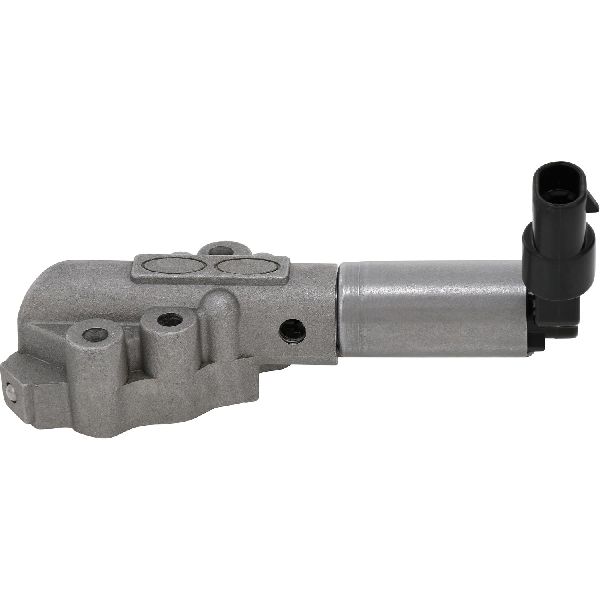
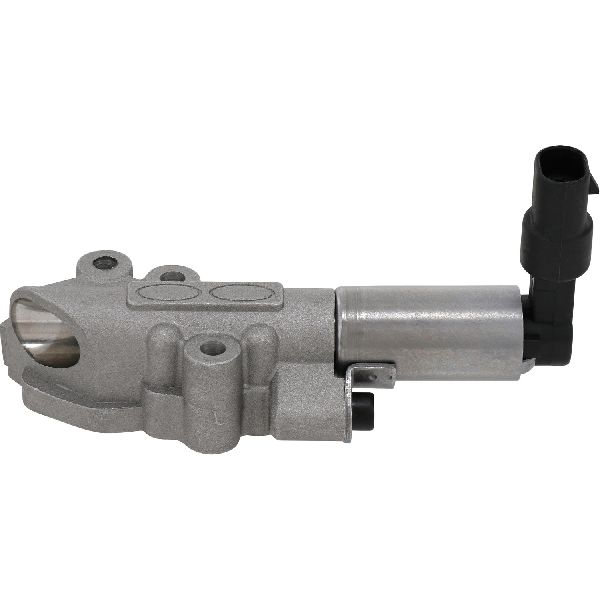
(OEM #24355-3L100)— This is the component that the P0010 code directly refers to. Its internal coil is the most likely point of failure in the circuit. This part number fits the G70, Stinger, G80, G90, and other Hyundai/Kia models.
Trusted brands: Hyundai/Genesis (Genuine OEM)
OEM price range: $50-$90
Aftermarket price range: $30-$60
Related Codes That Often Appear With This One
- P0011 — 'A' Camshaft Position - Timing Over-Advanced (Bank 1). This is a performance code indicating the timing is stuck in an advanced position. It can appear with P0010 if the OCV is failing in a way that affects both its electrical integrity and mechanical function. A user on Reddit reported fixing both codes by replacing the intake actuator solenoid.
- P0012 — 'A' Camshaft Position - Timing Over-Retarded (Bank 1). Similar to P0011, this performance code indicates a mechanical timing issue that can be caused by the same failing OCV that is also triggering the P0010 electrical code.
Technical Service Bulletins (TSBs) & Recalls
- NHTSA 24V209000 / Genesis Recall 019G / TSB 24-01-032G: Addresses a leaking LH turbocharger oil feed pipe on 2019-2022 models, which can cause low oil levels and related engine codes.
Platform-Specific Known Issues
- Recall 019G / TSB 24-01-032G: A leaking left-hand (driver's side) turbocharger oil feed pipe on 2019-2022 models can cause a sudden loss of engine oil. A low oil condition can trigger various CVVT system codes and should be checked to see if the recall has been performed. The fix involves replacing the original pipe with a full stainless steel version.
Mechanic-Grade Diagnostic Values
- Bank 1 Intake Oil Control Valve (OCV) Coil Resistance — expected: 6.9 - 7.9 Ohms at 68°F (20°C). Failure: A reading of infinity (OL) indicates an open circuit, while a reading near zero indicates a short circuit. Both mean the OCV has failed.
- OCV Harness Connector Voltage — expected: Approximately 12V (battery voltage). Failure: No voltage or significantly low voltage with Key On, Engine Off suggests a problem in the wiring harness, fuse, or relay, not the OCV itself.
- OCV Harness-to-ECM Wire Continuity — expected: Below 1.0 Ohm. Failure: A high resistance or open (OL) reading indicates a break in the wire between the OCV connector and the ECM.
- OCV Harness Wire to Chassis Ground — expected: 10 kOhms or higher. Failure: A low resistance reading indicates a short to ground in the wiring harness.
- Scan Tool Live Data: CVVT Actual vs. Desired Angle — expected: The 'Actual Position' PID should track the 'Desired Position' PID within a few degrees across different engine loads and RPMs.. Failure: A large, persistent gap between the actual and desired angles, or an actual angle that is stuck, points to a functional problem in the CVVT system.
Scan Tool Commands That Help
- Hyundai/Kia GDS (or equivalent advanced scanner): Active Test: CVVT Oil Control Valve — After confirming the P0010 code, this bidirectional test allows you to command the Bank 1 intake OCV to activate while the engine is idling. A noticeable change in engine idle (stumbling/roughness) confirms the ECM driver, wiring, and OCV are all capable of functioning. No change in idle points to a failure in one of those three areas.
- Hyundai/Kia GDS (or equivalent advanced scanner): Vehicle S/W Management: Resetting Adaptive Values — This function should be used after replacing any CVVT component, such as an OCV or cam phaser. It clears the ECM's learned data, forcing it to re-learn the operational characteristics of the new part, which can prevent future timing-related codes.
Wiring & Ground Locations
- Bank 1 Intake OCV Connector — On the front of the passenger's side (Bank 1) valve cover, plugging into the forward-most solenoid.. This is the primary connection point for the component flagged by P0010. It is highly susceptible to heat damage from the nearby turbocharger and oil contamination, which can cause a poor connection and trigger a circuit code.
- Main Engine Ground — Typically a heavy gauge wire bolted from the engine block to the chassis frame rail, often near the alternator or on the fender wall. There are also smaller ground straps from the valve covers to the chassis.. A loose or corroded main engine ground can cause unstable voltages and create floating grounds for sensors and actuators. This can lead to a variety of electrical circuit codes, including P0010, even if the OCV and its direct wiring are perfectly fine.
Real Owner Repair Stories
- Reddit user on r/GenesisG70 (Genesis G70 3.3T (year not specified)) — No turbo engagement, high idle, loss of acceleration, and a cluster of low-voltage circuit codes for all four OCVs (P0076, P0082, P0079, P0085) and other systems.
❌ Tried (didn't work) A non-dealer mechanic was hesitant to diagnose due to the sheer number of codes.
✅ What actually fixed it Resolution not posted, but the pattern of multiple, simultaneous low-voltage circuit codes strongly suggests a systemic electrical problem like a bad main ground or a failing ECM, rather than four individually failed solenoids. This is a critical clue for anyone who replaces the OCV for P0010 and finds the code persists or is accompanied by others.
When the Usual Fixes Don't Work
- While a faulty OCV is the most common cause of a solitary P0010 code, if you encounter P0010 (or its 'low circuit' equivalent P0076) alongside circuit codes for other OCVs (P0082, P0079, P0085), the problem is almost certainly not the individual OCVs. This pattern points to a shared electrical issue. Before replacing any parts, thoroughly inspect the main engine-to-chassis ground strap for corrosion or looseness. A bad ground is the most likely cause for multiple, simultaneous low-voltage circuit faults across different components.
OEM Part Supersession History
24355-3L100→24355-3N100 (unconfirmed)— Potential part update for newer models.
Heads up: Part number 24355-3N100 is listed for 2021+ Genesis models like the GV70/GV80. While it may be a direct replacement for 24355-3L100, it is critical to verify fitment with a VIN at the dealership before purchasing, as there could be subtle differences.
Model Year Variations Within This Range
- 2021-2024: The OEM part number for the OCV may have been updated from 24355-3L100 to 24355-3N100 for newer models in the Genesis lineup. While the core engine remained the same, this component may have been revised. Always confirm the part number with the vehicle's VIN.
Diagnostic Flowchart
Other Known Issues on This Vehicle
Issues unrelated to this code that are worth knowing about as an owner of this generation:
- Electronic Wastegate Actuator (EWGA) Failure 🔴 High — Very common. Often preceded by a distinct squeaking or rattling noise from the turbo area when shutting the engine off. Can cause underboost (P0299) or overboost (P0234) codes.
- Leaking LH Turbocharger Oil Feed Pipe 🔴 High — Common enough on 2019-2022 models to warrant a safety recall. The original pipe's rubber section degrades from heat, leaking oil onto the hot exhaust manifold, creating a fire risk. (Ref: NHTSA 24V209000 / Genesis Recall 019G / TSB 24-01-032G)
- High-Pressure Fuel Pump (HPFP) Failure 🟠 Medium — A well-documented failure point on the Lambda II engine family. Can cause stalling, hesitation, limp mode, and long cranks, sometimes without setting a code initially. (Ref: Genesis Campaign 023G / NHTSA 24V528 (Note: This recall may be for other Lambda engines but the issue is noted on the 3.3T as well))
- Intake Valve Carbon Buildup 🟠 Medium — A common issue inherent to all Gasoline Direct Injection (GDI) engines, including the 3.3T. Over time, it can cause rough idle, misfires, and reduced performance. Periodic GDI cleaning services are often recommended.
- Panoramic Sunroof Creaking/Rattling 🟡 Low — A widely reported annoyance where the sunroof assembly develops creaks or rattles over bumps.
Used vs. New Parts: Buying Guide for This Vehicle
When a used part is the smart pick: A used OEM Oil Control Valve (OCV) is a reasonable choice for this repair, as they are generally reliable components and a used part from a low-mileage vehicle offers significant cost savings over a new OEM part.
Donor-vehicle mileage cap: roughly under 50000 miles for the part to have meaningful remaining life.
What to inspect on the donor part:
- Ensure the donor vehicle was not in a front-end collision.
- Inspect the electrical connector for any cracks, brittleness, or signs of melting.
- Check that the metal screen on the valve is intact, clean, and free of metallic debris.
- Confirm the part number on the used part matches the original part exactly.
OEM-only on this vehicle (don't cheap out):
- Engine Oil Filter: Forum consensus strongly suggests that using non-OEM oil filters can lead to improper oil pressure and flow, which is a primary cause of CVVT system codes. Stick with the genuine Hyundai/Kia filter (Part No. 26320-3LTA0) to avoid introducing new problems.
Brands owners have reported issues with on this vehicle:
- Generic/unbranded oil filters.
Real Owner Stories
Aggregated from forums and TSBs cited above. Mileages and costs reflect what owners reported in those sources.
2019-2024 Genesis G70 3.3L T-GDi
Symptoms: The owner experienced both P0010 and P0011 codes simultaneously.
What fixed it: Replacing the camshaft intake actuator solenoid (OCV).
Source hint: Reddit - r/AskMechanics (CODE: P0010 & P0011)
2019-2024 Genesis G70 3.3L T-GDi
Symptoms: The owner reported a P0010 code but was initially confused between the actuator circuit (OCV) and the camshaft position sensor.
What fixed it: Diagnosis of the 'A' Camshaft Position Actuator Circuit (Bank 1).
Source hint: Reddit - r/GenesisG70 (Camshaft Position Sensor)
2018-2023 Kia Stinger GT (3.3L T-GDi)
Symptoms: Owners of this platform mate reported P0010/P0020 codes and issues with the electronic wastegate actuator in the same high-heat engine environment.
What fixed it: Replacing the Oil Control Valve (OCV).
Source hint: Kia Stinger Forum (No boost)
Related OBD-II Codes
Frequently Asked Questions
Does Genesis Recall 019G apply to my 2019-2022 G70 with a P0010 code?
Which specific part number do I need for the Bank 1 intake OCV on my 3.3L T-GDi?
How can I tell if the OCV itself is bad versus a wiring issue on my G70?
Is the P0010 code related to the common 'squeaking' noise I hear from the turbos?
Can I use any 5W-30 oil to fix the oil-related causes of P0010?
Why is the wiring harness for the OCV prone to failure on the G70?
Helpful Videos

We Have This Part in Stock


The information in this article is provided for general reference and educational purposes only. Vehicle specifications, procedures, and part compatibility can vary by production date, trim level, and region. Always consult your vehicle's factory service manual and verify part numbers before purchasing or performing repairs. Safety-critical components such as airbags, seat belts, and braking systems should be installed by a qualified professional.
- Genesis G70:
- 🧭 Diagnostic Flowchart
- 🎬 Helpful Videos
- 🛍️ Shop This Part
- What's Unique About the 2019-2024 Genesis G70
- Symptoms You May Notice
- Most Likely Causes
- Rare But Worth Checking
- Diagnosis Steps
- Parts You'll Likely Need
- Related Codes That Often Appear With This One
- Technical Service Bulletins (TSBs) & Recalls
- Platform-Specific Known Issues
- Mechanic-Grade Diagnostic Values
- Scan Tool Commands That Help
- Wiring & Ground Locations
- Real Owner Repair Stories
- When the Usual Fixes Don't Work
- OEM Part Supersession History
- Model Year Variations Within This Range
- Other Known Issues on This Vehicle
- Used vs. New Parts: Buying Guide for This Vehicle
- Real Owner Stories
- 2019-2024 Genesis G70 3.3L T-GDi
- 2019-2024 Genesis G70 3.3L T-GDi
- 2018-2023 Kia Stinger GT (3.3L T-GDi)
- Related OBD-II Codes
- Frequently Asked Questions
- 🎟️ Get 5% Off