

P0010 on 2007-2009 Saturn Aura 2.4L: Intake Cam Solenoid Causes and Fixes
On a 2007-2009 Saturn Aura with the 2.4L Ecotec engine, code P0010 is almost always caused by a failing intake camshaft position actuator solenoid. It's a common, inexpensive part that's easy to replace, typically costing $25-$50 for the part and taking less than 30 minutes to change. Always check the engine oil level and condition first, as low or dirty oil is a primary contributor.
- P0010 on your Saturn Aura almost always points to the intake camshaft actuator solenoid.
- Before buying parts, check your engine oil level and condition, as low or dirty oil is a common cause.
- The easiest way to confirm a bad solenoid is to swap it with the exhaust solenoid and see if the trouble code changes to P0013.
- This is a very DIY-friendly repair that requires basic tools and can be completed in under 30 minutes.
- Consider replacing both intake and exhaust solenoids at the same time to prevent future issues.
What's Unique About the 2007-2009 Saturn Aura
The 2.4L Ecotec engine, used across many GM models including the Saturn Aura, is known for having issues with its camshaft position actuator solenoids. These components are a frequent failure point due to their design and susceptibility to clogging from engine oil debris or simply failing electrically over time. The good news is that GM placed these solenoids in a very accessible location on top of the engine, making diagnosis and replacement significantly easier than on many other vehicles.
Symptoms You May Notice
- Check Engine Light illuminated
- Rough or unstable engine idle
- Engine may stall at low speeds or when stopping
- Noticeable loss of engine power and acceleration
- Worse-than-usual fuel economy
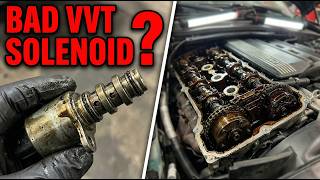
- Rattling, buzzing, or clicking noise from the top of the engine 🎬 Watch: 5 symptoms of a bad VVT solenoid
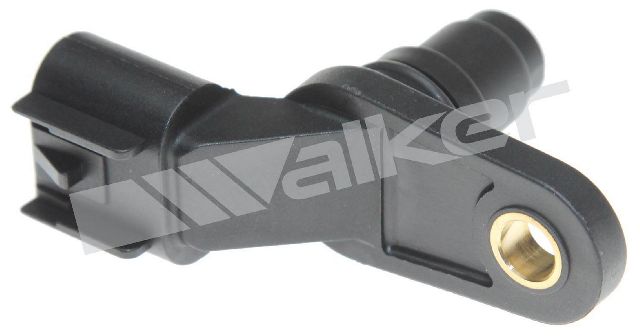
- Replacing the Camshaft Position SENSOR instead of the ACTUATOR SOLENOID. The P0010 code refers to the actuator solenoid, which controls oil flow, not the sensor that reads the camshaft's position. This is a very common mistake.
Most Likely Causes
- Faulty Intake Camshaft Position Actuator Solenoid 🔴 High Probability → Shop Engine Camshaft These solenoids are a well-documented common failure item on the 2.4L Ecotec engine due to heat, age, and internal screens becoming clogged with oil debris. The internal electronics are also prone to developing an open circuit, leading to fluctuating resistance readings.
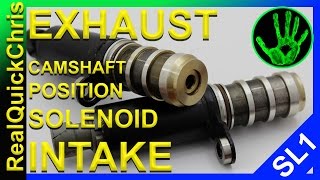
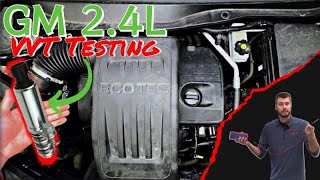
How to confirm: Swap the intake solenoid (front, gray connector) with the exhaust solenoid (rear, black connector). They are physically identical but have different colored connectors for identification. Clear the codes and drive. If the code changes to P0013 ('B' Camshaft Position Actuator Circuit), the solenoid is confirmed bad. Alternatively, test the solenoid's resistance with a multimeter; it should be between 8 and 13 ohms. A reading that is unstable and bounces around, or is infinite (OL), indicates an open circuit and a failed solenoid. 🎬 Watch: How to test GM 2.4 VVT solenoids
Typical fix: Replace the intake camshaft position actuator solenoid. It is highly recommended by technicians and covered in TSB 17-NA-098 to replace both the intake and exhaust solenoids at the same time.
Est. part cost: $20-$60 - Low or Dirty Engine Oil 🟡 Medium Probability The VVT system is entirely dependent on clean oil at the proper pressure. The 2.4L Ecotec can consume oil, and if the level is low or the oil is old and sludgy, it can clog the solenoid's fine mesh screens and prevent it from working correctly. This is the first thing to check before replacing parts.
How to confirm: Check the oil level on the dipstick and inspect its condition. If the oil is low, dark, or sludgy, this is a likely contributing factor.
Typical fix: Perform an oil and filter change using the manufacturer-recommended oil viscosity (5W-30). If the oil was very low, top it off and see if the issue resolves before replacing parts. Many technicians recommend an oil change whenever replacing the solenoids.
Est. part cost: $30-$70 for oil and filter - Damaged Wiring or Connector ⚪ Low Probability
How to confirm: Visually inspect the wiring harness and connector going to the intake camshaft solenoid. Look for any signs of fraying, melting, corrosion on the pins, or loose connections. The plastic connector tabs can become brittle and break. With the key on and engine off, one pin in the connector should have battery voltage (approx. 12V).
Typical fix: Repair the damaged section of wire or replace the pigtail connector.
Est. part cost: $10-$25 for a new pigtail connector
Rare But Worth Checking
- Faulty Engine Control Module (ECM): This is extremely rare. The ECM should only be considered after all other possibilities, including solenoids and wiring, have been exhaustively tested and ruled out.
- Stretched Timing Chain or Failed Tensioner: → Shop Engine Timing Chain While more likely to set correlation codes like P0016/P0017, a severely stretched timing chain can sometimes trigger VVT circuit codes as the system struggles to compensate. This is usually accompanied by a rattling noise from the engine.
Diagnosis Steps
- Check Engine Oil Level and Condition: Before anything else, verify the engine oil is full and clean. If it's low or dirty, correct this first, clear the code, and see if it returns.
- Read the Codes: Use an OBD-II scanner to confirm P0010 is the active code. Note any other codes present, especially P0011, P0013, or P0014.
- Inspect the Wiring: Visually inspect the connector and wiring going to the intake camshaft position actuator solenoid (the front-most solenoid on the top of the valve cover, typically with a gray connector).
- Swap Test the Solenoids: The easiest diagnostic step is to swap the intake (front) and exhaust (rear) solenoids. They are held in by a single 10mm bolt. Clear the codes and drive the vehicle. If the code returns as P0013 ('B' Camshaft Position Actuator Circuit), you have confirmed the solenoid you moved is faulty.
- Test Solenoid Resistance (Optional): If you have a multimeter, unplug the suspect solenoid and measure the resistance between its two pins. A good solenoid should read between 8 and 13 ohms. A reading that is significantly higher (open circuit/OL) or bounces around wildly indicates a bad solenoid.
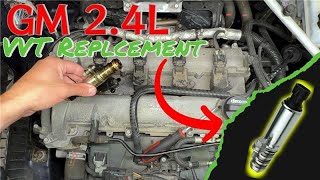
- Replace the Faulty Part(s): If the solenoid is confirmed bad, replace it. It is highly recommended to replace both solenoids as a pair since they are the same age and have endured the same conditions, as advised in GM TSB 17-NA-098. 🎬 See this step-by-step VVT solenoid replacement guide
- Perform Oil Change: It is strongly recommended to perform an engine oil and filter change when replacing the solenoids to ensure the new parts operate in a clean environment.
- Clear Codes and Test Drive: After replacing the part(s) and changing the oil, clear the codes from the ECM and perform a test drive to ensure the problem is resolved.
Parts You'll Likely Need
- Intake Camshaft Position Actuator Solenoid
(OEM #12655420 (Original), 12679099 (Updated per TSB 17-NA-098))— This is the most common failure part for a P0010 code on this engine. It has a gray electrical connector.
Trusted brands: ACDelco, Delphi, Dorman (p/n 917-215)
OEM price range: $40-$60
Aftermarket price range: $20-$40 - Exhaust Camshaft Position Actuator Solenoid
(OEM #12655421 (Original), 12679100 (Updated per TSB 17-NA-098))— Often replaced as a pair with the intake solenoid as a preventative measure, as it is the same age and prone to the same failures. It has a black electrical connector. TSB 17-NA-098 recommends replacing both.
Trusted brands: ACDelco, Delphi, Dorman (p/n 917-216)
OEM price range: $40-$60
Aftermarket price range: $20-$40
Related Codes That Often Appear With This One
- P0011 — P0011 indicates 'Intake Camshaft Position Timing - Over-Advanced'. A failing solenoid can cause both an electrical circuit fault (P0010) and a mechanical timing performance issue (P0011). They often appear together.
- P0013 — This code is for the exhaust ('B') camshaft actuator circuit. It often appears if a technician swaps the intake and exhaust solenoids for diagnosis, or if both solenoids are failing around the same time, which is common.
Technical Service Bulletins (TSBs) & Recalls
- GM TSB 17-NA-098: Addresses rough running, hesitation, and DTCs P0010, P0011, P0013, or P0014. The official correction is to replace both camshaft position actuator solenoid valves and verify the ECM has the latest software calibration.
Mechanic-Grade Diagnostic Values
- Intake/Exhaust VVT Solenoid Resistance — expected: 8 to 13 Ohms. Failure: A resistance reading outside this range, an open circuit (OL), or a reading that is unstable and fluctuates when wiggling the connector indicates a faulty solenoid.
- VVT Solenoid Connector Voltage (Key On, Engine Off) — expected: One pin should show battery voltage (approx. 12V). The other pin is the ground-side control from the ECM.. Failure: Absence of 12V power points to a problem in the supply circuit (fuse or wiring). If power is present but a known-good solenoid doesn't work, the fault may be in the control wire to the ECM or the ECM driver itself.
- VVT Solenoid Signal Type — expected: 12V Pulse Width Modulated (PWM) signal at a fixed frequency of 150 Hz.. Failure: An advanced scan tool can monitor the commanded duty cycle versus the actual state. A mismatch for more than 5 seconds can set the code.
Scan Tool Commands That Help
- GM Tech2 / GDS2 or equivalent professional scanner: Camshaft Position Actuator Solenoid Control / VVT Solenoid Test — This bidirectional command allows a technician to manually command the solenoid on and off. This can be used to verify if the solenoid clicks and operates, and to check for voltage and ground on the control circuit while it's being commanded, confirming wiring and ECM driver integrity without having to swap parts.
Wiring & Ground Locations
- Intake VVT Solenoid Connector — Top of the engine on the valve cover, toward the front of the vehicle (radiator side). The connector is typically gray.. This is the primary connection point for the component that sets code P0010. It should be inspected for corrosion, damage, or loose pins.
- Exhaust VVT Solenoid Connector — Top of the engine on the valve cover, toward the rear of the vehicle (firewall side). The connector is typically black.. This connector is for the exhaust solenoid (P0013). Knowing its location is critical for the diagnostic 'swap test'.
- ECM (Engine Control Module) — Located on the left side of the engine compartment, in front of the battery.. The ECM provides the 12V PWM signal and ground control for the VVT solenoid. A poor connection at the ECM connector or a failed internal driver (rare) could cause P0010.
- Intake Solenoid Control Circuit — The control wire (typically Dark Blue with a White stripe) runs from the solenoid connector to the ECM. The power wire (typically Pink with a Black stripe) comes from the underhood fuse block.. A short to ground or an open circuit on the control wire between the solenoid and the ECM will cause a P0010 code. A loss of power on the supply wire will also cause the code.
Real Owner Repair Stories
- Chevy HHR Network forum user (2009 Chevrolet HHR 2.4L (Same LE5 engine and VVT system)) — Check Engine Light with codes P0010, P0011, P0013, P0014.
✅ What actually fixed it The user replaced both the intake and exhaust camshaft position actuator solenoids. The post includes detailed pictures and part numbers, confirming the fix resolved the codes. The user noted the simplicity of the repair, requiring only a 10mm socket.
OEM Part Supersession History
12655420→12679099— Updated part design for improved reliability, as referenced in TSB 17-NA-098.12655421→12679100— Updated part design for improved reliability, as referenced in TSB 17-NA-098.
Model Year Variations Within This Range
- 2009: For the 2009 model year, the 2.4L LE5 engine was paired with a more modern 6-speed 6T40 automatic transmission, replacing the 4-speed 4T45-E used in 2008. This improved fuel economy and performance but does not affect the diagnosis of code P0010.
- 2007: The 2.4L LE5 engine was not the base engine in 2007; it was primarily available in the Aura Green Line Hybrid (as the LAT engine variant). The non-hybrid 2.4L became more common starting in the 2008 model year. Diagnosis remains the same.
Diagnostic Flowchart
Other Known Issues on This Vehicle
Issues unrelated to this code that are worth knowing about as an owner of this generation:
- Sudden Loss of Electric Power Steering (EPS) 🔴 High — Very common. Can happen at any time while driving, leading to a sudden increase in steering effort. Covered by GM recall N140115 (NHTSA #14V153000). (Ref: NHTSA Campaign #14V153000)
- Timing Chain Guide & Tensioner Wear 🔴 High → Shop Engine Timing Chain — Common on higher-mileage LE5 engines. Worn plastic guides or a failed tensioner can cause a chain rattle noise, especially on startup. If ignored, it can lead to jumped timing or catastrophic engine failure.
- Fractured Transmission Shift Cable 🟠 Medium — Affects 2007-2010 models with the 4-speed automatic (4T45-E). The cable end tabs can break, preventing the driver from shifting or causing the gear indicator to be inaccurate. Covered by GM recall 14152 (NHTSA #14V224). (Ref: NHTSA Campaign #14V224)
- Harsh Shifting or Slipping (4T45-E Transmission) 🟠 Medium — The 4-speed automatic transmission paired with the 2.4L engine can develop issues like harsh shifts, slipping, or failure of shift solenoids (different from the engine's VVT solenoids).
Used vs. New Parts: Buying Guide for This Vehicle
When a used part is the smart pick: For this specific repair, using a used part is NOT recommended. The VVT solenoids are a high-failure item and are considered a maintenance/wear part. They are inexpensive to buy new, and a used part from a junkyard has an unknown history and is likely to fail soon, if it works at all.
What to inspect on the donor part:
- Not applicable, as used parts are not advised for this repair.
OEM-only on this vehicle (don't cheap out):
- While not strictly 'OEM-only', many professional technicians and forum users strongly recommend using genuine ACDelco or Delphi solenoids. Some aftermarket brands have a reputation for premature failure, sometimes within months.
Aftermarket brands forum-validated for this vehicle:
- ACDelco (OEM)
- Delphi (often the OEM supplier)
Brands owners have reported issues with on this vehicle:
- Dorman (for electrical components like solenoids, many mechanics report high failure rates, though their hard parts are often fine).
- Unbranded, no-name parts from online marketplaces.
Real Owner Stories
Aggregated from forums and TSBs cited above. Mileages and costs reflect what owners reported in those sources.
2009 Saturn Aura 2.4L Ecotec
Symptoms: Check engine light with codes P0010 and P0011.
What fixed it: Replacement of the intake camshaft actuator solenoid.
Source hint: Reddit r/MechanicAdvice (2014) thread titled '2009 Saturn Aura P0010 and P0011 engine code'
2008 Saturn Aura 2.4L Ecotec
Symptoms: Check engine light illuminated with code P0010.
What fixed it: Replaced the solenoid by removing a single screw and wiggling the part out with pliers.
Source hint: BobIsTheOilGuy.com (2014) thread titled 'Saturn Aura CE Light P0010'
2006-2011 Chevrolet HHR 2.4L LE5
Symptoms: Codes P0010, P0011, P0013, and P0014 appearing together.
What fixed it: Replacement of the camshaft position actuator solenoid valves.
Source hint: Chevy HHR Network (2010) thread 'Camshaft Position Actuator Solenoid Valve Replacement w/pics P0010-11 P0013-14'
Related OBD-II Codes
Frequently Asked Questions
Is there an official GM technical service bulletin for P0010 on my 2007-2009 Saturn Aura?
Which solenoid do I need to replace for code P0010 on the 2.4L Ecotec engine?
Can I test the solenoids myself before buying new parts for my Aura?
Why does my Saturn Aura rattle at the top of the engine when P0010 is active?
Does my oil change interval affect the P0010 code on the 2.4L Ecotec?
Are the intake and exhaust solenoids the same part for the Saturn Aura?
Helpful Videos
We Have This Part in Stock


The information in this article is provided for general reference and educational purposes only. Vehicle specifications, procedures, and part compatibility can vary by production date, trim level, and region. Always consult your vehicle's factory service manual and verify part numbers before purchasing or performing repairs. Safety-critical components such as airbags, seat belts, and braking systems should be installed by a qualified professional.
- Saturn Aura:
- 🧭 Diagnostic Flowchart
- 🎬 Helpful Videos
- 🛍️ Shop This Part
- What's Unique About the 2007-2009 Saturn Aura
- Symptoms You May Notice
- Most Likely Causes
- Rare But Worth Checking
- Diagnosis Steps
- Parts You'll Likely Need
- Related Codes That Often Appear With This One
- Technical Service Bulletins (TSBs) & Recalls
- Mechanic-Grade Diagnostic Values
- Scan Tool Commands That Help
- Wiring & Ground Locations
- Real Owner Repair Stories
- OEM Part Supersession History
- Model Year Variations Within This Range
- Other Known Issues on This Vehicle
- Used vs. New Parts: Buying Guide for This Vehicle
- Real Owner Stories
- 2009 Saturn Aura 2.4L Ecotec
- 2008 Saturn Aura 2.4L Ecotec
- 2006-2011 Chevrolet HHR 2.4L LE5
- Related OBD-II Codes
- Frequently Asked Questions
- 🎟️ Get 5% Off