

P0010 on 2008-2010 Saturn Vue 2.4L: Camshaft Actuator Solenoid Causes and Fixes
On the 2.4L Ecotec engine, P0010 almost always means the intake camshaft position actuator solenoid has failed. This is a very common and inexpensive fix. Replacing the solenoid costs about $25-$50 for the part and can be done in under 30 minutes with basic tools.
- P0010 on your Saturn Vue 2.4L is almost certainly a bad intake camshaft actuator solenoid.
- Before buying any parts, check your engine oil level and condition. Low or dirty oil is a primary cause of this code on this specific engine due to its oil consumption issues.
- The easiest way to confirm a bad solenoid is to swap the intake and exhaust solenoids and see if the code changes to P0013.
- This is a very easy and inexpensive DIY repair that requires only basic tools and takes less than 30 minutes.
- GM recommends replacing both intake and exhaust solenoids at the same time with the updated part numbers.
What's Unique About the 2008-2010 Saturn Vue
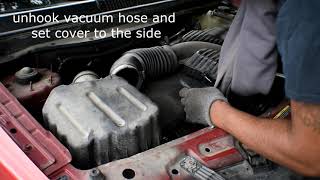
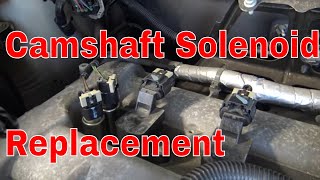
The 2.4L Ecotec engine, used across many GM vehicles like the Chevy Cobalt, HHR, and Equinox, is notorious for failures of the camshaft position actuator solenoids. This is a well-documented pattern failure. The good news is that on the Saturn Vue, these solenoids are located right on top of the engine and are extremely easy to access and replace, making this a very common and straightforward DIY repair. 🎬 Watch: Step-by-step Saturn Vue solenoid replacement guide GM even issued a technical service bulletin (TSB 17-NA-098) for similar models with this engine, acknowledging the high failure rate and recommending the replacement of both solenoids if codes like P0010 or P0013 are present.
Symptoms You May Notice
- Check Engine Light is on
- Rough or unstable idle
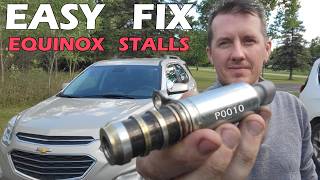
- Engine stalling, especially at low speeds or when stopping 🎬 See how to fix stalling issues caused by these codes
- Reduced engine power and poor acceleration
- Decreased fuel economy
- Rattling or knocking noises from the engine
- Replacing the Camshaft Position *Sensor* instead of the Camshaft Position *Actuator Solenoid*. These are two different parts. P0010 specifically refers to the actuator solenoid circuit.
Most Likely Causes
- Failed Intake Camshaft Position Actuator Solenoid 🔴 High Probability → Shop Engine Camshaft These solenoids are a known high-failure part on the 2.4L Ecotec engine family due to internal electronic faults or clogging from oil sludge. GM TSB 17-NA-098 acknowledges this common failure.
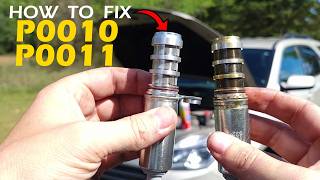
How to confirm: Swap the intake solenoid (gray connector) with the exhaust solenoid (black connector). Clear the codes. If the code changes to P0013 (Exhaust Circuit), the solenoid is confirmed bad. You can also test resistance with a multimeter; a failed solenoid will often read Open Loop (OL) or millions of ohms (Megaohms), whereas a good one should be between 8-15 ohms.
Typical fix: Replace the intake camshaft position actuator solenoid. It is highly recommended to replace both the intake and exhaust solenoids at the same time as a pair, as recommended by GM.
Est. part cost: $25-$50 - Low or Dirty Engine Oil 🟡 Medium Probability The VVT system is hydraulic and relies on clean oil and proper pressure. These Ecotec engines are infamous for excessive oil consumption due to piston ring issues, making low oil levels a very common problem that starves and damages the VVT solenoids.
How to confirm: Check the engine oil dipstick for a low level or a dark, sludgy consistency. Low oil is a primary contributor to solenoid failure and other major engine issues like timing chain wear on this platform.
Typical fix: Perform an oil and filter change using the manufacturer-specified 5W-30 synthetic oil. If the oil was very low or dirty, the solenoid may already be damaged and still require replacement.
Est. part cost: $30-$60 - Damaged Wiring or Connector ⚪ Low Probability The wiring harness connector can become brittle from engine heat cycles, and pins can break or back out. The plastic locking tabs are also fragile.
How to confirm: Visually inspect the wiring and the gray connector going to the intake solenoid. Check for broken wires, corrosion, or loose pins. Wiggle the connector while the engine is running to see if it affects the idle.
Typical fix: Repair the broken wire or replace the connector pigtail.
Est. part cost: $10-$25
Rare But Worth Checking
- Faulty Powertrain Control Module (PCM): This is extremely rare. All other possibilities, especially the solenoid and oil level, should be exhausted before considering the PCM as the cause.
Diagnosis Steps
- Check Engine Oil: Before doing anything else, check the engine oil level and condition. If it is low, top it off. If it is old or sludgy, perform an oil and filter change. This is critical on the 2.4L Ecotec.
- Inspect Wiring: Visually inspect the wiring harness and connector for the intake camshaft solenoid (the one with the gray connector, closer to the front of the vehicle). Look for any obvious damage, corrosion, or loose connections.
- Swap Solenoids: This is the most effective diagnostic test. Unplug both the intake (gray) and exhaust (black) solenoids. Remove the 10mm bolt holding each one in place. Swap their positions. Clear the trouble codes with a scanner and start the engine.
- Re-scan for Codes: If the code P0013 ('B' Camshaft Position Actuator Circuit) appears, you have confirmed the solenoid you moved to the exhaust position is faulty. Purchase and replace it.
- If P0010 Returns: If the same P0010 code returns after the swap, the problem is not the solenoid itself but likely in the wiring or the PCM. The original solenoid is good.
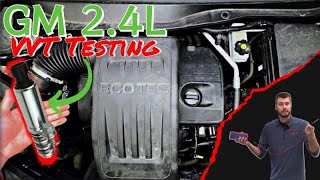
- (Optional) Test Resistance: If you have a multimeter, you can test the solenoid's resistance. A good solenoid should measure between 8 and 15 ohms. 🎬 Watch: How to test GM 2.4L VVT solenoids A reading of infinity (OL - open) or in the mega-ohm range confirms it's bad.
Parts You'll Likely Need
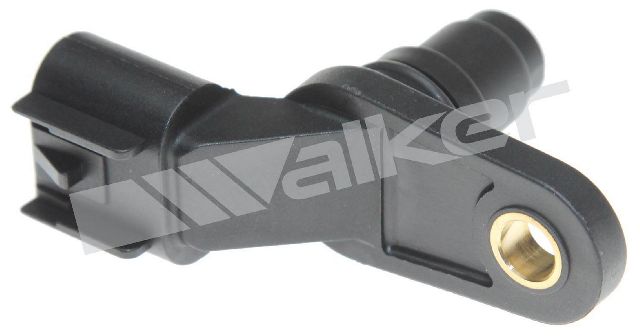
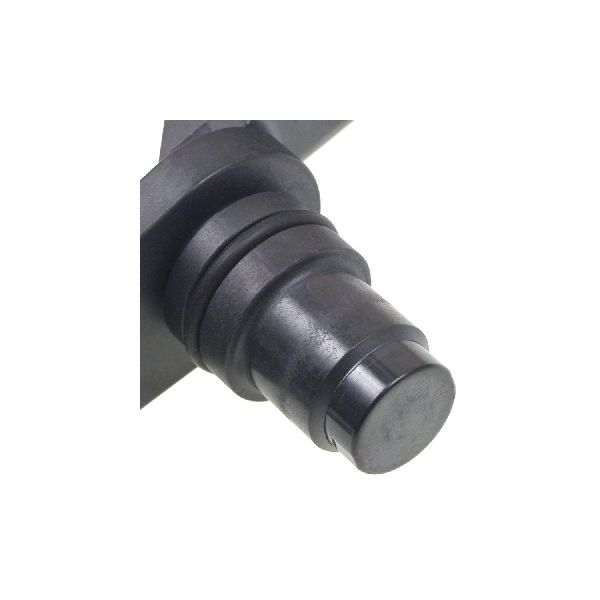
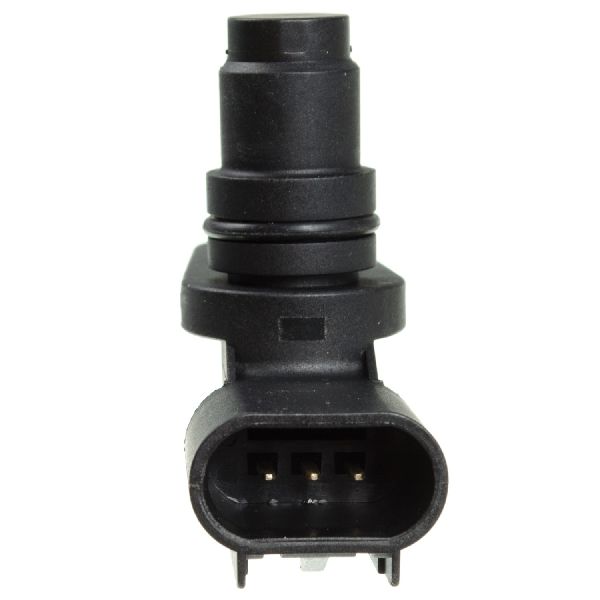
- Intake Camshaft Position Actuator Solenoid
(OEM #12655420, superseded by 12679099)— This is the most common failure point for code P0010 on this engine. The internal coil windings fail, creating an open circuit. GM TSB 17-NA-098 (updated 2019) specifies the updated part number 12679099.
Trusted brands: ACDelco (GM Original Equipment), Delphi, Dorman (e.g., 917-215)
OEM price range: $40-$60
Aftermarket price range: $20-$40 - Exhaust Camshaft Position Actuator Solenoid
(OEM #12655421, superseded by 12679100)— It is highly recommended to replace both solenoids as a pair. They are the same age and subjected to the same conditions, so if one has failed, the other is likely near the end of its service life. This is also the official GM recommendation per TSB 17-NA-098.
Trusted brands: ACDelco (GM Original Equipment), Delphi, Dorman (e.g., 917-216)
OEM price range: $40-$60
Aftermarket price range: $20-$40
Related Codes That Often Appear With This One
- P0011 — P0011 indicates 'Intake Camshaft Position Timing - Over-Advanced'. It's a performance code that often appears with P0010 because the circuit fault (P0010) prevents the camshaft from reaching its target position, causing a timing error (P0011).
- P0013 — This is the equivalent code for the exhaust solenoid. If you swap the intake and exhaust solenoids for diagnosis, P0010 will turn into P0013 if the solenoid is the faulty component.
- P0014 — This is the performance code equivalent to P0011, but for the exhaust side ('Exhaust Camshaft Position Timing - Over-Advanced'). It may appear alongside P0013.
Technical Service Bulletins (TSBs) & Recalls
- GM TSB 17-NA-098: Addresses rough running, hesitation, and DTCs P0010, P0011, P0013, or P0014 on 2.4L engines in platform mates (Equinox/Terrain). The official correction is to replace both camshaft position actuator solenoid valves with updated parts and verify ECM software.
Platform-Specific Known Issues
- The 2.4L Ecotec engine in this vehicle is known for higher-than-average oil consumption, which can lead to low oil levels that cause or exacerbate VVT solenoid issues. Regular oil level checks (e.g., every other fuel fill-up) are critical.
- The plastic connectors for the solenoids can become brittle and break easily during removal. Be gentle when lifting the locking tab and disconnecting the harness.
Mechanic-Grade Diagnostic Values
- VVT Actuator Solenoid Internal Resistance — expected: 8 to 15 Ohms. Failure: A reading of Open Loop (OL), infinity, or in the mega-ohm (MΩ) range indicates a failed internal coil. A reading near zero indicates a short.
- Voltage at Solenoid Connector (Key On, Engine Off) — expected: One pin should have 8.5V - 12V+ (battery voltage). The other pin is the control wire from the ECM.. Failure: No voltage indicates a problem with the power supply circuit, fuse, or wiring, not the solenoid itself.
- Scan Tool Live Data: Desired vs. Actual Cam Angle — expected: At idle, both values should be near 0 degrees. When RPM is raised to 1500-2000, the ECM will command an advance (e.g., 10-20 degrees). The 'Actual' PID should follow the 'Desired' PID closely.. Failure: If the ECM commands an advance ('Desired' changes) but the 'Actual' angle does not change, it confirms a fault in the VVT system (solenoid, wiring, or mechanical).
Scan Tool Commands That Help
- GM Tech2 / GDS2 or equivalent professional scan tool: Intake Camshaft Position Actuator Solenoid Control — Use this bidirectional control in the 'Output Control' menu to command the solenoid on and off while the engine is idling. You should hear an audible click from the solenoid and see a change in engine RPM or even a stall. This directly tests the solenoid's mechanical function and the integrity of the control circuit from the ECM. If the engine stumbles, the solenoid and its hydraulics are likely working. If nothing happens, the solenoid is likely stuck or the circuit is open.
Wiring & Ground Locations
- G105 / G107 — G105 is at the left rear of the engine; G107 is at the rear of the engine, on the engine block.. These are the primary engine block grounds for the ECM and its sensors. A loose, corroded, or broken ground connection at these points can create electrical noise or voltage drops, causing the ECM to misinterpret sensor signals or incorrectly flag a circuit fault like P0010. Cleaning these grounds is a valid diagnostic step if wiring issues are suspected.
- Intake VVT Solenoid Connector — Top of the engine, toward the front of the vehicle (intake side), with a gray plastic connector.. This is the point of failure. Pin A (typically Pink/Black wire) should be 12V ignition power. Pin B (typically a Tan or other color wire) is the control circuit that the ECM pulses to ground. Testing for power at Pin A and using a noid light between Pin A and Pin B while cranking can confirm if the ECM is attempting to control the solenoid.
Real Owner Repair Stories
- Compilation of forum posts and mechanic videos (2009 Chevy Equinox 2.4L Ecotec (platform mate)) — P0010 and P0011 codes, rough idle, stalling when coming to a stop.
❌ Tried (didn't work) Replaced the intake VVT solenoid with a new ACDelco part., Performed an engine oil and filter change., Cleared codes, but P0010 and P0011 returned within a day of driving.
✅ What actually fixed it The vehicle was taken to a shop that specialized in engine work. The mechanic noted that even with a new solenoid, the scan tool showed the actual cam timing was not responding to commands. Further diagnosis revealed a stretched timing chain. The excessive slack in the chain prevented the camshaft phaser from adjusting timing correctly, which the ECM eventually flagged as a control system error. A full timing chain kit replacement was required to resolve the codes permanently.
When the Usual Fixes Don't Work
- While over 90% of P0010 codes on this engine are fixed by replacing the solenoid, a significant minority of cases are not. If a new, quality solenoid and a fresh oil change do not resolve the code, the next most likely cause is not a wiring issue, but a stretched timing chain. This is especially true if the vehicle has over 100,000 miles and a history of oil consumption. Technicians familiar with the 2.4L Ecotec will often check for timing chain stretch (via scan tool data or physical inspection) before spending extensive time diagnosing a wiring harness that is rarely the root cause.
OEM Part Supersession History
12655420 (Intake)→12679099 (Intake)— Updated design to improve reliability and prevent premature failure.12655421 (Exhaust)→12679100 (Exhaust)— Updated design to improve reliability and prevent premature failure.
Diagnostic Flowchart
Other Known Issues on This Vehicle
Issues unrelated to this code that are worth knowing about as an owner of this generation:
- Excessive Oil Consumption 🔴 High — Extremely common, often starting around 60,000-80,000 miles. Caused by a piston ring design flaw that allows oil to bypass into the combustion chamber. (Ref: No specific recall for the Vue, but GM acknowledged the issue in lawsuits and special coverage programs (e.g., 15285C) for platform mates like the Chevy Equinox.)
- Premature Timing Chain Failure 🔴 High → Shop Engine Timing Chain — Common failure, often before 100,000 miles. The issue is severely accelerated by low oil levels from the known oil consumption problem, which starves the hydraulic tensioner and plastic guides. (Ref: No recall, but it is a widely documented failure. A rattling noise on cold startup is the primary symptom.)
- Faulty Electronic Throttle Body 🟠 Medium — Common issue causing 'Reduced Engine Power' mode, stalling, and unstable idle. (Ref: GM Special Coverage Program No. 15267 was issued for 2008-2009 models, acknowledging a defect in the throttle position sensor.)
- Faulty Body Control Module (BCM) 🟡 Low — Can cause a wide range of strange electrical issues, including flickering dash lights, starting problems, and random warning lights.
- Rear Main Seal Oil Leak 🟠 Medium — A notable number of owners report leaks from the rear main crankshaft seal at higher mileage (100k+ miles). This is a labor-intensive repair.
Used vs. New Parts: Buying Guide for This Vehicle
When a used part is the smart pick: Never. VVT solenoids are a high-failure, wear-and-tear item that is highly sensitive to oil contamination and quality. They are inexpensive to buy new. Installing a used solenoid with an unknown history is extremely likely to result in the same code returning shortly, wasting time and effort.
What to inspect on the donor part:
- Not applicable. Do not purchase this part used.
Aftermarket brands forum-validated for this vehicle:
- ACDelco (GM Original Equipment)
- Delphi (Often the original OEM supplier)
- Dorman (A widely available and generally accepted standard replacement)
Brands owners have reported issues with on this vehicle:
- Unbranded, no-name solenoids from online marketplaces. These often have high failure rates out of the box or fail prematurely due to poor quality internal windings and materials.
Real Owner Stories
Aggregated from forums and TSBs cited above. Mileages and costs reflect what owners reported in those sources.
2008-2010 Saturn Vue 2.4L LE5
Symptoms: Check engine light on, rough or unstable idle, and the engine was stalling at low speeds.
What fixed it: Replacing the VVT solenoids and performing an oil change.
Source hint: SaturnFans.com
2015 Chevrolet Equinox 2.4L (Platform Mate)
Symptoms: P0010 code present; owner demonstrated diagnostic swap test to confirm failure.
What fixed it: Replacement of the VVT solenoids.
Source hint: YouTube - NoNonsenseKnowHow
2017 Chevrolet Equinox 2.4L (Platform Mate)
Symptoms: Codes P0010 and P0011; rough running and hesitation.
What fixed it: Solenoid replacement and a critical oil change.
Source hint: YouTube - Techn' Moto
Related OBD-II Codes
Frequently Asked Questions
Does GM TSB 17-NA-098 apply to my 2008-2010 Saturn Vue with the 2.4L engine?
I have a P0010 code; which solenoid should I check on my Ecotec engine?
Can low oil levels cause the P0010 code on my Saturn Vue?
Is there a way to test if the solenoid is actually bad before I buy a new one?
Should I replace both solenoids even if only the intake one is failing?
My Vue is stalling at stoplights and has a P0010 code; are these related?
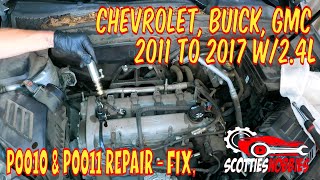
Helpful Videos
We Have This Part in Stock


The information in this article is provided for general reference and educational purposes only. Vehicle specifications, procedures, and part compatibility can vary by production date, trim level, and region. Always consult your vehicle's factory service manual and verify part numbers before purchasing or performing repairs. Safety-critical components such as airbags, seat belts, and braking systems should be installed by a qualified professional.
- Saturn Vue:
- 🧭 Diagnostic Flowchart
- 🎬 Helpful Videos
- 🛍️ Shop This Part
- What's Unique About the 2008-2010 Saturn Vue
- Symptoms You May Notice
- Most Likely Causes
- Rare But Worth Checking
- Diagnosis Steps
- Parts You'll Likely Need
- Related Codes That Often Appear With This One
- Technical Service Bulletins (TSBs) & Recalls
- Platform-Specific Known Issues
- Mechanic-Grade Diagnostic Values
- Scan Tool Commands That Help
- Wiring & Ground Locations
- Real Owner Repair Stories
- When the Usual Fixes Don't Work
- OEM Part Supersession History
- Other Known Issues on This Vehicle
- Used vs. New Parts: Buying Guide for This Vehicle
- Real Owner Stories
- 2008-2010 Saturn Vue 2.4L LE5
- 2015 Chevrolet Equinox 2.4L (Platform Mate)
- 2017 Chevrolet Equinox 2.4L (Platform Mate)
- Related OBD-II Codes
- Frequently Asked Questions
- 🎟️ Get 5% Off