

P0011 on 2015-2019 Ford Fusion Hybrid: Causes and Fixes for Over-Advanced Camshaft Timing
The most likely cause for a P0011 code on your Fusion Hybrid is a sticking intake Variable Camshaft Timing (VCT) solenoid, often due to dirty oil, incorrect oil viscosity, or debris. An oil change using the correct SAE 5W-20 oil and, if needed, replacing the VCT solenoid is the most common and effective fix.
- P0011 on your Fusion Hybrid almost always points to an issue with the intake VCT solenoid or the engine oil.
- Always start your diagnosis by checking the engine oil level and condition. An oil change is the cheapest and easiest first step.
- The most common repair is replacing the intake VCT solenoid, a task that is accessible for a DIYer with basic tools.
- A Ford TSB (SSM 50067) confirms that sticking VCT solenoids are a known issue on these vehicles.
- Do not immediately assume you need to replace expensive components like the camshaft phaser or timing chain.
What's Unique About the 2015-2019 Ford FUSION HYBRID
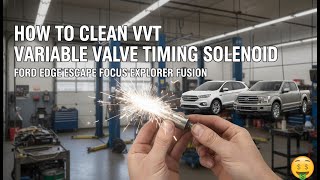
The 2.0L Atkinson-cycle engine in the Fusion Hybrid relies on clean, correct-viscosity oil for the hydraulic operation of its Twin Independent Variable Camshaft Timing (Ti-VCT) system. Ford has issued multiple Technical Service Bulletins (TSB #SSM 50067, SSM 47170) that specifically mention this group of vehicles and codes, stating that small debris in the oil can cause the VCT solenoid to stick. This makes a sticking solenoid a highly probable cause. The diagnostic procedure even recommends using a scan tool to cycle the solenoid 10 times to clear debris before replacement.
🎬 Watch: How to clean a VCT solenoid to clear codes.Diagnostic Flowchart
Tap your situation to follow the diagnostic path that matches what you're seeing on this vehicle.
Symptoms You May Notice
- Check Engine Light illuminated
- Rough or unstable idle
- Hesitation or sluggish acceleration
- Reduced fuel economy
- Engine stalling in some cases
- Hard starting condition
- Rattling noise from the engine, especially on startup
- Replacing the camshaft position sensor. The sensor is usually just reporting the problem that the VCT system is causing; it's rarely the sensor itself that has failed.
- Replacing the camshaft phaser when the issue is only a dirty or faulty VCT solenoid. Always start with the oil and solenoid, as they are cheaper and easier to replace.
Most Likely Causes
- Sticking or Failed Intake VCT Solenoid 🔴 High Probability A manufacturer TSB (#SSM 50067) directly states that debris can cause the VCT solenoid to stick on these engines. The fine mesh screens on the solenoid can become clogged with sludge from overdue oil changes.
How to confirm: Perform an oil change first. If the code returns, use a bidirectional scan tool to perform pinpoint test HK12, which cycles the solenoid to dislodge debris. If that fails, swap the intake and exhaust VCT solenoids (if they are identical parts). If the code changes to P0014 (exhaust camshaft), the solenoid is confirmed faulty.
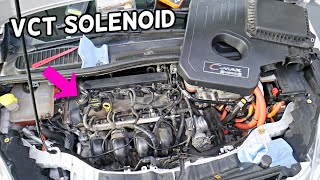
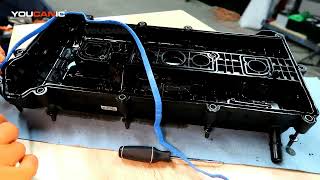
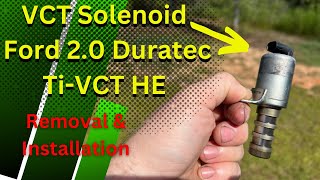
Typical fix: Replace the Bank 1 intake VCT solenoid. On this specific 2.0L Hybrid engine, this requires removing the valve cover for access. 🎬 Watch: Locate and replace the VCT solenoid on your Fusion.
Est. part cost: $30-$80 - Low, Dirty, or Incorrect Viscosity Engine Oil 🔴 High Probability The Ti-VCT system is hydraulically operated by engine oil. Low levels, contamination, or using oil thicker than the specified SAE 5W-20 can restrict flow in small passages, causing solenoids to stick or phasers to respond slowly.
How to confirm: Check the oil dipstick for level and inspect the oil for darkness, thickness, or a gritty texture. Confirm the last oil change used the correct viscosity.
Typical fix: Perform an oil and filter change using the manufacturer-specified SAE 5W-20 Synthetic Blend oil.
Est. part cost: $40-$80 - Damaged Camshaft Phaser ⚪ Low Probability → Shop Engine Camshaft While less common than a solenoid failure, the phaser (the gear that the solenoid controls) can become clogged with sludge or fail mechanically, getting stuck in the advanced position.
How to confirm: This is a more advanced diagnosis. It often presents with a distinct rattling or knocking noise from the timing cover area. Professional diagnosis is recommended as replacement is labor-intensive.
Typical fix: Replace the camshaft phaser. This is a labor-intensive job with shop costs potentially ranging from $800 to $2500.
Est. part cost: $150-$250
Rare But Worth Checking
- Timing Chain/Tensioner Issue: → Shop Engine Timing Chain A stretched timing chain or failed tensioner can cause the base timing to be off, triggering this code. This is usually accompanied by rattling noises from the engine and is a more serious repair.
- Wiring Harness Damage: Damage to the wires leading to the VCT solenoid can cause a loss of signal. This can be checked with a multimeter for continuity and visual inspection for chafing or corrosion.
Diagnosis Steps
- Check the engine oil level and condition. If it is low, dirty, or the wrong viscosity, correct this first. Use SAE 5W-20 oil. Clear the code and see if it returns.
- Use an OBD-II scanner to check for any other pending or active codes.
- Inspect the wiring and connector for the intake VCT solenoid on Bank 1 for any visible damage, corrosion, or loose connections.
- If you have a bidirectional scan tool, follow the procedure in TSB SSM 50067 (Pinpoint Test HK12) to command the VCT solenoid to cycle 10 times. This may dislodge debris and fix the issue.
- If the code persists, remove the valve cover to access the VCT solenoids. Swap the intake VCT solenoid with the exhaust VCT solenoid. Clear the codes and drive the vehicle. If the code returns as P0014 (Exhaust Camshaft Position), the solenoid you moved is faulty and needs to be replaced.
- If the code remains P0011 after the swap, the problem lies elsewhere. You can test the solenoid by applying a 12V power source to its terminals to see if the internal plunger actuates.
- If the solenoid and wiring test good, the issue may be with the camshaft phaser or timing chain, which often requires professional diagnosis.
Parts You'll Likely Need
- Engine Variable Valve Timing (VVT) Solenoid
(OEM #HL3Z-6M280-A)— This is the most common point of failure for this code, as confirmed by multiple TSBs. It gets stuck due to oil debris, preventing proper timing adjustments.
Trusted brands: Motorcraft, Dorman, Standard Motor Products
OEM price range: $45-$70
Aftermarket price range: $25-$60 - Engine Oil and Filter — Clean oil of the correct viscosity (SAE 5W-20) is critical for the VCT system to operate. An oil change is a necessary first step and often a fix in itself.
Trusted brands: Motorcraft (oil and filter)
OEM price range: $50-$80
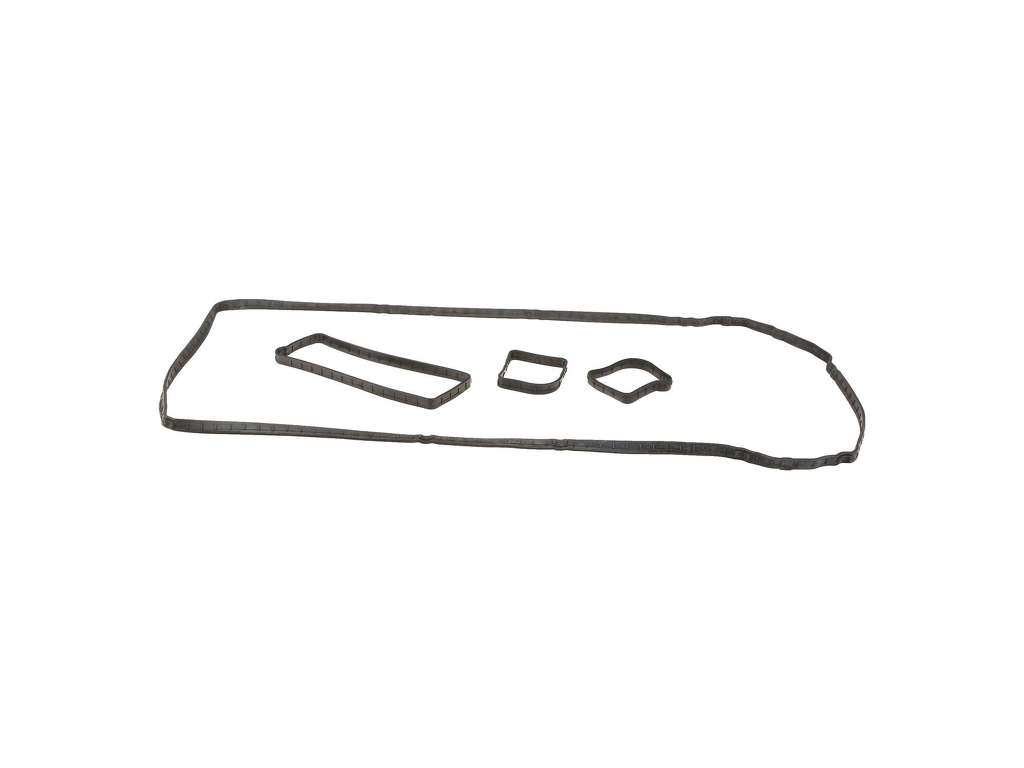
Aftermarket price range: $40-$60 - Valve Cover Gasket Set — Required for the VCT solenoid replacement on this specific engine, as the valve cover must be removed. It is best practice to replace the gasket anytime the cover is removed to prevent oil leaks. 🎬 See this step-by-step guide for replacing the valve cover gasket.
Trusted brands: Fel-Pro, Motorcraft
OEM price range: $40-$60
Aftermarket price range: $20-$40
Related Codes That Often Appear With This One
- P0012 — P0012 is for 'Timing Over-Retarded'. It's possible for a sticking VCT solenoid to cause intermittent over-advanced and over-retarded conditions.
- P0010 — P0010 indicates a circuit malfunction for the VCT solenoid. If you see this code alongside P0011, it points more strongly to an electrical issue with the solenoid or its wiring.
- P0014 — This code is for the exhaust camshaft ('B' Camshaft) on Bank 1. If it appears after swapping the intake and exhaust solenoids, it confirms the original intake solenoid was faulty.
Technical Service Bulletins (TSBs) & Recalls
- SSM 50067: Notes that various VCT-related DTCs, including P0011, may be caused by small debris making the VCT solenoid stick. Recommends running a diagnostic pinpoint test (HK12) to cycle the solenoid before replacement.
- SSM 47170: An earlier TSB with nearly identical advice to SSM 50067, confirming this is a long-standing known issue. It also advises using Pinpoint Test HK11 to cycle the solenoid.
Platform-Specific Known Issues
- NHTSA Technical Service Bulletin #SSM 50067 directly links P0011 (and other VCT codes) on 2015-2021 Ford vehicles to small debris causing the VCT solenoid to stick.
- Unlike many other Ford engines where VCT solenoids are externally accessible, on the 2.0L Hybrid engine the solenoids are located underneath the valve cover, requiring its removal for service or replacement.
Mechanic-Grade Diagnostic Values
- VCT Solenoid Internal Resistance — expected: 7 to 14 Ohms. Failure: A reading of OL (infinite) indicates an open coil, while a reading under 5 Ohms suggests a short.
- VCT Solenoid Connector Voltage — expected: ~12V (Battery Voltage) with Key On, Engine Off. Failure: No voltage at the power pin (when measured against a good ground) points to an issue in the power supply circuit, such as the PCM power relay or a fuse.
- Scan Tool PID: VCT_ADV_ERR (Camshaft Timing Error) — expected: Close to 0 degrees (+/- 5 degrees) at idle and during steady-state driving.. Failure: A large, persistent positive value indicates the camshaft is stuck in an over-advanced position and not responding to PCM commands.
Scan Tool Commands That Help
- Ford IDS, FORScan, or equivalent professional scanner: VCT Solenoid On/Off State Control / Output State Control (OSC) — This bidirectional command manually cycles the VCT solenoid, often 10 times, as recommended by Ford TSBs. It can dislodge small debris causing the solenoid to stick, potentially fixing the code without replacing parts. It also confirms the PCM's ability to control the solenoid.
Wiring & Ground Locations
- Fuse F8 — In the under-hood fuse box (Battery Junction Box).. This fuse provides power to the VVT solenoids. If this fuse is blown, the solenoids will not have power, leading to timing control faults.
- G104 — A primary engine ground point located on the right side of the engine compartment.. A loose or corroded connection at this primary engine ground can cause insufficient grounding for various engine components and sensors, potentially leading to erratic sensor readings and control issues related to the VCT system.
- VCT Solenoid Connector — Plugged into the top of each VCT solenoid, located under the valve cover on the 2.0L Hybrid engine.. This two-wire connector provides power and the control signal from the PCM. A partial wiring diagram shows wire colors may include White/Brown and Violet/Gray. Damage or corrosion at the connector or in its wiring will cause a loss of control over the solenoid, triggering codes P0010 or P0011.
Real Owner Repair Stories
- YouTube user comment (Vehicle not specified, but symptoms and fix are directly applicable.) — P0011 error code present.
❌ Tried (didn't work) Initial diagnosis pointed to a VVT solenoid issue.
✅ What actually fixed it The owner removed and cleaned the VVT solenoids with carburetor cleaner, performed an engine flush, and then did an oil change with fresh oil. The code did not return after 1,000 miles of driving, and the engine idled smoothly and was responsive.
Model Year Variations Within This Range
- 2015-2019: The Ford Fusion received a cosmetic facelift for the 2017 model year (new grille, rotary shifter, SYNC 3) and another minor update in 2019 (standard Co-Pilot 360). However, the core 2.0L I4 Atkinson-Cycle hybrid powertrain and its Ti-VCT system remained fundamentally unchanged throughout this period, making the causes and fixes for P0011 consistent across all specified model years.
Helpful Videos
We Have This Part in Stock


The information in this article is provided for general reference and educational purposes only. Vehicle specifications, procedures, and part compatibility can vary by production date, trim level, and region. Always consult your vehicle's factory service manual and verify part numbers before purchasing or performing repairs. Safety-critical components such as airbags, seat belts, and braking systems should be installed by a qualified professional.
- Ford FUSION HYBRID:
- 🧭 Diagnostic Flowchart
- 🎬 Helpful Videos
- 🛍️ Shop This Part
- What's Unique About the 2015-2019 Ford FUSION HYBRID
- Symptoms You May Notice
- Most Likely Causes
- Rare But Worth Checking
- Diagnosis Steps
- Parts You'll Likely Need
- Related Codes That Often Appear With This One
- Technical Service Bulletins (TSBs) & Recalls
- Platform-Specific Known Issues
- Mechanic-Grade Diagnostic Values
- Scan Tool Commands That Help
- Wiring & Ground Locations
- Real Owner Repair Stories
- Model Year Variations Within This Range
- 🎟️ Get 5% Off