

P0011 on 2013-2019 Ford Taurus 3.5L: Causes and Fixes for Over-Advanced Camshaft Timing
On a 2013-2019 Ford Taurus with the 3.5L V6, code P0011 is most often caused by low/dirty engine oil or a faulty Variable Camshaft Timing (VCT) solenoid on Bank 1. The first step is always to check the oil and change it if necessary. If the oil is fine, the VCT solenoid is the next likely culprit, costing between $30 and $90 for an OEM part. Ford TSBs suggest debris in the oil is a common cause for the solenoid sticking.
- Always check your engine oil level and condition first; a simple oil change with 5W-20 synthetic blend oil can often fix code P0011.
- The most common failed part is the Bank 1 (firewall side) intake VCT solenoid. Swapping it with the Bank 2 solenoid is a definitive, no-cost diagnostic step.
- If the code persists after an oil change and solenoid swap, the issue could be a more serious mechanical problem like a cam phaser or timing chain, potentially caused by a failing internal water pump contaminating the oil.
- Use OEM Motorcraft parts for VVT components for the best reliability.
What's Unique About the 2013-2019 Ford Taurus
The 3.5L Cyclone V6 engine uses a Twin Independent Variable Camshaft Timing (Ti-VCT) system that is highly dependent on clean oil and correct oil pressure to function. Ford has issued service bulletins (SSMs) acknowledging this system is sensitive to small debris in the oil, which can cause the VCT solenoids to stick and trigger codes like P0011. A unique and critical vulnerability of this engine is its internal, timing-chain-driven water pump. A water pump failure can leak coolant directly into the engine oil, causing widespread contamination that quickly leads to VVT system and timing component failure, which can manifest as a P0011 code.
Symptoms You May Notice
- Check Engine Light is on
- Rough idling
- Poor acceleration or sluggish performance
- Engine stalling
- Decreased fuel economy
- Engine rattling noise, especially on cold start
- Replacing the camshaft position sensor. While possible, the sensor is less likely to fail than the VCT solenoid. A faulty sensor would typically throw a different code related to the sensor circuit itself. Always diagnose VCT solenoid and oil issues first.
Most Likely Causes
- Low or Dirty Engine Oil 🔴 High Probability The Ti-VCT system is operated by hydraulic oil pressure. Low levels or oil that is dirty, sludgy, or the wrong viscosity will prevent the VCT solenoids and phasers from operating correctly. This is the most common cause of P0011.
How to confirm: Check the engine oil dipstick for proper level and inspect the oil's color and consistency. If it's low, black, gritty, or has a milky appearance (coolant contamination), it needs to be changed immediately.
Typical fix: Perform an oil and filter change using the Ford-specified 5W-20 synthetic blend oil. This simple step often resolves the code.
Est. part cost: $40-$80 - Sticking or Failed VCT Solenoid (Oil Control Valve) 🔴 High Probability Ford TSBs (#SSM 47170 and #SSM 48423) state that small debris in the oil can cause the VCT solenoid to stick, which is a primary cause for this code on this platform. TSB 16-0093 also notes a high failure rate for solenoids on some low-mileage 2016 models, suggesting a potential manufacturing defect.
How to confirm: Swap the Bank 1 (firewall side) intake VCT solenoid with the Bank 2 (radiator side) intake VCT solenoid. Clear the codes and drive. If the code changes to P0021, the solenoid is confirmed to be faulty. Alternatively, test the solenoid's resistance with a multimeter; it should be between 5-14 ohms.
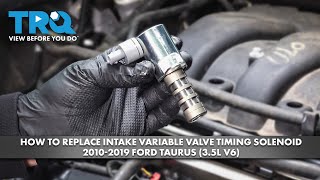
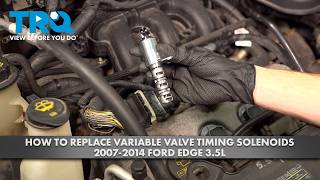
Typical fix: Replace the faulty VCT solenoid. 🎬 See this walkthrough for replacing the intake VVT solenoid It is highly recommended to use an OEM Motorcraft part for reliability. Before replacement, a technician may use a scan tool to perform pinpoint test HK11, which cycles the solenoid to dislodge debris, potentially fixing it without replacement.
Est. part cost: $30-$90
Rare But Worth Checking
- Worn Camshaft Phaser: → Shop Engine Camshaft While less common than a solenoid failure on the naturally aspirated 3.5L, the phaser itself can fail mechanically or become clogged with sludge, preventing it from adjusting cam timing correctly. This is a more involved and expensive repair, often accompanied by a startup rattle.
- Stretched Timing Chain or Failed Guides: → Shop Engine Timing Chain If the engine has high mileage or a history of poor oil maintenance, the timing chain can stretch. This is a significant mechanical issue that requires extensive labor to fix. It is often indicated by the presence of code P0016 alongside P0011.
- Internal Water Pump Failure: → Shop Engine Water Pump A failing water pump can contaminate the oil with coolant. If you find milky, frothy oil, this is a critical issue that must be addressed immediately to prevent catastrophic engine damage. This failure is a known weak point of the 3.5L Cyclone engine design.
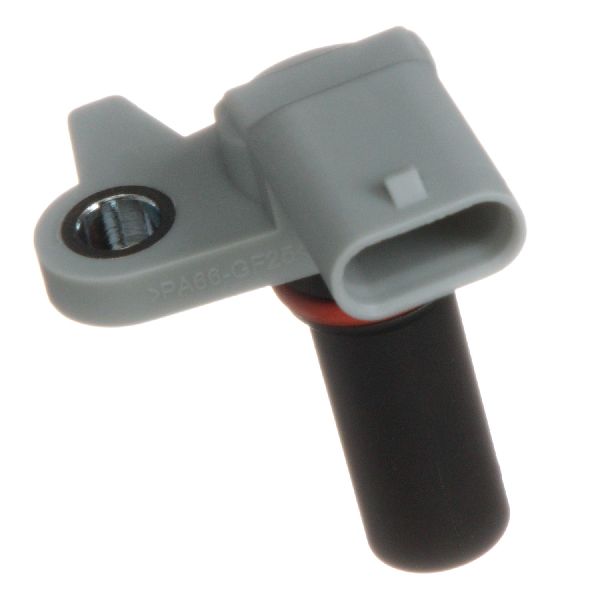
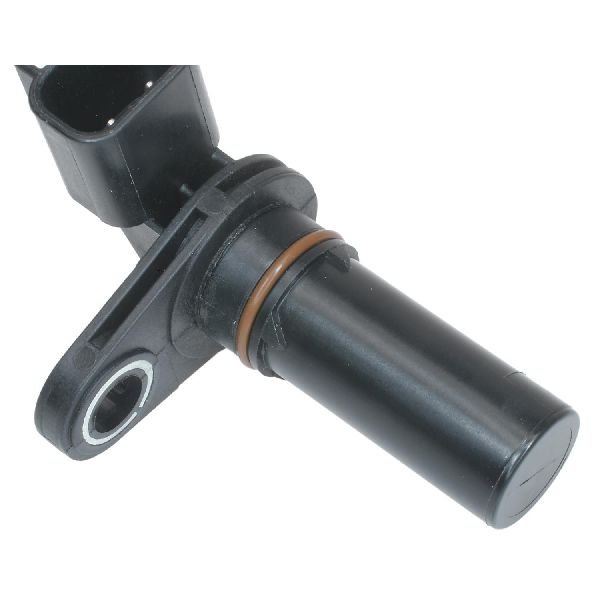
- Faulty Camshaft Position Sensor: → Shop Engine Camshaft Position Sensor It is uncommon for the sensor itself to cause a performance code like P0011 without also setting a specific sensor circuit code (e.g., P0340). However, if all other VCT components check out, a faulty sensor providing incorrect data to the PCM is a remote possibility.
Diagnosis Steps
- Check the engine oil level and condition. Top off or change the oil and filter if necessary. Use Ford-specified 5W-20 oil. Clear the code and see if it returns.
- If the code returns, use an OBD-II scanner to view live data for commanded vs. actual camshaft position angles 🎬 Watch: How to diagnose VVT solenoids and check engine codes for Bank 1 (VCT_ADV1 PID). A large, persistent deviation indicates a problem.
- Per Ford TSBs, a capable scan tool can be used to run pinpoint test HK11 to command the VCT solenoid to cycle, which may dislodge debris and fix the issue.
- Locate the intake VCT solenoids on Bank 1 (firewall side) and Bank 2 (radiator side). They are mounted on the valve covers.
- Swap the Bank 1 and Bank 2 intake VCT solenoids. They are identical parts.
- Clear the trouble codes and drive the vehicle to see if the code returns.
- If code P0021 (for Bank 2) appears, the solenoid you moved is faulty and must be replaced.
- If code P0011 returns, the problem is not the solenoid. Inspect the wiring and connector to the Bank 1 solenoid for damage or corrosion. Test the solenoid's resistance; it should be 5-14 ohms.
- If wiring and the solenoid are good, the issue is likely a more complex mechanical problem, such as a faulty cam phaser or timing chain issue, which may require professional diagnosis.
Parts You'll Likely Need
- Intake Variable Camshaft Timing (VCT) Solenoid
(OEM #7T4Z-6M280-C)— This is the most common part to fail for this code, often due to getting stuck from oil debris. This part number supersedes 7T4Z-6M280-A, 7T4Z-6M280-AA, and 7T4Z-6M280-B.
Trusted brands: Motorcraft, Dorman
OEM price range: $60-$90
Aftermarket price range: $30-$60 - Engine Oil and Filter — Low or dirty oil is a primary cause of VVT system faults. An oil change is a crucial first step and may resolve the issue on its own.
Trusted brands: Motorcraft (Synthetic Blend 5W-20), Mobil 1, Valvoline
OEM price range: $50-$80
Aftermarket price range: $40-$70
Related Codes That Often Appear With This One
- P0021 — This is the same over-advanced timing code but for Bank 2. If P0011 and P0021 appear together, it strongly points to a global issue like low/dirty engine oil, low oil pressure, or a severe mechanical problem like a slipped timing chain affecting both banks.
- P0016 — Indicates a correlation error between the crankshaft and the Bank 1 camshaft. If seen with P0011, it significantly increases the likelihood of a base mechanical timing issue like a stretched chain, jumped tooth, or failing cam phaser, as the computer is seeing a physical misalignment.
Technical Service Bulletins (TSBs) & Recalls
- SSM 47170 / SSM 48423: Note that P0011 may be due to small debris causing the VCT solenoid to stick and recommend cycling the solenoid with a scan tool before replacement.
- TSB 16-0093: For 2016 models with low mileage (<2000 miles), this TSB advises replacing the affected VCT solenoid directly, suggesting a known early part failure issue.
Platform-Specific Known Issues
- Ford Technical Service Bulletins #SSM 47170 and #SSM 48423 note that P0011 can be caused by small debris causing the VCT solenoid to stick. The bulletins recommend attempting to clear the debris by cycling the solenoid with a scan tool (pinpoint test HK11) before replacement.
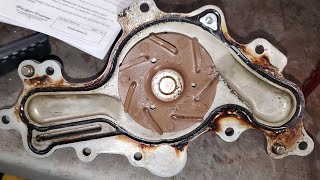
- The internal timing-chain-driven water pump is a known weak point. Its failure contaminates the oil with coolant, leading to VVT and timing component damage. A check for milky oil or coolant loss without an external leak is critical. 🎬 Watch: Expert tips on diagnosing 3.5L Ford water pump failure
- TSB 16-0093 was issued for 2016 models with the 3.5L engine, recommending VCT solenoid replacement for P0011 on vehicles with less than 2,000 miles, indicating a known batch of faulty parts from the factory.
Mechanic-Grade Diagnostic Values
- VCT Solenoid Internal Resistance — expected: 5-14 Ohms (general), 6.9-7.9 Ohms (platform specific at ~68°F). Failure: A reading of 0 Ohms (short), infinite/OL (open), or significantly outside the specific range indicates a faulty solenoid.
- Scan Tool PID: VCT_ADV_ERR (VCT Advance Error) — expected: Should hover around 0° (+/- 5°) at idle and during steady-state driving.. Failure: A consistent, non-zero value, especially +6 degrees or greater than desired at idle, indicates the PCM cannot achieve the commanded cam angle.
- Scan Tool PID: VCT_INT_ADV_ACT1 (Actual Cam Angle Bank 1) — expected: Should closely match the desired angle PID (VCT_INT_ADV_DES1).. Failure: A reading of +6 degrees or greater than the desired angle at idle confirms an over-advanced condition.
- Engine Oil Pressure (at operating temp) — expected: Minimum of 15 PSI at idle.. Failure: Pressure below 15 PSI at hot idle can starve the VCT system and cause timing codes.
Hidden / Shadow Codes Worth Checking
- Mode $06, TID $81: This is not a hidden code but a monitor test ID within standard OBD-II diagnostics that tracks VCT system performance. A failing test under this ID can indicate a borderline component or intermittent fault before a persistent DTC like P0011 is set. (see via A professional scan tool with Mode 6 capabilities, such as the Ford IDS or a high-end FORScan setup.)
Scan Tool Commands That Help
- Ford IDS (or FORScan): Pinpoint Test HK11 / VCT Solenoid Output State Control — As recommended by Ford SSMs 47170 and 48423, this command cycles the VCT solenoid 10 times. It should be used before replacing the solenoid to attempt to dislodge small debris that may be causing it to stick.
- Ford IDS: Histogram Mode for VCT Error PIDs — This function graphically displays the distribution of VCT error (VCT_ADV_ERR) over a drive cycle. It is useful for identifying intermittent faults or anomalies that are difficult to spot by watching live data numbers alone.
Wiring & Ground Locations
- VCT11 (Bank 1 Intake) PCM Connector Pin — Pin 68 of the C175E connector at the Powertrain Control Module (PCM).. If the VCT solenoid tests good and swapping it doesn't resolve the P0011 code, testing for continuity and voltage at this specific pin helps rule out a break or short in the wiring harness between the PCM and the solenoid.
- Main Engine Ground Strap — Typically located on the transmission case, connecting to the chassis. On the front of the engine, a smaller ground strap is often found near the passenger side strut tower.. A loose or corroded main engine ground can cause electrical noise and voltage drops across all engine sensors, including the Camshaft Position Sensor. While not a direct cause, it can create erratic readings that complicate diagnosis.
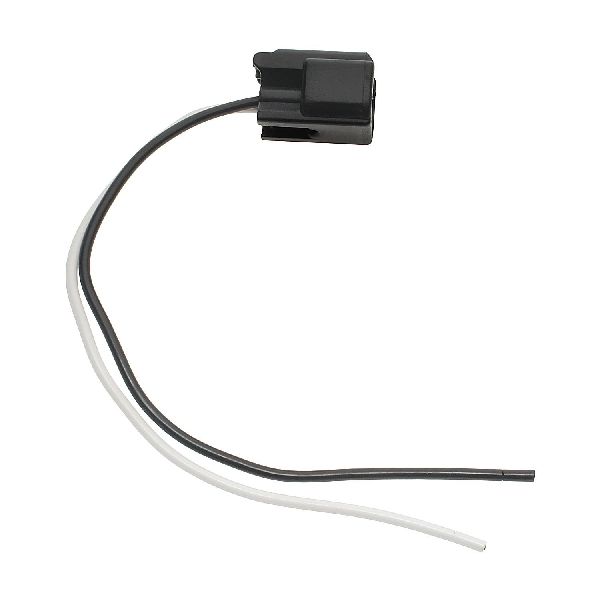
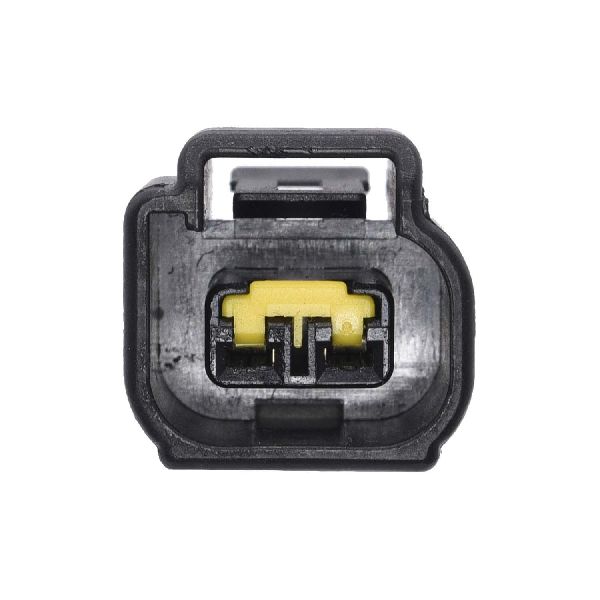
- VCT Solenoid Connector — On the valve cover, connected to the VCT solenoid. The intake solenoid connector is often gray or white.. The connector itself or its pigtail can become brittle, corroded, or contaminated with oil, leading to a poor connection and intermittent solenoid operation. Pigtail replacements are available.
Real Owner Repair Stories
- Ford Truck Enthusiasts Forum User (2016 Ford F-150 5.0L (similar VCT system), 89,000 miles) — Stumble and die at idle, P0012 code initially.
❌ Tried (didn't work) Replaced Bank 1 intake and exhaust VCT solenoids. The code did not return, but the stumbling and dying at stops persisted.
✅ What actually fixed it The user was preparing to replace the Bank 2 VCT solenoids next, acknowledging they were 'throwing parts' at the problem. This story illustrates that even when a solenoid replacement clears a code, it may not solve the underlying drivability issue, pointing towards a more complex problem or issues on the other bank. - Reddit r/FordEdge User (2010 Ford Edge 3.5L) — Engine sounded weird, poor acceleration, multiple codes P0011, P0016, P0018, P0021.
❌ Tried (didn't work) The user had previously replaced the timing chain, sprockets, water pump, and tensioners about a year prior.
✅ What actually fixed it The thread did not have a final resolution posted by the original user. However, the combination of codes across both banks (P0011/P0021) and correlation codes (P0016/P0018) strongly suggests a catastrophic failure of the recent timing job or a new, severe mechanical timing issue, not a simple solenoid fault.
OEM Part Supersession History
7T4Z-6M280-A, 7T4Z-6M280-AA, 7T4Z-6M280-B→7T4Z-6M280-C— Standard part evolution for improved reliability and performance. Later revisions often address issues like sticking or internal coil failure seen in earlier versions.
Heads up: All previous versions are directly replaced by 7T4Z-6M280-C. They are physically and electrically compatible.
Model Year Variations Within This Range
- 2013-2019: The 2013 model year refresh introduced Twin Independent Variable Camshaft Timing (Ti-VCT) to the base 3.5L V6, increasing horsepower to 288. This means vehicles from 2013 onward have four VCT solenoids (intake and exhaust for each bank), making diagnosis by swapping solenoids possible. Pre-2013 models had a different VCT setup.
Diagnostic Flowchart
Other Known Issues on This Vehicle
Issues unrelated to this code that are worth knowing about as an owner of this generation:
- Internal Water Pump Failure 🔴 High → Shop Engine Water Pump — A well-documented, common failure point across all 3.5L/3.7L Cyclone engines. Failure can occur at any mileage but becomes more likely after 80,000 miles. When the seal fails, it leaks coolant directly into the engine oil.
- AWD Power Transfer Unit (PTU) Failure 🔴 High — Common on all-wheel-drive models. The PTU is located near the hot exhaust, causing its 'lifetime' fluid to break down, leading to seal leaks, gear wear, and eventual failure, often signaled by a grinding noise or burning oil smell.
- Electronic Throttle Body Failure 🟠 Medium — Affects many Ford vehicles with this engine, causing sudden stalling, loss of power, and the 'wrench' light to appear. The issue is often internal electronic failure or contamination. (Ref: Ford TSB 16-0139 covers this issue on other models, indicating a known problem with the part.)
- HVAC Blend Door Actuator Failure 🟡 Low — Extremely common failure. Presents as a persistent clicking sound from the dashboard upon startup or an inability to control temperature on the passenger side. The plastic gears inside the actuator strip out.
- Worn Front Strut Mount Bearings 🟡 Low — A frequent complaint is a clunking or binding noise from the front suspension when turning the steering wheel at low speeds. The bearings in the upper strut mounts wear out prematurely.
Used vs. New Parts: Buying Guide for This Vehicle
When a used part is the smart pick: For this specific repair, using a used VCT solenoid is generally not recommended. The primary failure mode is internal clogging or sticking due to oil debris, and a used part from a junkyard carries a high risk of having the same or imminent issues. The cost of a new, quality aftermarket or OEM part is low enough that the labor involved in a potential second replacement outweighs any savings.
Donor-vehicle mileage cap: roughly under 40000 miles for the part to have meaningful remaining life.
What to inspect on the donor part:
- If considering a used part, verify the donor vehicle had documented, regular oil changes.
- Inspect the screen on the used solenoid for any signs of sludge, metal shavings, or debris. A perfectly clean screen is the only acceptable condition.
- Test the resistance of the used solenoid with a multimeter before purchase; it must be within the 6.9-7.9 Ohm range.
OEM-only on this vehicle (don't cheap out):
- VCT Solenoid: While some aftermarket brands are acceptable, Motorcraft (OEM) is highly recommended for reliability due to the sensitivity of the Ti-VCT system.
- Camshaft Phasers: If the issue is diagnosed as a failed phaser, using OEM Motorcraft parts is critical. Aftermarket phasers have a very high failure rate on this platform.
- Timing Chain Components: Due to the catastrophic nature of a timing failure, only OEM or top-tier, OE-supplier kits should be used.
Aftermarket brands forum-validated for this vehicle:
- Dorman (for VCT Solenoids)
- Standard Motor Products (SMP)
Brands owners have reported issues with on this vehicle:
- Unbranded, no-name VCT solenoids and phasers from online marketplaces are frequently cited in forums as failing shortly after installation.
Real Owner Stories
Aggregated from forums and TSBs cited above. Mileages and costs reflect what owners reported in those sources.
2016 Ford Taurus 3.5L V6 — ~1500 miles
Symptoms: Check engine light on with P0011 code at very low mileage.
What fixed it: Replacement of the VCT solenoid as per TSB 16-0093 due to a known batch of faulty parts.
Source hint: TSB 16-0093
Ford Taurus 3.5L V6
Symptoms: Owner reported P0011, P0021, and other timing codes simultaneously; engine showing over-advanced timing on both banks.
What fixed it: The issue was determined to be a mechanical failure (slipped timing chain) rather than a simple solenoid failure.
Source hint: SHO Forum: '4 codes. How screwed am I?'
2010 Ford Edge 3.5L V6
Symptoms: Vehicle ran poorly with four codes: P0011, P0016, P0018, and P0021.
What fixed it: A significant timing issue triggering a cascade of related DTCs, indicating a serious mechanical problem rather than a single sticking solenoid.
Source hint: Reddit r/FordEdge: '2010 Ford Edge... CEL shows 4 codes P0011, P0016, P0018, P0021'
Related OBD-II Codes
Frequently Asked Questions
I have a 2016 Ford Taurus with very low mileage and a P0011 code. Is there a known manufacturing defect?
Can I just clean the VCT solenoid on my Taurus instead of replacing it?
Which side of the engine is Bank 1 for the P0011 code on a 3.5L Taurus?
Could a coolant leak cause a P0011 timing code on this engine?
What specific oil should I use to prevent VCT issues in my 2013-2019 Taurus?
Is there a way to test if the solenoid is actually bad before I buy a new one?
Helpful Videos
We Have This Part in Stock


The information in this article is provided for general reference and educational purposes only. Vehicle specifications, procedures, and part compatibility can vary by production date, trim level, and region. Always consult your vehicle's factory service manual and verify part numbers before purchasing or performing repairs. Safety-critical components such as airbags, seat belts, and braking systems should be installed by a qualified professional.
- Ford Taurus:
- 🧭 Diagnostic Flowchart
- 🎬 Helpful Videos
- 🛍️ Shop This Part
- What's Unique About the 2013-2019 Ford Taurus
- Symptoms You May Notice
- Most Likely Causes
- Rare But Worth Checking
- Diagnosis Steps
- Parts You'll Likely Need
- Related Codes That Often Appear With This One
- Technical Service Bulletins (TSBs) & Recalls
- Platform-Specific Known Issues
- Mechanic-Grade Diagnostic Values
- Hidden / Shadow Codes Worth Checking
- Scan Tool Commands That Help
- Wiring & Ground Locations
- Real Owner Repair Stories
- OEM Part Supersession History
- Model Year Variations Within This Range
- Other Known Issues on This Vehicle
- Used vs. New Parts: Buying Guide for This Vehicle
- Real Owner Stories
- 2016 Ford Taurus 3.5L V6 — ~1500 miles
- Ford Taurus 3.5L V6
- 2010 Ford Edge 3.5L V6
- Related OBD-II Codes
- Frequently Asked Questions
- 🎟️ Get 5% Off