

P0012 on 2007-2015 Audi A3: Causes for Over-Retarded Camshaft Timing
On a 2007-2015 Audi A3 with a 2.0T engine, P0012 is most often caused by a failing timing chain tensioner or a stretched timing chain. It can also be caused by a faulty camshaft adjuster magnet (N205 solenoid) or low/dirty engine oil. Addressing this immediately is critical to avoid catastrophic engine damage from the chain failing completely.
- P0012 on a 2007-2015 Audi A3 is a serious code that should not be ignored. The risk of catastrophic engine failure from a failed timing chain is high.
- The most likely cause is a stretched timing chain and/or a failed timing chain tensioner, a well-known issue with these engines.
- Before assuming the worst, check the simple things first: ensure the engine oil is full, clean, and of the correct VW/Audi specification.
- A faulty Camshaft Adjuster Magnet (N205 solenoid) is another common and much cheaper fix to investigate.
- Diagnosing with an Audi-specific tool to check the camshaft adaptation value is the most effective way to confirm or rule out timing chain stretch.
What's Unique About the 2007-2015 Audi A3
The 2007-2015 Audi A3, particularly models with the 2.0T EA888 engine (Gen 1 and early Gen 2), is highly susceptible to timing chain system failures. Early versions of the timing chain tensioner used a design prone to premature failure, which allows the chain to become loose. This well-documented issue, which led to class-action lawsuits, makes a stretched timing chain or failed tensioner a primary suspect for code P0012, far more so than on other vehicles. The original tensioner design can fail without warning, allowing the piston to retract when oil pressure is lost (engine off), leading to the chain skipping time or breaking upon the next startup, causing catastrophic engine damage.
Generation note: This range covers the Audi A3 8P (2006-2013) and the early 8V (2013-2020) generations. Both generations used versions of the EA888 engine that are known for the timing chain tensioner and stretch issues. The diagnostic process and common causes are very similar for both generations within this year range. The problematic tensioner was used in models from 2008-2013.
Symptoms You May Notice
- Check Engine Light is on
- Engine rattling noise, especially on cold startup for 1-3 seconds
- Persistent rattling or clatter from the engine, even when warm or on deceleration
- Rough or unstable idle
- Noticeable loss of engine power and acceleration
- Engine hesitation or stumbling
- Engine stalling at low RPMs
- Reduced fuel economy
- Extended engine cranking before startup
- Replacing the camshaft position sensor. While the sensor reports the problem, it is rarely the cause. The issue is almost always mechanical or hydraulic (timing chain, tensioner, solenoid, or oil pressure). A range/performance code like P0012 means the sensor is working but reporting a value that is out of the expected range.
Most Likely Causes
- Worn Timing Chain and/or Failed Tensioner 🔴 High Probability → Shop Engine Timing Chain Early revisions of the timing chain tensioner on EA888 engines are a known weak point and were subject to a class-action lawsuit. The original design (P/N 06H-109-467) can fail, allowing the piston to retract. The updated tensioner (P/N 06K-109-467) has a stronger design. Chain stretch is also common, even on models with the updated tensioner.
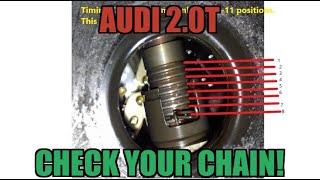
How to confirm: Use a diagnostic tool (like VCDS or OBDeleven) to check the 'camshaft adaptation' value (Measuring Block 93 or via Advanced Measuring Values on UDS controllers). A value exceeding -4.0 to -5.0 degrees 🎬 Watch: How to check for timing chain stretch using a scan tool. strongly indicates a stretched chain. A mechanic can also remove the inspection plug on the lower timing cover to visually inspect how far the tensioner has extended. If it is extended past 6-7 'ribs' or notches, the chain is stretched.
Typical fix: Replacement of the timing chain, tensioner, and all associated guides and rails. This is a significant labor-intensive repair. 🎬 Watch: A complete step-by-step guide to replacing the timing chain. It is critical to install the latest revision parts.
Est. part cost: $300-$600 for a complete timing kit - Faulty Camshaft Adjuster Magnet (N205 Solenoid) 🟡 Medium Probability → Shop Engine Camshaft This solenoid controls the oil flow that adjusts the cam timing. It can become clogged with oil sludge or fail electrically, preventing proper camshaft adjustment. Debris from a failing camshaft bridge screen can also clog the solenoid's fine mesh screens.
How to confirm: The solenoid can be removed (3x T30 bolts) and inspected for sludge or debris. It can be tested by applying 12V to see if it actuates, or by checking its resistance (should be between 6.9 and 7.9 ohms). Swapping the intake and exhaust magnets and seeing if the fault code changes to the exhaust cam (e.g., P0014) is another effective diagnostic step.
Typical fix: Replace the camshaft adjuster magnet. It is located on the front of the upper timing cover and is relatively easy to access. 🎬 See this walkthrough on replacing the cam adjuster magnet and solenoid.
Est. part cost: $40-$100 - Low, Dirty, or Incorrect Engine Oil 🟡 Medium Probability The VVT system is hydraulically operated by engine oil. These engines can consume oil, and if the level is low, pressure is insufficient to operate the cam phasers correctly. Using oil that does not meet VW/Audi specifications (e.g., VW 502.00) can lead to sludge and blockages in the narrow oil passages of the VVT system.
How to confirm: Check the engine oil level via the dipstick or MMI system. Verify the vehicle has the correct oil viscosity (e.g., 5W-40) that meets the appropriate VW specification. An oil change is the first and cheapest diagnostic step.
Typical fix: Top off or change the engine oil and filter using manufacturer-specified oil. Clear codes and re-test.
Est. part cost: $60-$120 for a DIY oil change
Rare But Worth Checking
- Broken Camshaft Bridge Screen: → Shop Engine Camshaft The camshaft support bridge (located under the valve cover) has a small screen that can disintegrate over time. The pieces can travel through oil passages and clog the adjuster magnet (N205) or the cam phaser itself, causing timing issues. If replacing the adjuster magnet, it's wise to inspect the bridge. If the screen is missing, the bridge should be replaced and oil passages checked for debris.
- Sticking Camshaft Phaser / Actuator: → Shop Engine Camshaft The mechanical actuator on the end of the camshaft can get stuck due to oil sludge or debris from a failed screen. This is less common than the solenoid failing but can happen, requiring a more involved repair that includes removing the timing chain.
- Failed Camshaft Position Sensor (G40): → Shop Engine Camshaft Position Sensor While very rare, the sensor itself can fail. However, this is highly unlikely to be the root cause. The sensor is usually accurately reporting a mechanical or hydraulic problem. Do not replace this sensor without first ruling out all other more common causes.
Diagnosis Steps
- Check Engine Oil: Verify the oil level is full and the oil is clean and of the correct VW 502.00 specification. If in doubt, perform an oil and filter change as the first step.
- Scan the Vehicle: Use an Audi-specific scan tool (like VCDS or OBDeleven) to read fault codes and check live data.
- Check Camshaft Adaptation: In the engine control module, view Measuring Block 93 (or search 'camshaft adaptation intake bank 1' in Advanced Measuring Values). A value more negative than -4.0 degrees indicates significant chain stretch. Some consider anything beyond -3.0 a warning. Values between 0 and -2.0 are considered healthy.
- Inspect Camshaft Adjuster Magnet (N205): Unplug the connector and check for oil contamination. Remove the three T30 bolts holding it to the timing cover. Inspect the screens for sludge or metal/plastic debris. Test its function with a 12V source or check resistance (spec: 6.9-7.9 ohms).
- Visually Inspect Timing Chain Tensioner: Remove the small plastic inspection plug on the lower timing cover. Using a mirror and light, observe the tensioner. If it is the old-style tensioner or is extended past 6-7 'ribs', the chain and tensioner must be replaced.
- Inspect Camshaft Bridge: If the N205 solenoid is clean but the problem persists, remove the valve cover and inspect the camshaft bridge underneath for a broken or missing screen. If it's broken, the bridge must be replaced and a search for the debris is recommended.
- Mechanical Timing Inspection: If all else fails, the valve cover and timing covers must be removed to physically inspect the timing chain, guides, and cam phaser for damage or misalignment.
Parts You'll Likely Need
- Timing Chain Kit
(OEM #06K109158BE (Chain), 06K109467K (Tensioner))— This is the most probable cause of P0012 on early EA888 engines due to known issues with tensioner failure and chain stretch. A complete kit ensures all worn components (chain, tensioner, guides) are replaced with updated parts.
Trusted brands: INA, Febi Bilstein, Genuine VW/Audi
OEM price range: $500-$700
Aftermarket price range: $300-$500 - Camshaft Adjuster Magnet (N205 Solenoid)
(OEM #06L109259A (or newer revision 06L109259D))— This solenoid is a common failure point that directly controls cam timing. It can get clogged or fail electrically. It's a common and relatively simple part to replace to fix this code.
Trusted brands: Genuine VW/Audi, BorgWarner, Pierburg
OEM price range: $80-$120
Aftermarket price range: $40-$80
Related Codes That Often Appear With This One
- P0016 — Crankshaft/Camshaft Correlation. This code often appears with P0012 when the timing chain has stretched or jumped a tooth, creating a fundamental mismatch between the crank and cam sensors that the VVT system cannot correct.
- P0341 — Camshaft Position Sensor 'A' Circuit Range/Performance. This can be triggered if the camshaft's actual position is so far out of spec that the sensor signal is deemed implausible by the ECM.
- P000A — 'A' Camshaft Position Slow Response. This code points specifically to a slow reaction of the VVT system, often caused by low oil pressure, sludge, or a sticking N205 solenoid.
- P0300, P0301, P0302, P0303, P0304 — Random or specific cylinder misfire codes. Incorrect cam timing disrupts the air/fuel mixture and combustion stability, leading to misfires.
Platform-Specific Known Issues
- A class-action lawsuit was settled regarding premature timing chain tensioner failure on 2008-2013 model year 2.0T EA888 engines. The original tensioner design was prone to catastrophic failure.
- Even on later models with the updated tensioner, the timing chain itself can stretch over time, eventually requiring replacement around 80,000-120,000 miles.
- The plastic chain guides can become brittle with age and heat cycles, breaking apart and causing chain slack or damage, even if the tensioner is still functional.
Mechanic-Grade Diagnostic Values
- Camshaft Adaptation Phase Angle (VCDS) — expected: 0 to -3.0 degrees. Failure: A value more negative than -4.0 degrees is a strong indicator of a stretched timing chain. Some technicians recommend replacement at values beyond -3.0 degrees, and values of -5.0 or more negative are considered critical.
- Camshaft Adjuster Magnet (N205) Resistance — expected: 6.9 to 7.9 Ohms at 68°F (20°C). Failure: A reading outside of this range, or an open circuit (infinite resistance), indicates the solenoid has failed electrically and must be replaced.
- Engine Oil Pressure (Manual Gauge) — expected: While specific values vary, pressure should be stable at hot idle and rise with RPM. A healthy engine should not trigger the low-pressure warning.. Failure: A low oil pressure warning at hot idle that disappears above ~1000 RPM points to a potential oil delivery issue, such as a clogged pickup tube or worn oil pump components, which can cause P0012.
Scan Tool Commands That Help
- VCDS (VAG-COM): Engine -> Output Tests -> Intake Camshaft Adjustment — This test allows the technician to command the N205 solenoid to actuate on demand. You should hear an audible click from the solenoid if it is functioning mechanically. A lack of a click points to a seized solenoid or a wiring issue, helping to diagnose the N205 without removing it from the engine.
Wiring & Ground Locations
- Engine Bay Ground Lug — On the passenger-side frame rail, near or behind the headlight assembly.. This is a primary chassis ground point for the engine bay. A corroded or loose connection here can cause erratic behavior from various sensors and actuators, including the Camshaft Position Sensor (G40) and the Adjuster Magnet (N205).
- ECU Ground Point — Under the plastic scuttle/cowl cover at the base of the windshield, often near the Engine Control Unit (ECU) housing.. A poor ground connection near the ECU can directly impact the reference voltage for sensors and the ECU's ability to control actuators correctly, potentially leading to false codes or incorrect timing adjustments.
- N205 Solenoid Connector — The electrical connector on the Camshaft Adjuster Magnet (N205) itself, on the upper timing cover.. When replacing an older N205 solenoid (e.g., P/N 06J109259A) with the updated version (e.g., P/N 06L109259D), the connector style is different. A new connector housing (P/N 4H0973702A) is required to be spliced onto the harness for the new part to fit.
Real Owner Repair Stories
- AudiWorld Forums User (2001 Audi A4 1.8T AWM (demonstrates VVT principle)) — Loud rattling noise between 2000-2800 RPM, CEL with code P0012, no low-end torque.
❌ Tried (didn't work) The initial problem was caused by a failed aftermarket part. After replacing it, the code returned without a CEL, leading to further confusion.
✅ What actually fixed it The root cause was an aftermarket (Bapmic brand) cam chain tensioner that failed within 100 miles. The user replaced it with a genuine Audi tensioner. The lingering code prompted a meticulous re-check of the mechanical timing, specifically ensuring exactly 16 chain rollers between the camshaft gear timing marks. The combination of using a quality OEM part and verifying precise mechanical timing resolved the issue.
OEM Part Supersession History
06H109467T (and earlier revisions)→06K109467K— The original tensioner design used a ratchet mechanism that could fail, allowing the tensioner piston to retract when oil pressure was off, leading to a loose chain on startup. The new 'K' revision uses a stronger, more reliable design to prevent this retraction.06J109259A / 06H109259C→06L109259A, then 06L109259D, then 06L109259E— Updates to the Camshaft Adjuster Magnet (N205) for improved reliability and performance.
Heads up: When replacing an early part number like 06J109259A with the updated 06L109259D/E, the electrical connector is different. A new connector housing, part number 4H0973702A, must be purchased and spliced onto the engine harness.
Model Year Variations Within This Range
- 2008-2013: These model years are most likely to have the EA888 Gen 1 and early Gen 2 engines fitted with the original, failure-prone timing chain tensioner design. While chain stretch can occur on any year, the risk of sudden, catastrophic tensioner failure is highest in this range.
- 2013-2015: Later models in this range, particularly those with the A3 8V chassis, may be equipped with the EA888 Gen 3 engine. The Gen 3 features a significantly redesigned timing system with a more robust chain and tensioner, making the classic P0012 causes of tensioner failure and chain stretch less common than on the Gen 1/2 engines.
Diagnostic Flowchart
Used vs. New Parts: Buying Guide for This Vehicle
When a used part is the smart pick: For easily accessible electronic components like the Camshaft Adjuster Magnet (N205 Solenoid) or Camshaft Position Sensor (G40), a used part from a reputable salvage yard can be a viable, low-cost diagnostic step or repair, provided the donor vehicle is low-mileage.
Donor-vehicle mileage cap: roughly under 80000 miles for the part to have meaningful remaining life.
What to inspect on the donor part:
- Verify the part number on the used component; aim for a later revision if possible.
- Inspect the screens on a used N205 solenoid for any signs of sludge or metal debris.
- Ensure electrical connectors are free of cracks, corrosion, or oil contamination.
OEM-only on this vehicle (don't cheap out):
- Timing Chain
- Timing Chain Tensioner
- Timing Chain Guides
- Camshaft Bridge
Aftermarket brands forum-validated for this vehicle:
- INA (often the Original Equipment supplier for timing components)
- Febi Bilstein
- Pierburg (for solenoids)
- BorgWarner (for solenoids)
Brands owners have reported issues with on this vehicle:
- Unbranded, generic kits from online marketplaces.
- Bapmic (specifically for timing chain tensioners, based on forum reports of premature failure).
Real Owner Stories
Aggregated from forums and TSBs cited above. Mileages and costs reflect what owners reported in those sources.
2007 Audi A3 2.0T
Symptoms: The owner received a P0012 fault code.
What fixed it: Forum members suggested cleaning the camshaft adjuster solenoid as a common and simple first step to try before pursuing more expensive repairs.
Source hint: AudiForums.com: p0012 Fault code
Audi A4 1.8T
Symptoms: A persistent P0012 code that would not go away after an engine rebuild, accompanied by engine rattling.
What fixed it: The issue was traced to a failed aftermarket cam chain tensioner that had been installed during the rebuild.
Source hint: AudiWorld Forums: P0012 Code Won't Go Away...
Audi A6/S6
Symptoms: The owner was trying to diagnose a potential timing chain issue by interpreting VCDS data.
What fixed it: The owner learned from the community that camshaft adaptation values from Measuring Block 93 exceeding -4.0 degrees indicated a stretched chain that required replacement.
Source hint: AudiWorld Forums: Need some help understanding measuring block 93
Related OBD-II Codes
Frequently Asked Questions
I heard there was a class-action lawsuit about the timing chain on these cars. Does that apply to my A3?
How can I check if my timing chain is stretched without a major teardown?
My A3 is making a rattling noise on startup. Is this related to the P0012 code?
Is there an updated part for the faulty timing chain tensioner?
What kind of engine oil should I use in my 2.0T A3 to help prevent VVT issues?
How can I test the Camshaft Adjuster Magnet (N205 solenoid)?
Helpful Videos

We Have This Part in Stock

The information in this article is provided for general reference and educational purposes only. Vehicle specifications, procedures, and part compatibility can vary by production date, trim level, and region. Always consult your vehicle's factory service manual and verify part numbers before purchasing or performing repairs. Safety-critical components such as airbags, seat belts, and braking systems should be installed by a qualified professional.
- Audi A3:
- 🧭 Diagnostic Flowchart
- 🎬 Helpful Videos
- 🛍️ Shop This Part
- What's Unique About the 2007-2015 Audi A3
- Symptoms You May Notice
- Most Likely Causes
- Rare But Worth Checking
- Diagnosis Steps
- Parts You'll Likely Need
- Related Codes That Often Appear With This One
- Platform-Specific Known Issues
- Mechanic-Grade Diagnostic Values
- Scan Tool Commands That Help
- Wiring & Ground Locations
- Real Owner Repair Stories
- OEM Part Supersession History
- Model Year Variations Within This Range
- Used vs. New Parts: Buying Guide for This Vehicle
- Real Owner Stories
- 2007 Audi A3 2.0T
- Audi A4 1.8T
- Audi A6/S6
- Related OBD-II Codes
- Frequently Asked Questions
- 🎟️ Get 5% Off