

P0012 on 2018-2021 Ford EcoSport: Causes, Fixes, and VCT Solenoid Issues
P0012 on a Ford EcoSport most often points to a sticking Variable Camshaft Timing (VCT) solenoid, usually caused by low or dirty engine oil. An oil change and a new VCT solenoid (around $40-$80 for the part) is the most common fix. For the 1.0L engine, this code is a serious warning sign for the degradation of the oil pump's 'wet belt', which is under a major recall.
- P0012 on the EcoSport is a serious code that should be addressed immediately to prevent engine damage.
- The first and most important diagnostic step is to check the engine oil level and quality. An oil and filter change is often the first step in the repair.
- The most common part to fail is the intake VCT solenoid, which gets stuck due to oil debris.
- If you have a 1.0L EcoBoost engine, check if your vehicle is affected by safety recall 23S64 for the oil pump assembly, as this could be the root cause.
- The presence of codes P0014 or P0299, or finding metal shavings in the oil, indicates a more severe problem that requires professional diagnosis.
What's Unique About the 2018-2021 Ford ECOSPORT
For the 2018-2021 EcoSport, particularly models with the 1.0L EcoBoost engine, this code is often a symptom of a larger, well-documented issue. The 1.0L engine uses an oil-immersed timing belt, known as a 'wet belt', for its oil pump. Ford issued a major safety recall (23S64 / 23V905) because this belt and/or its tensioner can degrade and fracture. As the belt breaks down, rubber particles and debris contaminate the engine oil, clogging the oil pickup screen and the fine mesh filters on the VCT solenoids. This oil starvation or contamination directly causes the VCT solenoids to stick, triggering P0012 and often leading to catastrophic engine failure if not addressed. Ford's own TSBs acknowledge that debris in the oil is a primary cause for VCT-related codes.
Diagnostic Flowchart
Tap your situation to follow the diagnostic path that matches what you're seeing on this vehicle.
Symptoms You May Notice
- Check Engine Light is on
- Engine stalling or won't start
- Rough or unstable idle
- Reduced engine power or 'Powertrain Malfunction' message
- Decreased fuel economy
- Rattling noises from the engine, especially on startup
- Low Oil Pressure warning light illuminates
- Replacing the camshaft position sensor first. While possible, it's much less likely to be the cause than oil quality issues or a faulty VCT solenoid.
Most Likely Causes
- Low, Dirty, or Incorrect Engine Oil 🔴 High Probability The VCT system is highly dependent on oil pressure and cleanliness. The TSBs for this platform directly cite debris in the oil as a cause for sticking solenoids. For the 1.0L, this is often a direct result of the oil pump 'wet belt' degrading. Owner complaints also mention contaminated oil.
How to confirm: Check the engine oil dipstick. The oil level should be full, and the oil should be amber/brown, not black, thick, or gritty. Check for a low oil pressure warning light on the dash. A mechanic can perform an oil pressure test, expecting >=15 psi at idle and 45-65 psi at 3,000 rpm for a healthy 1.0L engine.
Typical fix: Perform an engine oil and filter change using the manufacturer-specified grade of oil (e.g., Motorcraft). If oil is contaminated with belt material, a more extensive repair is needed.
Est. part cost: $40-$70 - Sticking or Failed VCT Solenoid 🔴 High Probability → Shop Engine Variable Valve Timing (VVT) Solenoid Ford TSBs #SSM 48423 and #SSM 50067 explicitly state that debris can cause the VCT solenoid to stick, triggering this code. The fine mesh screens on the solenoids are easily clogged by particles from a deteriorating oil pump belt in the 1.0L engine.
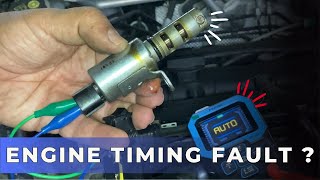
How to confirm: After checking the oil, this is the next logical step. A mechanic can test the solenoid's resistance (typically 7-14 ohms) or apply 12V to see if it actuates with a click. 🎬 See how to test a VVT solenoid yourself. A common DIY method is to swap the intake and exhaust VCT solenoids; if the code changes to P0014, the solenoid is bad.
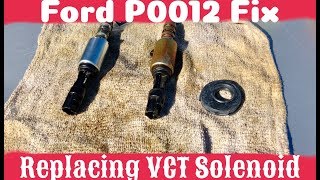
Typical fix: Replace the Bank 1 intake VCT solenoid. 🎬 Watch this walkthrough on replacing the VCT solenoid. It is highly recommended to change the engine oil at the same time.
Est. part cost: $40-$80 - Failing Oil Pump Belt / Tensioner (1.0L EcoBoost) 🟡 Medium Probability There is a specific safety recall (23S64) for the 1.0L engine where the oil pump drive 'wet belt' or its tensioner can fail. The belt material degrades in the oil, shedding debris that clogs oil passages and starves the engine of pressure, triggering P0012 as a primary symptom. This is a catastrophic failure that can lead to complete engine seizure.
How to confirm: Check for an active recall on your vehicle's VIN. A sudden low oil pressure warning light, along with engine noise, is a strong indicator. Diagnosis requires dropping the oil pan to inspect for belt debris in the oil pickup screen.
Typical fix: The recall procedure involves replacing the oil pump belt and tensioner. If engine damage has occurred, an engine replacement may be necessary, which Ford has stated will be covered under the recall as an interim repair.
Est. part cost: $0 (if under recall)
Rare But Worth Checking
- Clogged VCT Solenoid Screens: → Shop Engine Variable Valve Timing (VVT) Solenoid Sometimes the solenoid itself is not electrically faulty, but its small, integrated filter screens are completely blocked with sludge or belt debris. Upon removal, the screens will be visibly contaminated. Cleaning is not recommended; replacement is the proper fix.
- Worn Timing Chain or Cam Phaser: → Shop Engine Timing Chain If the oil and VCT solenoid are good, the issue could be mechanical wear in the timing system. This is a more involved and expensive repair. A rattling noise on startup is a common symptom.
- Failed Camshaft Position Sensor: → Shop Engine Camshaft Position Sensor The sensor itself can fail, sending incorrect data to the ECM. This is less common than oil or solenoid issues. Often, other codes like P0340 or P0344 will be present if the sensor is the root cause.
Diagnosis Steps
- Check your vehicle's VIN for active recalls, especially safety recall 23S64 for the 1.0L engine, before beginning any repairs.
- Check engine oil level and condition. If low, dirty, or overdue for a change, address this first. Note any gritty texture or visible debris, which on a 1.0L is a red flag for belt degradation.
- Scan for any other DTCs to see if P0012 is part of a larger problem.
- Inspect the electrical connector for the Bank 1 intake VCT solenoid for damage or corrosion.
- Test the VCT solenoid. You can do this by checking its resistance with a multimeter or by swapping it with the exhaust solenoid (if identical) and seeing if the code changes to P0014.
- If you replace the solenoid, inspect the old part's screens for sludge or debris. Heavy contamination confirms an oil quality issue.
- If the solenoid and oil appear fine, perform a direct oil pressure test with a mechanical gauge to rule out a failing oil pump.
- If no issues are found, the problem may lie with the camshaft position sensor or the timing components (chain, phaser), which may require more advanced diagnostics.
Parts You'll Likely Need
- Intake VCT Solenoid (Oil Control Valve)
(OEM #CM5Z-6M280-G (for 1.0L EcoBoost). Note: This part supersedes CM5Z-6M280-D and CM5Z-6M280-F. Always verify with VIN.)— This part is directly responsible for controlling oil flow to the cam phaser. It is prone to sticking or failing due to oil contamination, as noted in Ford TSBs.
Trusted brands: Motorcraft, Delphi, Dorman
OEM price range: $60-$100
Aftermarket price range: $40-$80 - Engine Oil and Filter — Clean oil of the correct viscosity is critical for the VCT system to function. Dirty or low oil is a primary cause of this code. Using the Ford-specified oil is especially important on the 1.0L EcoBoost to minimize 'wet belt' degradation.
Trusted brands: Motorcraft (Synthetic Blend or Full Synthetic), Pennzoil, Mobil 1
OEM price range: $50-$80
Aftermarket price range: $40-$70
Related Codes That Often Appear With This One
- P0014 — This code is for the exhaust camshaft ('B') on the same bank. It's frequently seen with P0012, as mentioned in NHTSA complaints ODI #11531784 and #11606356, often pointing to a systemic oiling problem affecting both VCT solenoids.
- P0299 — This code means 'Turbo Underboost Condition'. It was reported in NHTSA complaint ODI #11579824 along with P0012. Poor camshaft timing can lead to inefficient engine operation, which in turn can affect the turbocharger's performance. A failing oil pump can also starve the turbo of lubrication.
Technical Service Bulletins (TSBs) & Recalls
- SSM 50067: Notes that P0012 and other VCT codes may be caused by small debris causing the solenoid to stick.
- SSM 48423: An earlier TSB with the same guidance as SSM 50067.
- 23S64 / 23V905: Safety recall for the 1.0L EcoBoost oil pump belt and tensioner.
Platform-Specific Known Issues
- NHTSA TSB #SSM 50067 & #SSM 48423: 🎬 Watch: Ford VCT solenoid diagnostic and timing codes explained. Ford acknowledges that on some 2015-2021 vehicles, including the EcoSport, DTCs like P0012 may be caused by small debris making the VCT solenoid stick. The recommended first step before component replacement is to perform an oil and filter change.
- NHTSA Owner Complaints: Multiple owners of 2018-2021 EcoSports have reported receiving code P0012 alongside P0014, followed by a diagnosis of 'metal contamination in oil,' sometimes leading to engine failure. (NHTSA ODI #11531784, #11579824)
- 1.0L EcoBoost Oil Pump Recall: Safety recall 23S64 (NHTSA 23V905) was issued for 2018-2022 EcoSport models with the 1.0L engine. It addresses a faulty oil-pump drive belt tensioner and a degrading 'wet' belt that can fracture, causing a sudden loss of oil pressure, power braking assist, and engine power.
Mechanic-Grade Diagnostic Values
- VCT Solenoid Internal Resistance — expected: 7 to 14 Ohms. A common range is 6.9-7.9 Ohms at 68°F (20°C).. Failure: A reading of 0 Ohms (short) or infinite/OL (open circuit).
- 1.0L EcoBoost Engine Oil Pressure (Mechanical Gauge) — expected: At least 14.5 psi (1 bar) at hot idle and 29-65 psi (2-4.5 bar) at 2,000-3,000 RPM.. Failure: Pressure below 14.5 psi at idle strongly suggests a clogged oil pickup strainer from a degrading wet belt, even if the oil light is not on.
- Ford IDS 'VCT Advanced Error' PID — expected: Close to 0°, with an acceptable variance of +/- 5° during closed-loop operation.. Failure: A consistent, large deviation from 0° while the PCM is commanding VCT changes.
- VCT Solenoid Power Supply Voltage — expected: Battery voltage (approx. 12V) at Pin 1 (Blue-Green wire) with key on.. Failure: No voltage indicates a wiring or fuse issue.
Hidden / Shadow Codes Worth Checking
- Mode $06, Test ID $53: This is a non-continuous monitor for cylinder misfire counts. A P0012 timing issue often causes misfires, and this test can show which cylinders are affected before a specific P030x code is set, confirming the severity of the performance issue. (see via A professional scan tool with Mode $06 capabilities is required.)
Scan Tool Commands That Help
- Ford IDS (or equivalent high-level scanner): VCT Advanced Error PID Monitoring — Use this live data PID to see the real-time difference between the commanded and actual camshaft angle. A large, persistent error value confirms the phaser is not moving as instructed.
- Ford IDS (or equivalent high-level scanner): VCT Solenoid Duty Cycle PID — Monitor the duty cycle percentage the PCM is sending to the solenoid. If the PCM is commanding a high duty cycle but the 'VCT Advanced Error' PID isn't changing, it suggests a stuck solenoid or a mechanical/hydraulic issue.
- Basic Power Probe or Multimeter: Solenoid Actuation Test — With the solenoid removed, apply a fused 12V and ground to its pins. A healthy solenoid will produce a sharp, audible 'click' as its internal plunger moves. No click or a weak click indicates it is stuck or failed.
Wiring & Ground Locations
- VCT Solenoid Connector — On the top/front of the engine, plugged into the VCT solenoid on the valve cover.. This connector provides power and the control signal. For the intake solenoid (A), Pin 1 (often a Blue-Green wire) is the 12V power supply from fuse F16, and Pin 2 is the ground-side control wire from the PCM.
- F16 - Engine Compartment Fuse Box — Located in the engine bay, this fuse box contains the power supply for the VCT solenoids.. Fuse F16 (15A) provides power to the VCT solenoids. While a blown fuse is unlikely to be the only issue (it may power other components), it should be checked if there is no voltage at the solenoid connector.
- Main Engine/Transmission Ground Points — Key ground straps are located from the battery negative terminal to the chassis, and from the chassis to the engine block and transmission case.. Ford has issued TSBs for other models regarding poor grounding causing various electrical issues. On the EcoSport, owners have reported no-start or running issues from incorrect ground point attachment after engine work, specifically on the engine block and behind the intake manifold. A poor ground can affect sensor and actuator performance.
Real Owner Repair Stories
- YouTube channel 'Fix it Felix' (2005 Ford Expedition 5.4L (Analogous oil-related issue)) — Flashing check engine light, no power, struggling to accelerate past 40 MPH. Codes P0012, P0301, P0304.
❌ Tried (didn't work) The owner noted reading many online forums where replacing the VCT solenoid did NOT fix the problem for others.
✅ What actually fixed it For this owner, replacing the Bank 1 VCT solenoid and its seal did resolve all symptoms and codes. The parts cost under $100 and the repair was done DIY. - Reddit user Winter-Seaweed8458 (2021 Ford EcoSport, 1.0L Engine) — Original engine failed at 62,000 miles (implying wet belt failure). After a complete engine replacement under warranty, the vehicle developed a new acceleration shudder.
❌ Tried (didn't work) The new engine itself did not resolve all vehicle issues.
✅ What actually fixed it The issue was unresolved, but the owner suspected the transmission was now failing, noting a 'slipping' sensation and engine revving without acceleration. This story highlights the potential for cascading failures after the primary engine problem (often causing P0012) is addressed.
"I Checked Everything" — The Actual Cause
- A common scenario for P0012 is not a failed smoke test, but when standard component tests pass. A technician may find the oil level is correct and the VCT solenoid tests good electrically (correct resistance) and mechanically (clicks with 12V). However, the code returns. The actual cause is often insufficient oil pressure that is still above the threshold to trigger the oil warning light. On the 1.0L EcoBoost, this is a classic symptom of a degrading wet belt clogging the oil pump pickup screen, which can only be confirmed with a mechanical oil pressure gauge test.
OEM Part Supersession History
CM5Z-6M280-D, CM5Z-6M280-F→CM5Z-6M280-G— Part revision and improvement by the manufacturer.
Heads up: Applies to the 1.0L EcoBoost engine.CM5Z-6M280-A→CM5Z-6M280-C— Part revision and improvement by the manufacturer.
Heads up: Applies to the 2.0L Duratec engine. Do not use parts for the 1.0L engine.
Model Year Variations Within This Range
- 2018-2021: The root cause of P0012 is highly dependent on the installed engine. For the 1.0L EcoBoost I3, the code is a primary indicator of oil contamination/starvation due to the degrading oil pump 'wet belt' (Recall 23S64). For the 2.0L I4, which uses a timing chain, the cause is more likely to be traditional sludge from extended oil intervals or random VCT solenoid failure, not the systemic belt degradation issue.
Helpful Videos


The information in this article is provided for general reference and educational purposes only. Vehicle specifications, procedures, and part compatibility can vary by production date, trim level, and region. Always consult your vehicle's factory service manual and verify part numbers before purchasing or performing repairs. Safety-critical components such as airbags, seat belts, and braking systems should be installed by a qualified professional.
- Ford ECOSPORT:
- 🧭 Diagnostic Flowchart
- 🎬 Helpful Videos
- What's Unique About the 2018-2021 Ford ECOSPORT
- Symptoms You May Notice
- Most Likely Causes
- Rare But Worth Checking
- Diagnosis Steps
- Parts You'll Likely Need
- Related Codes That Often Appear With This One
- Technical Service Bulletins (TSBs) & Recalls
- Platform-Specific Known Issues
- Mechanic-Grade Diagnostic Values
- Hidden / Shadow Codes Worth Checking
- Scan Tool Commands That Help
- Wiring & Ground Locations
- Real Owner Repair Stories
- "I Checked Everything" — The Actual Cause
- OEM Part Supersession History
- Model Year Variations Within This Range
- 🎟️ Get 5% Off