

P0012 on 2017-2020 Lincoln Continental: Causes for Over-Retarded Cam Timing
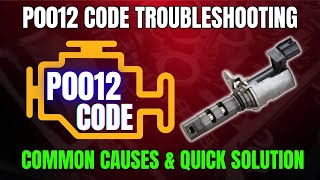
For a 2017-2020 Lincoln Continental, code P0012 is most often caused by low or dirty engine oil, or a failing Variable Camshaft Timing (VCT) solenoid. Always check the oil first. If the oil is clean and full, the VCT solenoid for Bank 1 is the next likely culprit. For the 2.7L/3.0L engines, the OEM part is around $85-$120, while for the 3.7L V6, it's about $60-$90. Accessing the Bank 1 (firewall side) solenoid is labor-intensive.
- The first and most important step when diagnosing P0012 is to check the engine oil level and condition. An oil change often fixes the problem.
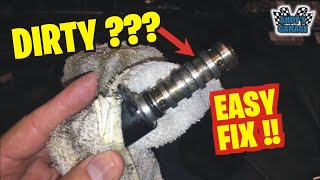
- The most common failed part is the Bank 1 intake VCT solenoid, which gets stuck from oil debris. Accessing it on the firewall side is labor-intensive.
- Swapping the Bank 1 and Bank 2 intake VCT solenoids is a reliable, low-cost method to confirm a faulty solenoid.
- A rattling noise on startup points to a more severe timing chain or phaser issue, which is a known but less common problem on these engines.
What's Unique About the 2017-2020 Lincoln CONTINENTAL
The V6 engines used in the 2017-2020 Lincoln Continental (3.7L Cyclone, 2.7L/3.0L EcoBoost) feature a Variable Camshaft Timing (VCT) system that is known to be highly sensitive to oil quality and pressure. As documented in multiple Ford/Lincoln Technical Service Bulletins, the VCT solenoids have fine mesh screens that are prone to sticking or clogging due to small debris or sludge in the engine oil. This is a well-known characteristic of this platform, making regular oil changes with the correct viscosity oil (e.g., SAE 5W-30) critically important to prevent this code.
Diagnostic Flowchart
Tap your situation to follow the diagnostic path that matches what you're seeing on this vehicle.
Symptoms You May Notice
- Check Engine Light illuminated
- Rough idle or stalling
- Poor acceleration and loss of power
- Decreased fuel economy
- Engine struggling or hesitating
- Hard starting
- Rattling noise from the engine on cold startups, which may indicate timing chain or phaser issues.
- Replacing the camshaft position sensor. The P0012 code indicates a mechanical timing issue (the cam is not where it's supposed to be), not an electrical fault with the sensor itself. A bad sensor would typically set a different code, such as P0340.
Most Likely Causes
- Low, Dirty, or Incorrect Viscosity Engine Oil 🔴 High Probability The VCT system is hydraulic and relies on clean oil at the correct pressure to function. The TSBs for this platform explicitly state that debris in the oil can cause VCT solenoids to stick. Owners of platform-mate vehicles have often reported that an oil change alone resolved the P0012 code.
How to confirm: Check the engine oil dipstick for proper level and inspect the oil's color and consistency. If it's dark, gritty, or below the 'add' line, it needs service. In some cases, owners report the oil looking 'dirty' even when not near its change interval, suggesting contamination.
Typical fix: Change the engine oil and filter using the manufacturer-recommended viscosity (e.g., 5W-30 for EcoBoost, 5W-20 for 3.7L). If oil is heavily contaminated, an engine flush may be considered.
Est. part cost: $40-$80 - Failing Variable Camshaft Timing (VCT) Solenoid 🔴 High Probability → Shop Engine Camshaft Manufacturer TSBs #SSM 48423 and #SSM 47170 directly state this may be due to small debris causing the VCT solenoid to stick. This is the most common mechanical failure for this code across the Ford/Lincoln V6 lineup.
How to confirm: Use a scan tool to command the solenoid and watch for a change in cam timing. A more common method is to swap the Bank 1 intake solenoid with the Bank 2 intake solenoid and see if the code changes to P0022 (the equivalent code for Bank 2). This confirms the solenoid is the faulty component.
Typical fix: Replace the Bank 1 intake VCT solenoid. Given the labor to access the rear bank, many owners recommend replacing all solenoids on that bank at the same time.
Est. part cost: $40-$120 - Worn Timing Chain or Guides ⚪ Low Probability → Shop Engine Timing Chain While less common than oil or solenoid issues, timing chains can stretch over time, especially with high mileage or poor maintenance. The 3.7L engine's internal water pump can also fail, leaking coolant into the oil and accelerating timing component wear.
How to confirm: Listen for a rattling noise from the engine on cold starts, which is a primary indicator of chain wear. Confirmation requires a physical inspection of the timing components, which is labor-intensive.
Typical fix: Replace the timing chain, tensioners, and guides. This is a significant repair.
Est. part cost: $400-$800
Rare But Worth Checking
- Faulty Camshaft Phaser: → Shop Engine Camshaft The phaser is the mechanical gear that the VCT solenoid controls. If the solenoid is confirmed good but the timing is still incorrect, the phaser itself may be stuck or failing internally. Phaser failure is a known issue on high-mileage EcoBoost engines.
- Clogged Oil Passages: Severe oil sludge can block the small passages that feed oil to the VCT system, starving the components of the pressure needed to operate. This is often a consequence of severely neglected oil changes.
Diagnosis Steps
- Verify the code with an OBD-II scanner.
- Check the engine oil level and condition. If low or dirty, perform an oil and filter change with the correct viscosity oil, clear the code, and re-test. This is the most critical first step.
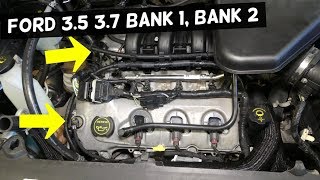
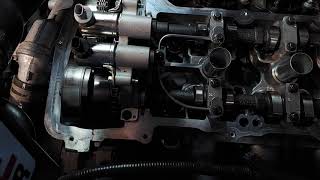
- If the oil is fine, the next step is to inspect the Bank 1 intake VCT solenoid. It is located on the valve cover for the rear cylinder bank (against the firewall).
- For V6 engines, a common diagnostic technique is to swap the Bank 1 intake solenoid with the Bank 2 intake solenoid (on the front of the engine). Clear the codes and drive the vehicle. If the code returns as P0022 (for Bank 2), the solenoid is confirmed to be faulty.
- Per TSB SSM 48423, a scan tool can be used to command the VCT solenoid on and off 10 times to try and dislodge any debris before resorting to replacement.
- Test the solenoid's circuit for proper voltage and ground from the PCM.
- If solenoids and wiring are good, listen for a timing chain rattle on startup. If present, further mechanical inspection of the timing chain and phasers is required.
Parts You'll Likely Need
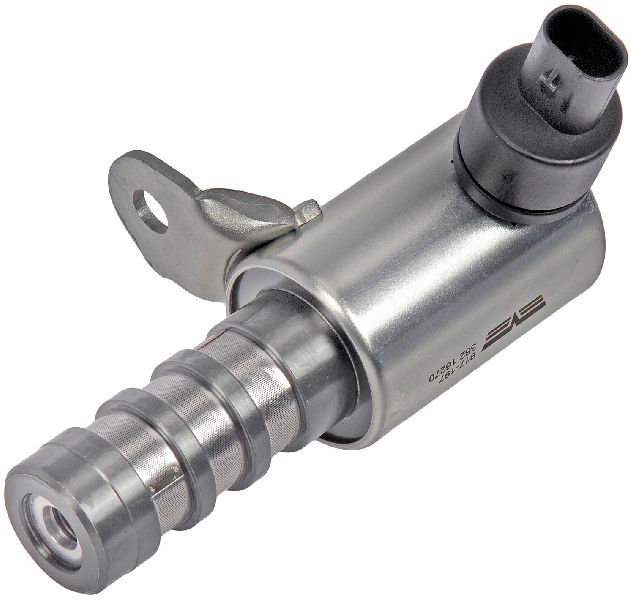
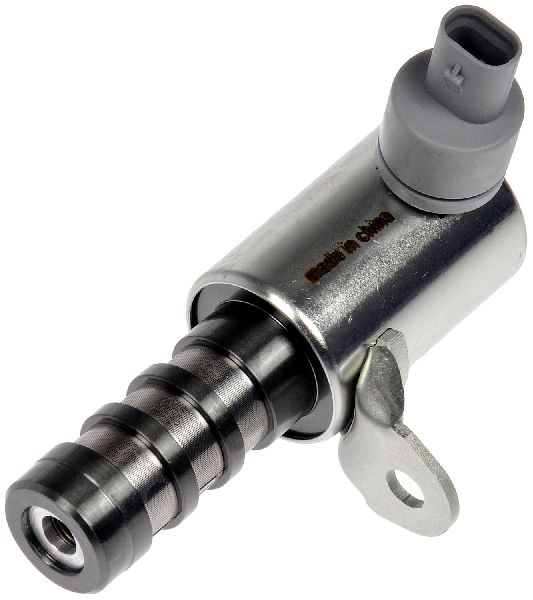
- Engine Variable Valve Timing (VVT) Solenoid
(OEM #2.7L/3.0L: FT4Z-6M280-B (or -C); 3.7L: AT4Z-6M280-A / 7T4Z-6M280-C)— This is the most common part to fail, as it can become clogged with debris or fail electrically, preventing it from properly controlling oil flow to the cam phaser. This is explicitly mentioned in manufacturer TSBs.
Trusted brands: Motorcraft, Dorman, SKP
OEM price range: $60-$120
Aftermarket price range: $35-$70 - Valve Cover Gasket — The VCT solenoids are located under the valve covers. The gasket should always be replaced when the valve cover is removed to prevent oil leaks. For the EcoBoost engines, sealant may also be required at the timing cover joints.
Trusted brands: Motorcraft, Fel-Pro
OEM price range: $50-$80
Aftermarket price range: $30-$50 - Upper Intake Manifold Gasket — To access the Bank 1 (rear) valve cover on these V6 engines, the upper intake manifold must typically be removed. Its gaskets are considered one-time use and must be replaced to prevent vacuum leaks.
Trusted brands: Motorcraft, Fel-Pro
OEM price range: $30-$60
Aftermarket price range: $20-$40
Related Codes That Often Appear With This One
- P0022 — This is the equivalent code for Bank 2. Seeing both P0012 and P0022 strongly suggests a systemic issue affecting both banks, such as low oil pressure or severe oil contamination.
- P0011, P0014, P0015, etc. — These are all VCT-related timing codes. The manufacturer TSBs (SSM 54366, SSM 48423, SSM 47170) list a wide range of these codes appearing together due to sticking VCT solenoids.
- P0016 — This code indicates a crankshaft/camshaft correlation error. It can appear alongside P0012 if the timing has jumped or the chain is significantly stretched, representing a more severe mechanical issue.
Technical Service Bulletins (TSBs) & Recalls
- SSM 54366 - General TSB for multiple VCT codes on 2015-2021 Ford/Lincoln vehicles.
- SSM 48423 - Notes that P0012 and other VCT codes may be due to small debris causing the VCT solenoid to stick.
- SSM 47170 - An earlier TSB with the same guidance as SSM 48423, indicating a persistent known issue.
Platform-Specific Known Issues
- Technical Service Bulletin #SSM 48423 states: "Some 2015-2020 Ford and Lincoln vehicles may exhibit an illuminated MIL with diagnostic trouble codes (DTCs) P0011, P0012, P0014, P0015... This may be due to small debris causing the VCT solenoid to stick." It advises using a scan tool to cycle the solenoid before replacement.
- Technical Service Bulletin #SSM 47170 provides similar guidance, indicating this is a known issue across multiple model years.
- On the V6 engines, Bank 1 is the rear bank against the firewall. Accessing the VCT solenoids on this bank is more labor-intensive as it may require removing the upper intake manifold.
- For the 3.7L V6, a potential long-term issue is the internal, timing-chain-driven water pump. If it fails, it can leak coolant into the oil, leading to widespread damage to timing components and triggering codes like P0012.
Mechanic-Grade Diagnostic Values
- VCT Solenoid Resistance — expected: 6.9 to 7.9 ohms at 68°F (20°C). A broader range of 5-15 ohms is generally acceptable.. Failure: A reading of 0 ohms (short circuit) or OL/infinity (open circuit) indicates a failed solenoid.
- VCT Solenoid Connector Voltage (Key On, Engine Off) — expected: Approximately 12V (battery voltage) at the power supply pin.. Failure: No voltage or significantly low voltage points to a problem in the wiring harness, fuse, or PCM power relay.
- Scan Tool PID: VCT_ADV_ERR (VCT Advance Error) — expected: Should be close to 0 degrees (+/- 5 degrees) at idle and during steady-state driving.. Failure: A large, persistent error value indicates the camshaft is not reaching its commanded position.
- Engine Oil Pressure (Hot Idle) — expected: Minimum of 15 PSI.. Failure: Pressure below the minimum spec will cause the VCT system to malfunction, as it is hydraulically operated.
Scan Tool Commands That Help
- Ford Integrated Diagnostic System (IDS): Pinpoint Test HK11 / HK12 (per TSBs SSM 48423, 50067) — This is a specific diagnostic function recommended by Ford to address VCT codes. It commands the PCM to cycle the suspect VCT solenoid on and off 10 times to attempt to dislodge small debris that may be causing it to stick. This should be performed after verifying correct oil level and condition, but before replacing the solenoid.
Wiring & Ground Locations
- Bank 1 Intake VCT Solenoid Connector — On the valve cover for the rear cylinder bank (firewall side), plugging into the intake VCT solenoid.. This 2-pin connector provides power and control to the solenoid. Pin 1 is typically the ~12V power supply from a fused source, and Pin 2 is the ground-side control wire from the PCM. Damage, corrosion, or oil contamination in this connector can interrupt the signal and cause the P0012 code, mimicking a failed solenoid.
- Engine Compartment Fuse Box — Located in the engine compartment, typically on the driver's side.. This box contains the fuse and relay (often the PCM Power Relay) that provides the 12V power to the VCT solenoids. While a failure here would likely cause multiple other codes, a poor connection could lead to intermittent power loss.
Real Owner Repair Stories
- YouTube user 'proclaimliberty2000' (General vehicle, demonstrates common VVT issue) — Check Engine Light and a Low Oil Pressure warning light were on.
❌ Tried (didn't work) Initial diagnosis was leaning toward replacing VCT components like the solenoid or phaser.
✅ What actually fixed it An engine oil and filter change. The old oil was noted as being very dirty ('a 7 out of 10'). This simple service resolved both the P0012 code and the oil pressure light. - Reddit user on r/f150 (2016 Ford F-150 5.0L V8 (platform-mate VCT system)) — Noticeable stumble at warm idle, but no Check Engine Light. A scan revealed a stored fault for the passenger intake VCT.
✅ What actually fixed it Preventatively replacing all four VCT solenoids at 91k miles. The result was a gain of nearly 2 MPG and noticeably more low-end torque, demonstrating that solenoids can degrade performance even before they fail completely and trigger a constant CEL. - Ford F150 Forum user (2005 Ford F-150 (platform-mate VCT system)) — P0012 code present. After replacing the Bank 1 VCT solenoid, the engine would no longer crank.
❌ Tried (didn't work) Assuming the new VCT solenoid was faulty.
✅ What actually fixed it The issue was an improperly seated PCM connector. The lift-to-release connectors for the PCM were not fully re-engaged after the repair. Re-seating all electrical connectors that were disconnected during the job resolved the no-crank condition.
"I Checked Everything" — The Actual Cause
- In the context of P0012, the equivalent of a 'smoke test clean' scenario is when an oil change and VCT solenoid replacement do not fix the code. In one documented case, a vehicle owner reported that after an engine rebuild and replacing the VVT solenoid, the P0012 code persisted. The final suspected cause was a faulty camshaft phaser/sprocket, which is the next mechanical component in the system that the solenoid controls.
OEM Part Supersession History
FT4Z-6M280-A→FT4Z-6M280-B, then FT4Z-6M280-C— Manufacturer revision to improve durability or address performance issues.
Heads up: Applies to the 2.7L and 3.0L EcoBoost engines. These parts are generally interchangeable, but it is always best to use the latest revision.7T4Z-6M280-A, 7T4Z-6M280-AA, 7T4Z-6M280-B→7T4Z-6M280-C— Multiple manufacturer revisions over time.
Heads up: Applies to the 3.7L V6 engine. Always use the latest revision (C) when replacing.AT4Z-6M280-A / AT4Z-6M280-B→AT4Z-6M280-C— Manufacturer revision.
Heads up: Applies to 3.7L V6. Note that some Ford VCT solenoids have different colored connectors (e.g., black, blue, gray). It is critical to match the connector color and style of the original part, as they are not interchangeable.
Helpful Videos

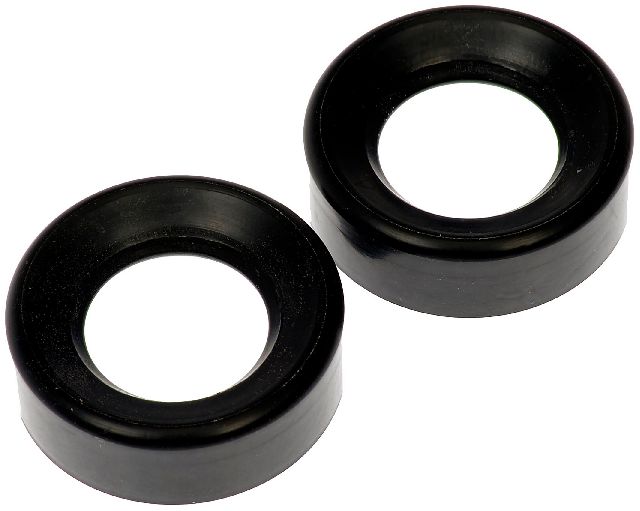
We Have This Part in Stock


The information in this article is provided for general reference and educational purposes only. Vehicle specifications, procedures, and part compatibility can vary by production date, trim level, and region. Always consult your vehicle's factory service manual and verify part numbers before purchasing or performing repairs. Safety-critical components such as airbags, seat belts, and braking systems should be installed by a qualified professional.
- Lincoln CONTINENTAL:
- 🧭 Diagnostic Flowchart
- 🎬 Helpful Videos
- 🛍️ Shop This Part
- What's Unique About the 2017-2020 Lincoln CONTINENTAL
- Symptoms You May Notice
- Most Likely Causes
- Rare But Worth Checking
- Diagnosis Steps
- Parts You'll Likely Need
- Related Codes That Often Appear With This One
- Technical Service Bulletins (TSBs) & Recalls
- Platform-Specific Known Issues
- Mechanic-Grade Diagnostic Values
- Scan Tool Commands That Help
- Wiring & Ground Locations
- Real Owner Repair Stories
- "I Checked Everything" — The Actual Cause
- OEM Part Supersession History
- 🎟️ Get 5% Off