

P0013 on 2006-2013 Audi A3 2.0T: Causes and Fixes for the Exhaust Cam Actuator Circuit
On a 2008.5-2013 Audi A3 with the 2.0T EA888 engine, code P0013 is almost always a faulty exhaust camshaft adjuster solenoid (VVT solenoid) or low/dirty engine oil. Replacing the solenoid is a simple DIY fix, with the part costing between $40 for aftermarket and $130 for OEM. In some cases, debris from a failing camshaft bridge screen can clog and damage the solenoid, requiring further inspection.
- P0013 on this engine is an electrical fault code for the exhaust VVT solenoid; do not confuse it with the camshaft position sensor.
- Always check your engine oil level and condition first. An oil change with VW 502 00 spec oil is the cheapest and easiest first step.
- The most likely fix is replacing the exhaust camshaft adjuster solenoid (part # 06L109259D or successor), a simple DIY job.
- If you see metal or plastic debris on the old solenoid, you must investigate the camshaft bridge for a failed screen to prevent a repeat failure.
- If P0013 is accompanied by a P0016 code or a rattling noise at startup, stop driving and have the timing chain and tensioner inspected immediately.
What's Unique About the 2006-2013 Audi A3
The 2.0T EA888 engine is notoriously sensitive to oil level and quality, and its VVT system is no exception. Unlike generic vehicles where this code might just be a simple part failure, on the A3 it can often be a direct symptom of the engine's known oil consumption issues leading to low oil levels. Furthermore, this engine has specific failure points that can trigger P0013, such as the camshaft adjuster solenoid leaking oil into its own electrical connector, or a small screen in the camshaft support bridge disintegrating and sending debris into the oil passages, which can clog the solenoid. Audi has issued a Technical Service Bulletin (TSB 2045732) recommending the removal of this screen if the bridge is ever serviced.
Generation note: The 2006-2013 Audi A3 (8P) spans two engine families. Early models (2006-2008) used the 2.0T FSI (EA113) engine, while this guide focuses on the 2.0T TSI (EA888) engine found in models from mid-2008 to 2013 (engine codes CCTA, CBFA). Within the EA888 family, earlier models (approx. 2008-2012) are more susceptible to a known timing chain tensioner defect, which can be a critical related issue.
Symptoms You May Notice
- Check Engine Light is on
- Rough or unstable idle
- Reduced engine power and sluggish acceleration
- Noticeable decrease in fuel economy
- Engine hesitation or stalling at low RPM
- Rattling noise from the engine on startup (could indicate a more serious timing chain issue or oil pressure problem)
- Replacing the camshaft position *sensor* (G300) instead of the camshaft adjuster *solenoid* (N318). P0013 is an actuator circuit code, not a sensor reading code.
- Replacing the VVT solenoid without first checking for debris from the camshaft bridge screen. If debris is present, the new solenoid will likely fail again quickly.
Most Likely Causes
- Failed Exhaust Camshaft Adjuster Solenoid (VVT Solenoid) 🔴 High Probability → Shop Engine Camshaft This solenoid is a common failure point on the EA888 engine. It can fail from an internal open circuit in its coil, get clogged with oil sludge, or leak oil through its body directly into the electrical connector, causing a short.
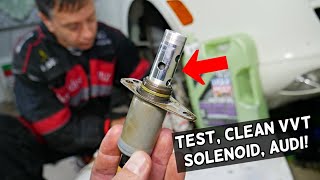
How to confirm: Unplug the connector and check for oil inside; if wet, the solenoid is bad. Test the solenoid's resistance with a multimeter; a healthy one should read between 5.0 and 15.0 ohms, with many sources specifying a tighter range of 6.9-7.9 ohms. An infinite reading (OL) means an open circuit, and a reading near zero means a short. 🎬 Watch: How to test and clean your VVT solenoid A definitive test is to swap it with the identical intake solenoid (N205) and see if the code changes to P0010.
Typical fix: Replace the exhaust camshaft adjuster solenoid. It is typically held in by one or three T30 Torx bolts and is easily accessible on the upper timing cover.
Est. part cost: $40-$130 - Low, Dirty, or Incorrect Engine Oil 🔴 High Probability The EA888 engine is known for oil consumption, which can cause the level to drop between services. The VVT system is hydraulic and highly sensitive to oil pressure and cleanliness. Using oil that does not meet the VW 502 00 specification can lead to sludge buildup that clogs the fine mesh screens on the solenoid.
How to confirm: Check the engine oil level on the dipstick and assess its condition. If the level is low or the oil is dark and sludgy, this is a likely contributor. This should always be the first check.
Typical fix: Top off the oil to the correct level or perform a complete oil and filter change using a full-synthetic oil that meets the VW 502 00 specification, such as 5W-40.
Est. part cost: $50-$100 - Damaged Wiring or Connector 🟡 Medium Probability The wiring harness to the solenoid is located in a high-heat area, which can make the wires brittle and prone to cracking over time. The connector pins can also corrode or become saturated with oil from a leaking solenoid.
How to confirm: Visually inspect the wiring harness leading to the solenoid for any signs of fraying, breaks, or heat damage. Unplug the connector and check for corrosion, bent pins, or oil contamination.
Typical fix: Repair the damaged section of wire or replace the connector pigtail. The common 2-pin connector part number is 4H0973702A.
Est. part cost: $10-$30
Rare But Worth Checking
- Disintegrated Camshaft Bridge Screen: → Shop Engine Camshaft The oil screen in the camshaft support bridge is a known weak point that can break apart. Metal or plastic debris can then travel through oil passages and clog the new VVT solenoid, causing a repeat failure. Audi issued a TSB (2045732/1) recommending the removal of this screen if the bridge is serviced, stating its absence will not affect the valve's operation.
- Failing Timing Chain or Tensioner: → Shop Engine Timing Chain While P0013 is an electrical code, it can sometimes appear with mechanical timing codes like P0016. This combination, especially if accompanied by a startup rattle, strongly suggests a stretched timing chain or failed tensioner—a critical issue on pre-2013 EA888 engines that can lead to catastrophic engine failure.
- Faulty Powertrain Control Module (PCM): This is extremely rare, but if all other components and wiring test perfectly, the fault could lie within the PCM's driver circuit for the solenoid. This should be the last consideration after all other possibilities are exhausted.
Diagnosis Steps
- Check Engine Oil: Verify the oil level is full and the oil is clean and meets VW 502 00 spec. If low or overdue for a change, address this first, clear the code, and see if it returns.
- Inspect Electrical Connector: Unplug the exhaust camshaft solenoid connector (N318). Look for oil contamination inside the plug. If oil is present, the solenoid has failed internally and must be replaced.
- Inspect Wiring: Check the wires leading to the connector for any signs of cracking, fraying, or heat damage. Ensure the connection is secure. With the key on, engine off, check for battery voltage at pin 1 of the connector.
- Test the Solenoid: Use a multimeter to measure the resistance across the two pins on the solenoid. A good solenoid should read between 5.0 and 15.0 ohms (a tighter range of 6.9-7.9 ohms is often cited). An infinite reading (OL) means an open circuit, and a reading near zero means a short. Both indicate a bad solenoid.
- Swap Test (Definitive): The intake (N205) and exhaust (N318) solenoids are identical. Swap their positions. Clear the codes and run the engine. If the fault code changes to P0010 (Intake Camshaft Actuator Circuit), the solenoid is definitively bad. If P0013 returns, the problem is in the wiring or ECU.
- Check for Debris: When removing the old solenoid, inspect its oil screen for metal or plastic particles. If debris is found, it may point to a disintegrating camshaft bridge screen, which must be addressed to prevent repeat failure.
- Scan for Other Codes: If codes like P0016 are present, halt diagnosis and immediately investigate the timing chain and tensioner for wear. A scan tool like VCDS can check camshaft phase adaptation; a value between -4.0° and -5.0° at warm idle indicates significant chain stretch. 🎬 Watch: Step-by-step EA888 timing chain replacement tutorial
Parts You'll Likely Need
- Exhaust Camshaft Adjuster Solenoid (VVT Solenoid)
(OEM #06L109259D)— This is the most common part to fail, either electrically (internal open/short) or by getting clogged with debris. Part numbers have been updated several times; previous numbers include 06L109259A, 06H109259A, 06J109259A, and 06H109259C. Always verify the latest part number with your VIN.
Trusted brands: VW/Audi Genuine, Pierburg, INA, Bosch, Delphi, Febi Bilstein
OEM price range: $70-$130
Aftermarket price range: $40-$80
Related Codes That Often Appear With This One
- P0010 — This is the identical circuit fault for the intake camshaft solenoid. It will appear if you swap the solenoids for diagnosis and the original part was faulty.
- P0016 — Crankshaft/Camshaft Position Correlation error. Seeing this with P0013 is a major red flag for a mechanical timing issue like a stretched chain or failed tensioner, which requires immediate attention.
- P0014 — Indicates 'Timing Over-Advanced' for the same exhaust camshaft. It can appear if the electrical fault in P0013 causes the solenoid to get stuck, or if both codes are triggered by an underlying oil pressure problem.
Technical Service Bulletins (TSBs) & Recalls
- TSB 2045732 / 15 16 30: Advises on the removal of the non-return valve screen in the camshaft bridge if it is found to be damaged during a repair, to prevent debris from circulating in the oil.
- TSB 15 12 01 / 2028302: Addresses engine rattling noises and timing issues related to the faulty timing chain tensioner on early EA888 engines.
Platform-Specific Known Issues
- Water Pump Failure Experience: An owner of a 2009 A3 2.0T with 68,000 miles reported a failure of the original water pump where the plastic housing broke, causing a major coolant leak. This highlights the known weakness of the plastic water pump/thermostat assembly on the EA888 engine. Another owner noted that a low coolant warning w
Mechanic-Grade Diagnostic Values
- Camshaft Phase Adaptation (VCDS) — expected: 0° to -4.0° at warm idle on a healthy chain.. Failure: A value consistently between -4.0° and -5.0° indicates significant chain stretch requiring replacement soon. A value over -5.0° indicates a high risk of failure.
- Exhaust Camshaft Adjuster Solenoid (N318) Resistance — expected: 6.9 - 7.9 Ohms at room temperature. Some sources allow a wider range of 5.0 to 18.0 Ohms depending on part revision and temperature.. Failure: An infinite reading (Open Loop) or a value near zero ohms (short circuit) confirms a failed solenoid coil.
- N318 Solenoid Connector Voltage — expected: Pin 1: Battery Voltage (approx. 12V) with key on, engine off. Pin 2: Ground signal, pulse-width modulated by the ECU when the engine is running.. Failure: No voltage at Pin 1 indicates a problem with the power supply wire or fuse. If voltage is present but the solenoid doesn't work, the issue could be the ground signal from the ECU or the solenoid itself.
Scan Tool Commands That Help
- VCDS (VAG-COM) or OBDeleven: Output Test: Camshaft Adjustment Valve, Exh. (N318) — This is a direct bidirectional test to confirm if the N318 solenoid is functional. When activated via the software, you should hear a distinct 'click' from the solenoid. A lack of a click points to a failed solenoid or a wiring/power issue, helping to isolate the fault without removing any parts.
- VCDS (VAG-COM) or OBDeleven: Advanced Measuring Values: 'Camshaft adaptation intake bank 1: phase position' — Use this to check for timing chain stretch, which is a common and critical issue on the EA888 engine. If P0013 is present with other codes like P0016, or if there's a startup rattle, this reading is essential to determine if the root cause is mechanical timing wear rather than just a faulty solenoid.
Wiring & Ground Locations
- Ground Connection 368 — In the main engine wiring harness.. This is a ground connection within the main engine harness. While not a single chassis point, corrosion or damage within the harness at this junction could affect multiple components, including the N318 circuit.
- Ground Point 12 — On the left side of the engine compartment, near the battery.. This is a primary chassis ground point in the engine bay. A loose or corroded connection here can cause a wide range of intermittent electrical issues for engine components, including the ECU and its actuator circuits.
- Ground Point 607 / 609 — In the plenum chamber (the area under the windshield wipers).. This ground serves components related to the Engine Control Module (ECM). A poor connection here can directly impact the ECM's ability to properly control actuators like the VVT solenoid, potentially causing a P0013 code even if the solenoid and its direct wiring are good.
- N318 Solenoid Connector (T2hq) — Directly on the N318 solenoid at the top front of the engine, exhaust side.. This is the final connection point. It is prone to oil contamination from a leaking solenoid, heat damage, and vibration, making it a common point of failure for the circuit.
Real Owner Repair Stories
- AudiWorld Forums (2011 Audi A4 2.0T (EA888 Engine)) — Check engine light with codes P0013 and others, rough running.
❌ Tried (didn't work) Initial diagnosis pointed towards common VVT solenoid failure.
✅ What actually fixed it The root cause was a disintegrated camshaft bridge screen. Debris from the screen had clogged the oil passages leading to the VVT solenoid, causing the circuit/performance code. The fix required removing the camshaft bridge, cleaning out the debris, and removing the remainder of the screen as per the TSB.
OEM Part Supersession History
06H109259A, 06J109259A, 06H109259C, 06L109259A→06L109259D— The 'D' revision is reported to have improved internal coil windings compared to earlier versions, which were more prone to failure from overheating and insulation breakdown.
Heads up: While functionally interchangeable on most EA888 Gen 1/2 engines, always verify with VIN. The latest revision (06L109259D) is the recommended replacement for all previous versions.
Model Year Variations Within This Range
- 2008.5-2012: These earlier EA888 engines are equipped with a timing chain tensioner design that is highly prone to premature failure. A P0013 code, especially when paired with a startup rattle or a P0016 code, should prompt an immediate inspection of the tensioner's extension via the inspection port on the lower timing cover.
- 2006-2008: These models used the 2.0T FSI (EA113) engine. While they can also suffer from VVT solenoid failures, the part numbers, locations, and related failure patterns (like the cam follower for the high-pressure fuel pump) are different from the EA888 engine this guide focuses on.
Diagnostic Flowchart
Other Known Issues on This Vehicle
Issues unrelated to this code that are worth knowing about as an owner of this generation:
- Timing Chain Tensioner Failure 🔴 High → Shop Engine Timing Chain — Common on pre-2013 EA888 Gen 1/2 engines, typically between 60,000-100,000 miles. Failure can be sudden and cause catastrophic engine damage. (Ref: Multiple revisions of the tensioner were released. A class-action lawsuit was also filed regarding this issue.)
- Excessive Oil Consumption 🟠 Medium — Very common on EA888 Gen 2 engines due to piston ring design. Owners may need to add oil every 1,000-1,500 miles. Can lead to other issues if oil level is not maintained. (Ref: TSBs were issued for an oil consumption test and potential piston/ring replacement, though often outside of warranty.)
- Water Pump / Thermostat Housing Failure 🟠 Medium — The plastic housing is prone to cracking and leaking coolant, often after 60,000 miles. Failure can cause overheating. (Ref: A TSB was issued for low coolant levels related to this.)
- PCV Valve Failure 🟡 Low — The diaphragm inside the PCV (oil separator) is known to tear, causing vacuum leaks, rough idle, increased oil consumption, and potential oil seal leaks due to high crankcase pressure. (Ref: Multiple part revisions exist, with later versions being more durable.)
- Intake Manifold Runner Flap Failure 🟠 Medium → Shop Engine Intake Manifold — Carbon buildup can cause the intake manifold's runner flaps to stick or the actuator motor/sensor to fail, typically after 80,000 miles, resulting in rough idle and performance issues.
- Carbon Buildup on Intake Valves 🟠 Medium — As a direct-injection engine, fuel does not wash over the intake valves. This leads to significant carbon buildup over 50,000-80,000 miles, causing misfires, hesitation, and reduced power.
Used vs. New Parts: Buying Guide for This Vehicle
When a used part is the smart pick: A used VVT solenoid is generally not recommended due to the high failure rate and low cost of a new aftermarket part. However, if sourcing from a verified low-mileage (under 50,000 miles) wrecked vehicle for a very low price, it can be a budget-friendly option to get a genuine OEM part.
Donor-vehicle mileage cap: roughly under 50000 miles for the part to have meaningful remaining life.
What to inspect on the donor part:
- Ask for the donor vehicle's VIN to verify mileage and engine type.
- Inspect the solenoid's screen for any metal or plastic debris.
- Check the electrical connector pins for any signs of corrosion or oil contamination.
- If possible, ask the seller to provide a resistance reading (should be 6.9-7.9 ohms).
OEM-only on this vehicle (don't cheap out):
- Timing Chain Tensioner
- Timing Chain and Guides
- Powertrain Control Module (PCM)
Aftermarket brands forum-validated for this vehicle:
- Pierburg (often the Original Equipment supplier)
- Bosch
- INA
- Febi Bilstein
Brands owners have reported issues with on this vehicle:
- Unbranded, no-name parts from online marketplaces should be avoided. Owners frequently report these failing within a few months, causing the code to return.
Real Owner Stories
Aggregated from forums and TSBs cited above. Mileages and costs reflect what owners reported in those sources.
2009 Audi A3 2.0T — 68000 miles
Symptoms: Major coolant leak caused by the plastic housing breaking.
What fixed it: Replacement of the water pump/thermostat assembly.
Source hint: AudiWorld Forums - 'Water pump fail'
Related OBD-II Codes
Frequently Asked Questions
My 2009 Audi A3 is making a rattling noise on startup along with the P0013 code; is this just the solenoid?
Can I use any synthetic oil in my A3 to prevent VVT issues?
Is there a way to verify if the N318 solenoid is actually bad before I buy a new one?
What should I look for if I find oil inside the electrical connector of the solenoid?
Does TSB 2045732 apply if I find metal bits when removing my solenoid?
Helpful Videos


We Have This Part in Stock

The information in this article is provided for general reference and educational purposes only. Vehicle specifications, procedures, and part compatibility can vary by production date, trim level, and region. Always consult your vehicle's factory service manual and verify part numbers before purchasing or performing repairs. Safety-critical components such as airbags, seat belts, and braking systems should be installed by a qualified professional.
- Audi A3:
- 🧭 Diagnostic Flowchart
- 🎬 Helpful Videos
- 🛍️ Shop This Part
- What's Unique About the 2006-2013 Audi A3
- Symptoms You May Notice
- Most Likely Causes
- Rare But Worth Checking
- Diagnosis Steps
- Parts You'll Likely Need
- Related Codes That Often Appear With This One
- Technical Service Bulletins (TSBs) & Recalls
- Platform-Specific Known Issues
- Mechanic-Grade Diagnostic Values
- Scan Tool Commands That Help
- Wiring & Ground Locations
- Real Owner Repair Stories
- OEM Part Supersession History
- Model Year Variations Within This Range
- Other Known Issues on This Vehicle
- Used vs. New Parts: Buying Guide for This Vehicle
- Real Owner Stories
- 2009 Audi A3 2.0T — 68000 miles
- Related OBD-II Codes
- Frequently Asked Questions
- 🎟️ Get 5% Off