

P0013 on 2005-2010 Chevrolet Cobalt 2.2L: Exhaust Cam Solenoid Circuit Causes and Fixes
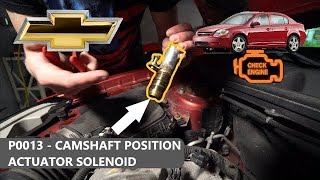
On a 2005-2010 Cobalt with the 2.2L engine, P0013 almost always means the exhaust camshaft actuator solenoid has failed. This is a very common, inexpensive, and easy DIY fix, typically costing $25-$60 for the part and taking less than 20 minutes to replace. The code specifically indicates an electrical circuit fault, not a mechanical timing issue.
- P0013 on your Cobalt almost certainly means you need a new exhaust camshaft actuator solenoid (Part #12655421).
- Before buying parts, always check your engine oil level first; low or dirty oil is a common contributing factor.
- This is a great DIY repair for beginners. It requires only a 10mm socket and about 20 minutes.
- A definitive diagnostic test is to swap the intake and exhaust solenoids to see if the code changes to P0010.
- For peace of mind, it's highly recommended to replace both the intake and exhaust solenoids at the same time.
What's Unique About the 2005-2010 Chevrolet Cobalt
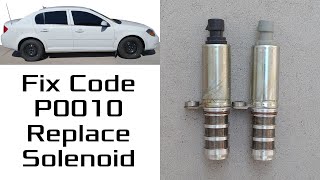
The 2.2L Ecotec engine in the Cobalt (and its platform mates) uses two camshaft actuator solenoids, one for intake and one for exhaust, located right on top of the engine for extremely easy access. They are a known high-failure item due to internal electrical faults. The good news is they are inexpensive and very easy to access and replace with a single 10mm bolt each. This makes diagnosis straightforward; a common trick is to swap the intake (front, gray connector) and exhaust (rear, black connector) solenoids to see if the trouble code follows the part (e.g., P0013 becomes P0010), confirming the failure without any special tools.
Symptoms You May Notice
- Check Engine Light is on
- Rough idle
- Poor acceleration and reduced engine power
- Decreased fuel economy
- Engine stalling, especially when coming to a stop
- Rattling or clattering noise from the top of the engine
- Replacing the Camshaft Position SENSOR. P0013 refers to the actuator SOLENOID (an oil control valve), not the position sensor. The sensor reads the camshaft's position, while the solenoid controls it. Replacing the sensor will not fix this code.
Most Likely Causes
- Faulty Exhaust Camshaft Actuator Solenoid 🔴 High Probability → Shop Engine Camshaft These solenoids are a common failure point on Ecotec engines. The internal coil windings can fail, creating an open or short circuit which directly triggers the P0013 electrical fault code. This is more common than mechanical clogging for this specific code.
How to confirm: Swap the exhaust (rear) solenoid with the intake (front) solenoid. Clear the codes. If the code changes to P0010 (Intake Camshaft Position Actuator Circuit), the solenoid is bad. Alternatively, test the solenoid's resistance with a multimeter; it should be between 8-12 ohms. A reading of infinite (open), near-zero (short), or a high reading like 25 ohms confirms failure.
Typical fix: Replace the exhaust camshaft actuator solenoid. Many owners and technicians recommend replacing both the intake and exhaust solenoids at the same time as a preventative measure, as they are the same age and subjected to the same conditions.
Est. part cost: $25-$60 - Low or Dirty Engine Oil 🟡 Medium Probability The VVT system is operated by oil pressure. If the oil is low, old, or sludgy, it can clog the fine mesh screens on the solenoid, impeding its function or causing it to stick. While P0013 is an electrical code, poor oil quality can contribute to premature electrical failure of the solenoid.
How to confirm: Check the oil level on the dipstick and inspect the oil's condition. If it's low, dark, or gritty, it needs attention. This should be the first step in any VVT-related diagnosis.
Typical fix: Top off or change the engine oil and filter using the manufacturer-specified 5W-30 viscosity. Clear the code and see if it returns.
Est. part cost: $30-$70 - Damaged Wiring or Connector ⚪ Low Probability The wiring harness on top of the engine is exposed to heat, which can cause the plastic loom and wire insulation to become brittle and degrade over time. The connector clip itself can also break. This can lead to shorts or open circuits.
How to confirm: Visually inspect the wiring and the black electrical connector going to the exhaust VVT solenoid. Look for signs of corrosion, oil contamination, loose pins, or frayed wires. Wiggle the connector with the engine running to see if it affects idle.
Typical fix: Repair the damaged section of the wiring harness or clean the connector terminals. If the connector itself is damaged, it may need to be replaced with a pigtail connector.
Est. part cost: $10-$50
Rare But Worth Checking
- Faulty Engine Control Module (ECM): This is extremely rare. The ECM should only be considered after all other possibilities, including solenoids and wiring, have been thoroughly tested and ruled out. An ECM failure would typically involve more than just this single code.
Diagnosis Steps
- Check Engine Oil: Before any other steps, verify the engine oil level is full and the oil is clean. Low or dirty oil is a primary cause of VVT system faults.
- Inspect Connector and Wiring: Visually inspect the electrical connector (black) and wiring for the exhaust camshaft actuator solenoid, located at the rear of the engine on the valve cover. Check for damage, corrosion, or oil saturation.
- Perform the 'Solenoid Swap': This is the most definitive and common diagnostic step. Swap the exhaust (rear, black connector) solenoid with the intake (front, gray connector) solenoid. They are held by a single 10mm bolt each. Clear the codes and drive the vehicle.
- Analyze Swap Results: If the code returns as P0010 (Intake solenoid circuit fault), the solenoid you moved is confirmed to be faulty and needs replacement.
- Test Solenoid Resistance (Optional): If you have a multimeter, disconnect the solenoid and measure the resistance between its two pins. A healthy solenoid should read between 8 and 12 ohms. A reading far outside this range, such as infinite (open) or zero (short), confirms a bad solenoid.
- Test Wiring Circuit: If a new solenoid does not fix the code, test the control circuit for a short to ground, short to voltage, or an open/high resistance using a multimeter and scan tool, following the factory service manual procedure.
- Consider ECM: If the solenoids and wiring test good, the ECM may be at fault, but this is highly unlikely and should be the last consideration.
Parts You'll Likely Need
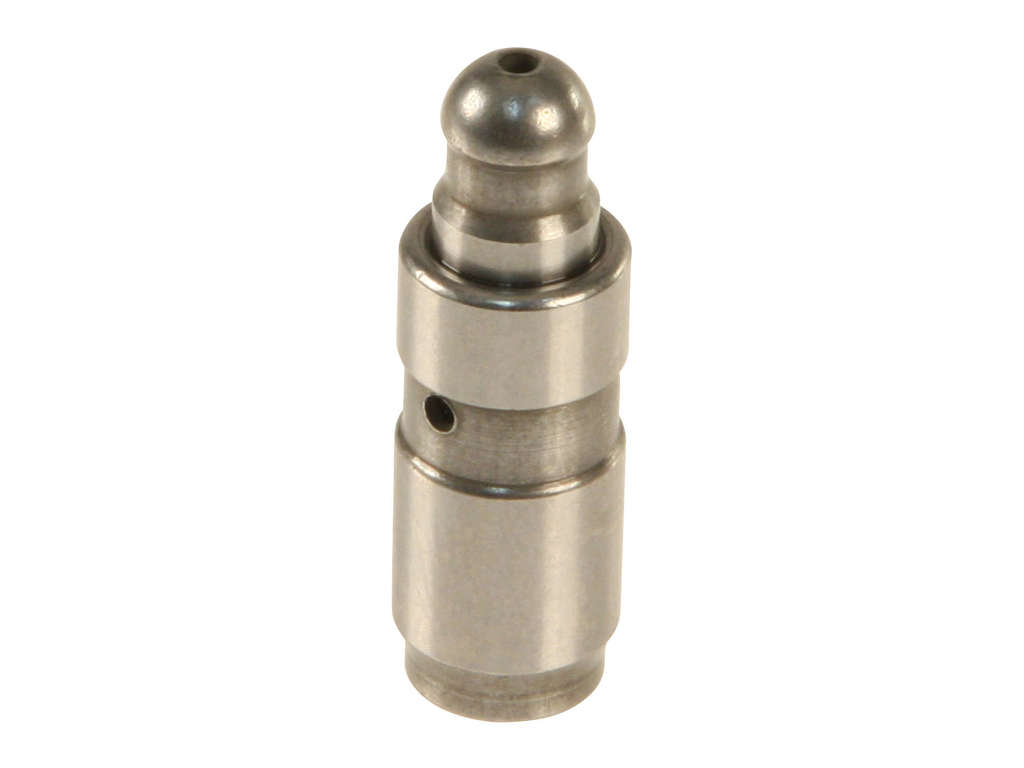
- Exhaust Camshaft Position Actuator Solenoid
(OEM #12655421)— This is the component that fails electrically in over 90% of P0013 cases on this vehicle. The internal coil windings develop an open or short circuit.
Trusted brands: ACDelco (GM Genuine), Delphi, Dorman (P/N: 917-216)
OEM price range: $40-$60
Aftermarket price range: $25-$45 - Intake Camshaft Position Actuator Solenoid
(OEM #12655420)— It is highly recommended to replace both solenoids at the same time. They are the same age and subjected to the same operating conditions. If the exhaust solenoid has failed, the intake solenoid may not be far behind.
Trusted brands: ACDelco (GM Genuine), Delphi, Dorman (P/N: 917-215)
OEM price range: $40-$60
Aftermarket price range: $25-$45
Related Codes That Often Appear With This One
- P0014 — P0014 indicates 'Exhaust Camshaft Position Timing Over-Advanced'. A faulty solenoid that triggers P0013 can fail to control the camshaft properly, causing it to get stuck in a position that the ECM flags as over-advanced. Seeing them together strongly points to the solenoid.
- P0010 — This is the equivalent circuit code for the intake solenoid. It will often appear after swapping a faulty exhaust solenoid to the intake side as a diagnostic test. If both P0010 and P0013 appear together initially, it could point to a wiring harness issue common to both solenoids or severe oil contamination.
Technical Service Bulletins (TSBs) & Recalls
- GM Service Bulletin 09226: Addresses a safety recall for cracked fuel pump modules on certain Cobalt models, primarily in warm-weather states, which could cause fuel leaks. While unrelated to P0013, it's a critical safety issue for this platform.
- GM Service Bulletin 10V073000 / N100023: A safety recall to replace the electric power steering motor due to a risk of sudden loss of power steering assist.
- GM Service Bulletin 14113 / 14V047000: The infamous ignition switch recall. The switch can move out of the 'run' position, shutting off the engine and disabling airbags.
- TSB Bulletin #GCUS-9-2816: A manufacturer service bulletin notes that P0013 (Exhaust Camshaft Position Actuator Solenoid Valve Control Circuit) may set as a result of an internal broken wire in the solenoid.
Platform-Specific Known Issues
- Owner Experience: P0013 followed by P0010: A user on ChevroletForum 'in2pro' reported getting a P0013 code on their 2009 Cobalt. Replacing the exhaust actuator (GM Part No. 12655421) fixed the issue. However, about six weeks later, a P0010 code appeared for the intake actuator. The user concluded it's best to replace both solenoids in pairs.
- Owner Experience: Resistance Test Confirms Failure: On CobaltSS.net, a user diagnosed P0013 and P0014 by testing the solenoid's resistance with a multimeter. The faulty solenoid read 25 ohms, well outside the 10-12 ohm specification, confirming the electrical failure. Replacing the solenoid fixed the problem.
Mechanic-Grade Diagnostic Values
- Camshaft Actuator Solenoid Resistance — expected: 8 to 12 Ohms at approximately 68°F (20°C).. Failure: A reading of infinite resistance (Open Loop), near-zero (short circuit), or a reading that is unstable or significantly outside the 8-12 Ohm range. Some failures show high resistance, like 25 Ohms or even into the mega-ohm range.
- Solenoid Connector Voltage (Key On, Engine Off) — expected: One pin should have battery voltage (11-12V+). This is the ignition voltage supply.. Failure: Less than battery voltage indicates a problem in the power supply wire or the related fuse.
- Solenoid Low Reference Circuit to Ground — expected: Less than 5 Ohms.. Failure: Greater than 5 Ohms indicates high resistance or an open in the low-reference (ground control) wire between the solenoid connector and the ECM.
Scan Tool Commands That Help
- GM Tech2 / GDS2 (or equivalent professional scanner): Camshaft Position Actuator Solenoid Control — This is a bidirectional test used to command the solenoid ON or to a specific duty cycle. While monitoring live data for 'Desired' vs. 'Actual' camshaft angle, a technician can confirm if the solenoid is responding to commands. If the engine idle does not change or stumble when the exhaust solenoid is commanded ON, and the actual angle PID does not change, it confirms a failure in the solenoid, its circuit, oil flow, or the phaser itself.
- GM Tech2 / GDS2 (or equivalent professional scanner): Camshaft Position Variation Relearn — No specific relearn or adaptation procedure is required after replacing the camshaft actuator solenoids on this platform. The ECM adapts automatically after clearing the codes.
Wiring & Ground Locations
- Exhaust VVT Solenoid Connector — On top of the engine's valve cover, at the rear (firewall side). It is the black connector.. This is the primary connection point to test for power, ground control, and solenoid resistance. Pin A is the control circuit from the ECM, and Pin B is the low reference circuit. Corrosion, oil contamination, or loose pins here are a direct cause of P0013.
- G105 — On the lower left front of the transmission case.. This is a primary engine and transmission ground point. While not directly for the solenoid, a poor ground here can cause a variety of electrical issues and unpredictable behavior from the ECM and its controlled components.
- Engine Control Module (ECM) — Located in the engine bay, typically near the driver's side strut tower, behind the battery.. The control wire (low reference) for the exhaust VVT solenoid runs from Pin A at the solenoid connector directly to a pin on the ECM. A continuity test between these two points is the final step to rule out a wiring break before condemning the ECM.
Real Owner Repair Stories
- ChevroletForum user 'in2pro' (2009 Chevrolet Cobalt 2.2L) — Intermittent P0013 code. The Check Engine Light would come on, but then go off.
❌ Tried (didn't work) Initially found the plastic wire loom on top of the engine had disintegrated. The user removed the rotted loom and re-wrapped the harness with heat tape. This seemed to work for a short time, but the code returned intermittently.
✅ What actually fixed it Replacing the exhaust camshaft actuator solenoid (GM Part No. 12655421) with a new OEM part permanently resolved the P0013 code. Notably, six weeks later, a P0010 code appeared, which was fixed by replacing the intake solenoid, leading the owner to recommend replacing them in pairs. - NHTSA ODI #11321403 — An owner reported that a reduced engine power light came on while driving. The diagnostic code was P0013, which required the replacement of the exhaust camshaft position actuator.
- NHTSA ODI #10870877 — A report describes a repair on the exhaust VVT solenoid for the exhaust side of the engine after codes P0013 and P0014 were triggered.
OEM Part Supersession History
12628348→12646784, then 12655421. Some sources also show 12679100 as a valid service number.— Standard part evolution for improved durability or manufacturing process changes.
Heads up: All listed part numbers for the exhaust solenoid are interchangeable for this application. Ensure the connector is black. The intake solenoid (gray connector) has different part numbers and is not interchangeable despite being mechanically identical.
Model Year Variations Within This Range
- 2009-2010: The 2.2L engine was updated for the 2009 model year to the LAP variant, which added dual Variable Valve Timing (VVT). Models from 2005-2008 with the 2.2L L61 engine do NOT have VVT and cannot set this code. This article is only relevant for 2009-2010 2.2L Cobalts (and 2.4L models from 2006-2008).
Diagnostic Flowchart
Other Known Issues on This Vehicle
Issues unrelated to this code that are worth knowing about as an owner of this generation:
- Ignition Switch Failure 🔴 High — Extremely widespread, subject of a massive and highly publicized safety recall. (Ref: NHTSA Campaign 14V047000. The ignition switch can be bumped or weighed down, causing it to move out of the 'Run' position, shutting off the engine and disabling airbags.)
- Electric Power Steering (EPS) Motor Failure 🔴 High — Very common, affecting a large number of vehicles and leading to a major safety recall. (Ref: NHTSA Campaign 10V073000. The EPS motor can fail suddenly, causing a loss of power steering assist, which requires significantly more effort to steer, especially at low speeds.)
- Cracked Fuel Pump Module 🟠 Medium — Common enough to warrant a safety recall, particularly for vehicles in warm-weather states. (Ref: NHTSA Campaign 09V419000 (expanded by 12V459000). The plastic supply or return port on the fuel pump module can crack, leading to a fuel leak and potential fire hazard.)
- Front Lower Control Arm Bushing Failure 🟠 Medium — A common wear item that fails prematurely, causing clunking noises from the front suspension, poor alignment, and uneven tire wear.
Used vs. New Parts: Buying Guide for This Vehicle
When a used part is the smart pick: A used part is NOT recommended for the VVT solenoid itself. It is an inexpensive, high-failure electrical part, and a used one has unknown life remaining and may be faulty already. A used wiring connector pigtail from a junkyard is a smart choice if your original connector's locking tab is broken or the terminals are corroded.
Donor-vehicle mileage cap: roughly under 100000 miles for the part to have meaningful remaining life.
What to inspect on the donor part:
- For a wiring pigtail, ensure the plastic is not brittle and the locking tab is intact.
- Check for any signs of corrosion (green crust) on the metal pins.
- Ensure there is at least 4-6 inches of wire attached to the pigtail for easier splicing.
OEM-only on this vehicle (don't cheap out):
- Engine Control Module (ECM)
Aftermarket brands forum-validated for this vehicle:
- ACDelco (OEM supplier)
- Delphi
- Dorman (P/N: 917-216 is widely available and generally considered an acceptable replacement for this part)
Brands owners have reported issues with on this vehicle:
- No-name, unbranded parts from online marketplaces should be avoided, as quality control can be highly inconsistent and they are a common source of repeat failures.
Real Owner Stories
Aggregated from forums and TSBs cited above. Mileages and costs reflect what owners reported in those sources.
2009 Chevrolet Cobalt 2.2L
Symptoms: Check engine light on with code P0013.
What fixed it: Replacing the exhaust actuator (GM Part No. 12655421) fixed the issue, though the intake actuator failed six weeks later with code P0010.
Source hint: ChevroletForum user 'in2pro' in vehicle_specific_issues
2005-2010 Chevrolet Cobalt (Ecotec)
Symptoms: P0013 and P0014 codes present.
What fixed it: Replacing the solenoid after a multimeter test showed 25 ohms of resistance, which was outside the 10-12 ohm specification.
Source hint: CobaltSS.net user in vehicle_specific_issues
Cross-Manufacturer Reference (Chevrolet)
Symptoms: Reduced engine power light and diagnostic code P0013 at 7,473 miles.
What fixed it: Vehicle was towed to a dealer for repair and replacement of the exhaust camshaft position actuator.
Source hint: NHTSA ODI #11321403
Cross-Manufacturer Reference (Chevrolet)
Symptoms: Engine light on for one week with error codes P0013 and P0014, accompanied by an oil leak of approximately 2 drops per second.
What fixed it: Documented as a failure of the exhaust camshaft position actuator.
Source hint: NHTSA ODI #11495760
Related OBD-II Codes
Frequently Asked Questions
Is there a recall for the P0013 code on my 2005-2010 Chevrolet Cobalt?
Which solenoid do I need to replace for a P0013 code on my 2.2L Ecotec engine?
Can I test the solenoid myself before buying a new one?
Should I replace both the intake and exhaust solenoids at the same time?
How can I be sure the solenoid is the problem and not the engine wiring?
Does the oil type matter for the VVT system on the Cobalt?
Helpful Videos

We Have This Part in Stock

The information in this article is provided for general reference and educational purposes only. Vehicle specifications, procedures, and part compatibility can vary by production date, trim level, and region. Always consult your vehicle's factory service manual and verify part numbers before purchasing or performing repairs. Safety-critical components such as airbags, seat belts, and braking systems should be installed by a qualified professional.
- Chevrolet Cobalt:
- 🧭 Diagnostic Flowchart
- 🎬 Helpful Videos
- 🛍️ Shop This Part
- What's Unique About the 2005-2010 Chevrolet Cobalt
- Symptoms You May Notice
- Most Likely Causes
- Rare But Worth Checking
- Diagnosis Steps
- Parts You'll Likely Need
- Related Codes That Often Appear With This One
- Technical Service Bulletins (TSBs) & Recalls
- Platform-Specific Known Issues
- Mechanic-Grade Diagnostic Values
- Scan Tool Commands That Help
- Wiring & Ground Locations
- Real Owner Repair Stories
- OEM Part Supersession History
- Model Year Variations Within This Range
- Other Known Issues on This Vehicle
- Used vs. New Parts: Buying Guide for This Vehicle
- Real Owner Stories
- 2009 Chevrolet Cobalt 2.2L
- 2005-2010 Chevrolet Cobalt (Ecotec)
- Cross-Manufacturer Reference (Chevrolet)
- Cross-Manufacturer Reference (Chevrolet)
- Related OBD-II Codes
- Frequently Asked Questions
- 🎟️ Get 5% Off