

P0014 on 2015-2021 Ford Escape: Exhaust Cam Timing Causes and Fixes
On a 2015-2021 Ford Escape, P0014 is most often caused by low/dirty engine oil or a faulty exhaust Variable Camshaft Timing (VCT) solenoid. An oil change or replacing the solenoid (OEM Part # CN1Z6M280B or similar, approx. $40-$100) usually resolves the issue. On EcoBoost models, this code can also be a symptom of the much more serious coolant intrusion engine failure.
- P0014 on your Escape points to the exhaust camshaft timing being too far advanced.
- The first and cheapest step is to check your engine oil. An oil and filter change with the correct oil may fix the problem.
- The most common faulty part is the exhaust VCT solenoid, which is relatively easy and inexpensive to replace.
- On EcoBoost models, be aware of potential coolant intrusion. Unexplained coolant loss combined with this code is a major red flag for a serious engine problem.
- Do not ignore this code. Addressing it promptly can prevent a simple solenoid or oil issue from escalating into a major engine repair.
What's Unique About the 2015-2021 Ford ESCAPE

For this generation of Ford Escape, code P0014 is frequently linked to specific issues documented by Ford. Multiple Technical Service Bulletins (TSBs) point directly to small debris causing the VCT oil control solenoids to stick. Furthermore, the 1.5L and 2.0L EcoBoost engines are known to have a more serious underlying problem where a design flaw in the engine block allows coolant to leak into the engine oil. This contamination creates sludge that clogs the VCT system and triggers timing codes like P0014, often as a precursor to catastrophic engine failure.
Diagnostic Flowchart

Tap your situation to follow the diagnostic path that matches what you're seeing on this vehicle.
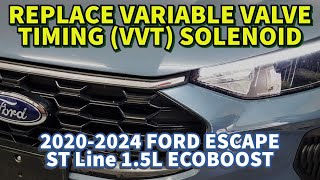
Generation note: The 2015-2021 year range covers two Ford Escape generations: the 3rd Gen (2013-2019) and the 4th Gen (2020-present). 🎬 See this VVT solenoid replacement for 2020 and newer models The primary causes, particularly the VCT solenoid issues and the EcoBoost coolant intrusion problem (TSB 19-2346), are relevant to engines used across both generations within this timeframe.
Symptoms You May Notice
- Illuminated Check Engine Light
- Rough engine idle
- Engine stalling or difficulty starting
- Reduced engine power and sluggish acceleration
- Decreased fuel economy
- Rattling or ticking noise from the engine
- Engine knocking or pinging
- Replacing the camshaft position sensor. While a sensor can fail, it is less common for it to cause an over-advanced code without also setting a specific sensor circuit code. The issue is more often mechanical (timing chain) or hydraulic (oil pressure/solenoid).
Most Likely Causes

- Low, Incorrect, or Dirty Engine Oil 🔴 High Probability The Ti-VCT (Ford's VVT system) is hydraulic and extremely sensitive to oil pressure and cleanliness. Delays in oil changes lead to sludge that clogs the fine mesh screens on the VCT solenoids and narrow passages in the phasers, causing them to stick.
How to confirm: Check the oil level on the dipstick and examine its color and consistency. If the oil is low, black, or sludgy, it needs to be changed. One owner on a forum noted the code appeared when oil was so low it didn't register on the dipstick.
Typical fix: Perform an engine oil and filter change using the manufacturer-specified oil viscosity (typically a 5W-20 or 5W-30 synthetic blend for EcoBoost engines). This is the first and most important diagnostic step.
Est. part cost: $40-$80 - Faulty Exhaust VCT Solenoid (Oil Control Valve) 🔴 High Probability → Shop Engine Variable Valve Timing (VVT) Solenoid Ford has issued multiple TSBs (SSM 54366, SSM 48423, SSM 47170) stating that P0014 can be caused by small debris causing the VCT solenoid to stick.
How to confirm: Remove the solenoid and inspect its screens for debris. Test its resistance with a multimeter; it should typically be between 5-15 ohms. You can also apply a 12V source to its pins to listen for an audible click, confirming the internal plunger is moving.
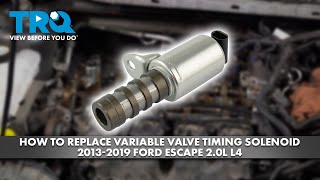
Typical fix: Cleaning the solenoid with brake or MAF sensor cleaner may be a temporary fix, but replacement is the most reliable solution. The OEM part number is often CN1Z6M280B 🎬 Watch: How to replace the VVT solenoid on a 2.0L engine or a similar variant.
Est. part cost: $40-$100 - Worn Timing Chain or Tensioner 🟡 Medium Probability → Shop Engine Timing Chain Over time, timing chains can stretch and hydraulic tensioners can weaken, especially if oil changes are neglected. This causes the base camshaft timing to be incorrect, which the VCT system cannot overcome, leading to a persistent code.
How to confirm: This is a complex diagnosis that usually requires partial engine disassembly to physically inspect the timing components for slack or damage. A rattling noise on startup that goes away after a few seconds is a common symptom. A Reddit user with P0012 and P0014 on a 1.6L Escape discovered their issue was caused by a shop that improperly performed a prior repair, loosening the crankshaft pulley and causing the timing to jump.
Typical fix: Replacement of the timing chain, guides, and tensioner. This is a labor-intensive job best left to professionals.
Est. part cost: $200-$500
Rare But Worth Checking
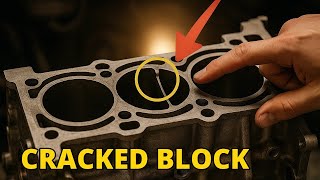
- Engine Block Coolant Intrusion (1.5L/2.0L EcoBoost): This is a severe issue documented in TSB 19-2346 where a flaw in the engine block design allows coolant to leak into the cylinders, contaminating the oil. This creates sludge that clogs the VCT system. An owner complaint (ODI #11727408) and a Reddit thread for a 2017 1.5L Escape directly link P0014 to this known coolant intrusion issue. Key symptoms include unexplained coolant loss, white exhaust smoke, and misfire codes (e.g., P0302, P0304). The only permanent fix is a redesigned long block engine assembly. 🎬 Learn more about the EcoBoost coolant intrusion and block crack issue
- Failed Camshaft Phaser: → Shop Engine Camshaft The phaser, which is the gear at the end of the camshaft, can mechanically fail and get stuck in the advanced position. This is less common than a solenoid failure and more expensive to repair, as it requires removing the timing chain.
Diagnosis Steps
- Check Engine Oil: Verify the oil level is full and the oil is clean and of the correct viscosity. If low or dirty, perform an oil and filter change. Clear the code and test drive. This is the simplest and most common fix.
- Inspect and Test VCT Solenoid: Locate the exhaust VCT solenoid on Bank 1. Disconnect and remove it. Inspect the mesh screens for sludge or debris. Clean it thoroughly with an appropriate cleaner. Test the solenoid's resistance with a multimeter; a normal reading is between 5-15 ohms. Briefly apply 12V power to check for a 'click'. If it fails either test or is heavily contaminated, replace it.
- Test Solenoid Electrical Circuit: Check the wiring and connector to the solenoid for damage or corrosion. Use a multimeter to verify battery voltage is present at the connector with the key on.
- Check for Coolant Intrusion (EcoBoost only): If you have a 1.5L or 2.0L EcoBoost, check the coolant level. If it's low with no visible external leaks, and you have misfire codes, suspect coolant intrusion. A mechanic can use a borescope to check for coolant inside the cylinders or perform a cooling system pressure test as outlined in TSB 19-2346.
- Inspect Timing System: If all else fails, the problem may be mechanical. This requires a more in-depth diagnosis by a professional to check the timing chain for stretching and the camshaft phaser for proper operation. This is a significant, labor-intensive job.
Parts You'll Likely Need
- Engine Variable Camshaft Timing (VCT) Solenoid (Exhaust)
(OEM #CN1Z6M280B, CN1Z6M280D, CN1Z6M280E)— This is the most frequent point of failure according to Ford's own TSBs and general repair data. It gets stuck due to debris or sludge in the engine oil.
Trusted brands: Motorcraft, Dorman, NGK/NTK
OEM price range: $70-$120
Aftermarket price range: $40-$80 - Engine Oil and Filter — Correct oil level and cleanliness are critical for the VCT system to function. This is the first and most important maintenance step.
Trusted brands: Motorcraft, Mobil 1, Valvoline
OEM price range: $50-$90
Aftermarket price range: $40-$70
Related Codes That Often Appear With This One
- P0012 — Intake Camshaft Position Timing - Over-Retarded. This code often appears with P0014, as seen in owner complaints (ODI #11727408, #11671735) and forum posts. This combination indicates a wider problem with the VCT system, likely due to oil contamination or pressure issues affecting both intake and exhaust cams.
- P0302 / P0304 — Cylinder 2 or 4 Misfire. These codes, when paired with P0014 on an EcoBoost engine, are a strong warning sign of the coolant intrusion issue, as the block commonly cracks between cylinders. An owner complaint (ODI #11727408) directly reports this combination.
- P0011, P0015, P0021, P0022, P0024, P0025 — These are all VCT-related timing codes. The TSBs from Ford (SSM 54366, 48423, 47170) list them as a group, suggesting a common cause like oil quality or solenoid issues can trigger any combination of them.
Technical Service Bulletins (TSBs) & Recalls
- SSM 54366: Notes that various DTCs including P0014 may be present and refers to pinpoint tests.
- SSM 48423: States that P0014 and other VCT codes may be due to small debris causing the VCT solenoid to stick.
Platform-Specific Known Issues
- TSB SSM 54366, SSM 48423, SSM 47170: Ford acknowledges that various VCT codes, including P0014, can be caused by small debris making the VCT solenoid stick. The recommended procedure involves diagnosing the solenoid before replacing more expensive components.
- EcoBoost Coolant Intrusion: On 1.5L and 2.0L EcoBoost engines, a known engine block design flaw can lead to coolant leaking into the oil, causing severe oil contamination that triggers VCT codes like P0014. Ford addressed this with TSB 19-2346, recommending a short block replacement with a revised design for affected vehicles which also include the Ford Edge, Fusion, and Lincoln MKC/MKZ.
Mechanic-Grade Diagnostic Values
- VCT Solenoid Internal Resistance — expected: 8 to 12 Ohms. Failure: A reading outside this range, or an open circuit (OL), indicates a faulty solenoid coil.
- VCT Solenoid Circuit Voltage — expected: Battery Voltage (approx. 12V) with key on, engine off.. Failure: No voltage indicates a wiring issue, blown fuse (F34), or problem with the PCM power supply.
- Scan Tool PID: VCT_ADV_ERR (VCT Advance Error) — expected: Should hover around 0°, with a variance no greater than +/- 5° for an excessive time.. Failure: A consistent, large value in either the positive or negative direction indicates the PCM cannot control the cam timing to the desired position.
- Scan Tool PID: VCT_EXH (Exhaust Cam Position) at hot idle — expected: 0°. Failure: A value significantly different from 0° at idle suggests the phaser is stuck or not returning to its base position.
Hidden / Shadow Codes Worth Checking
- Mode 6 Data: Mode 6 is not a specific code but a diagnostic mode that provides statistical data and test results for non-continuously monitored systems, including the VVT system. It can show if the VVT system is passing or failing its self-tests, even before a DTC is set. (see via Accessible with advanced scan tools like the Ford IDS (Integrated Diagnostic System) or some high-end aftermarket scanners. A technician would look for test results related to VCT timing.)
Scan Tool Commands That Help
- FORScan / Ford IDS: Output State Control / Actuator Test for VCT Solenoid — This bidirectional command allows the technician to manually activate the exhaust VCT solenoid while the engine is running. A change in idle quality or engine sound confirms the solenoid is mechanically responding to the command, helping to isolate a faulty solenoid from a wiring or PCM driver issue.
- FORScan / Ford IDS: Monitor PIDs: VCT_EXH_CMD (Commanded), VCT_EXH_ACT (Actual), and VCT_EXH_ERR (Error) — Graphing these PIDs simultaneously allows a technician to see if the actual camshaft position is tracking the PCM's commanded position. A significant lag or deviation (error) points directly to a problem in the hydraulic or mechanical part of the VCT system.
- FORScan / Ford IDS: Clear Transmission Adaptive Tables — While not directly for the engine code, if major engine work affecting torque output (like a timing chain replacement) is performed, clearing the transmission's learned shift strategies can prevent harsh shifting or performance complaints after the repair.
Wiring & Ground Locations
- Fuse F34 (Under-hood Fuse Box) — In the main engine fuse box located on the right side of the engine bay (when facing the engine).. This fuse supplies power to the Variable Camshaft Timing solenoids. If this fuse is blown, the solenoids will have no power, leading to VCT-related codes.
- Engine Ground Cable (e.g., GV6T-14324-R59CL for 1.5L) — Connects the engine block to the chassis or battery negative terminal to provide a return path for electrical current.. A poor or corroded engine ground can cause erratic behavior in sensors and actuators, including the VCT solenoids and Camshaft Position sensors, leading to incorrect readings and fault codes.
- PCM Location — Typically mounted on the left side of the engine compartment, near the firewall or shock tower.. This is the location of the Powertrain Control Module, where the wiring harness from the VCT solenoid terminates. Visual inspection of the connectors (e.g., C175B) for corrosion or damage is a key diagnostic step.
Real Owner Repair Stories
- Reddit user in r/fordescape (2017 Ford Escape 1.5L EcoBoost, 87k miles) — Check engine light with codes P0012 and P0014.
❌ Tried (didn't work) Not specified, but the diagnosis went straight to the known major failure.
✅ What actually fixed it The root cause was diagnosed as the known coolant intrusion issue. The user reported that the entire engine had to be replaced with a new long block to resolve the problem. - Reddit user in r/fordescape (2012 Ford Escape (demonstrates a relevant part compatibility issue)) — Car stalling after replacing VVT solenoid gasket.
❌ Tried (didn't work) Using an aftermarket VVT solenoid gasket.
✅ What actually fixed it The stalling issue was resolved by replacing the aftermarket gasket with a genuine OEM Ford part. The user noted the OEM part sits in a way that the aftermarket part could not replicate, highlighting a critical difference in manufacturing tolerances.
OEM Part Supersession History
CN1Z-6M280-B→CN1Z-6M280-D, then CN1Z-6M280-E— Part revisions by the manufacturer to improve reliability or address known failure modes.
Heads up: CN1Z-6M280-E is the latest, most reliable version and is backward compatible, replacing both -B and -D variants for the 1.5L and 1.6L engines. Always use the latest revision available.
Model Year Variations Within This Range
- 2015-2019 (3rd Generation): These years used a 6-speed 6F35 automatic transmission. The 1.5L 4-cylinder EcoBoost engine used in 2017-2019 models is particularly noted for the coolant intrusion issue (TSB 19-2346) which can cause P0014.
- 2020-2021 (4th Generation Redesign): The 2020 model year introduced a full redesign. The base engine became a new 1.5L 3-cylinder EcoBoost, and the optional 2.0L EcoBoost was paired with a new 8-speed automatic transmission. While VCT principles are the same, wiring, PCM software, and specific part numbers may differ from the 3rd generation. The known coolant intrusion TSB does not apply to the new 3-cylinder engine.
Helpful Videos
![How to Fix P0014 Engine Code in 4 Minutes [2 DIY Methods / Only $6.74]](https://img.youtube.com/vi/olrC8UYw9cQ/mqdefault.jpg)
We Have This Part in Stock


The information in this article is provided for general reference and educational purposes only. Vehicle specifications, procedures, and part compatibility can vary by production date, trim level, and region. Always consult your vehicle's factory service manual and verify part numbers before purchasing or performing repairs. Safety-critical components such as airbags, seat belts, and braking systems should be installed by a qualified professional.
- Ford ESCAPE:
- 🧭 Diagnostic Flowchart
- 🎬 Helpful Videos
- 🛍️ Shop This Part
- What's Unique About the 2015-2021 Ford ESCAPE
- Symptoms You May Notice
- Most Likely Causes
- Rare But Worth Checking
- Diagnosis Steps
- Parts You'll Likely Need
- Related Codes That Often Appear With This One
- Technical Service Bulletins (TSBs) & Recalls
- Platform-Specific Known Issues
- Mechanic-Grade Diagnostic Values
- Hidden / Shadow Codes Worth Checking
- Scan Tool Commands That Help
- Wiring & Ground Locations
- Real Owner Repair Stories
- OEM Part Supersession History
- Model Year Variations Within This Range
- 🎟️ Get 5% Off