

P0014 on 2016-2019 Ford Explorer 2.3L EcoBoost: Causes and Fixes for Over-Advanced Camshaft Timing
On a 2016-2019 Explorer with the 2.3L EcoBoost, P0014 is almost always caused by either dirty/low engine oil or a failing exhaust VCT solenoid. The most common fix is an oil change and replacing the exhaust VCT solenoid (OEM Part # CJ5Z6M280A), which costs about $30-$80 for the part and is a 2/5 DIY difficulty. Ignoring the code can lead to poor performance and potential long-term engine stress.
- P0014 on this Explorer points to the exhaust camshaft timing being too far advanced.
- The most likely cause is not a major mechanical failure, but rather an issue with oil quality or the exhaust VCT solenoid.
- Always check the oil level and condition first. An oil change is an inexpensive and easy first step.
- Replacing the exhaust VCT solenoid is the most common repair. It's a DIY-friendly job that can save significant labor costs.
- Do not replace the camshaft position sensor; it is almost never the cause of this code.
What's Unique About the 2016-2019 Ford Explorer
The 2.3L EcoBoost engine, like many modern direct-injection and turbocharged engines, is particularly sensitive to engine oil condition. The VCT system uses hydraulic oil pressure to adjust camshaft timing, and Ford has issued multiple Technical Service Bulletins (TSBs) acknowledging that small debris in the oil can cause the VCT solenoids to stick, leading to codes like P0014. This makes using the correct oil (5W-30 Synthetic Blend or Full Synthetic) and adhering to strict change intervals more critical than on older, simpler engines to prevent this specific fault.
Symptoms You May Notice
- Check Engine Light is on
- Rough or shaky idle
- Poor acceleration and sluggish performance
- Reduced fuel economy
- Engine may be difficult to start
- Rattling or ticking noise from the engine, especially on startup
- Engine may stall unexpectedly
- Replacing the camshaft position sensor. The sensor is usually doing its job correctly by reporting the timing deviation; it is rarely the cause of the problem. The code indicates a mechanical timing issue, not an electrical sensor failure.
Most Likely Causes
- Low, Dirty, or Incorrect Viscosity Engine Oil 🔴 High Probability The VCT system is hydraulically operated and highly sensitive to oil pressure and cleanliness. Ford TSBs confirm that debris in the oil is a primary cause of VCT solenoid sticking. Sludge buildup can clog the fine mesh screens on the solenoids, impeding their function.
How to confirm: Check the oil level on the dipstick. Inspect the oil's color and consistency; if it is dark, gritty, or past its service interval, it needs to be changed. Check the oil filler cap for signs of sludge, which indicates a more severe contamination problem.
Typical fix: Perform an engine oil and filter change using the manufacturer-specified grade (5W-30 synthetic blend or full synthetic).
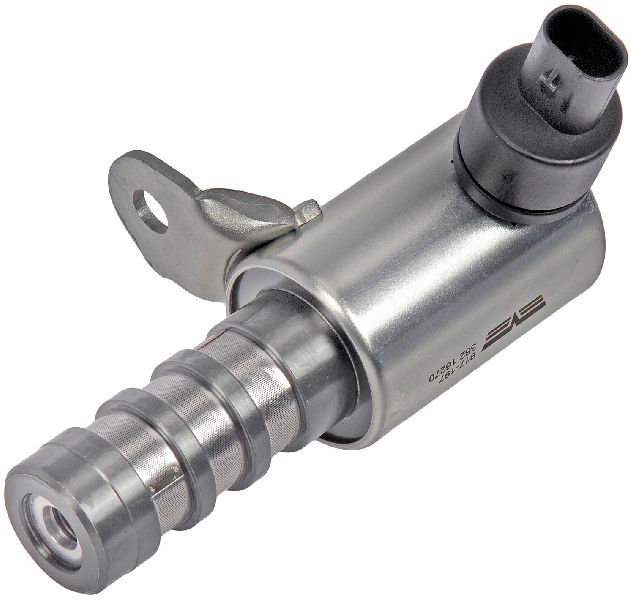
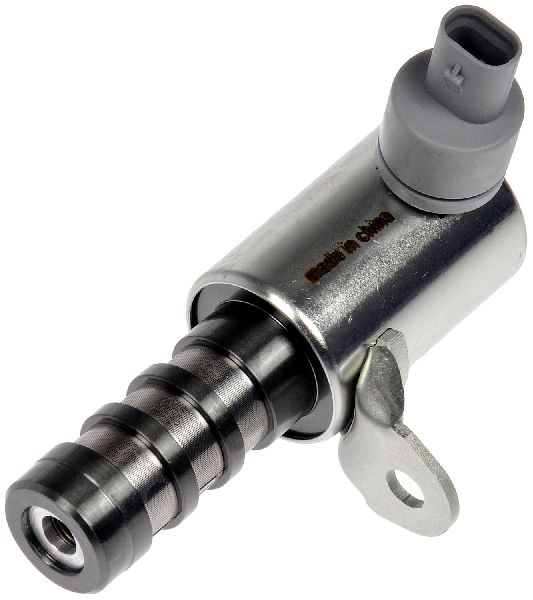
Est. part cost: $40-$80 - Failing Exhaust VCT Solenoid 🔴 High Probability → Shop Engine Variable Valve Timing (VVT) Solenoid Oil contamination or sludge can clog the fine mesh screens on the solenoid or cause the internal plunger to stick, preventing it from accurately controlling oil flow to the cam phaser. This is a widely acknowledged failure point on EcoBoost engines.
How to confirm: Use a scan tool to perform a VCT solenoid actuator test; the engine should stumble or run rough if the solenoid is working. A common DIY method is to swap the exhaust and intake solenoids; if the code changes to P0011 (Intake 'A' Camshaft Position Timing Over-Advanced), the solenoid is confirmed faulty. You can also test the solenoid's internal resistance with a multimeter; expected values are typically between 5 and 15 Ohms.
Typical fix: Replace the exhaust VCT solenoid (Part # CJ5Z6M280A). It is often recommended to replace both intake and exhaust solenoids at the same time, especially if oil contamination is suspected.
Est. part cost: $30-$80 - Damaged VCT Solenoid Wiring or Connector ⚪ Low Probability → Shop Engine Variable Valve Timing (VVT) Solenoid
How to confirm: Visually inspect the wiring harness and connector for the exhaust VCT solenoid for any signs of fraying, melting, or corrosion. Use a multimeter to check for proper voltage (battery voltage with ignition on) and continuity at the connector.
Typical fix: Repair or replace the damaged section of wiring or the connector pigtail.
Est. part cost: $15-$50
Rare But Worth Checking
- Stretched Timing Chain or Failed Cam Phaser: → Shop Engine Timing Chain While less common than oil or solenoid issues, excessive slack in the timing chain or a malfunctioning (stuck) cam phaser can cause the camshaft timing to be out of sync with the crankshaft, triggering this code. This is a more serious mechanical issue that often presents with a rattling noise on startup and requires professional diagnosis.
- Clogged VCT Oil Filter/Passages: → Shop Engine Oil Filter Adapter Some engines have small, inline oil filters in the passages leading to the VCT solenoids within the cylinder head. If these become clogged with sludge or debris, they can restrict oil flow and cause timing codes even with a good solenoid. Cleaning or replacing these may require significant disassembly.
Diagnosis Steps
- Check Engine Oil Level and Condition: Ensure the oil is full and clean. If it's low, old, or dirty, perform an oil and filter change with the correct 5W-30 oil. Clear the code and see if it returns. This is the most critical and common first step.
- Scan for Codes: Confirm P0014 is the primary code and note any other codes present.
- Inspect VCT Solenoid Wiring: Check the electrical connector and wiring for the exhaust VCT solenoid for any visible damage, like frayed wires or oil contamination.
- Test the VCT Solenoid (Scan Tool): Using a capable scan tool, command the exhaust VCT solenoid on and off (actuator test). Listen for a change in engine idle (stumbling or roughness), which indicates the solenoid is mechanically responding. Per Ford TSB SSM 50067, you can also try cycling the solenoid 10 times with the scan tool to dislodge small debris before replacement.
- Swap Solenoids (Diagnostic Trick): A simple and effective test is to swap the exhaust VCT solenoid with the intake VCT solenoid. They are typically identical and located next to each other on the valve cover. Clear the codes and drive the vehicle. If the trouble code changes from P0014 to P0011, the solenoid you moved is faulty and needs to be replaced.
- Replace the VCT Solenoid: If the solenoid is confirmed bad, replace it. Many technicians recommend replacing both intake and exhaust solenoids at the same time, especially on higher mileage vehicles or if sludge is present.
- Advanced Mechanical Diagnosis: If the problem persists after replacing the solenoid and verifying oil quality, the issue may be with the cam phaser or timing chain itself. This requires a more in-depth mechanical inspection (checking timing marks, chain tension) and is best left to a professional.
Parts You'll Likely Need
- Engine Variable Valve Timing (VVT) Solenoid
(OEM #CJ5Z6M280A)— This is the most common component to fail, typically by sticking or getting clogged with oil debris, directly causing the P0014 code. A newer part number, P2GZ-6M280-A, is listed for later models but CJ5Z6M280A is correct for this application.
Trusted brands: Motorcraft (OEM), Dorman, NGK, Standard Motor Products (SMP), INA
OEM price range: $50-$90
Aftermarket price range: $30-$60 - Engine Oil and Filter — Dirty, low, or incorrect oil is a primary cause of VCT system faults. An oil change is a critical first step and preventative measure.
Trusted brands: Motorcraft (OEM), Mobil 1, Valvoline, Castrol
OEM price range: $40-$80
Aftermarket price range: $35-$70
Related Codes That Often Appear With This One
- P0011 — If the intake solenoid is also failing or if solenoids were swapped for diagnosis.
- P0012 — Can appear with P0014 if there are significant oil sludge issues affecting both intake (retarded) and exhaust (advanced) timing control. A Ford Tech Makuloco video shows this exact scenario on a 2017 Explorer 2.3L EcoBoost.
Technical Service Bulletins (TSBs) & Recalls
- SSM 50067: Supersedes earlier TSBs. For 2015-2021 Ford/Lincoln vehicles, it states that VCT codes (P0011, P0012, P0014, etc.) may be due to small debris causing the solenoid to stick. It officially recommends using a scan tool to cycle the affected VCT solenoid 10 times to attempt to clear debris before replacing the part.
- SSM 48423: An earlier version of SSM 50067, also noting that debris in oil can cause VCT codes and recommending a diagnostic cycling procedure before replacement.
- SSM 47170: A previous iteration of the same TSB, confirming this has been a known issue for Ford for several years.
Platform-Specific Known Issues
- Real World Repair: Sludge Clogged Solenoids: A well-documented case by YouTube channel 'Ford Tech Makuloco' on a 2017 Explorer with the 2.3L EcoBoost showed codes P0012 and P0014 appearing together. The root cause was severe oil sludge buildup that completely clogged the screens on both VCT solenoids. The fix required removing the valve cover and replacing both solenoids, highlighting the critical role of oil maintenance.
Mechanic-Grade Diagnostic Values
- VCT Solenoid Internal Resistance — expected: 5.0 to 15.0 Ohms. Failure: A reading of 0 Ohms indicates a short, while an infinite or OL (Open Loop) reading indicates an open circuit.
- VCT Solenoid Connector Voltage (Key On, Engine Off) — expected: ~12V (Battery Voltage). Failure: No voltage or significantly low voltage points to a problem in the power supply wiring, fuse, or PCM power relay.
- Scan Tool Live Data: VCT Error (CAMERRR) — expected: Should hover around 0 degrees at idle and during steady-state driving.. Failure: A consistent, large error value (e.g., more than 5-10 degrees) in either a positive or negative direction indicates the phaser is not reaching its commanded position. For P0014, you would expect a significant positive error value.
- Scan Tool Live Data: VCT Solenoid Duty Cycle (CAMDCR) — expected: The PCM will vary the duty cycle to control oil flow. The value will change based on engine load and RPM.. Failure: If the PCM commands a high duty cycle (e.g., 75-95%) but the VCT error remains high, it suggests a mechanical or hydraulic issue (stuck phaser, low oil pressure) rather than an electrical one.
- Engine Oil Pressure at Idle (Hot) — expected: Minimum of 15 PSI at idle.. Failure: Pressure below 15 PSI can be insufficient to properly operate the VCT phasers, leading to timing codes.
Hidden / Shadow Codes Worth Checking
- Mode 6, Test ID $53 (on some models): Mode 6 data can contain manufacturer-defined test results. On some Ford vehicles, Test ID $53 relates to misfire counts per cylinder, which can sometimes be associated with severe timing issues. More relevant for VCT are the specific VCT test results, which may have different Test IDs. (see via A scan tool capable of displaying Mode 6 data is required.)
- VCT Advance Error PID (CAMERRR): While not a 'code', this live data parameter is the direct measurement the PCM uses to set P0014. A value consistently greater than the specified threshold (e.g., >20 degrees for a set time) will trigger the fault. Watching this PID provides more insight than just the code itself. (see via Ford IDS, FORScan, or a professional-grade scan tool with access to Ford-specific PIDs.)
Scan Tool Commands That Help
- Ford IDS (Integrated Diagnostic System): Active Commands > VCT Solenoid Duty Cycle Control / Actuator Test — This bidirectional control allows a technician to manually command the VCT solenoid on and off or to a specific duty cycle. If the engine idle changes or stumbles when the exhaust solenoid is commanded, it confirms the solenoid is mechanically functioning and oil pressure is sufficient to move the phaser.
- Ford IDS / High-End Aftermarket Scanners: Pinpoint Test HK11 / VCT Solenoid Cycling — As per Ford TSB SSM 50067, this function cycles the solenoid on and off 10 times. It's used to attempt to dislodge small debris that may be causing the solenoid to stick before resorting to replacement.
- FORScan: VCT_EXH_CMD (Exhaust VCT Commanded Duty Cycle), VCT_EXH_ERR (Exhaust VCT Error) — FORScan software allows monitoring of Ford-specific PIDs. Watching the commanded duty cycle versus the resulting error in degrees is crucial for advanced diagnosis. If the command (VCT_EXH_CMD) changes but the error (VCT_EXH_ERR) does not respond, it points to a stuck solenoid or phaser.
Wiring & Ground Locations
- Exhaust VCT Solenoid Connector — On the top of the valve cover, toward the front of the engine. The exhaust solenoid is typically the one closer to the exhaust manifold (rear side of the engine head on the 2.3L).. This is the primary electrical connection for the component that controls exhaust cam timing. The connector and its wiring are susceptible to heat from the engine, which can cause wires to become brittle or the connector lock to fail, leading to poor connection and intermittent faults.
- G106 (or similar engine ground) — There are several key ground points on the engine block and firewall. G106 is a common ground point on the firewall/bulkhead for various engine-related modules.. The PCM, which controls the VCT solenoid, relies on a solid ground connection. A poor engine or chassis ground can cause erratic behavior in various electronic systems, including the VCT system, potentially leading to incorrect operation and fault codes.
Real Owner Repair Stories
- YouTube, 'Ford Tech Makuloco' (2017 Ford Explorer 2.3L EcoBoost) — Check Engine Light with codes P0012 (Intake Cam Timing Over-Retarded) and P0014 (Exhaust Cam Timing Over-Advanced) present simultaneously.
❌ Tried (didn't work) The video focuses on direct diagnosis, not prior failed attempts.
✅ What actually fixed it The root cause was severe oil sludge buildup. The screens on both the intake and exhaust VCT solenoids were completely clogged. The fix was to remove the valve cover, clean the sludge, and replace both VCT solenoids.
OEM Part Supersession History
CJ5Z-6M280-A→CJ5Z-6M280-B (intermediate, now largely unavailable), then P2GZ-6M280-A for newer applications.— Part revisions are common to improve reliability, change materials, or consolidate parts. The move to 'B' and later part numbers for different models likely involves internal improvements to combat sticking from oil debris.
Heads up: For the 2016-2019 Explorer 2.3L, CJ5Z-6M280-A is the correct specified part. While P2GZ-6M280-A may physically fit, it is specified for 2023 and newer vehicles and may have different control characteristics. Always use the part number specified for the vehicle's VIN.
Diagnostic Flowchart
Other Known Issues on This Vehicle
Issues unrelated to this code that are worth knowing about as an owner of this generation:
- Coolant Intrusion into Cylinders 🔴 High — A known issue on some 2.0L and 2.3L EcoBoost engines where a faulty block/head design allows coolant to leak into the cylinders, leading to misfires and eventual engine failure. More prevalent on 2.0L but also reported on 2.3L. (Ref: Multiple TSBs exist for the 2.0L (e.g., 19-2346) and some customer satisfaction programs have been issued for other engines (21N12 for 1.5L).)
- Power Transfer Unit (PTU) Failure 🔴 High — On AWD models, the PTU (transfer case) is prone to overheating and failure. It contains a very small amount of fluid that is not easily serviced, leading to breakdown and expensive repairs, sometimes damaging the transmission case. Failures are common between 60k-100k miles. (Ref: No recall, but it is a widely documented failure. The 2.3L models are noted to be less prone to the extreme heat failure seen in the 3.5L V6 models due to better exhaust routing.)
- Cracked Exhaust Manifold 🟠 Medium — The integrated exhaust manifold on the cylinder head or the turbo manifold can develop cracks over time, leading to exhaust leaks, noise, and performance loss.
- Rear Suspension Toe Link Fracture 🔴 High — Affects most of the 5th generation Explorers. The rear suspension toe links can fracture due to stress, causing a sudden loss of steering control. (Ref: Recall 21S22)
Used vs. New Parts: Buying Guide for This Vehicle
When a used part is the smart pick: Never. The VCT solenoid is a relatively inexpensive part, and its failure is directly linked to oil contamination and internal wear. A used solenoid carries a high risk of being clogged or worn out from its donor vehicle, potentially causing the same P0014 code to return shortly after installation.
What to inspect on the donor part:
- Not applicable as used purchase is not recommended.
OEM-only on this vehicle (don't cheap out):
- Engine Variable Valve Timing (VVT) Solenoid
Aftermarket brands forum-validated for this vehicle:
- While OEM (Motorcraft) is most recommended, some professional technicians and forums report success with Dorman (specifically part # 917-196) and Bosch as reliable alternatives.
Brands owners have reported issues with on this vehicle:
- Unbranded, no-name solenoids from online marketplaces should be avoided. The VCT system requires precise tolerances, and cheap knock-offs are known for high failure rates, incorrect operation, and causing persistent codes.
Real Owner Stories
Aggregated from forums and TSBs cited above. Mileages and costs reflect what owners reported in those sources.
2017 Ford Explorer 2.3L EcoBoost — 95000 miles
Symptoms: The owner experienced a P0014 code accompanied by rough idling.
What fixed it: The owner replaced both VCT solenoids and performed an oil change after a second opinion correctly identified the solenoids as the issue rather than the timing chain.
Source hint: fordexplorerforum.com - Thread: 'P0014 code, 2017 2.3L'
2017 Ford Explorer 2.3L EcoBoost
Symptoms: Check engine light with codes P0012 and P0014 appearing together.
What fixed it: The fix required removing the valve cover and replacing both VCT solenoids due to severe oil sludge buildup clogging the solenoid screens.
Source hint: YouTube channel 'Ford Tech Makuloco' video cited in vehicle_specific_issues
Related OBD-II Codes
Frequently Asked Questions
My 2017 Explorer 2.3L has P0014; does Ford have a specific procedure to fix this without replacing parts immediately?
What is the specific part number for the exhaust VCT solenoid on my 2.3L EcoBoost Explorer?
Can I test the VCT solenoids myself by swapping them on my 2.3L engine?
What oil should I use in my 2016-2019 Explorer 2.3L to prevent P0014 codes?
Is there a specific electrical test for the VCT solenoid on this vehicle?
Helpful Videos

We Have This Part in Stock


The information in this article is provided for general reference and educational purposes only. Vehicle specifications, procedures, and part compatibility can vary by production date, trim level, and region. Always consult your vehicle's factory service manual and verify part numbers before purchasing or performing repairs. Safety-critical components such as airbags, seat belts, and braking systems should be installed by a qualified professional.
- Ford Explorer:
- 🧭 Diagnostic Flowchart
- 🎬 Helpful Videos
- 🛍️ Shop This Part
- What's Unique About the 2016-2019 Ford Explorer
- Symptoms You May Notice
- Most Likely Causes
- Rare But Worth Checking
- Diagnosis Steps
- Parts You'll Likely Need
- Related Codes That Often Appear With This One
- Technical Service Bulletins (TSBs) & Recalls
- Platform-Specific Known Issues
- Mechanic-Grade Diagnostic Values
- Hidden / Shadow Codes Worth Checking
- Scan Tool Commands That Help
- Wiring & Ground Locations
- Real Owner Repair Stories
- OEM Part Supersession History
- Other Known Issues on This Vehicle
- Used vs. New Parts: Buying Guide for This Vehicle
- Real Owner Stories
- 2017 Ford Explorer 2.3L EcoBoost — 95000 miles
- 2017 Ford Explorer 2.3L EcoBoost
- Related OBD-II Codes
- Frequently Asked Questions
- 🎟️ Get 5% Off