

P0014 on 2013-2019 Ford Taurus 3.5L V6: Exhaust Cam Timing Over-Advanced Causes and Fixes
On a 2013-2019 Taurus with the 3.5L V6, P0014 is almost always caused by low/dirty engine oil or a sticking exhaust VCT solenoid on Bank 1 (firewall side). An oil change and solenoid replacement is the most common fix, with the part costing between $30 and $90. Accessing the Bank 1 solenoid is difficult and requires removing the upper intake manifold.
- Always check the engine oil level and condition first. A simple oil change is often the fix for P0014 on this engine.
- The most common failed part is the Bank 1 (firewall side) exhaust VCT solenoid, which sticks due to oil debris.
- Before replacing the solenoid, try the Ford-recommended procedure of cycling it with a scan tool to clear debris.
- Repairing this code requires accessing the firewall side of the engine, which involves removing the upper intake manifold and is more labor-intensive than working on the radiator side (Bank 2).
- Be aware of the possibility of a failing internal water pump, a known issue on this engine that can cause oil contamination and lead to VCT codes.
What's Unique About the 2013-2019 Ford Taurus
The 3.5L 'Cyclone' V6 in this generation of Ford Taurus is known for having its Variable Camshaft Timing (VCT) system be particularly sensitive to oil quality and cleanliness. Ford has issued multiple Technical Service Bulletins (TSBs) acknowledging that codes like P0014 are frequently caused by small debris or sludge in the engine oil, which causes the VCT solenoids to stick. TSBs like SSM 48423 and SSM 47170 specifically advise technicians to use a scan tool to cycle the solenoid and attempt to clear debris before replacement. This makes regular oil changes with the correct specification oil (SAE 5W-20 is typical) not just routine maintenance, but a primary preventative measure for this specific fault code.
Generation note: The 2013-2019 year range covers the sixth generation of the Ford Taurus after its significant 2013 mid-cycle refresh. This generation started in 2010. The core 3.5L V6 engine and VCT system design remained consistent, so the causes and fixes for P0014 are the same across this entire year range and also apply to the earlier 2010-2012 models.
Symptoms You May Notice
- Check Engine Light illuminated
- Rough idling
- Poor acceleration and loss of power
- Engine stalling
- Reduced fuel economy
- Hard starting
- Replacing the camshaft position sensor. While a sensor can fail, it is not the most common cause for this specific code. The issue is more often with the mechanical/hydraulic control (the VCT solenoid) rather than the sensor reporting the position.
- Immediately replacing the cam phaser. Phaser failure is possible but much less common and more expensive than a sticking VCT solenoid. Solenoid issues should be ruled out first.
Most Likely Causes
- Low, Dirty, or Incorrect Viscosity Engine Oil 🔴 High Probability The VCT system is hydraulic and highly sensitive to oil pressure and cleanliness. Ford TSBs confirm that debris and sludge are primary causes of VCT solenoid issues on these engines. Many owner forum posts confirm that a simple oil and filter change resolved the code.
How to confirm: Check the engine oil level on the dipstick. Inspect the oil's color, consistency, and service interval. If it is low, dark, or past its recommended change interval, this is the most likely starting point.
Typical fix: Perform an engine oil and filter change using the manufacturer-recommended oil viscosity (typically SAE 5W-20). Clear the codes and drive to see if the issue is resolved.
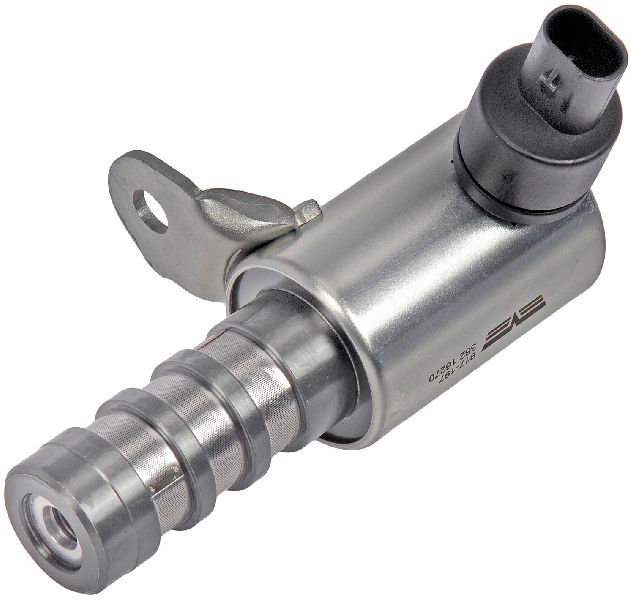
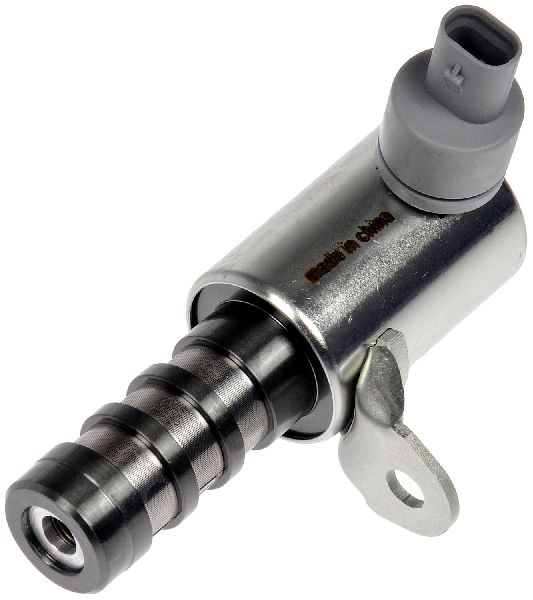
Est. part cost: $40-$80 - Sticking or Failed Exhaust VCT Solenoid (Bank 1) 🔴 High Probability → Shop Engine Variable Valve Timing (VVT) Solenoid As noted in multiple Ford TSBs (e.g., SSM 47170, SSM 48423), these solenoids are prone to getting clogged with oil debris, causing them to stick and trigger an over-advanced timing condition. The fine mesh screens on the solenoids get blocked, preventing proper oil flow.
How to confirm: A common diagnostic is to swap the Bank 1 exhaust VCT solenoid with the Bank 1 intake solenoid. If the code changes to P0011 (Intake Camshaft Position Timing - Over-Advanced), the solenoid is confirmed faulty. This requires removing the upper intake manifold for access on Bank 1. Alternatively, a scan tool can command the solenoid on and off to check for a change in engine operation.
Typical fix: Replace the Bank 1 exhaust VCT solenoid. Since Bank 1 is on the firewall side, this requires removing the upper intake manifold for access. It is highly recommended to replace the upper intake manifold gaskets at the same time.
Est. part cost: $30-$90
Rare But Worth Checking
- Failing Internal Water Pump: This is a critical failure point on the 3.5L Cyclone V6. The pump is internal and driven by the timing chain. A failed seal can leak coolant directly into the engine oil, causing contamination that triggers VCT codes. Check for milky oil ('milkshake' appearance) or dried coolant crust at the engine block weep hole, located just behind and above the alternator.
- Stretched Timing Chain or Failed Cam Phaser: → Shop Engine Timing Chain While less common than a solenoid failure for a single code, a stretched chain or a mechanically failed cam phaser can cause timing to be consistently off. This is usually accompanied by rattling noises, especially on cold starts, and may set multiple timing codes (e.g., P0016, P0017).
- Damaged Wiring or Connector: Inspect the wiring harness and connector for the Bank 1 exhaust VCT solenoid for any visible damage, corrosion, or loose connections before replacing parts. This is less common but should be part of a thorough diagnosis.
Diagnosis Steps
- Check Engine Oil: Verify the oil level is correct and the oil is clean. If low or dirty, perform an oil and filter change, clear the code, and see if it returns. This is the first and most important step.
- Scan Tool Analysis: Use a capable scan tool to monitor the desired vs. actual camshaft position for Bank 1 Exhaust (Ford PIDs: VCT_EXH_DCR1 vs VCT_EXH_ACT1). A large and persistent deviation indicates a problem.
- Cycle the Solenoid: As per Ford TSBs (like SSM 48423), use the scan tool's active command function to cycle the Bank 1 exhaust VCT solenoid 10 times. This may dislodge debris and resolve the issue without part replacement.
- Inspect Wiring: Check the wiring and connector to the Bank 1 exhaust VCT solenoid for damage, corrosion, or a loose connection.
- Swap Solenoids (for confirmation): For DIY confirmation, swap the Bank 1 exhaust solenoid with the Bank 1 intake solenoid. Clear codes and drive. If the code changes to P0011, the solenoid is bad. Note: This requires significant labor to access the firewall-side solenoids, including removal of the upper intake manifold.
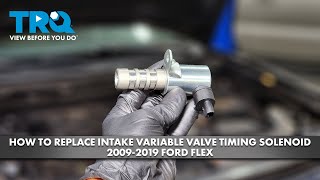
- Test Solenoid Resistance: Using a multimeter, test the resistance of the solenoid. A healthy solenoid should typically read between 5 and 14 ohms. An open circuit or a reading outside this range indicates a failed solenoid. 🎬 Watch: A professional guide to diagnosing and replacing VVT solenoids.
- Advanced Mechanical Checks: If all else fails, the issue may be a faulty cam phaser or a stretched timing chain, which requires more in-depth mechanical diagnosis, likely by a professional. This often involves checking for timing chain rattle on cold starts.
Parts You'll Likely Need
- Engine Variable Valve Timing (VCT) Solenoid
(OEM #AT4Z-6M280-B (also seen as -A or -C, verify with VIN))— This is the most common failure point for code P0014 on this platform, as confirmed by multiple Ford TSBs. It gets stuck from debris in the oil. Note: Part number 7T4Z-6M280-C is also commonly referenced for these engines; fitment should be verified.
Trusted brands: Motorcraft, Dorman, SKP
OEM price range: $60-$90
Aftermarket price range: $30-$60 - Upper Intake Manifold Gaskets
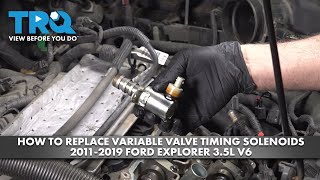
(OEM #Motorcraft: BR3Z-9E936-A, Fel-Pro: MS 96923)— To access the VCT solenoids on Bank 1 (firewall side), the upper intake manifold must be removed. The gaskets are considered a one-time-use part and must be replaced to prevent vacuum leaks upon reassembly. 🎬 See this step-by-step walkthrough for replacing solenoids on the 3.5L V6.
Trusted brands: Fel-Pro, Mahle, Motorcraft
OEM price range: $30-$50
Aftermarket price range: $15-$30
Related Codes That Often Appear With This One
- P0024 — This is the same over-advanced exhaust cam code, but for Bank 2 (radiator side). If P0014 and P0024 appear together, it strongly suggests a systemic problem like low oil pressure or severe oil contamination affecting the entire engine.
- P0011 — This is the code for an over-advanced intake camshaft on the same bank (Bank 1). If you swap the intake and exhaust solenoids for diagnosis and the code changes to P0011, it confirms the original exhaust solenoid was faulty.
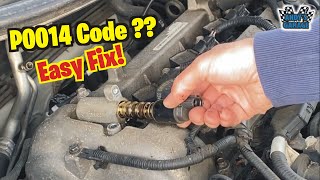
- P054A — Cold Start 'B' Camshaft Position Timing Over-Advanced (Bank 1). This code often appears with P0014 and points more specifically to a problem during the engine's warm-up phase, often related to a sticking VCT solenoid. 🎬 Watch: How to fix a P0014 code on your Ford.
Technical Service Bulletins (TSBs) & Recalls
- SSM 47170: Notes that P0014 and other VCT codes may be caused by small debris making the VCT solenoid stick and advises performing an oil and filter change before repairs. It also recommends using PC/ED pinpoint test HK11 to cycle the solenoid 10 times to clear debris.
- SSM 48423: Supersedes earlier TSBs, reiterating that various VCT DTCs on 2015-2020 models can be caused by debris. It strongly recommends using a scan tool (Pinpoint Test HK11) to cycle the solenoid to attempt to clear it before authorizing replacement.
Platform-Specific Known Issues
- The location of Bank 1 on the transverse 3.5L V6 is on the firewall side, making access to the VCT solenoids and sensors significantly more difficult and labor-intensive than for Bank 2 (radiator side). This requires removal of the upper intake manifold.
- These engines are highly susceptible to internal water pump failure, which contaminates the oil with coolant and can cause VCT system faults. This is a severe issue to be aware of if simple fixes for P0014 do not work.
Mechanic-Grade Diagnostic Values
- VCT Solenoid Internal Resistance — expected: 5 to 14 Ohms. Failure: A reading of 0 Ohms (short circuit) or OL/infinite resistance (open circuit). Some sources cite a tighter range of 6.9-7.9 Ohms.
- VCT Solenoid Connector Voltage (Key On, Engine Off) — expected: Battery Voltage (approx. 12V) on the power supply pin.. Failure: Low or no voltage points to a wiring issue, a bad connection, or a problem with the PCM power supply circuit.
- Scan Tool PID: VCT_EXH_ERR1 (Bank 1 Exhaust Camshaft Position Error) — expected: Should be close to 0 degrees at idle. A difference no greater than +/- 5 degrees is typically allowable.. Failure: A consistent error value outside the +/- 5 degree range for an excessive time indicates a timing deviation that can set the P0014 code.
- Scan Tool PIDs: VCT_EXH_DCR1 vs VCT_EXH_ACT1 — expected: The Desired (DCR) and Actual (ACT) values should track each other closely during engine operation.. Failure: A significant and persistent lag or deviation between the desired and actual values indicates a mechanical or hydraulic issue in the VCT system.
Scan Tool Commands That Help
- Ford IDS / FORScan: Pinpoint Test HK11 / VCT Solenoid Cycle Test — As per Ford TSBs SSM 47170 and SSM 48423, this command cycles the solenoid 10 times to dislodge small debris. It should be performed after an oil change and before replacing the solenoid, as it can sometimes resolve the fault without parts replacement.
- Ford IDS / FORScan / Professional Scan Tool: VCT Solenoid Actuator Test (Bidirectional Control) — To functionally test the solenoid and phaser. While the engine is idling, commanding the exhaust VCT solenoid ON should cause the engine to run rough or stall. If there is no change in engine operation, it confirms a problem with the solenoid (stuck/failed), oil passages (clogged), or the phaser itself.
Wiring & Ground Locations
- G101 — Left front of the engine compartment.. This is a primary engine compartment ground. While not directly for the VCT solenoid, a poor connection here can cause erratic behavior in various engine sensors and modules, including the PCM which controls the VCT system.
- G103 — Located at the left rear of the engine compartment on the cowl, above the brake booster.. This ground point serves the Powertrain Control Module (PCM) and the Data Link Connector (DLC). A fault at G103 can cause incorrect PCM operation, leading to false codes or improper VCT command signals.
- VCT Solenoid Connector (Bank 1) — On the top of the valve cover for the rear cylinder bank (firewall side). Access requires removal of the upper intake manifold.. This is the direct electrical connection for the faulty component. The connector and its wiring are subject to heat and vibration and should be inspected for damage, corrosion, or oil intrusion before the solenoid is replaced.
Real Owner Repair Stories
- Taurus Club of America Forum (2013 Ford Taurus 3.5L) — Check engine light with code P0014, along with P0016 and P0017.
❌ Tried (didn't work) Replacing VCT solenoids., Replacing camshaft position sensors.
✅ What actually fixed it The final repair was a complete timing job, including replacing the timing chains, guides, tensioners, and all four cam phasers. The root cause was determined to be a stretched timing chain.
OEM Part Supersession History
AT4Z-6M280-A / 7T4Z-6M280-C→AT4Z-6M280-B— Revisions to improve durability and resistance to debris and sticking.
Heads up: While multiple part numbers are referenced (AT4Z-6M280-A, -B, -C), they are generally interchangeable for the 3.5L/3.7L Cyclone V6, but it is critical to verify by VIN. The intake and exhaust solenoids are often different parts on other Ford engines, but on the 3.5L NA V6, they are typically the same part.
Model Year Variations Within This Range
- 2013-2015: Ford issued TSB 15-0149 for some 2013-2015 Explorer models with the 3.5L Ti-VCT engine for a rolling/surging or low idle during A/C operation. While for a different model, it shows that PCM calibrations were updated during this period to address idle stability, which can be a symptom related to VCT codes. It is possible a PCM reflash to the latest calibration could improve VCT operation on a Taurus from the same era.
Diagnostic Flowchart
Other Known Issues on This Vehicle
Issues unrelated to this code that are worth knowing about as an owner of this generation:
- Internal Water Pump Failure 🔴 High — A well-documented, critical failure point for the 3.5L/3.7L Cyclone V6 family. Can occur at any mileage but becomes a higher risk after 80,000 miles. Failure allows coolant to mix with engine oil, leading to catastrophic engine damage if not caught early.
- Power Transfer Unit (PTU) Overheating/Failure (AWD Models) 🟠 Medium — Common on AWD models. The PTU is located near the hot exhaust, lacks a drain plug, and holds very little fluid, causing it to overheat and fail. Symptoms include a burning gear oil smell, grinding noises, or a complete loss of AWD.
- Electronic Throttle Body Failure 🟠 Medium — Affects many Ford models from this era, including the Taurus. The throttle body can fail without warning, causing the vehicle to enter 'limp mode' with sudden power loss. This was subject to a Ford Customer Satisfaction Program and multiple TSBs (e.g., 16-0139). (Ref: TSB 16-0139)
Used vs. New Parts: Buying Guide for This Vehicle
When a used part is the smart pick: For this repair, using used parts is generally not recommended. The primary failure components (VCT solenoid, intake gaskets) are inexpensive and are wear items. A used solenoid carries the same risk of being clogged or failing as the part being replaced.
Donor-vehicle mileage cap: roughly under 80000 miles for the part to have meaningful remaining life.
What to inspect on the donor part:
- If considering a used engine component like a cylinder head, look for a donor vehicle with documented regular oil changes.
- Avoid parts from engines that show signs of heavy oil sludge under the oil cap or in the valve cover.
- Check for any signs of coolant contamination (milky residue), which would indicate a failed internal water pump.
OEM-only on this vehicle (don't cheap out):
- Timing Chain Kit (Phasers, Chain, Guides): Due to the critical nature of these parts and the high labor cost to replace them, using high-quality OEM (Motorcraft) or top-tier aftermarket (like Cloyes) is essential. Cheap kits are known to fail prematurely.
Aftermarket brands forum-validated for this vehicle:
- VCT Solenoid: Dorman, SKP
- Intake Gaskets: Fel-Pro, Mahle
Brands owners have reported issues with on this vehicle:
- Unnamed, no-brand VCT solenoids and timing kits from online marketplaces are a significant risk and often fail quickly.
Real Owner Stories
Aggregated from forums and TSBs cited above. Mileages and costs reflect what owners reported in those sources.
2015 Ford Taurus 3.5L V6
Symptoms: Check engine light is on with DTC codes present.
What fixed it: The owner scanned the codes and performed a repair to address the VCT-related issue.
Source hint: owner_reports: FixIT YouTube Channel
2013 Ford Edge 3.5L V6
Symptoms: Sluggish performance and multiple VCT codes including P0012, P0014, P0022, and P0024.
What fixed it: The owner investigated timing codes related to oil quality and VCT solenoid sticking.
Source hint: https://www.fordedgeforum.com/topic/29729-sluggish-new-to-me-2013-edge-code-p0012-p0014-p0022-and-p0024/
2015-2020 Ford Taurus 3.5L V6 — ~85000 miles
Symptoms: VCT system faults and potential oil contamination.
What fixed it: Following SSM 48423, the technician used a scan tool to cycle the solenoid 10 times to clear debris before attempting part replacement.
Source hint: SSM 48423
Related OBD-II Codes
Frequently Asked Questions
I have a 2015 Ford Taurus with P0014; does Ford have a specific service bulletin for this?
Why is the repair for Bank 1 more expensive on my 3.5L Cyclone V6 than Bank 2?
Can a simple oil change really fix a P0014 code on a Ford Taurus?
Could my Taurus's water pump issue be related to the P0014 code?
Is there a way to test if the solenoid is actually bad before I pay to remove the intake manifold?
If I have to replace the Bank 1 exhaust VCT solenoid, are there other parts I should change while the engine is open?
Helpful Videos
We Have This Part in Stock


The information in this article is provided for general reference and educational purposes only. Vehicle specifications, procedures, and part compatibility can vary by production date, trim level, and region. Always consult your vehicle's factory service manual and verify part numbers before purchasing or performing repairs. Safety-critical components such as airbags, seat belts, and braking systems should be installed by a qualified professional.
- Ford Taurus:
- 🧭 Diagnostic Flowchart
- 🎬 Helpful Videos
- 🛍️ Shop This Part
- What's Unique About the 2013-2019 Ford Taurus
- Symptoms You May Notice
- Most Likely Causes
- Rare But Worth Checking
- Diagnosis Steps
- Parts You'll Likely Need
- Related Codes That Often Appear With This One
- Technical Service Bulletins (TSBs) & Recalls
- Platform-Specific Known Issues
- Mechanic-Grade Diagnostic Values
- Scan Tool Commands That Help
- Wiring & Ground Locations
- Real Owner Repair Stories
- OEM Part Supersession History
- Model Year Variations Within This Range
- Other Known Issues on This Vehicle
- Used vs. New Parts: Buying Guide for This Vehicle
- Real Owner Stories
- 2015 Ford Taurus 3.5L V6
- 2013 Ford Edge 3.5L V6
- 2015-2020 Ford Taurus 3.5L V6 — ~85000 miles
- Related OBD-II Codes
- Frequently Asked Questions
- 🎟️ Get 5% Off