

P0014 on 2010-2018 Kia Forte: Exhaust Cam Timing Causes and Fixes
On a 2010-2018 Kia Forte, code P0014 is most often caused by low or dirty engine oil, or a failing exhaust Oil Control Valve (OCV). Always check your oil level first, as these engines can consume oil. If the oil is full and clean, the OCV is the next likely part to replace. A simple test is to swap the exhaust OCV with the intake OCV; if the code changes to P0011, the OCV is bad. An OEM OCV costs around $70-$120.
- Your first step must be to check the engine oil level and condition. Many P0014 codes on these cars are fixed with a simple oil top-off or change.
- If the oil level is fine, the next most likely culprit is a faulty exhaust Oil Control Valve (OCV), which is an affordable and accessible part to replace.
- Do not immediately replace the camshaft position sensor; it is rarely the cause of this code.
- If you have a 2.0L engine and the code appears with P0017, it strongly suggests a more serious internal failure of the CVVT actuator (cam phaser), which requires professional repair.
What's Unique About the 2010-2018 Kia Forte
The Kia Forte engines from this era, particularly the 2.0L Nu and the earlier 2.0L/2.4L Theta II, are known for issues with oil consumption and sludge buildup, which can directly trigger the P0014 code by starving the CVVT system of clean oil. Furthermore, the 2.0L Nu engine has a specific, well-documented failure where a dowel pin on the exhaust CVVT actuator (cam phaser) can break or recede into the camshaft, leading to a more serious timing problem that often presents with both P0014 and P0017 codes. Because of these known issues and related engine settlements, P0014 should be addressed promptly.
Generation note: This range covers two Kia Forte generations: the first (TD, 2010-2013) with 2.0L & 2.4L Theta II engines, and the second (YD, 2014-2018) with 1.6L Gamma, 1.8L Nu, and 2.0L Nu engines. While the primary causes are similar across all engines, the 2.0L Nu engine in the YD generation is particularly known for the CVVT actuator dowel pin failure, often throwing P0014 and P0017 together.
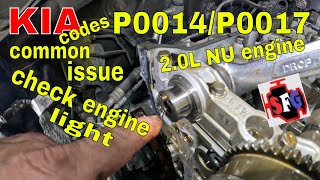
🎬 Watch: A breakdown of the common 2.0L Nu engine failure.Symptoms You May Notice
- Check Engine Light is on
- Rough or unstable idle
- Engine stalling, especially at low speeds
- Reduced engine power and hesitation
- Worse fuel economy
- Rattling noise from the engine, especially on startup
- Replacing the Camshaft Position Sensor (CPS). The CPS reports the cam's position, but P0014 indicates a mechanical problem with the timing *performance*, not an electrical fault with the sensor itself. A bad CPS typically throws a different, sensor-specific code. While some owners replace it, it rarely fixes P0014.
Most Likely Causes
- Low or Dirty Engine Oil 🔴 High Probability Many Kia engines of this period, including the Theta II and Nu, can consume oil between changes or develop sludge if maintenance is deferred. The CVVT system is highly sensitive to oil volume and cleanliness, and owners on forums frequently report that simply topping up very low oil resolved the code.
How to confirm: Check the engine oil dipstick. The oil level should be between the 'F' and 'L' marks. Note the color and consistency; if it's black, thick, or gritty, it's overdue for a change. One owner reported the code appeared when oil didn't even register on the dipstick.
Typical fix: Top off the oil to the correct level or perform a complete oil and filter change using the manufacturer-specified viscosity. An engine flush may be considered if sludge is suspected.
Est. part cost: $30-$70 - Failing Exhaust Oil Control Valve (OCV) 🔴 High Probability → Shop Engine Variable Valve Timing (VVT) Solenoid This solenoid controls oil flow to the cam phaser. It can become clogged with sludge or fail electrically, causing it to get stuck and command an over-advanced position. Many owner experiences confirm replacing a faulty OCV, even after trying cheaper aftermarket parts, with a genuine Hyundai/Kia part ultimately fixed the issue. NHTSA ODI #11704131 describes a case where an owner had to replace the exhaust camshaft position timing VCT solenoid due to an over-advanced Bank 1 condition.
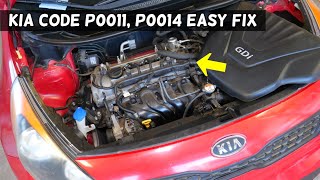
How to confirm: The exhaust OCV is located on the valve cover, typically on the rear side (firewall side) of the engine. You can test its internal resistance with a multimeter (should be around 6.9-7.9 ohms at 68°F). A common DIY test is to swap it with the identical intake OCV; if the code changes to P0011 (intake side), the OCV is bad.
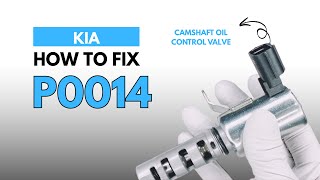
Typical fix: Replace the exhaust Oil Control Valve. It is held in by a single 10mm or T30 Torx bolt and is easily accessible after removing the engine cover. 🎬 See two methods for fixing the P0014 error code.
Est. part cost: $40-$120 - Failing CVVT Actuator (Cam Phaser) 🟡 Medium Probability This is a known and widespread issue on the 2.0L Nu engine, where a dowel pin inside the actuator can shear off, causing a loss of timing control. This is a more severe mechanical failure often diagnosed when P0014 and P0017 appear together. In NHTSA ODI #11532992, a technician retrieved codes P0017 and P0014 and discovered metal shavings inside the engine, necessitating a full engine replacement.
How to confirm: This is difficult to confirm without disassembly. It is often diagnosed when P0014 appears alongside P0017 and replacing the OCV does not fix the issue. A mechanic can remove the valve cover to inspect for the broken pin, which may be lodged in the camshaft.
Typical fix: Requires significant labor. The valve cover and timing components must be accessed. The timing chain, CVVT actuator, and sometimes the camshaft itself must be replaced.
Est. part cost: $150-$400 - Stretched Timing Chain ⚪ Low Probability → Shop Engine Timing Chain Over time, especially with poor oil maintenance or high mileage, the timing chain can stretch. This causes a deviation between the crankshaft and camshaft positions that the computer detects as a fault.
How to confirm: Requires removing the timing cover to physically inspect the chain for slack and verify the timing marks on the sprockets and chain line up correctly. This is typically a job for a professional.
Typical fix: Replace the timing chain, tensioner, and guides. It is often recommended to replace the CVVT sprockets at the same time.
Est. part cost: $200-$500
Rare But Worth Checking
- Clogged OCV Filter Screen: Some engines have a small, thimble-like filter screen in the oil passage leading to the OCV in the cylinder head. If this screen gets clogged with debris, it can restrict oil flow and cause P0014, even with a good OCV. It's worth checking and cleaning during an OCV replacement.
Diagnosis Steps
- Check Engine Oil Level and Condition: This is the first and most critical step. Pull the dipstick. If the oil is low, top it off, clear the code, and drive. If it's dirty, perform an oil and filter change.
- Scan for Other Codes: Check if other codes like P0017 or P0011 are present, as this can help pinpoint the root cause. P0017 + P0014 strongly suggests a mechanical timing issue on Nu engines.
- Inspect OCV Wiring: Check the electrical connector and wiring going to the exhaust OCV for any visible damage, corrosion, or loose connections.
- Swap the OCVs: A simple and effective diagnostic trick is to swap the exhaust OCV with the intake OCV (they are identical and located next to each other on the valve cover). Clear the codes and drive. If the code returns as P0011 (intake side), you have confirmed the OCV is faulty.
- Test the Exhaust Oil Control Valve (OCV): Unplug the OCV and measure its resistance with a multimeter. A reading between 6.9 and 7.9 ohms is expected. You can also briefly apply a 12V source to the terminals to listen for a 'click', indicating the solenoid is actuating. 🎬 Watch: How to replace the part causing P0014 or P0017.
- Advanced Diagnostics: If the above steps do not resolve the issue, the problem is likely more severe (CVVT actuator or timing chain). This requires professional diagnosis, involving removal of the valve and timing covers to inspect mechanical components for issues like a sheared dowel pin or stretched chain.
Parts You'll Likely Need
- Exhaust Oil Control Valve (VVT Solenoid)
(OEM #24375-2E100)— This is the most common part to fail after ruling out oil issues. It gets clogged or fails electrically, causing incorrect oil flow to the cam phaser. Owners report that using a genuine OEM part is crucial, as aftermarket versions sometimes fail to resolve the code.
Trusted brands: Kia (OEM), Hyundai (OEM), Dorman
OEM price range: $70-$120
Aftermarket price range: $40-$80 - CVVT Camshaft Sprocket (Actuator)
(OEM #24370-2E010)— This part is known to fail on the 2.0L Nu engine, where an internal pin breaks, causing the timing to be over-advanced. This is a major repair and is often the cause when P0014 is paired with P0017.
Trusted brands: Kia (OEM), Hyundai (OEM)
OEM price range: $120-$200
Aftermarket price range: $80-$150
Related Codes That Often Appear With This One
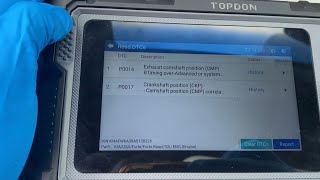
- P0017 — Crankshaft Position - Camshaft Position Correlation (Bank 1, Exhaust). This code often appears with P0014 on the 2.0L Nu engine when the CVVT actuator dowel pin has failed, indicating a serious mechanical timing discrepancy.
- P0011 — Intake 'A' Camshaft Position - Timing Over-Advanced. If both P0011 and P0014 are present, it points to a systemic issue affecting both camshafts, such as extremely low/dirty oil or sludge.
- P1326 — Knock Sensor Detection System (KSDS). This code can be triggered by the engine vibrations or knocking caused by the timing issue from P0014. The KSDS software update made the system very sensitive, and it's common to see these codes together.
- P0300 — Random or Multiple Cylinder Misfire Detected. NHTSA ODI #11551662 reports a vehicle experiencing engine issues with both P0014 and P0300 codes present.
Technical Service Bulletins (TSBs) & Recalls
- PS461 Rev 1 (September 13, 2016): For the 2017 Forte (YDm) with the 2.0L Nu MPI engine, this bulletin describes a diagnostic and relearn procedure using a Kia scanner (KDS) when DTC P0014 is found. It involves revving the engine to 4000 RPM and comparing commanded vs. actual cam angles, which should be less than 5 degrees apart.
- Bulletin #PS461R1 (September 13, 2016): This Pitstop bulletin provides guidance for technicians when encountering a customer concern of a Malfunction Indicator Light (MIL) with DTC P0014 (Exhaust Camshaft Position Timing Over-Advanced or System Performance).
Platform-Specific Known Issues
- On 2014-2018 models with the 2.0L Nu engine, P0014 is a strong indicator of a potential CVVT actuator failure, often accompanied by code P0017. A Reddit user with a 2020 Forte confirmed this exact failure mode: the dowel pin was broken, and replacing the sprocket and removing the pin from the cam resolved the P0017 code.
Mechanic-Grade Diagnostic Values
- Oil Control Valve (OCV) / VVT Solenoid Resistance — expected: 6.9 - 7.9 Ohms at 68°F (20°C). Failure: A reading outside this range, or an open/short circuit, indicates a faulty solenoid coil.
- Live Data: Exhaust Camshaft Position vs. Control Setpoint — expected: The difference between the 'Current Position of Exhaust Camshaft' and 'Control Camshaft Position Setpoint' should be less than 5 degrees.. Failure: A difference greater than 5 degrees while revving the engine from idle to 4000 RPM indicates a problem in the CVVT system.
Scan Tool Commands That Help
- Kia Diagnostic System (KDS): CVVT Relearn Procedure / Data Analysis — After clearing codes or replacing a component, a technician can use this function to verify the repair. By graphing the current and target cam angles while revving the engine to 4000 RPM, they can confirm the deviation is less than 5 degrees. If the deviation is larger, the TSB suggests holding the RPM at the point of failure to attempt a relearn.
Wiring & Ground Locations
- OCV Connector — The exhaust OCV is on the valve cover, toward the firewall. It is held by a T30 Torx bolt. The connector is a simple two-wire plug.. A damaged connector or wiring at this point can mimic a failed OCV. The connector can become brittle from heat cycles.
- Engine Ground Wire (YD Generation) — Part number 91860-A7140 is the engine ground wiring assembly for the 2014-2018 Forte. Key grounding points are on the cylinder head and engine block.. While not a primary cause, a poor engine ground can create a host of electrical issues and phantom codes. Ensuring the main engine-to-chassis ground is clean and tight is a best practice during any electrical diagnosis.
- Engine Ground Wire (TD Generation) — Part number 91860-1M120 is the ground cable for the 2010-2013 Forte 2.0L with a manual transmission.. Similar to the YD generation, a solid ground is crucial for stable sensor readings and actuator performance. A corroded or loose ground can cause unpredictable behavior in the engine control system.
Real Owner Repair Stories
- YouTube user 'Fix It All' (2018 Kia Forte, 2.0L, 112,000 miles) — Car would stall out suddenly while driving. Codes P0011 and P0014 were present.
❌ Tried (didn't work) Owner had previously replaced the VVT solenoids (OCVs) with aftermarket parts from eBay/Rock Auto., A shop replaced the entire timing chain set, but the problem remained exactly the same.
✅ What actually fixed it Replacing the aftermarket VVT solenoids with genuine OEM Kia parts. After replacement, the live scan tool data showed the current and control camshaft positions were perfectly in sync, resolving the stalling and clearing the codes. - Reddit user on r/MechanicAdvice (2016 Kia Sportage, 2.4L (similar Theta II architecture)) — P0014 code, engine rattles above 2,000 RPM, sputters under load, flashing check engine light.
❌ Tried (didn't work) Replacing the camshaft position sensor., Cleaning and testing the existing exhaust VVT solenoid (it tested good for resistance and actuation).
✅ What actually fixed it The user discovered the engine oil level was so low it didn't register on the dipstick. Adding almost 4 quarts of oil was the initial critical step, highlighting the extreme oil consumption issue that can directly cause this code by starving the VVT system. The thread implies this was the root cause of the VVT performance issue. - NHTSA ODI #11551662 — An owner reported experiencing engine issues and a check engine light with codes P0014 and P0300, noting that the manufacturer refused to look up possible recalls for the vehicle.
OEM Part Supersession History
27300-2E000→27300-2E601— This is a common supersession for the ignition coil on the 2.0L Nu engine, likely for reliability improvements. While not directly for P0014, it's relevant as timing issues can sometimes be misdiagnosed or accompanied by misfires.
Heads up: The newer part 27300-2E601 is the correct replacement for 2017-2020 Forte 2.0L models.
Model Year Variations Within This Range
- 2017-2018 (YD Generation): The 2.0L Nu MPI engine was primary. A Kia TSB specifically addresses a relearn procedure for P0014 on the 2017 model, indicating a known software/diagnostic path for this engine version.
- 2010-2013 (TD Generation): These models used the 2.0L and 2.4L Theta II engines. While the causes of P0014 are similar (oil, OCV), they are more known for general oil consumption and sludge issues rather than the specific CVVT dowel pin failure seen in the later Nu engines.
Diagnostic Flowchart
Other Known Issues on This Vehicle
Issues unrelated to this code that are worth knowing about as an owner of this generation:
- MDPS Steering Coupler Failure 🟠 Medium — Very common across many 2010-2017 Hyundai/Kia models. A clicking or knocking noise is heard from the steering column when turning the wheel. The flexible rubber coupler disintegrates over time. (Ref: TSB CHA074 describes the replacement procedure.)
- Engine Fire Risk (HECU & Engine Bay) 🔴 High — Affects a wide range of model years. Multiple recalls have been issued for different causes, including electrical shorts in the Hydraulic Electronic Control Unit (HECU) and fuel/oil leaks. (Ref: Recalls SC165, SC200, SC284. Owners are often advised to park outside and away from structures.)
- Theta II & Nu Engine Failure 🔴 High — Widespread enough to trigger multiple class-action lawsuits. Issues include excessive oil consumption, connecting rod bearing failure, and other catastrophic internal failures. (Ref: Multiple class-action settlements (e.g., In re: Kia Engine Litigation) have resulted in lifetime warranties and reimbursement for certain repairs for affected VINs.)
- Airbag Control Unit (ACU) Malfunction 🔴 High — Subject to a recall on 2010-2013 models. A short circuit in the ACU could prevent frontal airbags and seatbelt pretensioners from deploying in a crash. (Ref: Recall SC165.)
Used vs. New Parts: Buying Guide for This Vehicle
When a used part is the smart pick: For this repair, used parts are generally not recommended. The key components (OCV, CVVT actuator) are wear items sensitive to oil quality and internal contamination. A used part from a junkyard carries an unknown history and a high risk of being clogged or failing shortly after installation.
Donor-vehicle mileage cap: roughly under 50000 miles for the part to have meaningful remaining life.
What to inspect on the donor part:
- If considering a used part is unavoidable, pull the valve cover on the donor engine to check for sludge. Any sign of dark, thick sludge means the entire engine's oil-sensitive parts should be avoided.
- Ask for the vehicle's maintenance history if possible, specifically oil change intervals.
OEM-only on this vehicle (don't cheap out):
- Oil Control Valve (VVT Solenoid)
- CVVT Camshaft Sprocket (Actuator)
Aftermarket brands forum-validated for this vehicle:
- While OEM is strongly preferred, some professional technicians may have success with top-tier brands like Standard Motor Products (SMP) if OEM is unavailable.
Brands owners have reported issues with on this vehicle:
- Unbranded or generic 'white box' parts from online marketplaces like eBay or Amazon. Multiple owner accounts confirm these parts often do not work out of the box or fail quickly, leading to a repeat of the P0014 code.
Real Owner Stories
Aggregated from forums and TSBs cited above. Mileages and costs reflect what owners reported in those sources.
2020 Kia Forte 2.0L Nu
Symptoms: Persistent P0014 and P0017 codes.
What fixed it: Replacing the CVVT sprocket and removing a broken dowel pin that had become lodged in the camshaft.
Source hint: Reddit - r/kia - (HELP) persistent P0014 Kia Forte 2.0
2014-2018 Kia Forte 2.0L Nu
Symptoms: P0014 and P0017 codes appearing together, indicating a common mechanical issue.
What fixed it: Replacement of the CVVT actuator (cam phaser) due to a sheared dowel pin.
Source hint: YouTube - Shop Foreman Garage - KIA 2.0L NU Engine Codes P0014/P0017 Common Issue
2010-2013 Kia Forte Koup 2.4L Theta II
Symptoms: Frustrating experience with P0014 persisting even after replacing multiple parts.
What fixed it: The source highlights the complexity of the issue on the 2.4L engine, often requiring deep mechanical inspection beyond simple sensor swaps.
Source hint: Reddit - r/MechanicAdvice - Need some help with p0014
Related OBD-II Codes
Frequently Asked Questions
Is there a specific TSB for the 2017 Kia Forte with the 2.0L engine regarding P0014?
Can I use aftermarket Oil Control Valves (OCV) to fix P0014 on my Kia?
I have a 2.0L Nu engine; why is P0014 often paired with P0017?
How can I tell if my P0014 code is just caused by low oil?
Is there a simple DIY test to see if the exhaust OCV is the problem?
What are the resistance specifications for the OCV on a Kia Forte?
Helpful Videos
![How to Fix KIA P0014 Engine Code in 4 Minutes [1 DIY Method / Only $19.45]](https://img.youtube.com/vi/jvnWIsewzes/mqdefault.jpg)
We Have This Part in Stock


The information in this article is provided for general reference and educational purposes only. Vehicle specifications, procedures, and part compatibility can vary by production date, trim level, and region. Always consult your vehicle's factory service manual and verify part numbers before purchasing or performing repairs. Safety-critical components such as airbags, seat belts, and braking systems should be installed by a qualified professional.
- Kia Forte:
- 🧭 Diagnostic Flowchart
- 🎬 Helpful Videos
- 🛍️ Shop This Part
- What's Unique About the 2010-2018 Kia Forte
- Symptoms You May Notice
- Most Likely Causes
- Rare But Worth Checking
- Diagnosis Steps
- Parts You'll Likely Need
- Related Codes That Often Appear With This One
- Technical Service Bulletins (TSBs) & Recalls
- Platform-Specific Known Issues
- Mechanic-Grade Diagnostic Values
- Scan Tool Commands That Help
- Wiring & Ground Locations
- Real Owner Repair Stories
- OEM Part Supersession History
- Model Year Variations Within This Range
- Other Known Issues on This Vehicle
- Used vs. New Parts: Buying Guide for This Vehicle
- Real Owner Stories
- 2020 Kia Forte 2.0L Nu
- 2014-2018 Kia Forte 2.0L Nu
- 2010-2013 Kia Forte Koup 2.4L Theta II
- Related OBD-II Codes
- Frequently Asked Questions
- 🎟️ Get 5% Off