

P0015 on 2015-2019 Ford Taurus: Causes and Fixes for Over-Retarded Cam Timing
On a 2015-2019 Ford Taurus with the 3.5L V6, code P0015 is most often caused by a dirty or failed exhaust VCT solenoid on Bank 1. This is frequently due to old oil or debris. The first step is always an oil and filter change, followed by replacing the VCT solenoid, which costs around $40-$90 for the part. Accessing this specific solenoid requires removing the upper intake manifold.
- Always check your engine oil level and condition first; low or dirty oil is the leading cause of P0015 on this engine.
- The most likely failed part is the Bank 1 exhaust VCT solenoid, which gets stuck from oil debris.
- Bank 1 is the cylinder bank against the firewall, which requires removing the upper intake manifold to access the solenoid, significantly increasing repair complexity and labor time.
- Do not replace the camshaft position sensor first; it is rarely the cause of the problem.
- Consider swapping the suspect solenoid with the one on Bank 2 to confirm the failure before committing to the difficult replacement on Bank 1.
What's Unique About the 2015-2019 Ford TAURUS
The Ford 3.5L V6 engine (also known as the Cyclone engine), common in the Taurus, uses a Variable Camshaft Timing (VCT) system that is known to be sensitive to oil condition and cleanliness. Ford has issued multiple Technical Service Bulletins (TSBs), such as SSM 47170 and SSM 48423, which state that small debris in the engine oil can cause the VCT solenoids to stick, leading directly to code P0015. TSB SSM 47170 specifically advises technicians to use a scan tool to cycle the solenoid 10 times to attempt to clear debris 🎬 Watch: How to cycle and test the solenoid first before replacement. This makes oil maintenance and the health of the VCT solenoid the primary focus for this code on this specific vehicle.
Diagnostic Flowchart
Tap your situation to follow the diagnostic path that matches what you're seeing on this vehicle.
Symptoms You May Notice
- Check Engine Light is on
- Rough or shaky idle, sometimes fluctuating RPMs when coming to a stop
- Reduced engine power and poor, sluggish acceleration
- Decreased fuel economy
- Engine may hesitate or stall, especially at low speeds or when stopping
- Rattling or knocking noise from the engine, particularly on cold starts, which can indicate a more serious timing chain or phaser issue
- Replacing the camshaft position sensor. The sensor is usually doing its job correctly by reporting the timing error. The problem is typically with the mechanical or hydraulic parts that control the timing (oil, solenoid, phaser), not the sensor itself.
Most Likely Causes
- Dirty, Low, or Incorrect Viscosity Engine Oil 🔴 High Probability The VCT system is hydraulically operated and highly sensitive to oil pressure and cleanliness. Ford TSBs directly link oil debris to VCT solenoid failure, as sludge can clog the fine mesh screens on the solenoids.
How to confirm: Check the oil dipstick for level and observe the color and consistency of the oil. If it is dark, gritty, below the 'add' line, or smells of coolant (indicating a potential water pump failure on this engine), it needs immediate attention.
Typical fix: Perform an engine oil and filter change using the manufacturer-specified oil viscosity (SAE 5W-20 for the 3.5L V6). Consider using an engine flush product if sludge is suspected.
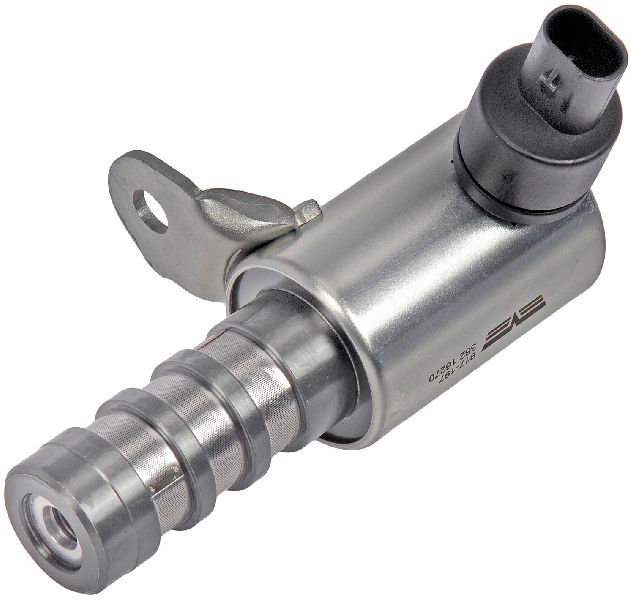
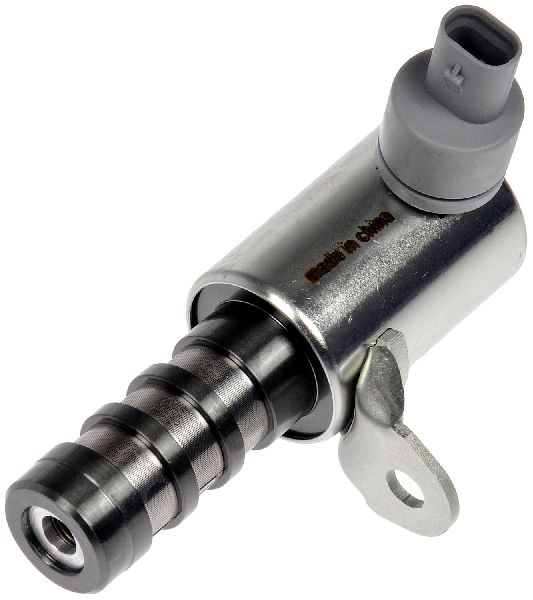
Est. part cost: $40-$80 - Faulty Exhaust VCT Solenoid (Bank 1) 🔴 High Probability → Shop Engine Variable Valve Timing (VVT) Solenoid As stated in Ford TSBs SSM 47170 and SSM 48423, these solenoids are prone to sticking due to small debris in the oil. They are the most common point of failure for this code.
How to confirm: After an oil change, if the code persists, swap the Bank 1 exhaust VCT solenoid with the Bank 2 exhaust VCT solenoid (front bank). If the code changes to P0025 (the equivalent code for Bank 2), the solenoid is confirmed to be faulty. Alternatively, test resistance with a multimeter (should be 5-14 ohms) or apply 12V to see if it actuates.
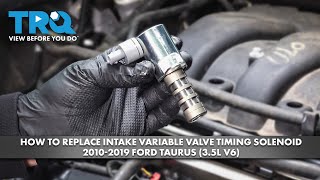
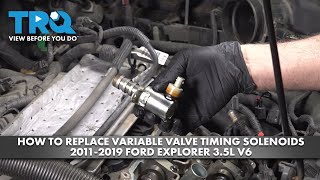
Typical fix: Replace the Bank 1 exhaust VCT solenoid. On the 3.5L V6, the Bank 1 solenoids are on the firewall side and require removing the upper intake manifold 🎬 See this walkthrough for removing the intake and solenoid and the valve cover for access, making it a more involved job. It is recommended to replace the valve cover gasket and spark plug tube seals at the same time.
Est. part cost: $40-$90 - Failed Camshaft Phaser ⚪ Low Probability → Shop Engine Camshaft While less common than a solenoid failure, the phaser itself can get clogged with sludge or fail mechanically, preventing it from adjusting cam timing correctly. This is usually a higher-mileage failure or a consequence of poor oil maintenance.
How to confirm: This is typically diagnosed after ruling out the oil and VCT solenoid. It may require more advanced diagnostics, including monitoring camshaft deviation with a scan tool or physical inspection of timing components, which is best left to a professional.
Typical fix: Replace the camshaft phaser, which is a labor-intensive job that also requires replacing the timing chain, guides, and tensioners. The internal water pump should also be replaced at this time.
Est. part cost: $200-$400
Rare But Worth Checking
- Stretched Timing Chain: → Shop Engine Timing Chain On higher-mileage 3.5L engines, the timing chain can stretch, which will cause correlation codes like P0015 and P0017 to appear. This is often accompanied by a rattling noise on startup and may be indicated by a fully extended timing chain tensioner. 🎬 Watch: How to diagnose a potentially stretched timing chain
- Wiring Harness Issue: Damage to the wiring or connector for the VCT solenoid or camshaft position sensor can cause an open or short, triggering the code. A visual inspection for oil contamination, loose connections, or frayed wires is warranted.
- Internal Water Pump Failure: A unique failure point on the Ford 3.5L V6 is the internal, timing-chain-driven water pump. If its seal fails, it leaks coolant directly into the engine oil. This contaminated oil quickly destroys VCT components and the entire timing system, leading to codes like P0015. Oil with a 'chocolate milk' appearance is a key symptom.
Diagnosis Steps
- Check the engine oil level and condition. If it is low, dirty, or appears contaminated with coolant, perform an oil and filter change with the correct 5W-20 viscosity oil and clear the code.
- If the code returns, scan for any other related trouble codes to see if the issue is isolated or systemic.
- Inspect the wiring and connector for the Bank 1 exhaust VCT solenoid for any signs of damage, corrosion, or oil saturation.
- Using a capable scan tool, command the Bank 1 exhaust VCT solenoid on and off (per TSB SSM 47170, this is part of pinpoint test HK11). Listen for a clicking sound from the solenoid and monitor cam position data for a response.
- A common DIY diagnostic step is to swap the Bank 1 exhaust VCT solenoid with the Bank 2 exhaust solenoid (on the front/radiator side). Clear the codes and drive the vehicle. If the code returns as P0025 (Bank 2 exhaust over-retarded), the solenoid is faulty and needs replacement.
- If the code P0015 returns after the swap, the problem is not the solenoid. Further diagnosis of the camshaft phaser, timing chain, and tensioners is required, which likely necessitates professional service.
Parts You'll Likely Need
- Engine Variable Valve Timing (VCT) Solenoid
(OEM #7T4Z-6M280-C)— This is the most common point of failure for code P0015 on this platform, often due to sticking from oil debris as noted in Ford TSBs. This part number has superseded previous versions 7T4Z-6M280-A, 7T4Z-6M280-AA, and 7T4Z-6M280-B.
Trusted brands: Motorcraft (OEM), Dorman, TRQ
OEM price range: $70-$90
Aftermarket price range: $30-$60 - Upper Intake Manifold Gasket Set
(OEM #Varies by year, e.g., Motorcraft CG803)— Required for replacing the Bank 1 (rear) VCT solenoid, as the upper intake manifold must be removed for access.
Trusted brands: Motorcraft, Fel-Pro
OEM price range: $25-$40
Aftermarket price range: $15-$30
Related Codes That Often Appear With This One
- P0017 — This code indicates a 'Crankshaft Position - Camshaft Position Correlation' error for the same bank and camshaft. It often appears with P0015 because the over-retarded state creates a direct mismatch with the crankshaft's position, strengthening the possibility of a base timing issue like a stretched chain.
- P0011 / P0012 — These codes relate to the intake ('A') camshaft on the same bank (Bank 1). If they appear with P0015, it strongly suggests a systemic problem like low/dirty oil or low oil pressure affecting the entire VCT system on that bank.
- P0025 — This is the identical 'over-retarded' code but for Bank 2 (front bank). If P0015 and P0025 appear together, it strongly points to a global issue like severe oil contamination, low oil pressure, or sludge affecting the entire engine.
Technical Service Bulletins (TSBs) & Recalls
- SSM 54366: 2015-2021 Ford/Lincoln vehicles may exhibit various VCT DTCs including P0015, requiring pinpoint tests.
- SSM 47170: Some vehicles may exhibit P0015 due to small debris causing the VCT solenoid to stick. Recommends cycling the solenoid to attempt to clear it before replacement. []
Platform-Specific Known Issues
- TSB SSM 48423 and SSM 47170: Ford notes that for some 2015-2020 vehicles, DTCs like P0015 may be caused by small debris making the VCT solenoid stick. It is recommended to perform diagnostics, specifically cycling the solenoid with a scan tool (Pinpoint Test HK11), before simply replacing the part.
- TSB 16-0093: For some low-mileage 2016 models, this TSB directly recommends replacing the exhaust VCT solenoid if P0015 is paired with P0017.
- Access to Bank 1 Solenoids: A major vehicle-specific issue is the labor involved. The Bank 1 (rear) solenoids are located under the valve cover, which itself is underneath the upper intake manifold. This makes replacement significantly more difficult and time-consuming than for Bank 2 (front).
Mechanic-Grade Diagnostic Values
- VCT Solenoid Coil Resistance — expected: 5-15 Ohms. More specifically, 6.9-7.9 Ohms is often cited as the target.. Failure: An open circuit (infinite resistance) or a direct short (near-zero resistance) indicates a failed solenoid coil.
- VCT Solenoid Connector Voltage (Key On, Engine Off) — expected: ~12 Volts (Battery Voltage) on the power supply pin.. Failure: Little to no voltage suggests a problem in the power supply wire or the related fuse (e.g., F16 in the Battery Junction Box).
- Scan Tool PID: VCT Advance Error (VCT_ADVERR or CAMERRR) — expected: Should hover close to 0 degrees at warm idle.. Failure: A consistent deviation of more than +/- 5 degrees for an extended period indicates the phaser is not reaching its commanded position.
- Scan Tool PID: VCT Solenoid Duty Cycle (VCTDC) — expected: The PCM will vary the duty cycle to control oil flow. At idle, it should be stable. When comparing banks, the duty cycle should be similar.. Failure: If the PCM commands a high duty cycle on the faulting bank with no corresponding change in cam angle, it points to a hydraulic or mechanical issue (stuck solenoid, bad phaser).
- Hot Idle Oil Pressure (measured with mechanical gauge) — expected: Should be a minimum of 15 psi at normal operating temperature.. Failure: Pressure below 15 psi at hot idle can cause the VCT system to malfunction, as it is hydraulically operated.
Hidden / Shadow Codes Worth Checking
- Mode $06, Test ID $53 (Misfire Monitor): While not a direct code for P0015, Mode $06 provides raw data from the PCM's non-continuous monitors before a full-blown DTC is set. Test ID $53 shows misfire counts per cylinder. A technician can use this to see if the timing issue from P0015 is causing a subtle misfire on Bank 1 cylinders that hasn't yet triggered a P030x code. (see via Requires a scan tool that can access Global OBD-II Mode $06 data. This is available on many professional and high-end DIY scanners.)
Scan Tool Commands That Help
- Ford IDS, FORScan, or equivalent professional scanner: VCT Solenoid On/Off State Control or Output Test Mode (OTM) — This bidirectional command is used to manually activate and deactivate the VCT solenoid while the engine is running at idle. A healthy solenoid will produce an audible click and cause a noticeable change in engine idle quality or even stall the engine. If commanding the solenoid on/off produces no change, it confirms a problem with the solenoid, its wiring, or oil flow. This is the test (Pinpoint Test HK11) recommended by Ford in TSBs.
Wiring & Ground Locations
- Bank 1 VCT Solenoid Connector — On the top of the rear valve cover (firewall side). The connector is accessible, but the solenoid itself is under the valve cover.. This is the primary electrical test point. The harness has two wires: one for ~12V power and one for the PCM-controlled ground signal. Check here for voltage, ground signal (with a scope), and for any signs of oil contamination or corrosion.
- G105 — A key ground point located at the right, center, rear of the engine compartment.. Service diagrams identify this as a critical ground for various engine control components. A poor connection here can cause erratic sensor readings and PCM behavior.
- Main Engine-to-Chassis Ground — Typically a braided strap from the engine block or transmission case to the vehicle's chassis/firewall, often below the brake booster.. A corroded or loose main ground can cause a host of electrical gremlins, including incorrect sensor readings that could contribute to timing codes. This should be inspected for integrity.
- PCM Connector C175B — One of the main multi-pin connectors at the Powertrain Control Module (PCM), typically located in the engine bay near the firewall.. This connector contains the signal pins from the camshaft and crankshaft position sensors. A poor pin fit, corrosion, or water intrusion at this specific connector can interrupt the critical timing signals the PCM needs, leading to codes like P0015 or P0016.
Real Owner Repair Stories
- Ford F150 Forum (2013 Ford F-150 3.5L EcoBoost (same engine family)) — Started as a no-crank/no-start issue. After cleaning grounds, it would start but ran very rough with a loud knock/rattle and would stall. Code P0015 was present.
❌ Tried (didn't work) Initial diagnosis focused on starter and battery cables due to the no-crank symptom.
✅ What actually fixed it The combination of P0015, severe rattle, and stalling pointed to a mechanical timing failure. The resolution was a complete timing component replacement, including the timing chain and cam phasers, using Ford's service kit (BL3Z-6D256-C). The initial no-crank may have been an early symptom of the timing being so far off that the engine couldn't turn over properly.
OEM Part Supersession History
7T4Z-6M280-A, 7T4Z-6M280-AA, 7T4Z-6M280-B→7T4Z-6M280-C— Standard part evolution for improved durability, material composition, or manufacturing process. The new part is the official service replacement.
Heads up: The older part numbers are obsolete. 7T4Z-6M280-C is the correct and compatible replacement for all 3.5L and 3.7L applications that used the previous versions.
Model Year Variations Within This Range
- 2015-2019: No significant variations have been noted for the 3.5L V6 engine's VCT system within this specific model year range for the Ford Taurus that would alter the diagnosis or common causes of code P0015. The primary known issues, such as VCT solenoid sensitivity and the internal water pump, are consistent across these years.
Helpful Videos

We Have This Part in Stock


The information in this article is provided for general reference and educational purposes only. Vehicle specifications, procedures, and part compatibility can vary by production date, trim level, and region. Always consult your vehicle's factory service manual and verify part numbers before purchasing or performing repairs. Safety-critical components such as airbags, seat belts, and braking systems should be installed by a qualified professional.
- Ford TAURUS:
- 🧭 Diagnostic Flowchart
- 🎬 Helpful Videos
- 🛍️ Shop This Part
- What's Unique About the 2015-2019 Ford TAURUS
- Symptoms You May Notice
- Most Likely Causes
- Rare But Worth Checking
- Diagnosis Steps
- Parts You'll Likely Need
- Related Codes That Often Appear With This One
- Technical Service Bulletins (TSBs) & Recalls
- Platform-Specific Known Issues
- Mechanic-Grade Diagnostic Values
- Hidden / Shadow Codes Worth Checking
- Scan Tool Commands That Help
- Wiring & Ground Locations
- Real Owner Repair Stories
- OEM Part Supersession History
- Model Year Variations Within This Range
- 🎟️ Get 5% Off