

P0016 on 2017-2023 Chrysler Pacifica Hybrid: Cam/Crank Correlation Causes and Fixes
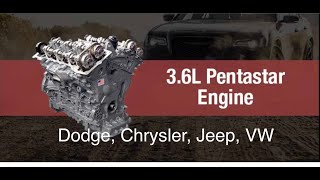
P0016 on a Pacifica Hybrid almost always indicates a mechanical timing issue with the 3.6L Pentastar engine, not a simple sensor failure. The most likely cause is a stretched timing chain, a well-documented issue for this engine family. Always check the engine oil level and condition first, but expect a potentially expensive repair that can cost between $1,800 and $3,000.
- P0016 on your Pacifica Hybrid is a serious code that points to a mechanical timing problem.
- Your first and easiest check should be the engine oil level and condition. An oil change might solve the problem if you're lucky.
- Do not replace the camshaft or crankshaft sensors unless they have been specifically tested and proven to be faulty; this is a common misdiagnosis.
- The most likely cause is a stretched timing chain, which is a significant and costly repair requiring a professional.
- If a mechanic is inspecting the timing chain, ask them to also check for the known issue of loose oil galley bolts under the valve cover.
What's Unique About the 2017-2023 Chrysler Pacifica Hybrid
The 3.6L Pentastar V6, while widely used, has a known susceptibility to timing chain stretch, which is a primary cause of P0016, often occurring between 80,000 and 120,000 miles. Another specific issue with this engine is the potential for oil galley bolts inside the cylinder head to loosen over time, causing a loss of oil pressure to the cam phasers and triggering this code. Unlike many other vehicles where a P0016 might point to a bad sensor, on the Pacifica Hybrid, it's more often a sign of a deeper mechanical or oil pressure-related problem that requires significant diagnosis.
Symptoms You May Notice
- Check Engine Light is on
- Engine runs rough or has a noticeable rattle, especially at startup
- Poor acceleration or reduced engine power, sometimes referred to as 'limp mode'
- Engine may crank but fail to start
- Stalling at idle or low speeds
- Worse than usual fuel economy
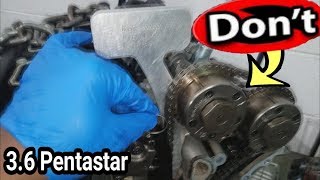
- Traction control light may illuminate alongside the check engine light 🎬 See why the traction control light triggers with this code.
- Replacing the camshaft position sensor without testing it. The sensor is often just reporting the mechanical timing fault, it is not the cause of it.
- Replacing the crankshaft position sensor without proper diagnosis. This is also rarely the root cause of a P0016 code.
- Assuming a timing chain failure without first checking oil level/condition and testing the VVT solenoids.
Most Likely Causes
- Low, dirty, or incorrect viscosity engine oil 🔴 High Probability The Pentastar's Variable Valve Timing (VVT) system is highly dependent on oil pressure and cleanliness to function. Incorrect oil (e.g., not using the specified 5W-20) can prevent the cam phasers from adjusting correctly.
How to confirm: Check the oil dipstick for level and inspect the oil for a dark, sludgy consistency. This should always be the first step before any tear-down.
Typical fix: Perform an oil and filter change using the manufacturer-specified oil viscosity (e.g., SAE 5W-20).
Est. part cost: $40-$80 - Stretched timing chain 🔴 High Probability → Shop Engine Timing Chain The 3.6L Pentastar engine is widely known to experience timing chain stretch over its lifespan, particularly after 80,000 miles. This is a very common cause for P0016.
How to confirm: A professional diagnosis is required. A mechanic can use a scan tool to view live cam/crank deviation data; a deviation of more than 8-10 degrees is a strong indicator. Visual inspection after removing the valve cover can reveal a fully extended tensioner piston or visible chain slack.
Typical fix: Replace the timing chains (primary and both secondary), guides, and tensioners. It is also wise to replace the water pump during this service as it is driven by the timing chain. 🎬 Watch this step-by-step timing chain and water pump replacement.
Est. part cost: $200-$600 - Failed VVT Solenoid (Oil Control Valve) 🟡 Medium Probability
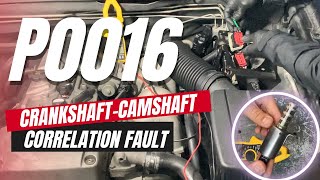
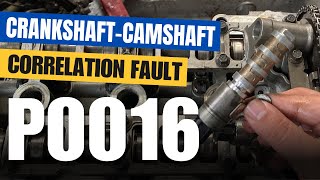
How to confirm: A mechanic can test the solenoid's operation by applying voltage or using a scan tool to command it on and off while monitoring engine parameters. Sometimes the internal screen on the solenoid fails.
Typical fix: Replace the faulty VVT solenoid for Bank 1. It is recommended to use OEM Mopar parts to avoid compatibility issues.
Est. part cost: $50-$150 - Failed Camshaft Phaser 🟡 Medium Probability → Shop Engine Camshaft
How to confirm: Diagnosis is complex and usually follows the elimination of other causes. It may involve inspecting the phaser for damage or sticking during a timing chain service. A scan tool may show slow phaser response.
Typical fix: Replace the camshaft phaser for the Bank 1 intake camshaft. This is typically done during a timing chain replacement.
Est. part cost: $100-$250
Rare But Worth Checking
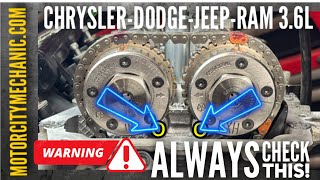
- Loose oil galley bolts: A known issue on the 3.6L Pentastar engine where two bolts under the valve cover can back out, causing a loss of oil pressure to the phasers on that head. This should be inspected any time the valve cover is removed for diagnosis and can be tightened with a 13mm wrench. 🎬 Watch: How to find and tighten loose oil galley bolts.
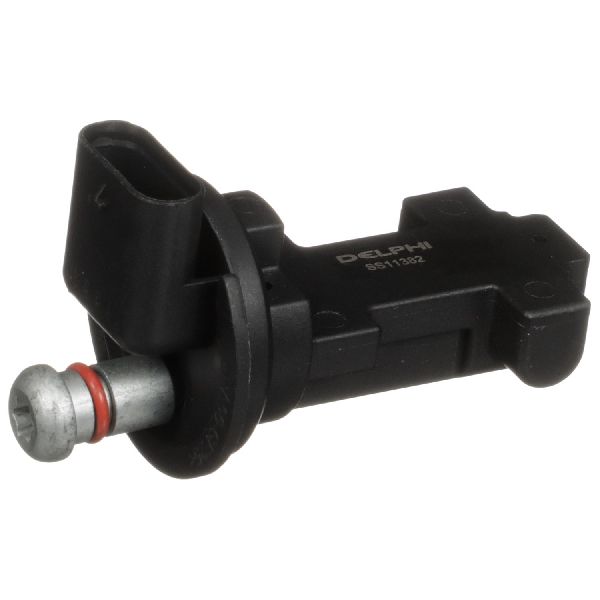
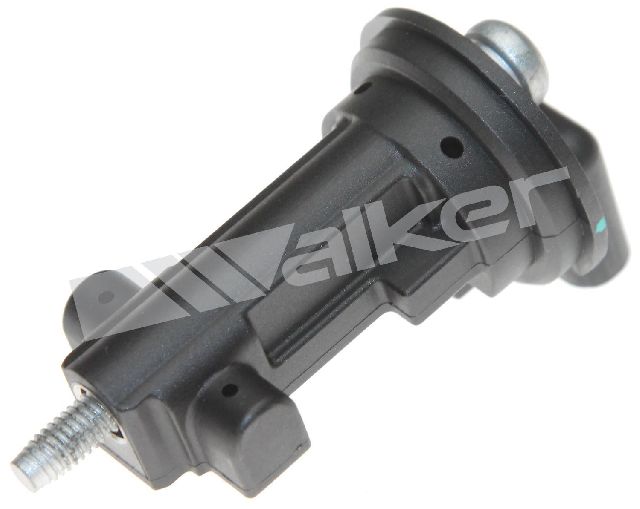
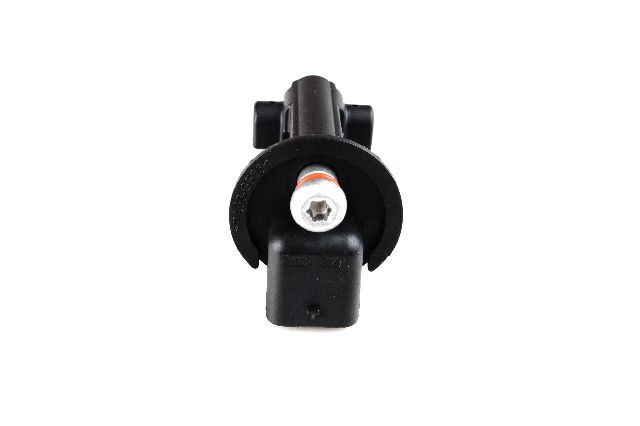
- Failed Crankshaft or Camshaft Position Sensor: → Shop Engine Camshaft Position Sensor While often mistakenly replaced first, the sensors themselves can fail. However, this is less common than mechanical or oil-related issues. A sensor should only be replaced after it has been tested and confirmed to be faulty, for example by swapping sensors between banks to see if the code follows the sensor. Manufacturer Bulletin #1807517 notes that P0016 can sometimes be found in conjunction with P0335 or P0339, which are specific to the crankshaft position sensor circuit.
- Damaged reluctor wheel: The tone ring on the crankshaft or camshaft that the sensor reads can become damaged or slip out of position, causing incorrect signals. This has been documented on GM engines with similar codes and can occur on the Pentastar as well.
Diagnosis Steps
- Check the engine oil level and condition. Top up or change the oil if it is low, old, or dirty. Use the correct oil viscosity (5W-20).
- Use a professional scan tool to check for any other stored trouble codes and to view live data for cam/crank deviation. A deviation over 8 degrees at idle points to a mechanical issue.
- Inspect the wiring and connectors for the Bank 1 intake camshaft position sensor and the crankshaft position sensor for any damage, corrosion, or loose connections.
- If oil and wiring are good, test the VVT solenoid for Bank 1. This can be done by commanding it with a scan tool or swapping it with the Bank 2 solenoid to see if the code changes.
- If sensors and solenoids test good, the problem is likely mechanical. A technician will need to inspect the timing system. This involves removing the valve cover to check for a stretched timing chain, worn guides, and loose oil galley bolts.
Parts You'll Likely Need
- Timing Chain Kit
(OEM #Example Kit P/N: 5184357AE)— A stretched timing chain is one of the most frequent causes of P0016 on the 3.6L Pentastar engine. A full kit ensures all wear items are replaced.
Trusted brands: Mopar, Cloyes (P/N: 9-0511S)
OEM price range: $300-$500
Aftermarket price range: $150-$300 - VVT Solenoid (Oil Control Valve)
(OEM #5047897AC)— This solenoid controls oil flow to the cam phaser. It can get stuck or clogged with debris, causing timing correlation errors. This part number is listed for the 3.6L PHEV engine.
Trusted brands: Mopar, Dorman, Hitachi
OEM price range: $80-$150
Aftermarket price range: $40-$90 - Camshaft Position Sensor (Bank 1 Intake)
(OEM #5149141AF)— Though less common, the sensor itself can fail. It's a more likely part to replace if accompanied by a sensor-specific circuit code. Mopar often uses the same part for all four cam sensors.
Trusted brands: Mopar, Bosch, NTK
OEM price range: $60-$100
Aftermarket price range: $30-$70
Related Codes That Often Appear With This One
- P0017 — This code indicates a correlation issue with the exhaust camshaft on the same bank (Bank 1). If both appear, it points to a more significant timing or oil pressure issue affecting the entire cylinder head.
- P000B — This code for 'Bank 1 Camshaft Position Slow Response' often appears with P0016 and points directly to a problem in the VVT system, such as a sticky phaser, bad solenoid, or low oil pressure. Manufacturer Bulletin #1807517 confirms these codes often appear together during diagnostic investigations.
- P0340 — This is a general fault code for the camshaft position sensor circuit. It might appear if the sensor itself or its wiring is failing, in addition to the correlation problem.
- P06DD — Indicates 'Engine Oil Pressure Control Circuit Stuck Off'. Since the cam phasers are operated by oil pressure, this code directly explains why a timing correlation code like P0016 might be set.
Technical Service Bulletins (TSBs) & Recalls
- While no TSB directly links P0016 to timing chain stretch on the Pacifica, TSB #9003648 for the 6.4L V8, point to VVT components for this code, indicating a known area of concern for the manufacturer.
- Manufacturer Bulletin #9003648 specifically notes that for vehicles with active P0016 or P000B fault codes, technicians should investigate the Variable Valve Timing (VVT) Solenoid and Variable Valve Timing (VVT) Phaser.
- A General Motors PI (PIP3423N) for similar V6 engines describes how a slipped crankshaft reluctor wheel can cause P0016, which is a possible, though rare, cause on the Pentastar as well.
Platform-Specific Known Issues
- The 3.6L Pentastar engine is known for timing chain stretch, which is a primary cause of P0016, often appearing after 80,000 miles.
- Loose oil galley bolts under the valve cover are a documented issue that can cause a loss of oil pressure to the cam phasers, leading to this code.
- Rocker arm failure is another known issue on the 3.6L Pentastar, causing a 'ticking' noise. While it doesn't directly cause P0016, the metal debris from the failure can contaminate the oil system, leading to VVT and timing issues.
Mechanic-Grade Diagnostic Values
- Cam/Crank Deviation Degrees (Live Data) — expected: Under 8 degrees at warm idle.. Failure: A consistent deviation of more than 8-10 degrees strongly indicates a mechanical timing issue like a stretched chain or slipped reluctor wheel.
- VVT Solenoid (Oil Control Valve) Internal Resistance — expected: 7.0 to 8.0 Ohms at 68°F (20°C). Some general guides allow for 5-15 Ohms.. Failure: A reading of infinity (OL) indicates an open coil, while near-zero Ohms indicates a shorted coil.
- Engine Oil Pressure (Mechanical Gauge) — expected: Minimum 5 PSI at warm idle (600 RPM). Minimum 30 PSI at 1200 RPM. The system uses a dual-stage pump, so pressure may be around 30 PSI at low RPM and jump to over 70 PSI above 3000-3500 RPM.. Failure: Pressure significantly below the minimum specifications, especially at idle, indicates an oil supply problem that can trigger VVT-related codes like P0016.
- Camshaft Position Sensor Signal (Oscilloscope) — expected: A clean, square wave pattern switching between 0 and 5 volts.. Failure: A missing signal, rounded-off square waves, or noise in the pattern can indicate a faulty sensor or metallic debris on the magnetic encoder wheel.
Scan Tool Commands That Help
- Chrysler wiTECH or equivalent professional scanner: VVT System Cleaning Procedure / Cam Phaser Cleaning Routine — This function can be used as a diagnostic step before teardown. The PCM cycles the cam phasers through their full range of motion to try and dislodge debris that may be clogging oil passages and causing the timing correlation error. If the code disappears after running this procedure, it points to dirty oil or sludge as the root cause.
- Chrysler wiTECH or equivalent professional scanner: VVT Solenoid Actuation Test — This bidirectional command allows a technician to manually turn a specific VVT solenoid on and off while the engine is running. By monitoring engine performance and cam deviation data during the test, a technician can confirm if the solenoid is mechanically responding to electrical commands, helping to isolate a bad solenoid from a wiring or phaser issue.
Wiring & Ground Locations
- Bank 1 Camshaft Position Sensor Connector — On the rear cylinder head (closer to the firewall). The 3.6L Pentastar uses a 4-wire sensor that is actually two sensors in one housing (intake and exhaust).. This connector is the primary point for testing the sensor circuit. P0016 relates to 'Sensor A' (intake), which corresponds to a specific pair of wires in this connector. A poor connection, oil contamination, or harness strain can interrupt the signal and cause this code.
- PCM Connector C2 — At the Powertrain Control Module (PCM).. This is the termination point for the camshaft sensor circuit. For example, on similar models, Pin 22 is the CMP 1/1 Signal, Pin 27 is the 5-Volt Supply. Checking for signal integrity here can rule out wiring issues between the sensor and the PCM.
- G300 — A major body ground point, often located at the base of the driver's side 'B' pillar.. While not directly for the sensor, a poor main body or engine ground can introduce electrical noise and cause erratic behavior from various engine sensors, including the cam and crank sensors. It's a foundational check for any persistent, hard-to-diagnose electrical fault codes.
Real Owner Repair Stories
- ScannerDanner Forum User (2014 Chrysler Town and Country 3.6L) — Check Engine Light with P0016 and P0018 after timing chain replacement.
❌ Tried (didn't work) Initial timing chain replacement resulted in codes., Tore down again, found timing was off by a tooth, re-timed it correctly., After re-timing, a new code P0019 appeared and the engine ran rough at startup., Confirmed timing was perfect multiple times using alignment tools.
✅ What actually fixed it The issue was traced to the new, aftermarket cam phasers that had been installed. After swapping the new phasers back to the original OEM phasers, the cam/crank correlation numbers on the scan tool returned to normal (-4.6 degrees) and the codes were resolved. - NHTSA ODI #10822363 — An owner reported a P0016 code that persisted even after the dealer used a snapshot device to capture the event. The dealer eventually replaced the cam phasers on Bank 1 (rear head) to address the issue.
Diagnostic Flowchart
Other Known Issues on This Vehicle
Issues unrelated to this code that are worth knowing about as an owner of this generation:
- Unexpected Engine Shutdown / Transmission Wiring Short 🔴 High — Affects 2017-2023 models. Led to a recall of over 67,000 vehicles. (Ref: NHTSA Recall 23V-010 (also referred to as Chrysler recall 03A).)
- Rocker Arm / Valvetrain Tick 🟠 Medium — A widely known issue across the 3.6L Pentastar engine family. An audible 'ticking' noise develops, which can lead to camshaft damage if ignored. (Ref: While no specific recall, it has been the subject of class-action lawsuits.)
- Transmission Performance Issues (eFlite) 🟠 Medium — Owners report jerky transitions between EV and gas modes, and sometimes a total loss of power, putting the vehicle into limp mode. (Ref: TSB 21-025-25 REV. A and extended warranty XE1 address some motor bearing and wiring issues inside the transmission.)
- High-Voltage Battery System Faults 🟠 Medium — Complaints include loss of power, intermittent starting, and various hybrid system warnings. (Ref: Multiple recalls exist, including one for a fire risk (NHTSA 20V-334).)
Used vs. New Parts: Buying Guide for This Vehicle
When a used part is the smart pick: For this repair, using used parts is generally not recommended for wear items. However, if an entire engine is being swapped, a low-mileage used engine from a reputable salvage yard can be a cost-effective alternative to a full timing job on a high-mileage engine. Used sensors or solenoids can be a cheap diagnostic tool (swapping to see if a code follows the part) but are not recommended for the final repair.
Donor-vehicle mileage cap: roughly under 70000 miles for the part to have meaningful remaining life.
What to inspect on the donor part:
- For a complete engine, ask for video of it running or proof of mileage from the donor vehicle's odometer.
- Check for signs of heavy oil leaks or sludge under the oil cap, which indicates poor maintenance.
- Avoid engines from vehicles with significant front-end collision damage, which could have damaged the harmonic balancer or front cover.
OEM-only on this vehicle (don't cheap out):
- Camshaft Phasers: As seen in repair stories, aftermarket phasers can have incorrect internal clocking or poor quality control, leading to persistent correlation codes even after a correct timing job. Stick with Mopar/OEM phasers.
- Camshaft/Crankshaft Position Sensors: The Pentastar engine is notoriously sensitive to sensor electronics. Many owners and technicians report that aftermarket sensors either fail quickly or cause new, incorrect codes to appear. Using OEM Mopar sensors is strongly advised to avoid misdiagnosis.
Aftermarket brands forum-validated for this vehicle:
- Cloyes: For timing chain kits, Cloyes is a widely respected and used aftermarket brand that is often considered equivalent in quality to OEM for this application.
Brands owners have reported issues with on this vehicle:
- Unbranded/White-box Timing Kits: Cheap, no-name timing kits from online marketplaces are a significant risk. There are reports of tensioners failing prematurely, leading to catastrophic engine failure shortly after the repair.
Real Owner Stories
Aggregated from forums and TSBs cited above. Mileages and costs reflect what owners reported in those sources.
2013-Present Ram ProMaster 3.6L Pentastar V6
Symptoms: A complex diagnostic case involving the relationship between oil quality, cam phasers, and the timing chain.
What fixed it: The diagnosis revealed the fault was rooted in the timing chain and VVT system components.
Source hint: YouTube video titled 'Pentastar 3.6 P0016 and P0017 codes. A fabulous mystery unfolds. Solved!'
Chrysler Pacifica 3.6L V6
Symptoms: P0016 code persisted even after a new timing belt and sensor replacement.
What fixed it: The issue pointed toward a deeper mechanical timing issue or a wiring problem.
Source hint: Chryslerforum.com thread titled 'P0016 - Code after new timing belt AND Sensor replacement'
2017-2023 Chrysler Pacifica Hybrid 3.6L V6 — ~85000 miles
Symptoms: Check engine light with P0016; engine known for timing chain stretch after 80,000 miles.
What fixed it: Replacement of the timing chains (primary and both secondary), guides, and tensioners.
Source hint: vehicle_specific_issues
Related OBD-II Codes
Frequently Asked Questions
Is there a recall for the 2017-2023 Chrysler Pacifica Hybrid that causes the engine to shut down unexpectedly?
My Pacifica Hybrid has a 'ticking' noise and now a P0016 code; are they related?
What oil should I use in my 3.6L Pentastar V6 to prevent VVT-related codes like P0016?
I'm seeing P0016 and my traction control light is on. Is this normal for a Pacifica?
Does Chrysler have a TSB for VVT components related to P0016?
Are there known transmission issues on the Pacifica Hybrid that cause limp mode?
Helpful Videos

We Have This Part in Stock


The information in this article is provided for general reference and educational purposes only. Vehicle specifications, procedures, and part compatibility can vary by production date, trim level, and region. Always consult your vehicle's factory service manual and verify part numbers before purchasing or performing repairs. Safety-critical components such as airbags, seat belts, and braking systems should be installed by a qualified professional.
- Chrysler Pacifica Hybrid:
- 🧭 Diagnostic Flowchart
- 🎬 Helpful Videos
- 🛍️ Shop This Part
- What's Unique About the 2017-2023 Chrysler Pacifica Hybrid
- Symptoms You May Notice
- Most Likely Causes
- Rare But Worth Checking
- Diagnosis Steps
- Parts You'll Likely Need
- Related Codes That Often Appear With This One
- Technical Service Bulletins (TSBs) & Recalls
- Platform-Specific Known Issues
- Mechanic-Grade Diagnostic Values
- Scan Tool Commands That Help
- Wiring & Ground Locations
- Real Owner Repair Stories
- Other Known Issues on This Vehicle
- Used vs. New Parts: Buying Guide for This Vehicle
- Real Owner Stories
- 2013-Present Ram ProMaster 3.6L Pentastar V6
- Chrysler Pacifica 3.6L V6
- 2017-2023 Chrysler Pacifica Hybrid 3.6L V6 — ~85000 miles
- Related OBD-II Codes
- Frequently Asked Questions
- 🎟️ Get 5% Off