

P0016 on 2010-2016 Hyundai Genesis Coupe 3.8L: Crankshaft Camshaft Correlation Causes and Fixes
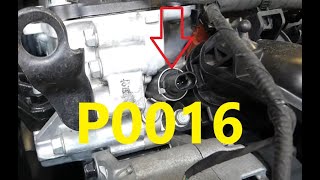
For the 3.8L Genesis Coupe, P0016 is most often caused by low/dirty engine oil or a failing Bank 1 (passenger side) intake Oil Control Valve (OCV). Before suspecting a major timing chain issue, always check the oil and consider replacing the Bank 1 intake OCV. A persistent startup rattle is a strong indicator of a more serious timing chain problem. The intake OCVs are a known failure point but require removing the upper and lower intake manifolds for access, making the job more involved than on
- P0016 means the passenger-side intake camshaft is out of sync with the crankshaft.
- Before any other repairs, check your engine oil level and condition. This is the simplest and most common cause.
- The most likely faulty part is the Bank 1 (passenger side) intake Oil Control Valve (OCV), but replacing it is labor-intensive as it's under the intake manifolds.
- A rattling noise when starting the engine is a strong sign of a failing timing chain tensioner, which is a more serious and expensive repair.
- Do not ignore this code. Continued driving can lead to severe and catastrophic engine damage.
What's Unique About the 2010-2016 Hyundai Genesis Coupe
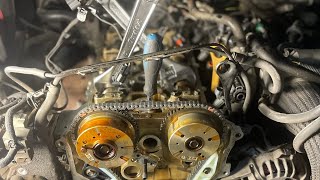
The 2010-2016 model years span two generations of the Genesis Coupe, the BK1 (2010-2012) and the BK2 (2013-2016). The 3.8L Lambda V6 engine was updated in 2013 from Multi-Port Injection (MPI) with 306 hp to Gasoline Direct Injection (GDI) with 348 hp. While both use the Continuously Variable Valve Timing (CVVT) system, the key platform-specific issue for this code is the location of the intake Oil Control Valves (OCVs). Unlike the easily accessible exhaust OCVs located on the front of the valve covers, the intake OCVs are located underneath the upper and lower intake manifolds (surge tank and plenum). This makes their replacement significantly more labor-intensive than on many other vehicles, as demonstrated in DIY videos.
Generation note: The vehicle range covers the BK1 (2010-2012) and BK2 (2013-2016) generations. The BK1 uses a 3.8L MPI Lambda V6 (G6DA), while the BK2 uses an updated 3.8L GDI Lambda V6 (G6DJ). The fundamental causes for P0016 are similar, but the GDI engine in the BK2 is generally considered more sensitive to oil quality and carbon buildup, which can clog OCV screens and oil passages. The difficult-to-access location of the intake OCVs beneath the intake manifolds is a challenge on both versions. The cold-start rattle indicating tensioner issues is a widely reported problem on both BK1 and BK2 models.
Symptoms You May Notice
- Check Engine Light is on
- Rough idle or stalling, sometimes to the point the engine will not restart
- Reduced engine power and poor acceleration
- Rattling noise from the engine on startup (cold start rattle) that lasts for 1-3 seconds
- Increased fuel consumption
- Engine juddering or shaking
- Replacing the camshaft and crankshaft position sensors immediately. The P0016 code points to a correlation problem, which is more often mechanical (timing chain) or hydraulic (oil pressure, OCV) than a failed sensor.
- Replacing only the timing chain tensioner after the code has appeared. If a startup rattle was present and the chain has already stretched, a new tensioner may quiet the noise but will not fix the incorrect timing correlation.
Most Likely Causes
- Low or Dirty Engine Oil 🔴 High Probability The CVVT system is entirely dependent on oil pressure to adjust cam timing. If the oil is low, dirty, or the wrong viscosity, the system cannot function correctly. Some owners report that using non-OEM oil filters can cause oil to drain back from the cylinder heads, leading to dry starts and rattles that contribute to timing system wear.
How to confirm: Check the oil level on the dipstick and inspect the oil's condition. If it is dark, gritty, or below the 'low' mark, this is a likely cause. Ensure the correct oil (typically 5W-30 full synthetic) is being used.
Typical fix: Perform an engine oil and filter change using a high-quality full synthetic oil and a genuine Hyundai/Kia OEM oil filter to ensure proper oil pressure and drain-back valve function.
Est. part cost: $50-$90 - Faulty Bank 1 Intake Oil Control Valve (OCV) 🔴 High Probability → Shop Engine Variable Valve Timing (VVT) Solenoid The OCV is an electromechanical solenoid that constantly works to control oil flow to the cam phaser. It can become clogged with sludge from infrequent oil changes or fail electrically.
How to confirm: A professional can command the OCV with a scan tool to check its response. A common DIY diagnostic is to swap the Bank 1 and Bank 2 intake OCVs. If the code changes to P0018 (Bank 2 Correlation), the OCV is faulty. However, this requires removing the upper and lower intake manifolds. Resistance can also be tested with a multimeter (spec is typically 6.7-7.9 ohms).
Typical fix: Replace the Bank 1 intake OCV. This requires removing the upper and lower intake manifolds to access the valve, along with replacing several gaskets.
Est. part cost: $70-$130 - Stretched Timing Chain or Failed Tensioner 🟡 Medium Probability → Shop Engine Timing Chain The hallmark symptom is a 1-3 second rattle on cold startups. This is caused by hydraulic tensioners losing oil pressure, allowing chain slack. Over time, this slack can cause the chain to stretch or jump a tooth, directly causing a correlation error.
How to confirm: A persistent rattling noise on startup is a strong indicator. A mechanic can verify this by removing the timing cover to inspect the chain for slack and check if the timing marks align correctly. This is a labor-intensive inspection.
Typical fix: Replace the timing chains (there are multiple), tensioners, and guides. This is a major, labor-intensive job often costing over $2000 at a shop.
Est. part cost: $300-$600 for a full OEM kit
Rare But Worth Checking
- Failed CVVT Cam Phaser (Actuator): → Shop Engine Timing Gear The mechanical gear on the camshaft itself can fail or get stuck due to sludge or internal failure. This is an expensive, labor-intensive repair typically performed during a full timing chain service. One owner on a forum reported a rattle persisted after a full timing job, which was then traced to the CVVT sprockets.
- Clogged Oil Passages: Severe oil sludge can block the small passages leading to the CVVT phasers or OCVs, preventing proper oil flow even if the components themselves are functional. This often requires extensive engine cleaning or disassembly. As a cross-manufacturer reference, NHTSA ODI #11690688 notes that a Hyundai 2.0L engine exhibited a P0016 code alongside severe oil sludge at 73,000 miles, highlighting how sludge can directly trigger this correlation fault.
- Faulty Camshaft or Crankshaft Position Sensor: → Shop Engine Crankshaft Position Sensor While possible, this is a very uncommon cause for a P0016 code. This code indicates a *correlation* problem between two sensors that are likely working, not a failure of one sensor. Replacing sensors is a common misdiagnosis.
Diagnosis Steps
- Check the engine oil level and condition. Top off or change the oil and filter if necessary. Use the correct viscosity oil and an OEM filter.
- Scan the vehicle for any other codes. Address other codes first if they are present, especially P0018, P0017, or P0019.
- Using a scan tool, observe the desired vs. actual camshaft angle for Bank 1 intake. A significant, consistent deviation points to a mechanical or hydraulic issue. A deviation of over 15 degrees will typically trigger the code.
- Listen for a 1-3 second rattling noise from the front of the engine during a cold start, which strongly indicates a timing chain tensioner or stretch issue.
- If you have advanced diagnostic skills, perform the labor-intensive task of removing the intake manifolds to access and swap the Bank 1 and Bank 2 intake OCVs. Clear the codes and drive the vehicle. If the code returns as P0018, the OCV you moved is faulty.
- If the OCV is not the issue, the next step is to inspect the timing chain, guides, and tensioners for wear, damage, or stretch. This involves significant disassembly of the front of the engine.
- While the timing components are exposed, inspect the CVVT phaser for any signs of damage or sludge.
Parts You'll Likely Need
- Intake Oil Control Valve (OCV) / VVT Solenoid (Bank 1)
(OEM #24355-3C200 (Right/Passenger/Bank 1))— This is a very common failure point. It gets clogged or fails electrically, preventing correct oil flow for cam phasing. Bank 1 is the passenger side.
Trusted brands: Hyundai/Kia Genuine
OEM price range: $80-$130
Aftermarket price range: $50-$90 - Intake Oil Control Valve (OCV) / VVT Solenoid (Bank 2)
(OEM #24355-3C100 (Left/Driver/Bank 2))— This is the corresponding part for the driver's side, often replaced at the same time or used for diagnostic swapping.
Trusted brands: Hyundai/Kia Genuine
OEM price range: $80-$130
Aftermarket price range: $50-$90 - Engine Oil and Filter
(OEM #26300-35505 (or similar, verify by VIN))— Incorrect oil level or condition is a primary cause of CVVT system faults. An OEM filter is highly recommended to ensure the anti-drainback valve functions correctly.
Related Codes That Often Appear With This One
- P0018 — This is the same correlation error but for Bank 2 (driver's side). If you swap a faulty Bank 1 OCV with the Bank 2 OCV, the code may change to P0018, confirming the OCV is the problem. If P0016 and P0018 appear together, it strongly suggests a base timing issue, like a jumped timing chain affecting the whole engine.
- P0017 — This code is for the exhaust camshaft correlation on Bank 1. If the timing chain has jumped a tooth, it can affect both intake and exhaust cam timing, causing both codes to appear.
Technical Service Bulletins (TSBs) & Recalls
- TSB 12-EM-004 - Searched, but relates to Electronic Waste Gate Actuator (EWGA) on turbo models, not the 3.8L V6.
- General search for P0016 TSBs for the Lambda V6 did not yield a specific campaign for this code, indicating it's treated as a standard diagnostic procedure.
Platform-Specific Known Issues
- The intake Oil Control Valves (OCVs) are located under the upper and lower intake manifolds, making a common repair much more labor-intensive than on other engines.
- A startup rattle is a well-documented symptom in the Genesis Coupe community that strongly points toward a failing timing chain tensioner, which can lead to P0016 if not addressed.
Mechanic-Grade Diagnostic Values
- Oil Control Valve (OCV) Solenoid Resistance — expected: 6.9–7.9 Ohms (Denso part) or 6.7–7.7 Ohms (Delphi part) at 68°F / 20°C.. Failure: A reading of infinity (open circuit) or near zero (short circuit).
- Scan Tool Live Data: Desired vs. Actual Camshaft Angle (Bank 1 Intake) — expected: The 'Actual' angle should closely track the 'Desired' angle, with a deviation near 0 degrees at idle.. Failure: A consistent deviation of more than a few degrees, or a value that is stuck and does not respond to changes in RPM. A deviation of over 15° is reported to trigger the P0016 code.
- Camshaft Position Sensor (CMPS) Signal Voltage — expected: A digital square wave signal that switches between approximately 0V and 5V as the camshaft rotates when viewed on an oscilloscope.. Failure: No signal, a constant voltage, or a noisy/erratic signal.
Scan Tool Commands That Help
- Hyundai GDS (Global Diagnostic System) or equivalent professional scanner: VVT (or CVVT) Actuator Test — This bidirectional command allows the technician to manually activate the Oil Control Valve (OCV) solenoid. By commanding the solenoid on and off while monitoring engine RPM or camshaft angle data, a technician can verify if the solenoid is electrically functional and if the mechanical phaser is responding to the oil pressure changes. This helps isolate a faulty OCV from a stuck phaser or an oil flow problem.
Wiring & Ground Locations
- ECU Ground Strap — On the 3.8L, there is a key ground strap that provides the ground path for the Engine Control Unit (ECU). One recommended grounding point is on the front of the engine.. A poor ECU ground can cause erratic behavior in sensor readings and actuator commands. While not a primary cause, a corroded or loose ECU ground could theoretically contribute to incorrect correlation calculations by causing noisy signals from the cam and crank sensors.
- GE01 / GE02 — Located at the right rear of the engine compartment on a 2013 model.. These are major engine compartment grounds. Any corrosion or looseness here can affect multiple engine sensors and actuators, including the OCVs and position sensors. Verifying these grounds are clean and tight is a fundamental step in diagnosing any complex electronic engine code.
- GHG03 — Located at the left rear of the engine on a 2012 model.. This is another primary engine ground point. The crank and cam sensors rely on a stable ground reference to produce a clean signal. A faulty ground connection can introduce noise, potentially leading the ECU to misinterpret the sensor data.
Real Owner Repair Stories
- Hyundai Forum user (2012 Genesis Coupe 2.0T (similar timing system principles)) — P0016 and P0017 codes, severe engine vibration at idle, very sluggish acceleration, hesitation when accelerating from a stop.
❌ Tried (didn't work) A shop had previously replaced the timing chain and fixed a bent valve, but the codes and symptoms returned immediately.
✅ What actually fixed it The user concluded the timing was set incorrectly during the initial repair. The persistence of both Bank 1 correlation codes (P0016 for intake, P0017 for exhaust) after a full timing job strongly pointed to a base timing misalignment by the mechanic, not a new component failure.
Model Year Variations Within This Range
- 2010-2012 (BK1) vs 2013-2016 (BK2): The timing components (chains, guides, tensioners) are NOT the same between the BK1 (MPI) and BK2 (GDI) 3.8L engines. While the core engine block is similar, the internals and heads were updated. Owners and parts suppliers confirm that different part numbers are required for a full timing service depending on the generation. It is critical to order parts by VIN.
Diagnostic Flowchart
Other Known Issues on This Vehicle
Issues unrelated to this code that are worth knowing about as an owner of this generation:
- Manual Transmission Grind / Lockout 🟠 Medium — Very common complaint, especially shifting into 2nd, 5th, or 6th gear, particularly during aggressive driving or when cold. Can be present from low mileage.
- Taillight Gasket Failure & Trunk Water Leak 🟠 Medium — Extremely common across all model years. The foam gaskets for the taillights degrade, allowing water to enter the trunk and pool in the spare tire well. (Ref: While no specific recall exists, Hyundai has general TSBs on diagnosing water leaks and condensation (e.g., TSB 12-BD-010), but the community has widely adopted DIY solutions.)
- Interior Chrome Finish Peeling 🟡 Low — Common cosmetic issue where the matte clear coat over chrome-look plastic trim on the steering wheel, door handles, and center console flakes off over time.
- Startup Rattle (Timing Chain Tensioner) 🔴 High — A very common symptom. A 1-3 second rattle on cold starts indicates the hydraulic timing chain tensioners are bleeding down oil pressure, causing temporary chain slack. If ignored, this can lead to stretched chains and the P0016 code.
Used vs. New Parts: Buying Guide for This Vehicle
When a used part is the smart pick: For this specific P0016 repair, using used parts is generally not recommended for the core failure components. However, a used part could be considered for a non-wear item if it was damaged during the repair, such as an engine cover or bracket. A used intake manifold assembly could also be a cost-effective option if the original was damaged during removal, as it is not a wear item.
Donor-vehicle mileage cap: roughly under 60000 miles for the part to have meaningful remaining life.
What to inspect on the donor part:
- For any used part, verify the donor vehicle's mileage and check for signs of sludge or poor maintenance.
- If considering a used OCV for testing, ensure it is clean and the screen is free of debris.
- Never install a used timing chain, tensioner, or guide. These are wear items and should always be replaced with new parts.
OEM-only on this vehicle (don't cheap out):
- Timing Chain Kit (Chains, Tensioners, Guides): The timing system is critical to engine health. Aftermarket kits can vary in quality, and given the high labor cost of this job, using OEM parts is the only way to ensure longevity and proper fitment. Forum members strongly advise against aftermarket timing components.
- Oil Control Valves (OCVs): While some aftermarket OCVs exist, OEM solenoids are recommended for reliability. A failed aftermarket OCV would require repeating the labor-intensive intake manifold removal.
Aftermarket brands forum-validated for this vehicle:
- For this specific repair, there are no widely forum-validated aftermarket brands that are considered equal to or better than OEM Hyundai/Kia parts for the critical timing components and solenoids.
Brands owners have reported issues with on this vehicle:
- Generic, unbranded timing kits from online marketplaces should be avoided. The risk of premature failure, incorrect fitment, and catastrophic engine damage is too high.
Real Owner Stories
Aggregated from forums and TSBs cited above. Mileages and costs reflect what owners reported in those sources.
2013 Hyundai Genesis Coupe 3.8 R-Spec
Symptoms: Check Engine Light with P0016 and a lumpy idle.
What fixed it: Replaced crankshaft position sensor.
Source hint: owner_reports - Reddit r/genesiscoupe
Documented NHTSA Reports
Sludge-Related Correlation Issues
Report: NHTSA ODI #11690688 describes a vehicle with a 2.0L engine built in Alabama that developed a P0016 code and severe oil sludge at 73,000 miles. The owner noted these symptoms were identical to those described in Recall 21V301, though their specific vehicle was excluded from that campaign.
Related OBD-II Codes
Frequently Asked Questions
Does TSB 12-EM-004 apply to my 3.8L V6 Genesis Coupe for this P0016 code?
Can I use an aftermarket oil filter on my 3.8L Genesis Coupe?
Why is the labor cost so high to replace the Oil Control Valve (OCV) on this specific car?
What kind of oil should I be using to prevent CVVT issues like P0016?
I hear a 1-3 second rattle when I start my car in the morning; is this related to P0016?
Is there a simple way to test if the OCV is the problem without buying new parts?
Helpful Videos
We Have This Part in Stock


The information in this article is provided for general reference and educational purposes only. Vehicle specifications, procedures, and part compatibility can vary by production date, trim level, and region. Always consult your vehicle's factory service manual and verify part numbers before purchasing or performing repairs. Safety-critical components such as airbags, seat belts, and braking systems should be installed by a qualified professional.
- Hyundai Genesis Coupe:
- 🧭 Diagnostic Flowchart
- 🎬 Helpful Videos
- 🛍️ Shop This Part
- What's Unique About the 2010-2016 Hyundai Genesis Coupe
- Symptoms You May Notice
- Most Likely Causes
- Rare But Worth Checking
- Diagnosis Steps
- Parts You'll Likely Need
- Related Codes That Often Appear With This One
- Technical Service Bulletins (TSBs) & Recalls
- Platform-Specific Known Issues
- Mechanic-Grade Diagnostic Values
- Scan Tool Commands That Help
- Wiring & Ground Locations
- Real Owner Repair Stories
- Model Year Variations Within This Range
- Other Known Issues on This Vehicle
- Used vs. New Parts: Buying Guide for This Vehicle
- Real Owner Stories
- 2013 Hyundai Genesis Coupe 3.8 R-Spec
- Documented NHTSA Reports
- Sludge-Related Correlation Issues
- Related OBD-II Codes
- Frequently Asked Questions
- 🎟️ Get 5% Off