

P0016 on 2020-2024 Kia Telluride 3.8L V6: Causes and Fixes for Cam/Crank Correlation
On the Kia Telluride 3.8L V6, P0016 is most often caused by low or dirty engine oil, or a failed Bank 1 intake Oil Control Valve (OCV). Always check oil level and quality first. OCV replacement is complex as the part is located under the intake manifold, making the repair costlier than on other vehicles.
- Always check your engine oil first. The level, cleanliness, and correct viscosity are critical for the Telluride's VVT system.
- The most likely failed part is the Bank 1 (rear) intake Oil Control Valve (OCV), but it is a difficult and expensive part to replace due to its location under the intake manifold.
- Do not ignore this code. While it might be a simple oil issue, it can also signal a serious mechanical problem that could lead to severe engine damage.
- If you've recently had an oil change and the light came on, the shop may have used the wrong oil viscosity or a low-quality filter.
- Due to the complexity and labor involved, professional diagnosis is highly recommended to avoid unnecessarily replacing parts.
What's Unique About the 2020-2024 Kia Telluride
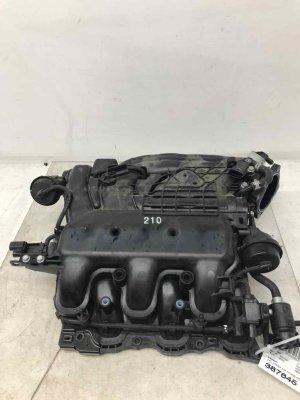
While the causes of P0016 are common across many vehicles, the Telluride's Lambda II 3.8L V6 engine presents a significant service challenge. The most common failed part, the intake Oil Control Valve (OCV), is located underneath the upper and lower intake manifolds. This turns what is a simple, inexpensive repair on many other engines into a multi-hour job requiring significant disassembly, which drastically increases labor costs. This design is shared with its platform mate, the Hyundai Palisade.
🎬 Watch: How to fix P0016 timing faults on Kia and Hyundai engines.Symptoms You May Notice
- Check Engine Light is on
- Sluggish acceleration or reduced power
- Rough or unstable idle
- Engine cranks but may be hard to start
- Rattling noise from the engine, especially on startup
- Decreased fuel economy
- Replacing the camshaft or crankshaft position sensors without proper testing. While they can be the cause, 🎬 See these 4 DIY methods to troubleshoot the P0016 code. oil-related issues or a faulty OCV are far more common.
- Replacing the easily accessible exhaust OCV on the valve cover instead of the correct intake OCV located under the intake manifold.
Most Likely Causes
- Low, Dirty, or Incorrect Viscosity Engine Oil 🔴 High Probability The CVVT (Continuously Variable Valve Timing) system is hydraulic and highly sensitive to oil pressure and cleanliness. Sludge or the wrong oil type can restrict flow and prevent the cam phasers from adjusting correctly. Forum users have reported the P0016 code appearing immediately after an oil change, suggesting high sensitivity to oil type or potential issues with the service.
How to confirm: Check the engine oil level on the dipstick. Inspect the oil's color and consistency. Review service records to ensure the correct oil viscosity (as specified in the owner's manual) was used.
Typical fix: Perform an engine oil and filter change with the manufacturer-specified oil type and grade.
Est. part cost: $40-$80 - Faulty Bank 1 Intake Oil Control Valve (OCV/VVT Solenoid) 🔴 High Probability → Shop Engine Variable Valve Timing (VVT) Solenoid The OCV is a common failure point in VVT systems. It can become clogged with debris from the oil or fail electrically, causing it to stick in one position. Due to its location under the intake manifold, it is a labor-intensive repair.
How to confirm: This is difficult for a DIYer due to the part's location. A professional would test the solenoid for resistance and operation. Because it is buried under the intake manifold, it is often replaced based on diagnostic data without a direct functional test, especially after oil level/condition is ruled out.
Typical fix: Replace the Bank 1 intake Oil Control Valve. This requires removing the upper and lower intake manifolds. 🎬 Watch: A step-by-step guide to fixing the Bank 1 correlation error. The intake manifold gaskets must also be replaced.
Est. part cost: $70-$150 - Stretched Timing Chain ⚪ Low Probability → Shop Engine Timing Chain While not common on newer vehicles, factors like infrequent oil changes can accelerate wear on the timing chain and its guides, causing slack that leads to a correlation error. The Lambda II engine uses two timing chains.
How to confirm: Listen for a rattling noise from the front of the engine. A definitive diagnosis requires removing the timing cover to inspect the chain, tensioners, and timing marks, which is a labor-intensive job.
Typical fix: Replace the timing chain, tensioners, and guides.
Est. part cost: $400-$800 - Faulty Camshaft or Crankshaft Position Sensor ⚪ Low Probability → Shop Engine Crankshaft Position Sensor
How to confirm: Use a scan tool to monitor live data from the sensors. A professional can use an oscilloscope to check for a proper waveform. Swapping the Bank 1 cam sensor with the Bank 2 sensor (if they are the same part number and accessible) can see if the code changes to P0018.
Typical fix: Replace the faulty sensor. Be aware that some Kia models may require a 'relearn' procedure after sensor replacement for the engine to run correctly.
Est. part cost: $50-$120
Rare But Worth Checking
- Damaged CVVT Cam Phaser: → Shop Engine Timing Gear The gear on the end of the camshaft can fail mechanically, getting stuck in one position. This is less common than an OCV failure but can happen. Diagnosis often follows the elimination of all other possible causes. A manufacturer service bulletin for other Kia models, Bulletin #PS731, notes that P0016 can also be caused by an incorrect camshaft reluctor wheel configuration.
- Clogged Oil Passages: Severe oil sludge can block the small passages leading to the VVT components, even if the OCV itself is functional. This typically points to a history of neglected maintenance and is a known risk on GDI engines with insufficient cleaning.
Diagnosis Steps
- Check Engine Oil: Verify the oil level is correct and the oil is clean. An oil change is a cheap first step if the oil is old or of unknown quality.
- Scan for Codes: Use an OBD-II scanner to confirm P0016 and check for any other related codes.
- Inspect Wiring: Visually inspect the wiring and connectors for the camshaft and crankshaft position sensors for any obvious damage or corrosion.
- Analyze Sensor Data: Using a capable scan tool, observe the live data for the cam and crank sensors to see if they are reading properly.
- Diagnose Oil Control Valve (OCV): This is the most likely cause but the most difficult to access. Due to the labor involved in reaching the intake OCV, diagnosis is often indirect. If oil and sensors are good, the OCV is the prime suspect.
- Inspect Mechanical Timing: If all electronic and hydraulic components check out, the final step is a mechanical inspection. This involves accessing the timing chain to check for slack, damage, or jumped teeth. This is a job for a professional.
- Consider Recalls: For 2024 models, be aware of recall SC296 for engine valve spring issues, which could cause related symptoms.
Parts You'll Likely Need
- Intake Oil Control Valve (OCV/VVT Solenoid)
(OEM #24355-3CAB2)— This is the most common part to fail that causes a P0016 code, aside from oil condition. It controls oil flow to the cam phaser.
Trusted brands: Kia Genuine, Hyundai Genuine
OEM price range: $70-$150
Aftermarket price range: $40-$80 - Upper Intake Manifold Gasket (Plenum Gasket)
(OEM #29215-3CFA1)— This must be replaced when removing the intake manifold to access the intake OCVs to prevent vacuum leaks.
Trusted brands: Kia Genuine, Fel-Pro
OEM price range: $15-$35
Aftermarket price range: $10-$20 - Lower Intake Manifold Gaskets
(OEM #28215-3CFA0)— These must be replaced when removing the intake manifold to access the intake OCVs. A set is required.
Trusted brands: Kia Genuine, Mahle
OEM price range: $15-$30 per set
Aftermarket price range: $10-$25 per set - Engine Oil and Filter — Correcting low, dirty, or incorrect viscosity oil is the first and easiest step in fixing this code.
Trusted brands: Mobil 1, Castrol, Pennzoil
OEM price range: $60-$100
Aftermarket price range: $40-$80
Related Codes That Often Appear With This One
- P0017 — This is the same correlation error but for the exhaust camshaft on Bank 1. If both P0016 and P0017 appear together, it strengthens the possibility of a base timing issue, like a stretched timing chain affecting the entire bank.
- P0011 — This code means 'Intake Camshaft Position Timing - Over-Advanced (Bank 1)'. It points to a problem within the same VVT system and is often caused by the same failing parts, like a stuck OCV.
- P0300-P0306 — Misfire codes can accompany P0016 because incorrect cam timing disrupts the combustion process, leading to misfires in one or more cylinders. TSB ENG228 was released to improve ECM logic for cold start misfires on 2020 models.
Technical Service Bulletins (TSBs) & Recalls
- SC296: Safety recall for certain 2024 Telluride models concerning engine valve springs which may break and could cause engine damage or failure.
- ENG228: For 2020 Tellurides, this TSB provides an ECM logic update to improve judgment for cold start misfire DTCs (P0300-P0306), which can sometimes appear alongside timing correlation codes.
- Bulletin #TSBENG170: This manufacturer bulletin for other Kia models provides a specific procedure to reset adaptive values for DTC P0016.
- Bulletin #TSBENG170_R1: An updated version of the adaptive value reset procedure for P0016, revised to include additional technical information.
- Bulletin #PS731: This Pitstop bulletin notes that DTCs P0011, P0014, P0016, and P0017 can be caused by an incorrect camshaft reluctor wheel configuration.
Platform-Specific Known Issues
- The intake Oil Control Valves (OCVs) for Bank 1 (rear) and Bank 2 (front) are located under the intake manifold, making their replacement a 3-5 hour job, significantly increasing repair costs compared to engines with more accessible OCVs.
Mechanic-Grade Diagnostic Values
- Oil Control Valve (VVT Solenoid) Internal Resistance — expected: 6.9 - 7.9 Ohms at 68°F (20°C). Failure: A reading outside this range, or an open/short circuit, indicates a failed solenoid.
- Camshaft Position Sensor (Hall-Effect Type) Signal Wire Voltage — expected: Switches between ~0V and ~5V (or 4.8V) as a metal object is passed over the sensor tip (with ignition on, engine off).. Failure: Voltage does not switch, or is stuck at 0V or 5V, indicates a faulty sensor.
- Camshaft Position Sensor Power Supply Wire Voltage — expected: Battery voltage (~12V) with ignition on.. Failure: No voltage indicates a wiring or power supply issue upstream of the sensor.
Scan Tool Commands That Help
- Kia Diagnostic System (KDS) or equivalent advanced scan tool: Reset Adaptive Values (for CVVT) — After replacing a CVVT component like an OCV or phaser, or if a code appears due to a temporarily stuck component. A TSB for other Kia models with P0016 suggests this reset can resolve the code if it's caused by a temporarily stuck CVVT assembly. The ECU relearns the camshaft position after the reset.
- Advanced Bi-directional Scan Tool (e.g., iCarsoft, Autel): VVT Solenoid Actuation Test — To command the OCV on and off while the engine is running to verify its mechanical operation. A change in engine sound or RPM should be noticeable. This helps confirm if the solenoid is stuck or responding to commands.
Real Owner Repair Stories
- tellurideforum.org user 'chrisecklund' (2020 Kia Telluride SX, 66,000 miles) — Check Engine Light with code P0016, slightly off idle, sluggish acceleration.
❌ Tried (didn't work) The user reported the issue occurred within 30 miles *after* a full synthetic 5W-30 oil change. The thread did not have a final resolution posted.
✅ What actually fixed it No final resolution was posted by the user. However, the story is valuable as it strongly correlates the appearance of P0016 with a recent oil change service, pointing towards oil type, level, or a coincidental failure. - NHTSA ODI #11712704 — An owner of another Kia model reported that the Check Engine Light would come on and off randomly, with codes P0017 and P0016 appearing as pending when the light was illuminated.
OEM Part Supersession History
221103CAB0, 221103CAB0A, 504R53CA00→24355-3CAB2— Standard part evolution and consolidation for the Bank 1 (Right/Firewall side) Intake OCV.
Model Year Variations Within This Range
- 2020-2022 vs 2023-2024: The 2023 model year introduced a significant cosmetic facelift, including new bumpers, grille, and a redesigned dashboard with a large single-piece display. However, the core powertrain, the 3.8L Lambda II V6 engine and 8-speed transmission, remained unchanged. Therefore, the causes and repair procedures for code P0016 are identical across the 2020-2024 model year range.
Diagnostic Flowchart
Other Known Issues on This Vehicle
Issues unrelated to this code that are worth knowing about as an owner of this generation:
- Premature Windshield Cracking 🟠 Medium — Very common across 2020-2023 models. Hundreds of NHTSA complaints filed. Cracks can appear spontaneously or from minor impacts. (Ref: Kia issued a 'goodwill' customer satisfaction initiative for 2020 models, but no formal recall.)
- Tow Hitch Wiring Harness Fire Risk 🔴 High — Affects 2020-2022 models equipped with the genuine Kia 4-pin tow hitch harness. Moisture and debris can short the module, causing a fire even when parked. (Ref: Recall SC247 (NHTSA 22V-626))
- High-Beam Headlight Failure (2020 Halogen models) 🔴 High — Common on 2020 models with halogen headlights. Heat from the bulb damages an internal mechanism, causing the high beams to fail. (Ref: Recall SC299 (NHTSA 24V148))
- Front Power Seat Motor Overheating 🔴 High — A stuck power seat switch can cause the motor to run continuously, creating a fire risk. Affects a large range of 2020-2024 models. (Ref: NHTSA Recall 24V-182)
- Carbon Buildup on Intake Valves 🟡 Low — A long-term consequence of all direct injection (GDI) engines, including the Lambda II. Typically becomes noticeable after 80,000-100,000 miles, potentially causing rough idle or reduced performance.
Used vs. New Parts: Buying Guide for This Vehicle
When a used part is the smart pick: For this repair, using a used part is generally not recommended for the electronic and hydraulic components. The labor cost to access the intake OCVs is very high, making it unwise to risk installing a used part with an unknown history that might fail prematurely. The only exception might be a major structural component like a timing cover if it were damaged, but that is not a common cause of P0016.
Donor-vehicle mileage cap: roughly under 30000 miles for the part to have meaningful remaining life.
What to inspect on the donor part:
- Verify the donor vehicle had no engine-related trouble codes.
- Check for signs of oil sludge or poor maintenance on the donor engine.
- For sensors, ensure connectors are free of corrosion or damage.
OEM-only on this vehicle (don't cheap out):
- Oil Control Valve (OCV/VVT Solenoid): Due to the high labor cost for replacement, using a genuine Kia/Hyundai part is strongly advised to ensure longevity and prevent a repeat repair.
- Camshaft/Crankshaft Position Sensors: While some aftermarket brands are reliable, OEM sensors are the safest bet to avoid compatibility or relearn issues.
Aftermarket brands forum-validated for this vehicle:
- Gaskets: Fel-Pro and Mahle are reputable brands for the required intake manifold gaskets.
- Sensors/Solenoids: Hitachi is often an OEM supplier for Japanese and Korean vehicles and is generally considered a reliable alternative if an OEM part is unavailable.
Brands owners have reported issues with on this vehicle:
- Unbranded, low-cost solenoids and sensors from online marketplaces. Forum and video discussions frequently mention that these parts often fail quickly or are dead-on-arrival, making the initial savings worthless, especially on a high-labor job like this one.
Real Owner Stories
Aggregated from forums and TSBs cited above. Mileages and costs reflect what owners reported in those sources.
2020 Kia Telluride SX — 66000 miles
Symptoms: Check Engine Light came on within 30 miles of a 5W-30 full synthetic oil change. The owner reported no odd noises and the car started fine, but the idle felt slightly off and acceleration was sluggish.
What fixed it: The owner did not report a fix in the thread.
Source hint: tellurideforum.org thread titled 'P0016 Error After Oil Change'
NHTSA ODI #11712704
Symptoms: The owner reported that the Check Engine Light would come on and off randomly. Diagnostic scans revealed that codes P0017 and P0016 would come up as pending when the engine light was on.
Related OBD-II Codes
Frequently Asked Questions
I just had an oil change on my 2020 Telluride and now the P0016 code is on. Is this common?
Is there a recall for my 2024 Telluride that could be related to engine performance issues?
Why is the labor cost so high to replace the Oil Control Valve on my Telluride?
My 2020 Telluride has a P0300 misfire code along with timing issues. Is there a software fix?
Can I swap sensors to diagnose a P0016 code on this engine?
Does the Hyundai Palisade have the same P0016 issues as the Kia Telluride?
Helpful Videos
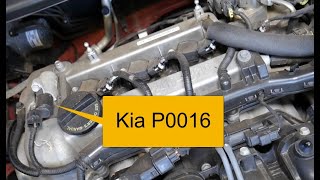
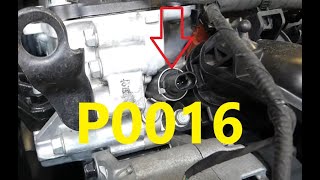
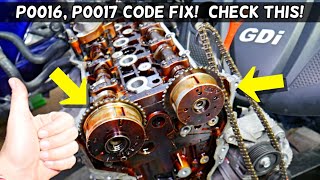
![How to Fix P0016 Engine Code in 6 Minutes [4 DIY Methods / Only $6.94]](https://img.youtube.com/vi/extiOvtV8_Y/mqdefault.jpg)
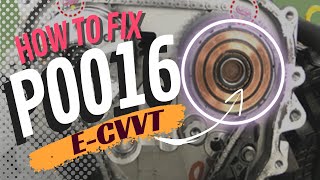
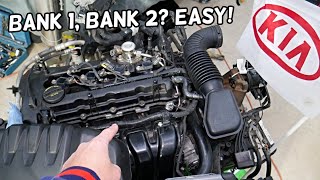

We Have This Part in Stock

The information in this article is provided for general reference and educational purposes only. Vehicle specifications, procedures, and part compatibility can vary by production date, trim level, and region. Always consult your vehicle's factory service manual and verify part numbers before purchasing or performing repairs. Safety-critical components such as airbags, seat belts, and braking systems should be installed by a qualified professional.
- Kia Telluride:
- 🧭 Diagnostic Flowchart
- 🎬 Helpful Videos
- 🛍️ Shop This Part
- What's Unique About the 2020-2024 Kia Telluride
- Symptoms You May Notice
- Most Likely Causes
- Rare But Worth Checking
- Diagnosis Steps
- Parts You'll Likely Need
- Related Codes That Often Appear With This One
- Technical Service Bulletins (TSBs) & Recalls
- Platform-Specific Known Issues
- Mechanic-Grade Diagnostic Values
- Scan Tool Commands That Help
- Real Owner Repair Stories
- OEM Part Supersession History
- Model Year Variations Within This Range
- Other Known Issues on This Vehicle
- Used vs. New Parts: Buying Guide for This Vehicle
- Real Owner Stories
- 2020 Kia Telluride SX — 66000 miles
- NHTSA ODI #11712704
- Related OBD-II Codes
- Frequently Asked Questions
- 🎟️ Get 5% Off