

P0016 on 2006-2007 Saturn Ion 2.4L: Crank/Cam Correlation Causes and Fixes
On the 2.4L Ecotec, P0016 almost always indicates a stretched timing chain, a known issue with this engine. This is a serious, complex repair costing $1,200-$2,500+. Before assuming the worst, check the engine oil and consider replacing the much cheaper VVT solenoids (~$40-$60 each), as they are also a common failure point.
- P0016 on a 2006-2007 Saturn Ion 2.4L is a serious code that should be addressed immediately to prevent catastrophic engine failure.
- The most likely cause is a stretched timing chain, a well-known issue with this engine.
- Before committing to a costly timing chain replacement, always check the engine oil level/condition and test the VVT solenoids by swapping them.
- Do not replace the cam or crank sensors hoping for a fix; they are rarely the cause of this specific code on this car.
- Due to the interference design of the engine, driving with this code is a significant gamble that can result in needing a complete engine replacement.
What's Unique About the 2006-2007 Saturn Ion
The 2.4L LE5 Ecotec engine used in the Saturn Ion and its platform mates (Cobalt, HHR, G6) is notorious for premature timing chain failures. The original plastic chain guides can become brittle and break, and the hydraulic tensioner is a weak point that GM redesigned multiple times. Unlike many vehicles where P0016 might be a simple sensor issue, on this platform, it is a very strong predictor of a significant mechanical timing problem that requires immediate attention.
Symptoms You May Notice
- Check Engine Light is on
- Engine runs rough or idles poorly
- Rattling, buzzing, or scraping noise from the passenger side of the engine, especially on a cold start for 2-5 seconds.
- Reduced engine power and poor acceleration
- Engine stalls unexpectedly
- Engine cranks but does not start (in severe cases of timing jump)
- Noticeably poor fuel economy
- Replacing the Crankshaft Position Sensor (CKP) or Camshaft Position Sensor (CMP). While these sensors provide the data, they are rarely the cause of a P0016 correlation code on this engine. A faulty sensor would typically set a specific sensor circuit code, like P0340 or P0335. A user on chevyhhr.net reported replacing the sensor three times before realizing the issue was the timing chain.
Most Likely Causes
- Stretched Timing Chain, Worn Guides, or Failed Tensioner 🔴 High Probability → Shop Engine Timing Chain The 2.4L LE5 Ecotec engine family is widely known for issues with its original timing chain components, including plastic guides that become brittle and a tensioner that can fail, losing hydraulic pressure. Extended oil change intervals exacerbate this wear.
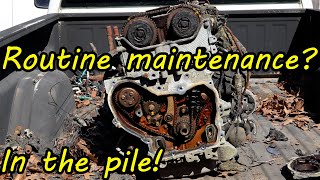
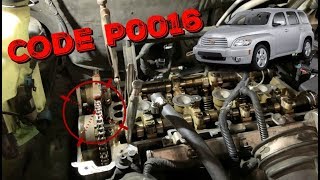
How to confirm: A persistent rattling noise from the side of the engine on startup is a classic symptom. A definitive check requires removing the valve cover to inspect for chain slack between the cam sprockets and looking for broken pieces of the black plastic guides. Finding metallic debris on the VVT solenoid screens is also a strong indicator of guide failure.
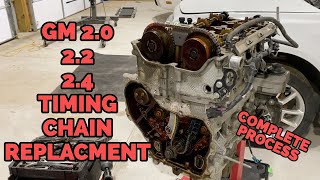
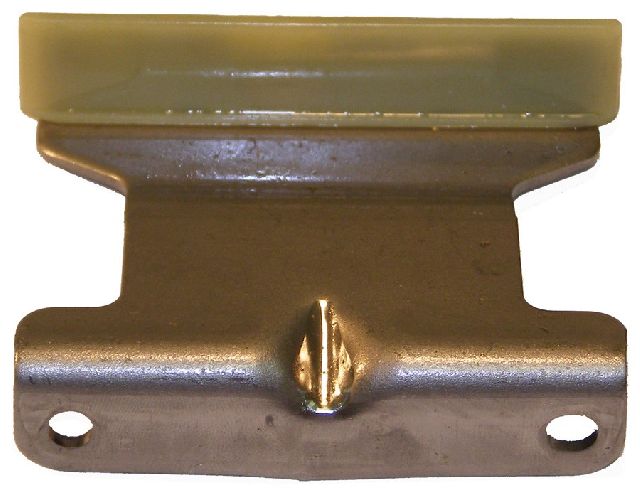
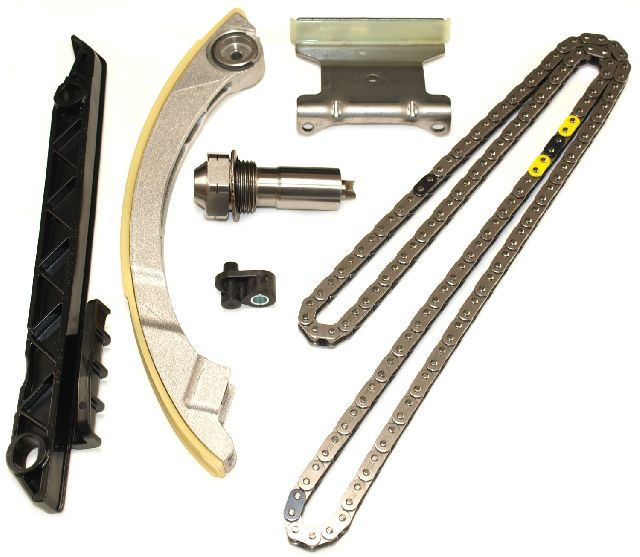
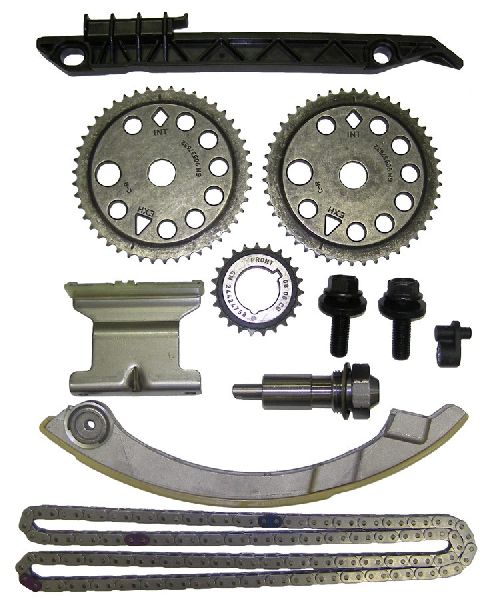
Typical fix: Replacement of the timing chain, tensioners, guides, and sprockets as a complete kit. It is also wise to replace the water pump (which is driven by the balance shaft chain) and front crank seal at the same time.
Est. part cost: $100-$300 - Faulty Intake Camshaft Position Actuator Solenoid (VVT Solenoid) 🟡 Medium Probability → Shop Engine Camshaft These solenoids are operated by oil pressure and are a common failure point on Ecotec engines, often getting clogged with sludge or failing electrically. They are sensitive to oil quality and level.
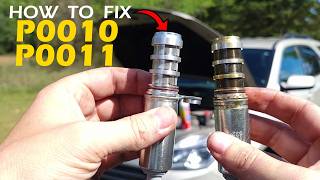
How to confirm: Swap the intake solenoid with the identical exhaust solenoid. They are on top of the valve cover, each held by one 10mm bolt. Clear the codes and drive. If the code changes from P0016 (Intake) to P0017 (Exhaust), the solenoid is confirmed to be faulty. You can also test resistance, which should be 8-13 ohms.
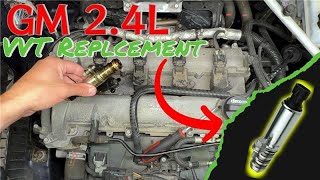
Typical fix: Replace the faulty solenoid. 🎬 See how to easily replace the VVT solenoids yourself. It's often recommended to replace both intake and exhaust solenoids at the same time as a preventative measure.
Est. part cost: $25-$60 - Low or Dirty Engine Oil 🟡 Medium Probability The VVT system and the hydraulic timing chain tensioner are both dependent on clean oil at the correct pressure. Neglecting oil changes can directly cause or accelerate timing system failures by clogging solenoid screens and causing premature chain wear.
How to confirm: Check the oil level on the dipstick and inspect its condition. If the oil is very low, dark, sludgy, or past its change interval, this is a likely contributor.
Typical fix: Perform an oil and filter change using a full synthetic 5W-30 oil that meets GM specifications (Dexos). Clear the codes and see if the issue returns. This is the cheapest and easiest first step.
Est. part cost: $40-$80
Rare But Worth Checking
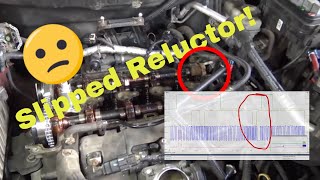
- Spun Camshaft Reluctor Ring: → Shop Engine Camshaft Documented in GM TSB #PIP4548F. If the engine has been timed correctly with a new chain and the code persists, this is a possible cause, especially if the engine has ever overheated. The reluctor ring is press-fit and can spin on the camshaft, causing a timing correlation error even when the chain is aligned. The TSB provides visual guides to check the reluctor's orientation relative to the cam lobes. The fix requires replacing the entire camshaft. 🎬 Watch: How to identify a slipped cam reluctor ring.
Diagnosis Steps
- Check the engine oil level and condition. If low, dirty, or overdue, perform an oil and filter change with 5W-30 synthetic oil, clear the codes, and re-test. This is the first and most crucial step.
- Scan for other codes. The presence of P0017 strongly suggests a timing chain issue. The presence of P0011 may point more toward a VVT solenoid.
- Listen for a rattling noise from the passenger side of the engine during a cold start. A 2-5 second rattle is a classic sign of a failing timing chain tensioner and slack in the chain.
- Test the VVT solenoids. Remove the intake and exhaust solenoids (they are identical and located on top of the valve cover, held by 10mm bolts). Inspect screens for sludge or metal fragments. Swap their positions. Clear codes and run the engine. If P0016 returns as P0017, the solenoid you moved is bad and needs replacement.
- If the oil is good and the solenoids test okay, the next logical step is to assume a mechanical timing issue. This requires removing the valve cover for a visual inspection of the timing chain for slack and checking the guides for damage. A properly tensioned chain should be tight.
- If a new timing chain is installed and the code persists, investigate the possibility of a spun camshaft reluctor ring as described in TSB #PIP4548F. This involves checking the alignment of the reluctor on the camshaft itself.
Parts You'll Likely Need
- Timing Chain Kit
(OEM #12680750 (Supersedes older kits))— This is the most probable cause of P0016 on the 2.4L Ecotec. A complete kit ensures all worn components (chain, guides, tensioner, gears) are replaced with updated designs.
Trusted brands: ACDelco, Cloyes
OEM price range: $200-$300
Aftermarket price range: $100-$200 - Intake Camshaft Position Actuator Solenoid
(OEM #12655420 (Also check 12628347, 12646783 as prior part numbers))— This VVT solenoid is a common failure item that can get clogged or fail electrically, causing timing correlation issues. It's a much cheaper and easier part to replace than the timing chain.
Trusted brands: ACDelco, Delphi, Dorman
OEM price range: $40-$60
Aftermarket price range: $25-$45 - Exhaust Camshaft Position Actuator Solenoid
(OEM #12655421 (Also check 12628348, 12646784 as prior part numbers))— Often replaced as a pair with the intake solenoid. Swapping the two is a key diagnostic step.
Trusted brands: ACDelco, Delphi, Dorman
OEM price range: $40-$60
Aftermarket price range: $25-$45
Related Codes That Often Appear With This One
- P0017 — Exhaust Camshaft Position Correlation. Seeing P0016 and P0017 together strongly indicates a base mechanical timing issue, like a stretched chain, as it's affecting both camshafts' correlation to the crank.
- P0011 — Intake Camshaft Position Timing Over-Advanced. This can point to a problem with the VVT system, such as a sticking intake solenoid or phaser, which are part of the system that triggers P0016.
- P0014 — Exhaust Camshaft Position Timing Over-Advanced. Often seen with P0017, this points to a VVT issue on the exhaust side. If you swap solenoids and P0011/P0016 becomes P0014/P0017, you've confirmed a bad solenoid.
Technical Service Bulletins (TSBs) & Recalls
- PIP4548F: MIL On With DTC P0016 And/Or P0017 Setting On A Properly Timed Engine. This TSB advises technicians to check for a spun camshaft reluctor ring if the code persists after timing has been verified as correct.
- PIP4716F: Intermittent Rattle Noise At Start Up, SES Light, DTC P0011, P0014, P0016 or P0017. This TSB addresses the classic 2-5 second startup rattle, linking it to cam actuators not parking correctly and potentially setting correlation codes.
Platform-Specific Known Issues
- The 2.4L LE5 Ecotec engine is widely known for premature timing chain stretch and guide failure.
- A spun camshaft reluctor ring, while rare, is a documented issue on this engine (TSB #PIP4548F) that can cause P0016/P0017 even with a properly timed chain.
Mechanic-Grade Diagnostic Values
- Camshaft Position Actuator Solenoid (VVT Solenoid) Resistance — expected: 8 to 13 Ohms. Failure: A reading outside this range, an open circuit (OL), or a short circuit indicates a faulty solenoid. Some sources cite a tighter range of 6.9-7.9 Ohms at 68°F.
- Scan Tool Live Data: Desired vs. Actual Camshaft Position Angle — expected: The 'Actual' angle PID should closely track the 'Desired' angle PID as engine RPM is varied.. Failure: If the 'Actual' angle is stuck, slow to respond, or does not match the 'Desired' angle, it points to a sticking camshaft phaser, a faulty VVT solenoid, or an oil pressure issue.
- Camshaft Position Sensor (CMP) Connector Voltage (Key On, Engine Off) — expected: Pin 1: 12V (Power), Pin 2: Ground, Pin 3: 5V (Signal reference).. Failure: Absence of 12V power or 5V reference voltage points to a wiring or ECM issue, not a sensor failure.
- Camshaft/Crankshaft Position Sensor Signal Waveform — expected: A clean digital square wave, toggling between 0V and 5V, when viewed with an oscilloscope.. Failure: A multimeter showing an average voltage (e.g., ~2.5V) is not a valid test. An oscilloscope is required. A missing, erratic, or misshapen waveform indicates a failed sensor or wiring issue.
Scan Tool Commands That Help
- Tech2 / GDS2 / Capable Bidirectional Scanner: VVT Solenoid Actuation Test / Camshaft Position Actuator Control — This command allows the technician to manually cycle the VVT solenoid on and off while the engine is running to verify its mechanical operation. A change in engine sound or RPM when activated confirms the solenoid is working mechanically. This helps differentiate between a failed solenoid and a wiring/ECM issue.
Wiring & Ground Locations
- G105 — Lower left rear of the engine block.. This is a primary engine ground. A poor connection here can introduce electrical noise or incorrect reference voltages for critical sensors like the crankshaft position sensor and the ECM itself, potentially causing correlation issues.
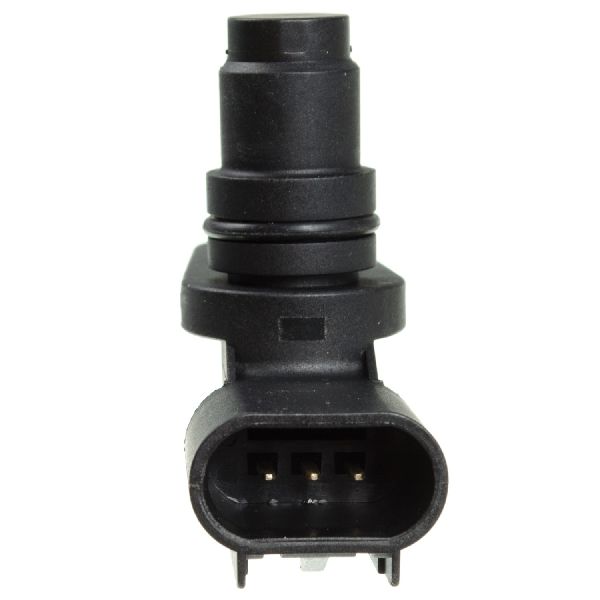
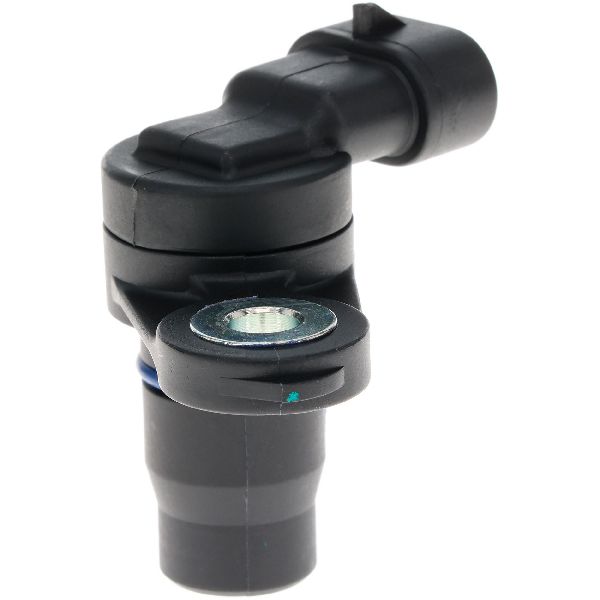
- CMP Sensor Connector — Top of the engine, at the front of the valve cover for the intake camshaft position sensor.. This is the direct connection point for the sensor providing the camshaft signal. The 3-pin connector provides power, ground, and signal. It should be inspected for oil contamination, corrosion, or damaged pins, which can disrupt the signal to the ECM.
- VVT Solenoid Connector — Top of the valve cover, one for intake (front) and one for exhaust (rear).. This 2-pin connector provides power and the control signal from the ECM to the solenoid. Damage here will set a circuit code (P0010/P0013) but can also lead to intermittent operation that contributes to a correlation code like P0016.
Real Owner Repair Stories
- Reddit user on r/MechanicAdvice (2008 Saturn Vue 2.4L Ecotec (same engine family)) — P0016 and P0017 codes present. Hesitation on acceleration. Fresh oil change did not resolve the codes.
❌ Tried (didn't work) Oil and filter change, Clearing codes
✅ What actually fixed it The user pulled the valve cover and found significant timing chain slack and a broken piece of an orange plastic timing chain guide. The confirmed fix was a full timing chain replacement job. - Mechanic comment on YouTube (2010 Chevy Equinox 2.4L Ecotec (same engine family)) — Persistent P0016 and P0017 codes immediately after a used engine was installed.
❌ Tried (didn't work) Tore down the front cover multiple times to verify timing was perfect, Replaced cam phasers and tensioners
✅ What actually fixed it After confirming mechanical timing was correct, the mechanic discovered the reluctor ring on the intake camshaft had spun on the shaft, a known issue (TSB PIP4548F) often caused by a previous engine overheat. The fix was to replace the entire intake camshaft with one that had a correctly positioned reluctor ring. - SaturnFans.com user 'Korvicus' (2007 Saturn Ion 2.4L Quad Coupe) — P0016, P0017, P0171. Low power below 4000 RPM when warm. Problem appeared gradually.
❌ Tried (didn't work) Full timing chain replacement, Replacement of both Camshaft Position sensors, Replacement of Crankshaft Position sensor, Replacement of all four fuel injectors, Replacement of fuel filter, Replacement of O2 sensors, Cleaned MAF sensor, Removed catalytic converter to test for blockage
✅ What actually fixed it The user had performed all common fixes without success, and the thread ends without a final confirmed solution. This story is valuable as a counter-example, showing that if a full timing job and sensor replacement does not fix the code, the root cause is likely an edge case like a spun reluctor ring, a wiring harness issue, or a problem with the ECM itself (the user mentioned sending it for a tune).
"I Checked Everything" — The Actual Cause
- In a detailed forum post, an owner of a 2007 Ion 2.4L with P0016/P0017 performed a smoke test to check for vacuum leaks as a potential cause of the related P0171 (lean) code, and the test came back clean with no leaks found. The actual problem was later confirmed to be a loose timing chain, demonstrating that this code is almost always mechanical timing-related and not caused by intake/vacuum leaks.
OEM Part Supersession History
Various older 2-piece designs→12608580— The main timing chain tensioner went through three designs. The first two were two-piece designs (one with an O-ring, one without). The final design is a one-piece unit with a smaller piston diameter that supersedes all previous versions.
Heads up: The newest tensioner (12608580) is shipped in a deactivated state and must be installed that way. It cannot be reset or re-deactivated without being disassembled. Installing an activated tensioner will cause immediate timing problems.12655420→12679099— Updated design for the Intake Camshaft Position Actuator Solenoid.12655421→12679100— Updated design for the Exhaust Camshaft Position Actuator Solenoid.
Model Year Variations Within This Range
- 2006-2007: No significant variations affecting the diagnosis or common causes of code P0016 are documented between the 2006 and 2007 model years for the 2.4L LE5 engine. The timing system components and associated TSBs apply to both years.
Diagnostic Flowchart
Other Known Issues on This Vehicle
Issues unrelated to this code that are worth knowing about as an owner of this generation:
- Electric Power Steering (EPS) Motor Failure 🔴 High — Very common. Can cause sudden loss of power steering assist while driving. Onset can be intermittent. (Ref: GM Special Coverage Adjustment #10187 extended the warranty to 10 years/100,000 miles for this repair, but has since expired for all affected vehicles.)
- Worn Front Lower Control Arm Bushings 🟠 Medium — Common failure item, especially after 80,000 miles. Causes clunking noises over bumps, poor alignment, and wandering steering.
- Ignition Control Module (ICM) Failure 🟠 Medium — A frequent cause of random misfire (P0300) issues. The module is mounted under the coil pack and is prone to failure from engine heat.
- Passlock Security System Faults 🟠 Medium — Can cause intermittent crank-no-start conditions. A well-known annoyance on Ions and other GM vehicles of the era.
Used vs. New Parts: Buying Guide for This Vehicle
When a used part is the smart pick: For this specific P0016 repair, using used parts is highly discouraged for the core components (timing chain, guides, tensioners, phasers). A used valve cover or sensor connector pigtail could be a cost-effective choice if needed.
Donor-vehicle mileage cap: roughly under 75000 miles for the part to have meaningful remaining life.
What to inspect on the donor part:
- When considering used VVT solenoids, remove them and inspect the screens. Any metallic or plastic debris on the screens is a definitive sign the donor engine had a timing component failure, and the solenoids should be rejected.
- Ask for the donor vehicle's history; if it was in a severe front-end collision or had an overheat event, avoid internal engine parts like camshafts, as the reluctor rings may have spun.
OEM-only on this vehicle (don't cheap out):
- Timing Chain Tensioner: The OEM (ACDelco) part has gone through critical revisions. Using a cheap aftermarket tensioner is a major risk that could lead to catastrophic failure of the entire job.
- Timing Chain Kit: While some aftermarket brands are reputable, the safest repair uses a complete OEM ACDelco kit to ensure all components are the latest design.
Aftermarket brands forum-validated for this vehicle:
- Cloyes: A widely used and generally trusted brand for timing chain kits, often considered an OEM-equivalent.
- Delphi: A reputable OEM supplier for solenoids and sensors.
- ZZP (ZZPerformance): Offers upgraded timing chain kits with proprietary components for high-performance or heavy-duty use cases.
Brands owners have reported issues with on this vehicle:
- Unbranded/White-box kits: Timing components are too critical to trust to no-name brands from online marketplaces.
- Dorman (for VVT Solenoids): While a major brand, owner reports on forums are mixed regarding the longevity of their VVT solenoids for Ecotec engines compared to OEM/Delphi parts.
Real Owner Stories
Aggregated from forums and TSBs cited above. Mileages and costs reflect what owners reported in those sources.
2006-2011 Chevrolet HHR 2.4L LE5
Symptoms: The owner experienced both P0016 and P0017 codes simultaneously. Other members of the community noted these were likely not sensor issues but mechanical timing failures.
What fixed it: Replacement of the timing chain and guides.
Source hint: Chevy HHR Network - 'VVT Codes P0016 & P0017 HELP!!!'
Related OBD-II Codes
Frequently Asked Questions
I hear a rattling noise from the passenger side of my 2.4L Ion for about 5 seconds when I start it cold. Is this related to P0016?
Can I just swap the sensors on my Saturn Ion to see if the P0016 code goes away?
My mechanic says my timing is perfect, but I still have a P0016 code on my 2007 Ion. What else could it be?
Is there a specific type of oil I should use in my 2.4L Ecotec to prevent these timing issues?
What should I look for if I remove the valve cover to inspect the timing chain?
Helpful Videos
We Have This Part in Stock


The information in this article is provided for general reference and educational purposes only. Vehicle specifications, procedures, and part compatibility can vary by production date, trim level, and region. Always consult your vehicle's factory service manual and verify part numbers before purchasing or performing repairs. Safety-critical components such as airbags, seat belts, and braking systems should be installed by a qualified professional.
- Saturn Ion:
- 🧭 Diagnostic Flowchart
- 🎬 Helpful Videos
- 🛍️ Shop This Part
- What's Unique About the 2006-2007 Saturn Ion
- Symptoms You May Notice
- Most Likely Causes
- Rare But Worth Checking
- Diagnosis Steps
- Parts You'll Likely Need
- Related Codes That Often Appear With This One
- Technical Service Bulletins (TSBs) & Recalls
- Platform-Specific Known Issues
- Mechanic-Grade Diagnostic Values
- Scan Tool Commands That Help
- Wiring & Ground Locations
- Real Owner Repair Stories
- "I Checked Everything" — The Actual Cause
- OEM Part Supersession History
- Model Year Variations Within This Range
- Other Known Issues on This Vehicle
- Used vs. New Parts: Buying Guide for This Vehicle
- Real Owner Stories
- 2006-2011 Chevrolet HHR 2.4L LE5
- Related OBD-II Codes
- Frequently Asked Questions
- 🎟️ Get 5% Off