

P0016 on 2007-2010 Saturn Outlook: Stretched Timing Chain Causes & Fixes
On a 2007-2010 Saturn Outlook, P0016 almost always indicates a stretched timing chain, a common and serious issue with the 3.6L V6 engine. This was caused by a combination of an inadequate original chain design and overly long oil change intervals recommended by the factory Oil Life Monitor. This is an expensive repair, often costing $2,000-$3,800, that requires replacing the timing chains, tensioners, and guides with updated parts.
- P0016 on a 2007-2010 Saturn Outlook is a strong indicator of a stretched timing chain, a well-known and widespread issue with the 3.6L V6 engine.
- Do not drive the vehicle. A broken timing chain will cause catastrophic, engine-destroying damage.
- Do not waste money replacing camshaft or crankshaft sensors unless a specific sensor fault code is also present. The problem is almost certainly mechanical.
- The root cause is a combination of an inadequate original chain design and excessively long oil change intervals; future prevention requires 3,000-5,000 mile oil changes with full-synthetic oil.
- This is a very expensive repair ($2,300-$3,800+) that requires significant engine disassembly.
What's Unique About the 2007-2010 Saturn OUTLOOK
The Saturn Outlook, along with its GM Lambda platform siblings (GMC Acadia, Buick Enclave, Chevrolet Traverse), uses a 3.6L V6 engine that is notorious for premature timing chain wear. The original timing chains were susceptible to stretching, a problem significantly exacerbated by extended oil change intervals promoted by GM's own Oil Life Monitoring System (OLM). The issue was so widespread that GM's first attempt at a fix was to reprogram the ECM to shorten the oil change interval, but when that proved insufficient, they issued Special Coverage program #11340 to cover the costly chain replacement. This makes P0016 a very common and dreaded code for these owners.
Diagnostic Flowchart
Tap your situation to follow the diagnostic path that matches what you're seeing on this vehicle.
Symptoms You May Notice
- Check Engine Light is on
- Engine running rough or misfiring
- Reduced engine power and sluggish acceleration
- Rattling or chain-like noise from the engine, especially on cold starts
- Engine is hard to start or cranks but won't start
- Replacing the Bank 1 camshaft position sensor without checking the timing chain slack.
- Replacing the crankshaft position sensor.
- Replacing only one of the three timing chains instead of the complete set.
- Clearing the code and hoping it doesn't return. This code rarely happens by accident and indicates a persistent mechanical issue.
Most Likely Causes
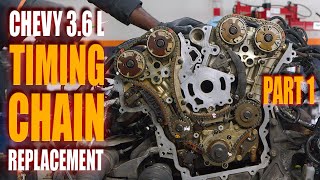
- Stretched Timing Chains 🔴 High Probability → Shop Engine Timing Chain The original timing chains on the GM 3.6L V6 were not robust enough and were prone to premature wear and stretching.
How to confirm: A mechanic can use an advanced scan tool or lab scope to check cam/crank correlation data electronically. The definitive test is 🎬 Watch: How to diagnose if you need a new timing chain. a physical inspection of chain slack by removing the timing cover, where the extension of the tensioner pistons can be a clear indicator of stretch.
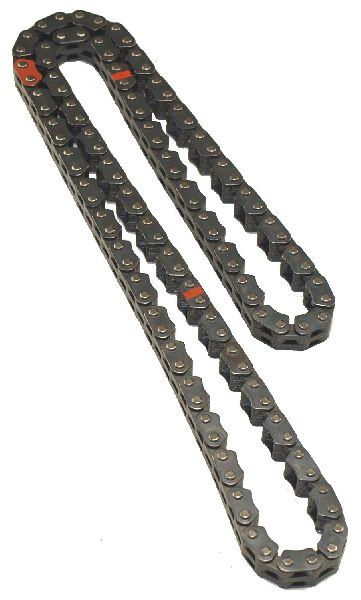
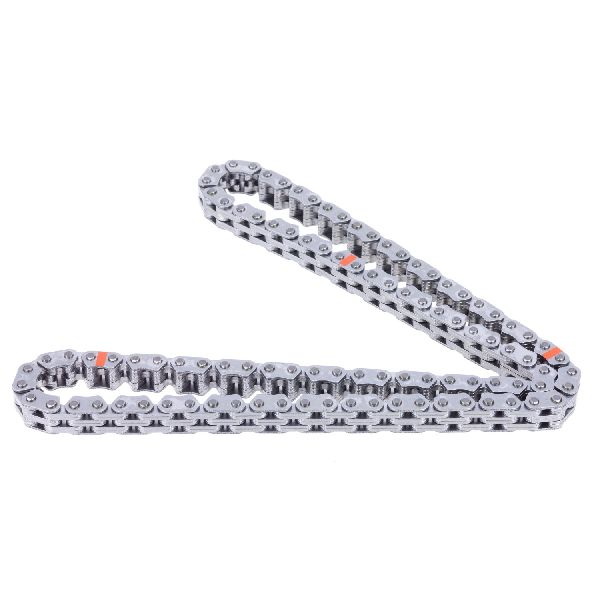
Typical fix: Replace all three timing chains, all tensioners, and all guides with an updated kit. It is also wise to replace the water pump at the same time, as it is driven by the timing chain and is inaccessible otherwise.
Est. part cost: $250-$500 - Failed Timing Chain Tensioners or Guides 🔴 High Probability → Shop Engine Timing Chain The hydraulic tensioners and plastic guides wear out, lose pressure, or become brittle and break, losing their ability to keep the chains properly tensioned.
How to confirm: Diagnosed during the physical inspection for a stretched timing chain. They are always replaced as part of a complete timing chain service.
Typical fix: Replace as part of a complete timing chain kit.
Est. part cost: $0 (included in kit) - Low Engine Oil Level or Poor Oil Quality 🟡 Medium Probability The timing chain tensioners are hydraulic and rely on clean oil at the correct pressure. GM's original Oil Life Monitor (OLM) calibration allowed for excessively long oil change intervals (10,000+ miles), which degraded the oil and starved the chains of proper lubrication, accelerating wear. This was the primary contributor to the widespread failures.
How to confirm: Check the oil dipstick and review vehicle service records. If oil is low, very dirty, or service intervals were longer than 5,000 miles, this is a root cause.
Typical fix: Correct the oil level and follow a stricter oil change interval (3,000-5,000 miles) with full-synthetic oil after repairs are made. This will not fix a chain that is already stretched.
Est. part cost: $40-$80 for an oil change
Rare But Worth Checking
- Faulty Camshaft or Crankshaft Position Sensor: → Shop Engine Crankshaft Position Sensor While a sensor can fail, it's far more likely to be a mechanical timing issue on this engine. People often replace sensors first, only to find the code returns. Unless another code specifically points to a sensor circuit fault, assume the problem is mechanical.
- Failed Camshaft Phaser / Actuator: → Shop Engine Camshaft The variable valve timing (VVT) actuator can get stuck or fail, causing a correlation code. This is less common than chain stretch but can happen, especially if oil sludge is present. Usually, a failing VVT solenoid or actuator will set its own specific trouble codes.
Diagnosis Steps
- Verify the P0016 code is present using an OBD-II scanner.
- Check the engine oil level and condition. Low or dirty oil is a major red flag and contributing factor.
- Listen for a rattling noise from the right side of the engine (passenger side), especially during a cold start.
- Using an advanced scan tool or lab scope, monitor the camshaft and crankshaft position sensor data. This allows for electronic verification of the timing deviation without engine disassembly, confirming the chains are out of sync.
- If the above steps point to a timing issue, the next step is to perform a physical inspection. This requires significant labor, including removing the engine timing cover to check for slack in the chains and the extension of the tensioners.
- If chains are found to be loose, replace them along with all related tensioners, guides, and ideally the water pump.
Parts You'll Likely Need
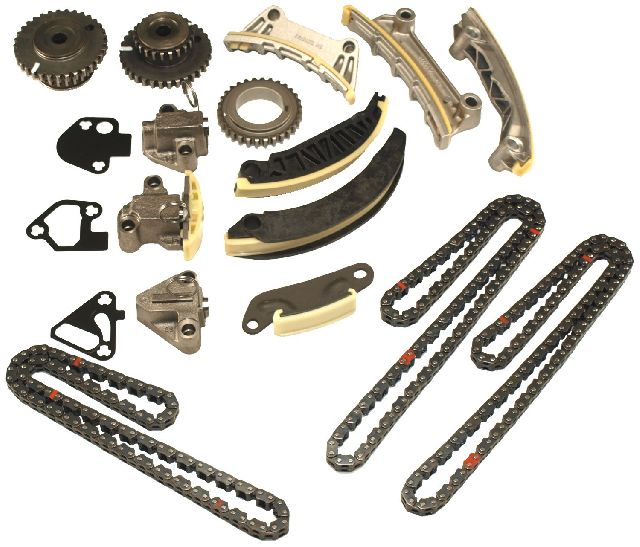
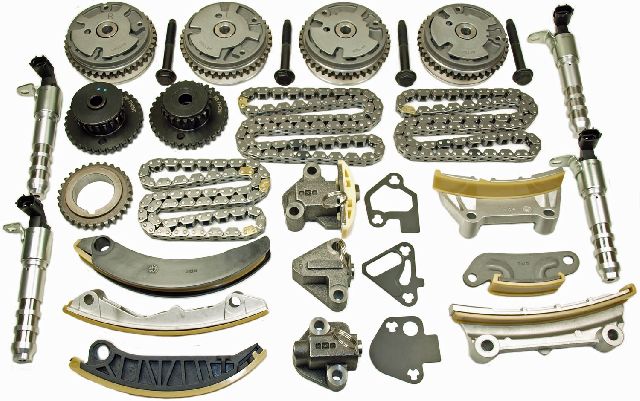
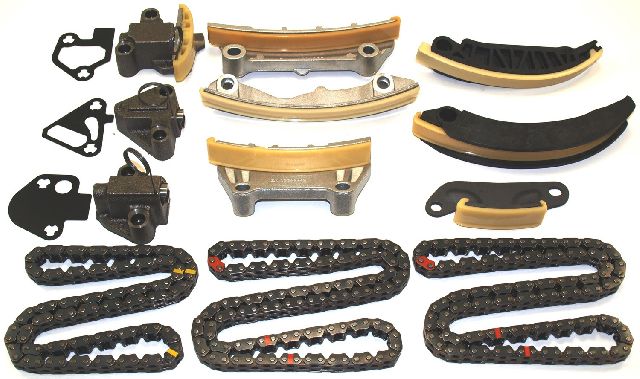
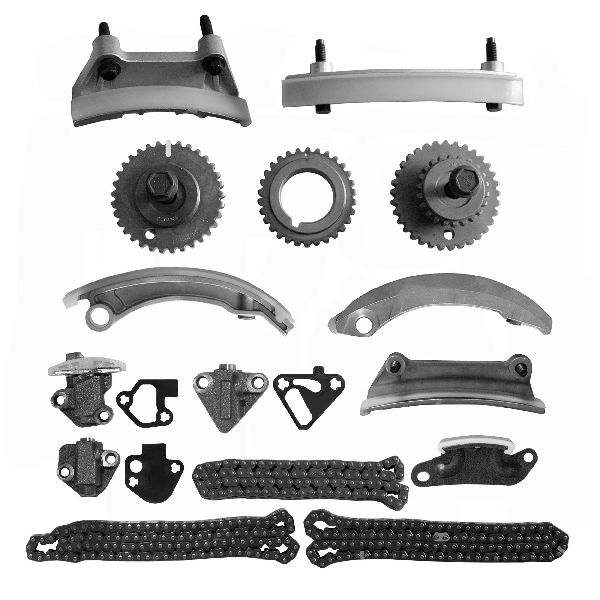
- Timing Chain Kit
(OEM #12650230 (for 2007-2008 LY7) or 12651450 (for 2009-2010 LLT))— This is the definitive fix for the root cause of P0016 on this engine. A complete kit ensures all worn components (chains, tensioners, guides) are replaced with updated parts. The part numbers are specified in GM bulletins.
Trusted brands: ACDelco (GM Genuine), Cloyes, Melling
OEM price range: $350-$500
Aftermarket price range: $200-$400
Related Codes That Often Appear With This One
- P0008 — This is a more general Engine Position System Performance code for Bank 1, often set alongside P0016 due to the same stretched timing chain issue.
- P0017 — This code indicates a correlation issue with the Bank 1 exhaust camshaft. If the primary timing chain has stretched, it can affect the timing of both intake and exhaust cams.
- P0018 / P0019 — These are the equivalent correlation codes for Bank 2 (front bank). Severe timing chain stretch can affect all camshafts, triggering multiple codes across both banks.
Technical Service Bulletins (TSBs) & Recalls
- PIP3423P: Mentions inspecting for loose timing chains or tensioners for codes including P0016.
- 12-06-01-009F: Announces the availability of updated, comprehensive timing chain kits to repair stretched chains that cause codes like P0016, P0008, and P0017.
- 11340B/C/G: This is the Special Coverage Adjustment that extended the warranty for timing chain replacement to 10 years/120,000 miles, explicitly linking the failure to premature wear.
Platform-Specific Known Issues
- GM issued Special Coverage Adjustment #11340 (eventually updated to 11340G), acknowledging the defect. It extended the warranty for this specific repair to 10 years or 120,000 miles. While this program has expired for all 2007-2010 models due to age, it serves as official acknowledgment of the widespread problem.
- GM's initial response to the issue was TSB #11340, which instructed dealers to simply reprogram the Engine Control Module (ECM) to use a less generous oil life calculation. When it became clear this did not solve the problem for chains that were already wearing, the Special Coverage was expanded to cover the full hardware replacement.
- The repair is very labor-intensive, often requiring the engine to be partially dropped from the vehicle to access the timing cover and components.
Mechanic-Grade Diagnostic Values
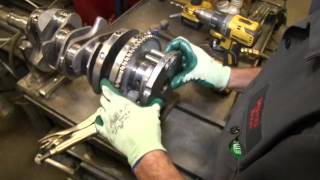
- Crankshaft Reluctor Wheel Alignment — expected: 25 to 26 mm from the end of the machined surface of the crankshaft throw to the edge of the open space 🎬 Watch: Important update on checking and securing the crankshaft reluctor wheel. in the reluctor wheel. This corresponds to approximately 3.5 teeth.. Failure: Any measurement other than the specified 25-26mm indicates the reluctor wheel has slipped on the crankshaft, which will cause persistent correlation codes even with new timing chains.
- Camshaft Position (CMP) Sensor Voltage Test (3-wire Hall effect type) — expected: With the sensor connected and ignition ON (engine OFF), back-probing the connector should show: ~5V on the reference wire, ~5V on the signal wire, and a good ground on the ground wire (verified by checking for battery voltage between the ground pin and the positive battery terminal).. Failure: Incorrect or missing voltage on the reference or signal wires points to a wiring or ECM issue. If voltages are correct, but the code persists, the sensor itself may be faulty. When the engine is running or cranked, the signal wire voltage should rapidly switch between ~5V and 0V.
- Camshaft Actuator (VVT) Solenoid Resistance — expected: Between 8 and 12 ohms across the two terminals of the solenoid. Some sources state a range of 5 to 15 ohms is acceptable, with new parts measuring around 12 ohms.. Failure: A reading of infinite resistance or extremely high resistance (e.g., mega-ohms) indicates an open circuit in the solenoid coil, requiring replacement. A reading of zero ohms would indicate a short circuit.
Scan Tool Commands That Help
- GM Tech 2 / GDS2: Camshaft Position Actuator Solenoid Control — After verifying oil level and pressure are good, this bidirectional command allows a technician to manually command the VVT solenoid on and off. By observing live data for camshaft angle, the technician can confirm if the solenoid is functioning and if the mechanical cam phaser is responding to commands. This helps differentiate between an electrical solenoid failure and a mechanical phaser failure.
Wiring & Ground Locations
- G101 — On the left side of the engine block.. The Engine Control Module (ECM) and its sensors rely on a clean ground connection to function properly. A poor ground at G101 can cause erratic sensor readings, potentially leading to false correlation codes.
- ECM Ground — The ECM is mounted to a bracket on the side of the engine. This bracket provides the ground path.. The mounting bracket can lose its clean connection to the engine block over time. Some technicians add a redundant ground wire directly from the ECM's metal case to the chassis or engine block to prevent intermittent electrical issues caused by a poor ground.
- Engine Harness Chafe Points — General areas to inspect on GM V6 engines include where the harness passes the front corner of the cylinder head, the drive belt idler pulley bracket, and the ECM/TCM bracket. TSB PI0090D specifically calls out checking for poor connections at the Camshaft Position Sensor harness connector on the 2007-2010 Outlook.. A chafed wire in the camshaft or crankshaft sensor circuits can cause a short or open, leading directly to a P0016 code. These chafe points are common failure areas due to engine vibration and movement.
Real Owner Repair Stories
- Camaro5 Forums user 'secrethero89' (2011 Chevrolet Camaro V6 (3.6L LLT engine) at 55,000 miles) — Check Engine Light with codes P0008, P0009, and P0016. The car was sluggish with extreme power loss.
❌ Tried (didn't work) Replaced all timing chains with a Cloyes kit., Replaced all 4 camshaft position sensors., Replaced all 4 VVT solenoids., Replaced all 4 camshaft phasers (actuators)., Flashed/reinstalled ECM software.
✅ What actually fixed it The crankshaft reluctor wheel had slipped 1.5 teeth from its correct position. A mechanic physically repositioned the wheel to the correct alignment (3.5 teeth from the crank's edge) without removing the crankshaft and applied a small tack weld to prevent it from moving again. This resolved all codes and restored engine power.
"I Checked Everything" — The Actual Cause
- The diagnostic equivalent for this code is when all sensors, solenoids, and even the timing chains have been replaced, yet the code persists. In these cases, the root cause is often a purely mechanical issue that is much harder to verify. The prime example for the GM 3.6L V6 is a slipped crankshaft reluctor wheel. Technicians may perform the entire, expensive timing chain job only to find the P0016 code returns because the crankshaft's reference point for the sensor is physically in the wrong spot.
When the Usual Fixes Don't Work
- While P0016 on this platform is overwhelmingly caused by stretched timing chains, there is documented evidence that performing a full timing chain replacement may not fix the issue. In a well-documented case on a similar 3.6L LLT engine, a vehicle had its timing chains, sensors, solenoids, and phasers replaced, but the P0016 code persisted. The ultimate cause was a spun crankshaft reluctor wheel, which provided an incorrect timing reference to the crankshaft position sensor. This proves that if the code returns immediately after a timing chain job, the reluctor wheel alignment must be verified before assuming the new parts are faulty or the job was done incorrectly.
OEM Part Supersession History
N/A (LY7 Piston)→N/A (LLT Piston)— Engine design change from port injection (LY7) to direct injection (LLT).
Heads up: Pistons for the LY7 (2007-2008) and LLT (2009-2010) engines are not interchangeable. The LLT piston has a different shape on top to accommodate the direct injector spray pattern and is designed for a higher compression ratio (11.3:1 vs 10.2:1). Using the wrong pistons will result in poor performance and potential engine damage.
Model Year Variations Within This Range
- 2007-2008 vs 2009-2010: The engine was changed from the 3.6L LY7 (port injection) in 2007-2008 to the 3.6L LLT (direct injection) in 2009-2010. This change affects the fuel system, pistons, and compression ratio.
- 2008 vs 2009-2010: According to GM TSB #PI0090D, when investigating intermittent hesitation or flutter that can be related to P0016, the specific camshaft position sensor connector to inspect differs. For the 2008 Outlook (LY7), the focus is the Bank 1 *Exhaust* sensor connector. For 2009-2010 models (LLT), the focus is the Bank 1 *Intake* sensor connector.
Helpful Videos
We Have This Part in Stock

The information in this article is provided for general reference and educational purposes only. Vehicle specifications, procedures, and part compatibility can vary by production date, trim level, and region. Always consult your vehicle's factory service manual and verify part numbers before purchasing or performing repairs. Safety-critical components such as airbags, seat belts, and braking systems should be installed by a qualified professional.
- Saturn OUTLOOK:
- 🧭 Diagnostic Flowchart
- 🎬 Helpful Videos
- 🛍️ Shop This Part
- What's Unique About the 2007-2010 Saturn OUTLOOK
- Symptoms You May Notice
- Most Likely Causes
- Rare But Worth Checking
- Diagnosis Steps
- Parts You'll Likely Need
- Related Codes That Often Appear With This One
- Technical Service Bulletins (TSBs) & Recalls
- Platform-Specific Known Issues
- Mechanic-Grade Diagnostic Values
- Scan Tool Commands That Help
- Wiring & Ground Locations
- Real Owner Repair Stories
- "I Checked Everything" — The Actual Cause
- When the Usual Fixes Don't Work
- OEM Part Supersession History
- Model Year Variations Within This Range
- 🎟️ Get 5% Off