

P0017 on 2008-2017 Buick Enclave 3.6L: Stretched Timing Chain Causes & Fixes
This code almost always means the timing chains have stretched, a very common and serious issue on this engine. The repair is expensive, typically costing $2,500-$3,700, and involves replacing the full timing chain kit. Do not simply replace sensors, as they are rarely the cause. An oil flush is a low-cost first step, but often does not resolve a mechanical timing issue.
- P0017 on a 2008-2017 Enclave is a very serious code that almost certainly means the timing chains have stretched.
- Do not waste money replacing the camshaft or crankshaft sensors; they are almost never the root cause of this code on this engine.
- The repair is complex and expensive, requiring a full timing chain kit replacement by a professional, with costs often exceeding $2,500.
- Stop driving the vehicle immediately to prevent the chain from breaking, which would cause catastrophic engine failure.
- The best preventative measure is frequent oil changes (every 3,000-5,000 miles) with a high-quality full synthetic oil to protect the timing components.
What's Unique About the 2008-2017 Buick Enclave
The GM 3.6L V6 engine family (LY7, LLT) used in the first-generation Enclave is infamous for premature timing chain stretching. This issue is so prevalent that codes P0017, P0008, and others are considered direct indicators of a mechanical timing failure rather than a sensor issue. The problem was often accelerated by the original Oil Life Monitor (OLM) calibration, which allowed for excessively long oil change intervals (sometimes over 10,000 miles), leading to oil degradation and sludge that damaged the chains and hydraulic tensioners. GM acknowledged this with Special Coverage Adjustment #11340C, which extended the warranty for this issue on certain model years and involved reprogramming the OLM for more frequent changes.
Symptoms You May Notice
- Check Engine Light illuminated
- Rough or uneven idle
- Rattling or chain-slap noise from the engine, especially on a cold start
- Reduced engine power and poor acceleration
- Engine may stall, especially at low speeds
- Sudden loss of power while driving at highway speeds.
- Replacing only the camshaft position sensor.
- Replacing only the crankshaft position sensor.
- An owner complaint filed with the NHTSA and numerous forum discussions confirm that replacing sensors alone does not fix the code when the underlying cause is mechanical. For instance, NHTSA ODI #11375379 reports that codes P0017 and P0008 continued to reappear while driving and parked even after replacing sensors.
Most Likely Causes
- Stretched Timing Chains 🔴 High Probability → Shop Engine Timing Chain The original timing chains used in the 3.6L V6 were of a design susceptible to premature wear and stretching, a well-documented issue across many GM platforms using this engine. NHTSA ODI #11317317 specifically documents worn out timing chains and gears as the cause for engine codes P0017, P0018, and P0019.
How to confirm: A professional technician can use a scan tool to view the 'Camshaft Position Variance' data. If the deviation for Bank 1 Exhaust exceeds the manufacturer's specification (10° retarded or 13° advanced), the chain is confirmed to be stretched. Visual inspection requires significant engine disassembly, but is the definitive confirmation.
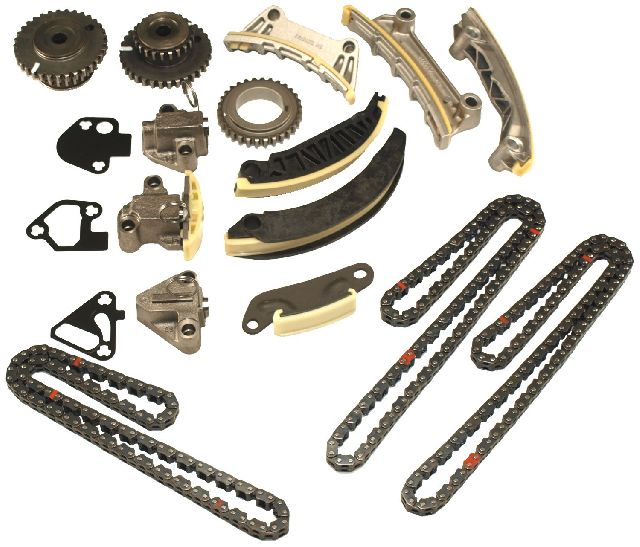
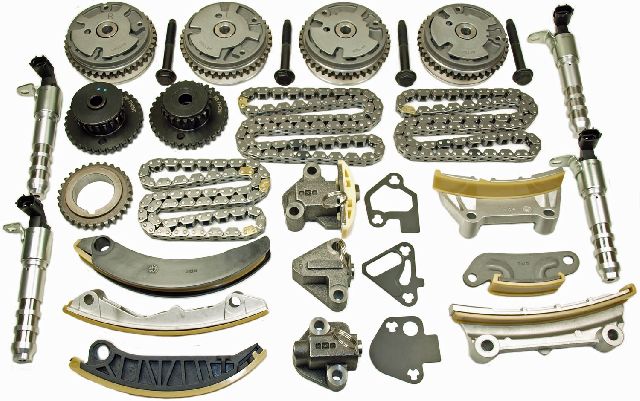
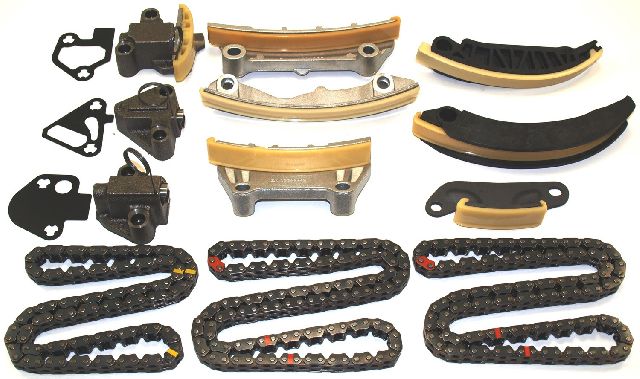
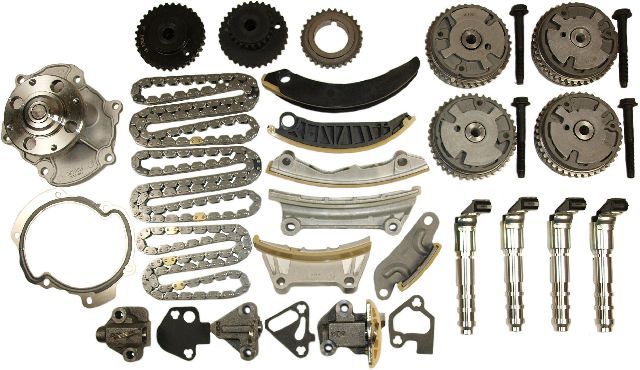
Typical fix: Complete replacement of all three timing chains, all tensioners, and all guides with an updated OEM or quality aftermarket kit. This is a very labor-intensive job. The updated GM kits were designed to be more durable.
Est. part cost: $400-$800 - Low or Degraded Engine Oil 🟡 Medium Probability The timing chain tensioners are hydraulic and rely on clean oil at the proper pressure to keep the chains tight. Extended oil change intervals, as originally recommended by the OLM, lead to sludge and oil breakdown, accelerating wear on the timing system.
How to confirm: Check the oil level on the dipstick and inspect its condition. If the oil is very dark, sludgy, or below the 'add' line, this is a likely contributing factor.
Typical fix: Perform an engine oil and filter change using a high-quality full synthetic oil meeting GM's dexos1 specification. An engine flush may be recommended by some mechanics to clean sludge from hydraulic components. This is often a preliminary step and may not solve the problem if the chains are already stretched.
Est. part cost: $50-$100 - Failed Timing Chain Tensioners 🟡 Medium Probability → Shop Engine Timing Chain The hydraulic tensioners can weaken, fail, or get stuck due to sludge or wear, leading to slack in the timing chains and causing correlation faults. Manufacturer Bulletin #PIP3423P notes that technicians should specifically inspect for loose timing chains or tensioners when P0017 is set.
How to confirm: This is typically diagnosed during a timing chain inspection by observing the tensioner piston extension. There is no easy way to confirm without disassembling the front of the engine.
Typical fix: Tensioners are always replaced as part of a complete timing chain kit replacement.
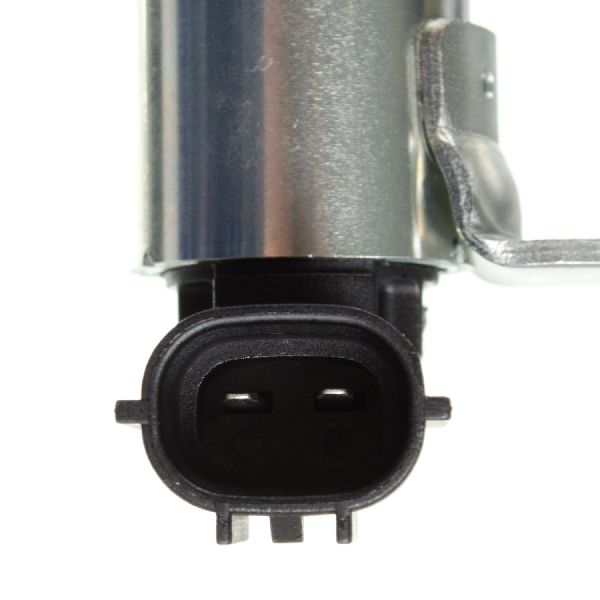
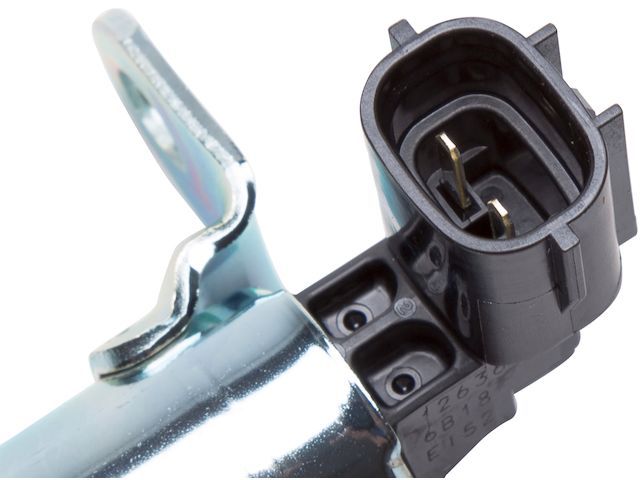
Est. part cost: $100-$200 (if bought separately, but included in kits) - Faulty Camshaft Actuator Solenoid (VVT Solenoid) ⚪ Low Probability → Shop Engine Camshaft These solenoids control oil flow to the camshaft phasers. They have fine mesh screens that can become clogged with sludge or debris, causing them to stick or respond slowly.
How to confirm: Swap the Bank 1 exhaust solenoid with the Bank 1 intake solenoid. Clear the codes and run the engine. If the code changes to P0016 (Intake Camshaft Position Correlation), the solenoid is faulty. If P0017 returns, the problem is mechanical (chains). They can also be tested for resistance (GM specification is 6.9-7.9 Ohms at 68°F/20°C).
Typical fix: Replace the faulty solenoid. It is often recommended to replace all four while the engine is apart for a timing chain job.
Est. part cost: $30-$70
Rare But Worth Checking
- Slipped Crankshaft Reluctor Wheel: → Shop Engine Crankshaft A GM Technical Service Bulletin (TSB #PIP3423P) notes that the reluctor wheel on the crankshaft, which the position sensor reads, can move or shift its position. This is a major mechanical repair that can mimic the symptoms of a stretched chain and can be inspected with a borescope through the crank sensor hole.
Diagnosis Steps
- Verify the engine oil level and condition. If low or dirty, consider an engine flush and perform an oil/filter change with the correct synthetic oil, then clear codes to see if they return.
- Scan the ECM for all stored trouble codes. Note if P0008, P0016, P0018, or P0019 are present, as this strongly indicates a timing chain issue. NHTSA ODI #11022515 describes a case where P0017 was stored alongside misfire code P0300, requiring a PFI system diagnostic test.
- Listen for a rattling noise from the passenger side of the engine on a cold start, which is a sign of a loose timing chain.
- As a low-cost diagnostic step, swap the Bank 1 exhaust and intake VVT solenoids. If the code changes from P0017 to P0016, the solenoid is bad. If P0017 returns, the issue is mechanical.
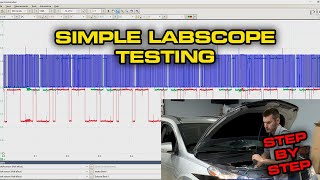
- If the above steps do not resolve the issue, seek professional diagnosis. A technician will use an advanced scan tool to monitor camshaft deviation angles 🎬 Watch: How to use a labscope to confirm timing issues. to definitively confirm a stretched timing chain before recommending a replacement.
- A technician may also use a borescope to inspect the crankshaft reluctor wheel for movement through the crankshaft position sensor opening, as outlined in TSB PIP3423P.
Parts You'll Likely Need
- Engine Timing Chain Kit
(OEM #12651450 (for LLT, superseded by 12700436 and 12693218))— This is the definitive fix for the high-probability cause of a stretched timing chain. A complete kit includes all chains, guides, and tensioners needed for the job. GM has released updated, more durable versions of these kits.
Trusted brands: ACDelco (OEM), Cloyes
OEM price range: $400-$600
Aftermarket price range: $250-$450 - Camshaft Position Actuator Solenoid (VVT Solenoid)
(OEM #12655421 (Exhaust))— Often replaced as a preventative measure during a timing chain job, or as a diagnostic step. Sludge can cause them to fail and trigger timing codes.
Trusted brands: ACDelco, Delphi
OEM price range: $40-$80
Aftermarket price range: $25-$50
Related Codes That Often Appear With This One
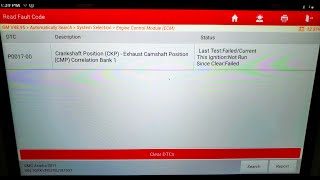
- P0008 — This is a general Engine Positions System Performance code for Bank 1. Its presence with P0017 is a classic and very strong 🎬 See this video for a breakdown of P0017 on GM 3.6L engines. indicator of a stretched primary timing chain affecting the entire bank.
- P0016 — This code is for the Bank 1 INTAKE camshaft. Seeing P0016 and P0017 together means the entire bank is out of time, further confirming a stretched secondary timing chain on Bank 1 or a stretched primary chain.
- P0018 / P0019 — These are the equivalent codes for Bank 2 (front of the engine). If codes for both banks are present (e.g., P0017 and P0018), it points definitively to a problem with the primary timing chain that connects the crankshaft to both cylinder heads or a slipped reluctor wheel.
Technical Service Bulletins (TSBs) & Recalls
- PIP3423P / PIP3423M: Guides technicians to inspect for loose timing chains and also for a slipped crankshaft reluctor wheel when P0017 and related codes are set. Bulletin #PIP3423P specifically mentions that P0016, P0017, P0018, P0019, P0008 or P0009 may be set.
- 12-06-01-009F (and later revisions): Provides information on updated timing chain kits and clarifies that for a simple stretched chain, only the chains, guides, and tensioners need replacement, not the sprockets or phasers.
- 11340C: This was a Special Coverage Adjustment, not a standard TSB. It provided an extended warranty (10 years/120,000 miles) for timing chain replacement on affected models, including the 2009 Enclave, and included an ECM reprogram.
Platform-Specific Known Issues
- GM issued a Special Coverage Adjustment (#11340C) for timing chain wear on 2009 Enclave models (among others), extending the warranty to 10 years or 120,000 miles. This program has since expired for all vehicles.
- The original factory programming for the Oil Life Monitor (OLM) was a major contributing factor to premature chain wear. The fix under Special Coverage #11340C included reprogramming the ECM to recommend more frequent oil changes.
- A class-action law
Mechanic-Grade Diagnostic Values
- Bank 1 Exhaust Camshaft Position vs. Crankshaft Position Correlation — expected: Deviation should be less than 10° retarded or 13° advanced.. Failure: A deviation exceeding these thresholds will trigger DTC P0017.
- Camshaft Position (CMP) Actuator Solenoid Resistance — expected: 6.9 to 7.9 Ohms at 68°F (20°C). Failure: A reading outside this range, or an open/short circuit, indicates a faulty solenoid.
- Camshaft Position (CMP) Sensor Signal Voltage (Key On, Engine Off) — expected: 4.8 to 5.2 Volts (testing between the sensor's signal circuit and a known good ground). Failure: Voltage significantly below 4.8V or above 5.2V points to a wiring or ECM issue, not necessarily a bad sensor.
- Crankshaft Reluctor Wheel Position — expected: 25 to 26 mm from the machined surface of the crankshaft throw to the edge of the open space in the reluctor wheel.. Failure: Any measurement outside this range indicates the reluctor wheel has slipped on the crankshaft, requiring crankshaft replacement.
Scan Tool Commands That Help
- GDS2 (GM Global Diagnostic System 2): Camshaft Position Actuator Test — This bidirectional control commands the VVT solenoid to a specific angle (e.g., 0 to 20 degrees) while the engine is running. The technician can then compare the 'Desired Camshaft Position' with the 'Actual Camshaft Position' PIDs. If the actual angle doesn't change or is slow to respond, it confirms a fault with the solenoid, oil passages, or the phaser itself.
- GDS2 (or high-end aftermarket scanner): Crankshaft Position Variation Learn — This procedure is critical and must be performed after replacing the crankshaft, crankshaft position sensor, or the ECM. It allows the ECM to learn the minor variations in the crankshaft reluctor wheel to ensure accurate timing calculations. Failure to perform this can result in persistent correlation codes even with all new parts.
Wiring & Ground Locations
- ECM Location — On the 3.6L engine, the ECM is located at the front of the engine, mounted near the vacuum pump. On Bank 1 (firewall side), it is near the ignition coils.. The ECM is the source of the 5V reference voltage for the sensors and controls the ground for the VVT solenoids. Its location is key for any circuit testing.
- G103 / G113 — On similar GM 3.6L platforms, G103 is a critical ground fastened to the ECM case, and G113 is located on the front center of the Bank 1 (firewall side) cylinder head.. A poor ground connection at the cylinder head or ECM can introduce electrical noise or voltage drops, corrupting the signals from the camshaft and crankshaft sensors and leading to false correlation codes.
- Bank 1 Camshaft Position Sensor / Solenoid Locations — Bank 1 is the cylinder head against the firewall. The intake and exhaust camshaft position sensors and actuator solenoids are located on this head, though access is tight.. Correctly identifying Bank 1 and the specific exhaust sensor/solenoid is essential, as swapping or testing the wrong components (on the easier-to-access Bank 2) will not diagnose a P0017.
Real Owner Repair Stories
- YouTube channel 'Rust Belt Auto' (2011 GMC Acadia 3.6L V6 (same platform/engine)) — Check Engine Light with code P0017.
❌ Tried (didn't work) The technician noted that many would incorrectly replace sensors or even timing chains for this code.
✅ What actually fixed it The technician used a graphing scan tool to monitor all four camshaft position sensor counters and the crankshaft position counter simultaneously. The cam sensors showed a steady, consistent 'stair step' pattern, while the crankshaft sensor signal was erratic and all over the place. This immediately pointed to a mechanical issue with the crankshaft reluctor wheel, not the timing chains or sensors. The confirmed fix is crankshaft replacement. - Reddit user in r/MechanicAdvice (Vehicle with 3.6L V6 engine) — P0017 code returned immediately after a major timing job.
❌ Tried (didn't work) Replaced timing chain, tensioners, both CVVT sprockets, and the exhaust camshaft itself due to a broken dowel pin., Replaced the crankshaft position sensor., Cleaned and tested the oil control valves (solenoids) prior to the job.
✅ What actually fixed it The issue was unresolved in the post, but the primary suggestions from other mechanics were that the problem was no longer the main mechanical parts. The likely causes were either residual sludge still affecting the oil control valve's operation or, more likely, the failure to perform a proper 'Crankshaft Position Variation Learn' procedure with a capable scan tool after the repair. Simply clearing the code with a basic reader is not sufficient. - NHTSA ODI #11197317 — An owner reported the "dreaded timing chain codes" P0008 and P0017 at 128,000 miles. They noted that most shops would not even perform the repair due to its extensive nature.
Documented NHTSA Reports
- NHTSA ODI #11317317: An owner reported worn out timing chain and gears causing engine codes P0017, P0018, and P0019.
- NHTSA ODI #11375379: A report describes codes P0017 and P0008 for the camshaft and crankshaft position sensors appearing while driving and parked, even after attempted repairs.
- NHTSA ODI #11022515: A technician performed a PFI system diagnostic test after codes P0017 and P0300 were stored, eventually requiring replacement of timing chains, spark plugs, and ignition coils.
OEM Part Supersession History
12651450→12693218, then 12700436— GM progressively updated the timing chain kits to incorporate more durable chains and improved guide materials to combat the premature stretching issue.
Heads up: While older kits may physically fit, only the latest available OEM part number (or a quality aftermarket equivalent like Cloyes 9-0753S) should be used to ensure the most durable components are installed and prevent a repeat failure.12655421 (Exhaust VVT Solenoid)→12679100— GM released updated service parts to resolve issues with internal clearances and susceptibility to clogging from oil debris.
Heads up: Per TSB #PIP5096C (for related codes), it is recommended to use the updated OEM service part rather than swapping solenoids as a permanent fix, as the original parts may have been from a faulty batch.
Model Year Variations Within This Range
- 2008 vs. 2009-2017: The 2008 model year used the 3.6L LY7 port-injected V6 (275 hp). From 2009-2017, the Enclave used the 3.6L LLT direct-injection V6 (288 hp). While the timing chain architecture and failure mode are fundamentally the same, some sensors and the ECM are different. The direct-injection LLT engine is also more sensitive to fuel system and carbon buildup issues, though these do not directly cause P0017.
Diagnostic Flowchart
Real Owner Stories
Aggregated from forums and TSBs cited above. Mileages and costs reflect what owners reported in those sources.
2011 Buick Enclave 3.6L V6 — 130000 miles
Symptoms: Experienced codes P0008 and P0017.
What fixed it: Confirmed as a stretched timing chain requiring complete replacement.
Cost: $3200-$4500
Source hint: enclaveforum.net thread titled "P0008, P0017 and the dreaded timing chain saga"
2009 Chevrolet Traverse 3.6L V6
Symptoms: Sudden loss of power while driving, accompanied by codes P0008, P0017, and P0420.
What fixed it: Identified as a stretched timing chain.
Source hint: Reddit (r/MechanicAdvice) thread titled "09-Chevy-Traverse, Codes P0008, P0017, P0420"
2009 Chevrolet Traverse 3.6L V6
Symptoms: Triggered code P0008 alongside P0017, P0018, and P0019.
What fixed it: Diagnosed as a primary timing chain issue or a slipped reluctor wheel based on factory service manual criteria.
Source hint: BobIsTheOilGuy.com thread titled "09 traverse p0008"
Related OBD-II Codes
Frequently Asked Questions
Does Special Coverage Adjustment #11340C still cover my Buick Enclave for timing chain replacement?
Why did my Enclave's timing chain stretch prematurely?
Can I just replace the VVT solenoids to fix P0017 on my 3.6L V6?
What parts need to be replaced if my Enclave has a stretched timing chain?
How can a mechanic confirm my Enclave's timing chain is stretched without taking the engine apart?
What does TSB PIP3423P mean for my diagnosis?
Helpful Videos


We Have This Part in Stock

The information in this article is provided for general reference and educational purposes only. Vehicle specifications, procedures, and part compatibility can vary by production date, trim level, and region. Always consult your vehicle's factory service manual and verify part numbers before purchasing or performing repairs. Safety-critical components such as airbags, seat belts, and braking systems should be installed by a qualified professional.
- Buick Enclave:
- 🧭 Diagnostic Flowchart
- 🎬 Helpful Videos
- 🛍️ Shop This Part
- What's Unique About the 2008-2017 Buick Enclave
- Symptoms You May Notice
- Most Likely Causes
- Rare But Worth Checking
- Diagnosis Steps
- Parts You'll Likely Need
- Related Codes That Often Appear With This One
- Technical Service Bulletins (TSBs) & Recalls
- Platform-Specific Known Issues
- Mechanic-Grade Diagnostic Values
- Scan Tool Commands That Help
- Wiring & Ground Locations
- Real Owner Repair Stories
- Documented NHTSA Reports
- OEM Part Supersession History
- Model Year Variations Within This Range
- Real Owner Stories
- 2011 Buick Enclave 3.6L V6 — 130000 miles
- 2009 Chevrolet Traverse 3.6L V6
- 2009 Chevrolet Traverse 3.6L V6
- Related OBD-II Codes
- Frequently Asked Questions
- 🎟️ Get 5% Off