

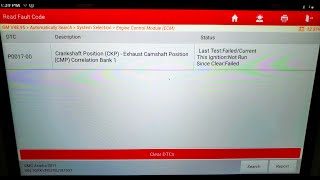
P0017 on 2016-2018 Buick Enclave: Crankshaft/Camshaft Correlation Causes and Fixes
On a 2016-2018 Buick Enclave, P0017 almost always indicates a stretched timing chain, a known issue with the 3.6L V6 engine. This is a serious, labor-intensive repair. Before committing to this expensive fix, a preliminary step is to perform an engine oil flush and change, as sludge can sometimes cause the VVT system to malfunction and trigger the code. Expect shop costs for a full timing chain kit replacement to range from $2,700 to $3,700.
- P0017 on a 2016-2018 Enclave is a serious code that almost always points to a stretched timing chain.
- Do not simply replace the sensors; they are rarely the root cause. The underlying issue is usually mechanical.
- Driving with this code is risky and can lead to complete engine failure if the timing chain breaks.
- The repair is complex and expensive, typically costing over $2,700. It is not a recommended DIY job.
- Always check the engine oil level and condition first, as low or dirty oil can cause issues with the VVT system and contribute to this code.
What's Unique About the 2016-2018 Buick ENCLAVE
The 3.6L V6 engine family (LY7, LLT, LFX, LFY) used in the Buick Enclave and its platform mates has a well-documented history of premature timing chain stretching. This issue was often attributed to a combination of factors: an early chain design susceptible to wear, and an overly optimistic Oil Life Monitor (OLM) calibration that encouraged excessively long oil change intervals. While designs were updated for later engines like the LFX and LFY, the problem can still occur. As a result, P0017 on this specific vehicle is much more likely to be a major mechanical fault than a simple sensor failure.
Diagnostic Flowchart
Tap your situation to follow the diagnostic path that matches what you're seeing on this vehicle.
Generation note: This range covers two generations. The 2016-2017 models belong to the first generation, while the 2018 model marks the beginning of the second generation. The 2016-2017 models use the 3.6L LFX V6 engine (288 hp), while the redesigned 2018 model uses an updated 3.6L LFY V6 (310 hp) with a new 9-speed transmission and start-stop technology. However, both engines share the same fundamental architecture and can suffer from similar timing chain issues leading to code P0017, as noted in GM TSB #PIP3423P which covers both LFX and LFY engines.
Symptoms You May Notice
- Check Engine Light illuminated
- Rough or unstable idle
- Reduced engine power and poor acceleration
- Rattling or whining noise from the engine, especially on cold startup
- Engine stalling or difficulty starting
- Increased fuel consumption
- Replacing only the camshaft position sensor without diagnosing the underlying mechanical timing system. The sensor is rarely the root cause on this engine.
- Replacing only the VVT solenoid when the timing chains are actually stretched. While a solenoid can be the cause, it's often a symptom of a larger oil sludge issue or a separate failure from the primary chain issue.
Most Likely Causes
- Stretched Timing Chains 🔴 High Probability → Shop Engine Timing Chain The GM 3.6L V6 has a known history of timing chain issues. The provided NHTSA TSB #PIP3423P directly links P0017 to inspecting for loose timing chains. Extended oil change intervals, as once recommended by the GM Oil Life Monitor, accelerate wear on the chains.
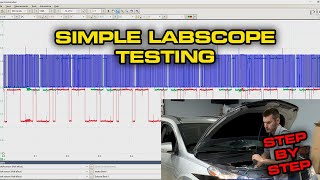
How to confirm: A technician can use a scan tool to observe the camshaft position deviation angles; a variance greater than 10-13 degrees 🎬 See how a technician uses a labscope to diagnose timing. suggests a mechanical timing issue. Definitive diagnosis requires physical inspection of the chains and tensioners for slack, which is labor-intensive.
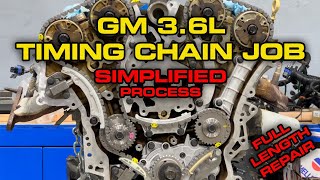
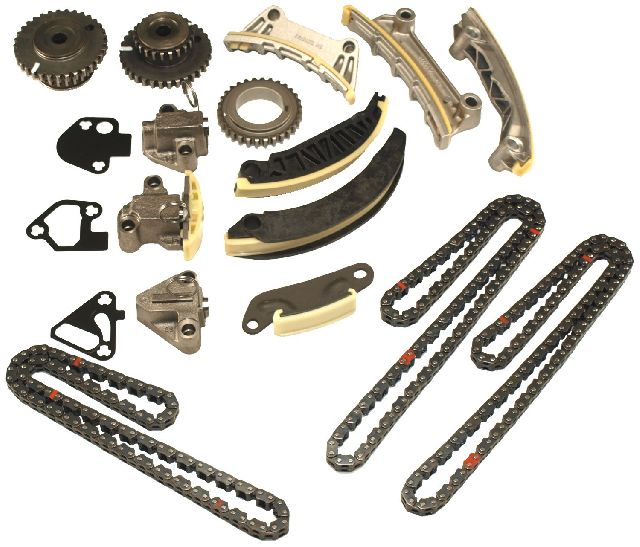
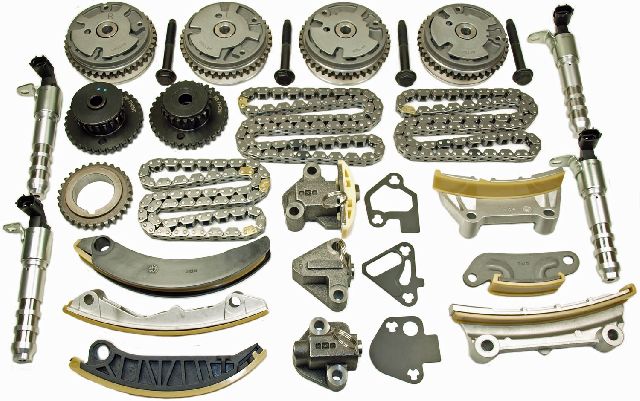
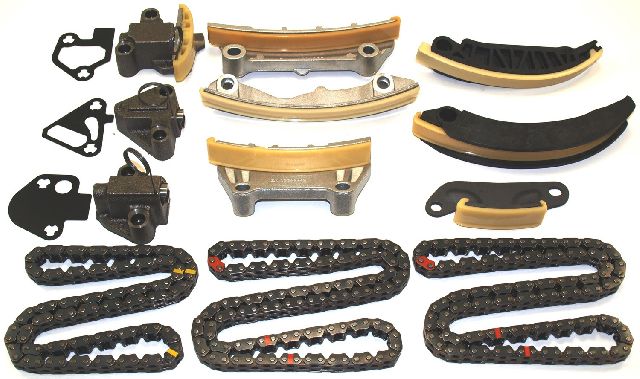
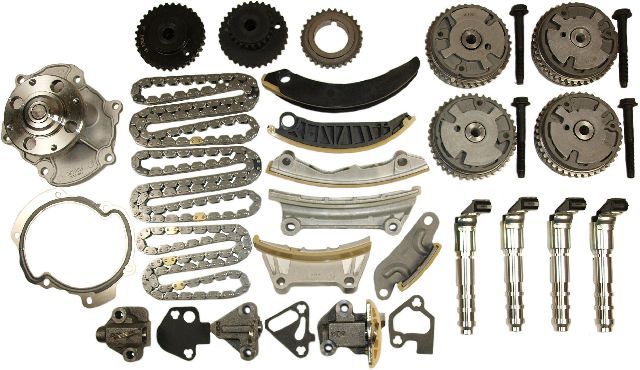
Typical fix: Replace all three timing chains, all tensioners, and all guides with a complete timing chain kit. It is also wise to replace the water pump and VVT solenoids during this extensive repair.
Est. part cost: $400-$800 - Failed Timing Chain Tensioner(s) 🔴 High Probability → Shop Engine Timing Chain The tensioners are hydraulic and rely on clean oil at the proper pressure to maintain chain slack. If they fail due to wear or oil sludge, the chain can become loose, causing correlation errors. They are always replaced along with the chains.
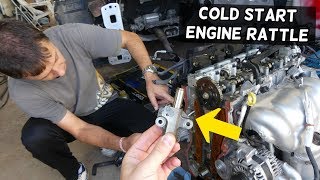
How to confirm: Physical inspection is required. A rattling noise, especially at startup, is a strong indicator of a slack chain due to a failed tensioner.
Typical fix: Replace the failed tensioner(s). It is highly recommended to replace the full timing chain kit at the same time, as the labor is nearly identical.
Est. part cost: Included in the full timing chain kit cost. - Low or Dirty Engine Oil 🟡 Medium Probability The camshaft phasers (actuators) and timing chain tensioners are hydraulically operated by engine oil pressure. Low or contaminated oil can cause them to function improperly, leading to timing correlation codes. Some owners suggest an engine flush as a first step before attempting major repairs. 🎬 Watch: Try this simple engine flush before replacing timing chains.
How to confirm: Check the oil level on the dipstick and inspect its condition and service history. An engine flush may be attempted as a preliminary diagnostic step.
Typical fix: Perform an oil and filter change using a full synthetic oil that meets the GM dexos1 specification. An engine flush may be beneficial if sludge is suspected.
Est. part cost: $50-$100 - Faulty Exhaust Camshaft Actuator Solenoid (VVT Solenoid) 🟡 Medium Probability → Shop Engine Camshaft This solenoid controls oil flow to the camshaft phaser. It has fine mesh screens that can get clogged with sludge or debris from infrequent oil changes, causing it to stick or respond slowly.
How to confirm: A technician can command the solenoid with a scan tool to check for response. It can also be removed, cleaned, and tested for resistance (typically 8 to 13 Ohms). Swapping the exhaust solenoid with the intake solenoid on the same bank is a common diagnostic trick; if the code changes to P0016, the solenoid is confirmed to be faulty.
Typical fix: Replace the Bank 1 exhaust camshaft actuator solenoid.
Est. part cost: $40-$90 - Faulty Camshaft Position Sensor (Bank 1 Exhaust) ⚪ Low Probability → Shop Engine Camshaft Position Sensor
How to confirm: Monitor the sensor's output with a scan tool or oscilloscope. Swapping the sensor with the one from the intake or the other bank to see if the code changes is a valid diagnostic step, but this sensor is rarely the root cause for a correlation code on this engine.
Typical fix: Replace the Bank 1 exhaust camshaft position sensor.
Est. part cost: $30-$70
Rare But Worth Checking
- Slipped Crankshaft Reluctor Wheel: → Shop Engine Crankshaft The reluctor wheel is what the crankshaft sensor reads. TSB #PIP3423P notes that this wheel, which is pressed onto the crankshaft, can move from its original position. This will cause timing codes even with perfect mechanical timing. Diagnosis can sometimes be done with a borescope through the crank sensor hole, but confirmation may require comparing to a new crankshaft. The fix is a full crankshaft replacement.
- Faulty Crankshaft Position Sensor: → Shop Engine Crankshaft Position Sensor While less likely to fail than a camshaft sensor for this specific code, a faulty crankshaft sensor can disrupt the correlation check. Estimated replacement cost is between $155 and $223.
- Wiring or Connector Issue: A damaged wire or loose/corroded connection to the Bank 1 exhaust camshaft position sensor or the VVT solenoid can cause intermittent signal loss, triggering the code.
Diagnosis Steps
- Verify the engine oil level and condition. An oil change with an engine flush is a recommended first step if oil quality is questionable.
- Use a professional scan tool to check for any other related trouble codes and view freeze-frame data.
- Monitor live data for 'Camshaft Position Variance' for Bank 1 Exhaust. A consistent deviation greater than 10-13 degrees at idle points to a mechanical timing issue.
- Inspect the wiring and connector for the Bank 1 exhaust camshaft position sensor and the VVT solenoid for any visible damage, corrosion, or loose pins.
- Command the Bank 1 exhaust VVT solenoid ON and OFF with the scan tool to check for an audible click and a change in engine idle.
- If the solenoid is suspected, swap the Bank 1 exhaust and intake solenoids. Clear codes and drive the vehicle. If the code changes to P0016, the solenoid is faulty.
- If the solenoid tests good, remove and test the camshaft position sensor. Check its resistance and consider swapping it with another sensor to see if the code follows.
- If all electronic and hydraulic tests pass, a mechanical timing issue is highly likely. This requires a physical inspection of the timing chains, guides, and tensioners, which is a labor-intensive process. At this stage, also consider the possibility of a slipped crankshaft reluctor wheel as per TSB PIP3423P.
Parts You'll Likely Need
- Engine Timing Chain Kit
(OEM #12651450 (May be superseded, verify with dealer))— This is the most common cause of P0017. A complete kit ensures all wear
Related Codes That Often Appear With This One
- P0008 — This is a general engine position system performance code for Bank 1. Its presence with P0017 strongly points to a base timing issue like a stretched primary timing chain affecting both camshafts on that bank.
- P0016 — This code indicates a correlation issue with the Bank 1 INTAKE camshaft. If P0016 and P0017 appear together, it's a very strong indication of a stretched secondary timing chain affecting all of Bank 1, or a stretched primary chain.
- P0018 / P0019 — These are the equivalent intake and exhaust correlation codes for Bank 2 (the cylinder bank closer to the radiator). Seeing these along with Bank 1 codes is a definitive sign of a primary timing chain issue or a slipped crankshaft reluctor wheel.
Technical Service Bulletins (TSBs) & Recalls
- Advises technicians that codes P0016, P0017, P0018, P0019, P0008, or P0009 can be caused by loose timing chains, failed tensioners, or a slipped crankshaft reluctor wheel. This TSB covers a wide range of GM HFV6 engines, including the LFX and LFY.
- Though expired for most vehicles, this was a warranty extension GM issued for earlier 3.6L models (primarily 2007-2011) due to the high rate of premature timing chain wear, acknowledging the widespread nature of the problem.
Platform-Specific Known Issues
- GM Oil Life Monitor (OLM) Calibration: In earlier models of the 3.6L V6, the OLM was calibrated to allow for very long oil change intervals (sometimes over 10,000 miles). This led to oil breakdown and sludging, which starved the hydraulic tensioners and chains of proper lubrication, drastically accelerating wear. GM later issued software updates to recommend more frequent changes. Owners are strongly advised to change the oil every 5,000 miles with full synthetic dexos1 oil, regardless of the OLM reading.
Mechanic-Grade Diagnostic Values
- Camshaft Position Actuator Solenoid (VVT Solenoid) Resistance — expected: 8 to 13 Ohms. Failure: A reading outside this range, or an open/short circuit, indicates a faulty solenoid.
- Camshaft Position Sensor Low Reference Circuit to Ground — expected: < 5.0 Ohms. Failure: Resistance greater than 5.0 Ohms indicates high resistance or an open in the sensor's ground circuit.
- Scan Tool 'Camshaft Position Variance' PID at Idle — expected: Stable and near 0 degrees.. Failure: A consistent deviation of more than +/- 4-5 degrees strongly suggests a mechanical timing issue.
- Camshaft Position Sensor Bolt Torque — expected: 10 N.m (89 lb in). Failure: N/A
Scan Tool Commands That Help
- GDS2 / Tech2: Camshaft Position Actuator Solenoid Control/Test — To functionally test the VVT solenoid, oil passages, and phaser. The command allows a technician to manually activate the solenoid while the engine is running. A change in engine idle or stalling confirms the hydraulic part of the system is responding.
- GDS2 / Tech2: Crankshaft Position (CKP) Variation Learn — This is mandatory after replacing the timing chains, crankshaft position sensor, or ECM. It allows the ECM to learn the minor variations in the crankshaft reluctor wheel to ensure accurate timing and misfire detection, preventing codes from returning after a repair.
Wiring & Ground Locations
- G113 — Left side of the engine, at an engine-to-transmission stud (Bank 1 side).. This is a critical ground point for the engine block on the same side as the affected sensors for P0017 (Bank 1). A loose or corroded connection here could impact the signal quality of the cam and crank sensors.
- G101 — Located on the left frame rail in the engine compartment.. This serves as a primary ground for the Engine Control Module (ECM). The ECM relies on this ground as a reference for all sensor inputs. A poor connection at G101 can cause erratic sensor readings and false correlation codes.
- Bank 1 Camshaft Position Sensors — Bank 1 is the cylinder bank closer to the firewall. The intake and exhaust camshaft position sensors are located on the right (passenger) side of that rear bank, often behind a bracket holding ECU connectors.. Correctly identifying Bank 1 and the 'B' sensor (exhaust) is critical for diagnosis. The sensors are located on the driver's side of the engine block, accessible after removing some components.
Real Owner Repair Stories
- YouTube channel 'Maybe we diagnosed it wrong! GM 3.6 cam sensor faults.' (GM vehicle with 3.6L V6 (LFX family)) — Check Engine Light with camshaft position sensor performance codes (P0366, P0346).
❌ Tried (didn't work) Replacing the camshaft position sensor with a new ACDelco part from the dealer., Replacing the sensor again with another new ACDelco part., Replacing the sensor with a CarQuest aftermarket part.
✅ What actually fixed it The technician discovered using an oscilloscope that multiple new sensors, including from the OEM supplier, were producing a faulty waveform. The issue was only resolved after trying multiple sensors until a used one from eBay provided the correct waveform. This highlights that even new, correct parts can be faulty, and waveform analysis is sometimes the only way to confirm. - YouTube channel 'Charles's Garage' (2007 Cadillac CTS 3.6L) — P0008 and P0017
❌ Tried (didn't work) Replacing the Bank 1 exhaust camshaft position sensor.
✅ What actually fixed it The narrator replaced the sensor hoping for an easy fix, but the check engine light returned after a 5-6 mile test drive. This is a classic example of a common misdiagnosis; the video creator acknowledges that the underlying problem is almost certainly the timing chains, which is the next step.
OEM Part Supersession History
12651450→12679117, 12693218, 12700436— Design updates to improve longevity and address premature stretching issues.
Heads up: Always verify the correct kit part number with the vehicle's VIN. The latest number is generally the most updated design.
Model Year Variations Within This Range
- 2016-2017 vs 2018: The 2016-2017 models use the 3.6L LFX V6, while the redesigned 2018 model uses the updated 3.6L LFY V6. While architecturally similar and both prone to timing chain issues per TSB #PIP3423P, some specific sensors, phasers, or internal components may have different part numbers. The LFY engine also incorporates start-stop technology, which may alter some diagnostic parameters.
Helpful Videos

We Have This Part in Stock


The information in this article is provided for general reference and educational purposes only. Vehicle specifications, procedures, and part compatibility can vary by production date, trim level, and region. Always consult your vehicle's factory service manual and verify part numbers before purchasing or performing repairs. Safety-critical components such as airbags, seat belts, and braking systems should be installed by a qualified professional.
- Buick ENCLAVE:
- 🧭 Diagnostic Flowchart
- 🎬 Helpful Videos
- 🛍️ Shop This Part
- What's Unique About the 2016-2018 Buick ENCLAVE
- Symptoms You May Notice
- Most Likely Causes
- Rare But Worth Checking
- Diagnosis Steps
- Parts You'll Likely Need
- Related Codes That Often Appear With This One
- Technical Service Bulletins (TSBs) & Recalls
- Platform-Specific Known Issues
- Mechanic-Grade Diagnostic Values
- Scan Tool Commands That Help
- Wiring & Ground Locations
- Real Owner Repair Stories
- OEM Part Supersession History
- Model Year Variations Within This Range
- 🎟️ Get 5% Off