

P0017 on 2010-2016 Cadillac SRX: Crank/Cam Correlation, Timing Chain Causes & Fixes
On a 2010-2016 SRX, code P0017 almost always means the timing chains have stretched. This is a serious and expensive repair, often costing $2,300-$4,500. The issue was so common it led to a class-action lawsuit. Before committing to this major job, check the engine oil level and consider testing the camshaft actuator solenoids, which are a cheaper, though less likely, fix.
- P0017 on a 2010-2016 Cadillac SRX is a serious code that almost always indicates stretched timing chains.
- Do not waste money replacing camshaft or crankshaft sensors; they are very rarely the cause.
- This is a major, labor-intensive repair with a high cost ($2300+). It is not recommended for DIY unless you are a very experienced mechanic with the proper tools.
- Driving with this code is not recommended, as a complete chain failure can destroy the engine.
- After repair, using high-quality full synthetic oil and shortening oil change intervals to 5,000 miles can help prolong the life of the new chains.
What's Unique About the 2010-2016 Cadillac SRX
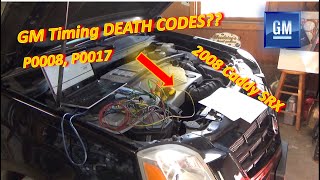
The second-generation SRX, with its 3.0L LF1 (2010-2011) and 3.6L LFX (2012-2016) V6 engines, is notorious for premature timing chain stretching. This isn't a random part failure; it's a well-documented pattern defect. While on many vehicles a P0017 code might point to a simple sensor or solenoid issue, on this specific platform, it is a very strong indicator of the need for a complex and expensive timing chain service. The problem is so common across the GM V6 lineup that technicians often refer to P0017 and its related codes (like P0008) as the 'GM Timing Death Codes 🎬 Watch: Why technicians call these the GM Timing Death Codes.'. This issue was so prevalent that GM issued multiple Technical Service Bulletins (TSBs) and updated parts to address the problem.
Symptoms You May Notice
- Check Engine Light is on
- Engine rattling noise, especially on a cold start
- Rough or unstable idle
- Loss of engine power
- Engine cranks for a long time before starting
- Reduced fuel economy
- Engine stalling unexpectedly
- Replacing only the camshaft or crankshaft position sensors. These sensors are rarely the root cause on this platform; the problem is almost always mechanical.
- Replacing only the VVT solenoids without verifying the mechanical timing. While solenoids can fail, they are a much less common cause for this code than stretched chains on the SRX.
- Performing an oil change and assuming it will fix the issue. While correct oil level is critical, an oil change cannot fix chains that are already physically stretched.
Most Likely Causes
- Stretched Timing Chains 🔴 High Probability → Shop Engine Timing Chain The 3.0L LF1 and 3.6L LFX engines have a well-documented history of premature timing chain stretching. This is often attributed to the original chain design, the extra strain from the high-pressure fuel pump for direct injection, and oil change intervals that were too long, leading to oil breakdown and increased wear.
How to confirm: The definitive diagnosis is to physically inspect the chains for slack, which requires removing the timing cover. A lab scope can also be used to compare camshaft and crankshaft sensor signals to a known-good waveform 🎬 See how to diagnose a stretched chain using sensor signals. to verify the timing misalignment without major disassembly. An advanced scan tool can also show 'Camshaft Position Variance', and significant deviation confirms the issue.
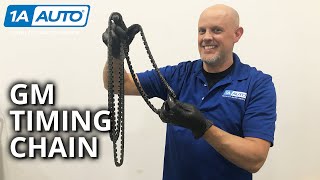
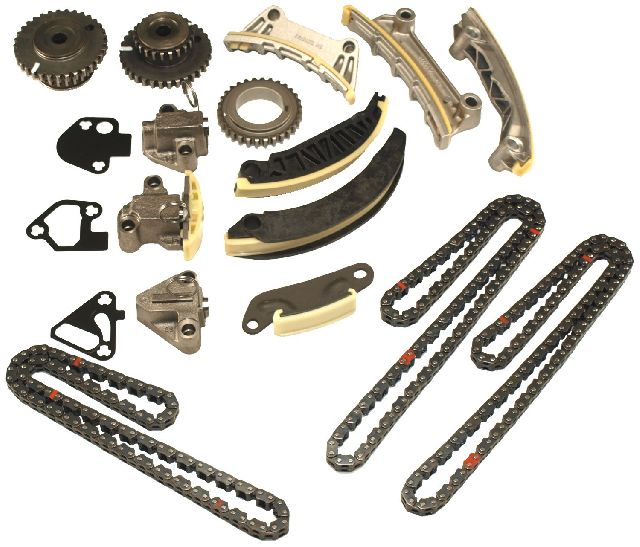
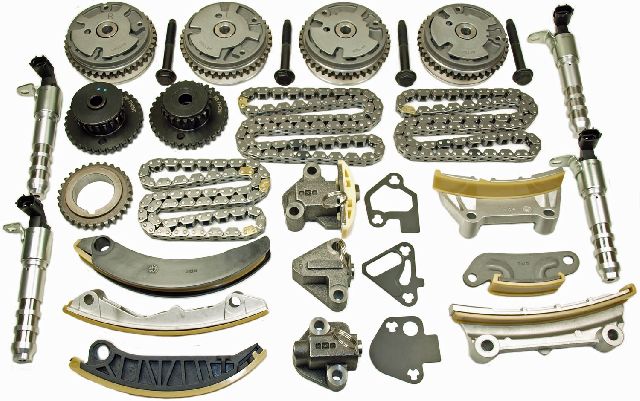
Typical fix: Replace all three timing chains, all tensioners, and all guides as a complete kit. It is critical to use the latest updated parts from the manufacturer (e.g., ACDelco) to prevent a repeat failure. Many technicians also recommend replacing the water pump and oil pump at the same time.
Est. part cost: $300-$700 - Low or Dirty Engine Oil 🟡 Medium Probability The timing chain tensioners and camshaft phasers are hydraulically operated by engine oil pressure. Low or dirty oil can cause the tensioners to function improperly, accelerating chain wear and causing timing correlation faults. Some owners have successfully cleared the code, at least temporarily, by performing an engine flush and oil change.
How to confirm: Check the oil level on the dipstick and inspect the oil's condition. If it is low, black, or sludgy, it needs to be changed. These engines are also known for excessive oil consumption (up to 1 quart per 2,000 miles), making it critical to check the oil level frequently.
Typical fix: Perform an oil and filter change with a high-quality full synthetic oil matching GM's Dexos specifications. Consider using an engine flush product like STP or Amsoil before the oil change to clean sludge from hydraulic components. This is a critical first step, but if the chains are already stretched, it will not solve the problem.
Est. part cost: $50-$100 - Faulty Camshaft Position Actuator Solenoid (VVT Solenoid) ⚪ Low Probability → Shop Engine Camshaft
How to confirm: Swap the Bank 1 exhaust solenoid with the Bank 2 exhaust solenoid (or the Bank 1 intake solenoid). Clear the codes and drive the vehicle. If the code changes to P0019 (Bank 2 Exhaust) or P0016 (Bank 1 Intake), the solenoid is faulty.
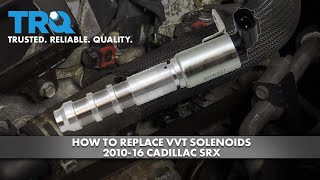
Typical fix: Replace the faulty solenoid. Given the low cost, some owners replace these as a first step 🎬 Watch: How to replace VVT solenoids on your Cadillac SRX. before diagnosing a timing chain issue.
Est. part cost: $30-$80
Rare But Worth Checking
- Slipped Crankshaft Reluctor Wheel: → Shop Engine Crankshaft This is a rare but serious issue documented in GM TSB PIP3423P. The reluctor wheel, which the crankshaft sensor reads, can physically move on the crankshaft, creating a timing correlation fault that perfectly mimics a stretched chain. The TSB notes a correct wheel should measure 25mm to 26mm from the crankshaft throw to the edge of the reluctor opening. If new chains don't fix the code, this is the likely culprit. The fix requires crankshaft replacement.
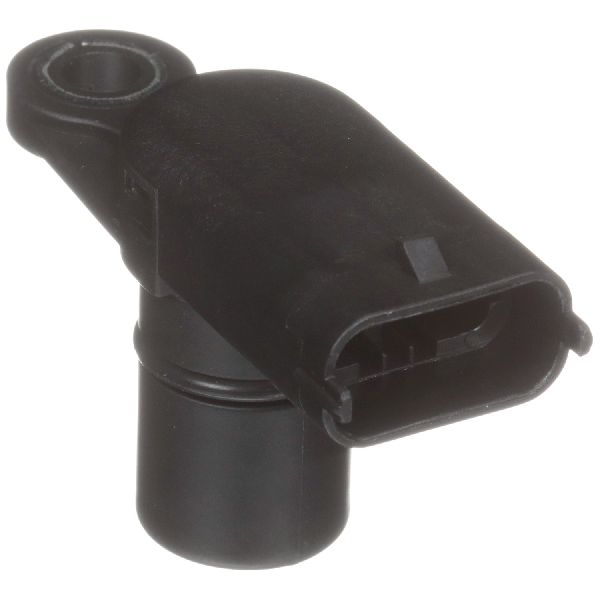
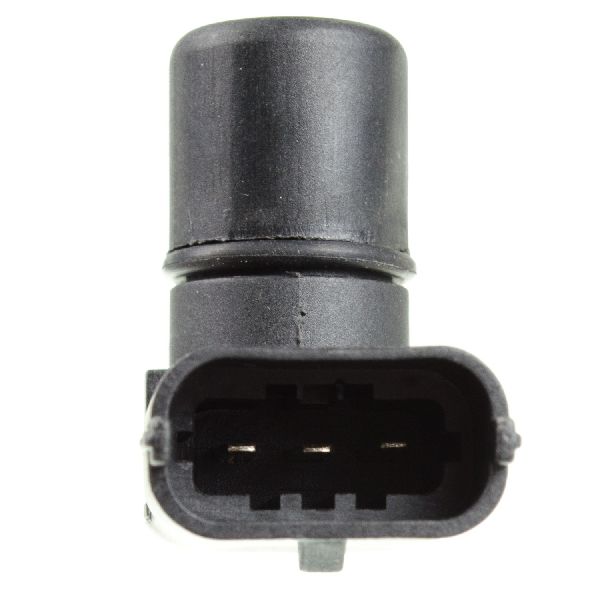
- Faulty Camshaft or Crankshaft Position Sensor: → Shop Engine Crankshaft Position Sensor While a sensor can fail, it is very rarely the cause of P0017 on this specific vehicle. Do not replace sensors without performing proper electrical tests and ruling out the much more common mechanical timing issues.
Diagnosis Steps
- Verify the Check Engine Light is on and code P0017 is present using an OBD-II scanner.
- Check the engine oil level and condition. Note that these engines can consume oil. Top off or change the oil if it is low or dirty. Consider an engine flush.
- Using a scan tool with live data, monitor the desired vs. actual camshaft position angles for Bank 1 Exhaust. A significant and persistent deviation (e.g., 'Camshaft Position Variance' greater than a few degrees) points to a timing issue.
- As a preliminary check, swap the Bank 1 exhaust VVT solenoid with the Bank 2 exhaust solenoid. If the code moves to P0019, the solenoid is bad.
- If solenoids and oil level are good, the next step is to verify mechanical timing. This can be done with a lab scope by comparing cam and crank sensor waveforms against a known good pattern.
- The most definitive step is to remove the engine timing cover and physically inspect the timing chains for slack and verify the timing marks on the sprockets, chains, and engine block.
Parts You'll Likely Need
- Timing Chain Kit
(OEM #ACDelco 12650230 (for 2010-2011 3.0L LF1) / ACDelco 12700437 (for 2012-2016 3.6L LFX))— This is the most common fix. The kit should include all three chains, all guides, and all tensioners. It is critical to use the latest revised part number to ensure durability.
Trusted brands: ACDelco (GM OE)
OEM price range: $400-$600
Aftermarket price range: $250-$450 - Camshaft Position Actuator Solenoid (Bank 1 Exhaust)
(OEM #ACDelco 12662737 or GM 25195245)— A possible but less likely cause. Often replaced as a diagnostic step due to its low cost and easy access compared to the timing chains. Bank 1 is the rear bank (firewall side).
Trusted brands: ACDelco, Delphi, Dorman
OEM price range: $50-$90
Aftermarket price range: $30-$60
Related Codes That Often Appear With This One
- P0008 — This is a general engine position system performance code for Bank 1. It often appears as a precursor or companion to P0017 as the timing chains begin to stretch, and is frequently cited in the same TSBs.
- P0016 — This is the correlation code for the intake camshaft on the same bank (Bank 1). Seeing P0016 and P0017 together strongly indicates a stretched timing chain affecting all of Bank 1.
- P0018 / P0019 — These are the equivalent correlation codes for Bank 2 (front bank). If these appear with P0017, it points to a severe, system-wide timing chain problem affecting both cylinder banks, likely originating from the primary chain.
Technical Service Bulletins (TSBs) & Recalls
- 12-06-01-009F: Announces the availability of updated, comprehensive timing chain service kits to repair stretched chains causing codes like P0017. It explicitly states not to replace sprockets or phasers unnecessarily. This bulletin provides high feature V6 timing chain kits and chain guide replacements for repairing stretched timing chains setting DTCs P0008, P0009, P0016, P0017, P0018 and/or P0019.
- PIP3423P: Instructs technicians to inspect for a slipped crankshaft reluctor wheel if timing chains are found to be good or if they have been replaced and the code returns. This is a critical TSB for avoiding a misdiagnosis, noting that Diagnostic Trouble Codes P0016, P0017, P0018, P0019, P0008 or P0009 may be set and technicians will need to inspect for loose timing chains or tensioners.
- PIP5029: Addresses potential low oil pressure concerns on the 3.0L/3.6L engines after engine repairs (like a timing chain job), which could be caused by a damaged oil pump O-ring or other issues.
Platform-Specific Known Issues
- Premature timing chain stretching is the primary issue for the 3.0L LF1 and 3.6L LFX engines in this vehicle, leading directly to code P0017.
- GM's original Oil Life Monitor (OLM) calibration allowed for excessively long oil change intervals, which is widely believed to have contributed to the accelerated chain wear.
- Class Action Lawsuit: A class-action lawsuit was filed against General Motors covering many vehicles with the 3.6L V6 engine (including the SRX's sister vehicles like the Traverse and Acadia) for the defective timing chains. While some owners received assistance under special coverage programs, many repairs still fall to the vehicle owner, especially on higher-mileage vehicles outside of warranty.
Mechanic-Grade Diagnostic Values
- Camshaft Position Actuator Solenoid (VVT Solenoid) Resistance — expected: 6.9 to 7.9 Ohms at 68°F (20°C).. Failure: A reading outside this range, or an open/short circuit, indicates a faulty solenoid. Note that some service documents state a wider acceptable range, such as 'below 5.0 Ohms' being a failure indicator, so comparison with a known-good solenoid is best.
- Camshaft Position Sensor (3-wire Hall Effect) Signal Voltage — expected: The sensor should produce a digital square wave, switching between approximately 0V and 5V (or battery voltage) as the engine is cranked.. Failure: No signal, a weak signal, or a signal that does not switch indicates a faulty sensor or wiring issue. A lab scope is required for this test.
Scan Tool Commands That Help
- GDS2 (GM Global Diagnostic System 2): VVT Solenoid Actuator Test / Camshaft Position Control — This bidirectional command allows a technician to manually command the ECM to activate a specific VVT solenoid while monitoring the engine's response and the camshaft angle PID. If the tech commands the Bank 1 Exhaust solenoid ON and the actual cam angle does not change (or changes incorrectly), it points to a problem with the solenoid, oil passages, or the phaser itself, helping to isolate the fault without disassembly.
- GDS2 / Techline Connect (TIS2Web): ECM/PCM Reprogramming — GM has released software updates for the ECM that can widen the acceptable tolerance for camshaft position variance before setting a code. If the timing chains are only marginally stretched, a software update might temporarily resolve the Check Engine Light, though it does not fix the underlying mechanical wear.
Wiring & Ground Locations
- G103 / G104 — These are the primary engine-to-chassis grounds. On the 3.6L LFX, they are typically located on the cylinder heads, one on each bank. For example, G103 may be on the front of the passenger side (Bank 1) head and G104 on the rear of the driver's side (Bank 2) head.. The ECM and all its sensors, including the camshaft and crankshaft position sensors, rely on a clean and solid ground path. A loose or corroded ground at G103 or G104 can introduce electrical noise and voltage drops, leading to erratic sensor signals and potentially triggering false correlation codes like P0017.
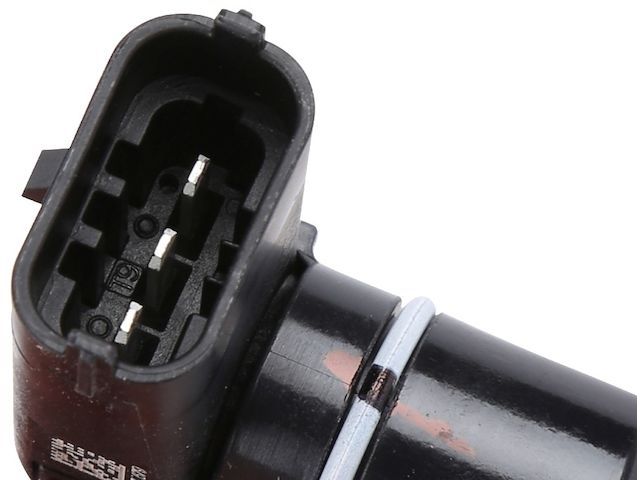
- Camshaft Position Sensor Connector — Located at the rear of the cylinder heads (firewall side for Bank 1), connecting to the camshaft position sensors.. This is the primary point for electrical testing of the sensor circuit. The three pins are typically Signal, 5V Reference, and Low Reference (Ground). Verifying voltage and ground at this connector is a key step before condemning a sensor.
Real Owner Repair Stories
- Camaro5 Forum User (Chevrolet Camaro with 3.6L LFX V6 (engine shared with SRX)) — P0008 and P0009 codes (related timing codes)
❌ Tried (didn't work) Replaced all 4 camshaft position sensors, Replaced all 4 VVT solenoids, Replaced the crankshaft position sensor, Performed a complete timing chain, guide, and tensioner replacement
✅ What actually fixed it The crankshaft reluctor wheel had slipped. A mechanic was able to physically force the wheel back to its correct position, resolving the codes. - Reddit user, r/AskMechanics (2012 Cadillac SRX AWD 3.6L V6) — P0011, P0014, P0017 codes, low oil light, rough running, loss of power, loud lifter clicking.
❌ Tried (didn't work) Oil and filter change (ran fine for 30 minutes then failed again), Replaced both VVT solenoids on one bank (sounded better at idle, but failed after 10 minutes of driving)
✅ What actually fixed it The user's story ends here, but the symptoms and failed fixes strongly point to the classic stretched timing chains, which were the next diagnostic step suggested by the community. - NHTSA ODI #11316222 — An owner reported that their vehicle would idle rough and stall, displaying an "engine shut off" message alongside code P0017. A dealership confirmed the timing chain required replacement.
- NHTSA ODI #11156496 — A vehicle owner reported that at 96,126 miles, the service engine light came on with code P0017, requiring a timing chain replacement. The issue reportedly recurred later at 122,962 miles.
- NHTSA ODI #11183359 — An owner noted that before being towed to a dealership, they checked the codes and found P0017 for the crankshaft sensor, which was the same code present when they previously had to replace the timing chains.
OEM Part Supersession History
Various older timing chain kits→12650230 (for 3.0L LF1) and 12700437 (for 3.6L LFX)— GM released multiple revisions of the timing chain kits to improve durability and address premature stretching. The newer kits feature more robust chains.
Heads up: Using an older, superseded timing chain kit, even if new-old-stock, will likely lead to a repeat failure. It is critical to install the latest available part number from GM/ACDelco.12586722, 12588943, 12615613, 12626012→12636175 (VVT Solenoid)— Part number consolidation and potential minor revisions over the production run.
Heads up: While the base part may be the same, it's always best to use the latest part number specified for the vehicle to ensure compatibility with any potential software updates and to get the latest production revisions.
Model Year Variations Within This Range
- 2010-2011: These models used the 3.0L LF1 V6. While also part of the High Feature V6 family and prone to timing chain issues, its specific timing chain kit (12650230) is different from the later 3.6L LFX.
- 2012-2016: These models used the 3.6L LFX V6. GM issued several TSBs (e.g., 12-06-01-009 and its revisions) that provided updated timing chain kits and repair procedures for this engine. It is crucial to use the latest revised parts for the LFX during a timing service to prevent a recurrence of the issue.
Diagnostic Flowchart
Real Owner Stories
Aggregated from forums and TSBs cited above. Mileages and costs reflect what owners reported in those sources.
2010 Cadillac SRX — 147888 miles
Symptoms: The check engine light came on and a diagnosis revealed code P0017 for crankshaft and camshaft position correlation.
What fixed it: Owner was seeking diagnostic advice; fix not specified in the initial report.
Source hint: Reddit r/MechanicAdvice
Cadillac SRX
Symptoms: Experienced a no-start condition immediately after installing new timing chains to fix a P0017 code.
What fixed it: Thread illustrates the complexity of the repair and potential for follow-on issues; specific fix not detailed in summary.
Source hint: CadillacForums.com: 'SRX No Start after new chains'
Cadillac SRX 3.0L
Symptoms: Vehicle presented with both P0017 and P0016 timing chain codes.
What fixed it: Timing chain replacement; technician noted the high-pressure direct injection fuel pump strain contributes to the stretch.
Source hint: CadillacForums.com: 'Cadillac SRX 3.0 Timing chain P0017 P0016'
2009 Chevy Traverse (3.6L)
Symptoms: Code P0017 came up along with multiple timing codes.
What fixed it: Diagnosed using a scan tool to observe cam angle variance, pointing to a primary chain or reluctor wheel issue.
Source hint: Carjunky.com Forum: '2009 Chevy traverse code p0017 coming up'
Related OBD-II Codes
Frequently Asked Questions
Is the P0017 code on my 2010-2016 Cadillac SRX covered by the timing chain class-action lawsuit?
Does TSB 12-06-01-009F mean I need to replace the sprockets and phasers on my 3.0L/3.6L engine?
I replaced the timing chains on my SRX but P0017 came back. What else could it be?
Can low oil cause the P0017 code on the LF1 or LFX engine?
How can I test if the VVT solenoid is causing P0017 before doing a timing chain job?
Why do the timing chains stretch prematurely on the 2010-2016 Cadillac SRX?
Helpful Videos
We Have This Part in Stock


The information in this article is provided for general reference and educational purposes only. Vehicle specifications, procedures, and part compatibility can vary by production date, trim level, and region. Always consult your vehicle's factory service manual and verify part numbers before purchasing or performing repairs. Safety-critical components such as airbags, seat belts, and braking systems should be installed by a qualified professional.
- Cadillac SRX:
- 🧭 Diagnostic Flowchart
- 🎬 Helpful Videos
- 🛍️ Shop This Part
- What's Unique About the 2010-2016 Cadillac SRX
- Symptoms You May Notice
- Most Likely Causes
- Rare But Worth Checking
- Diagnosis Steps
- Parts You'll Likely Need
- Related Codes That Often Appear With This One
- Technical Service Bulletins (TSBs) & Recalls
- Platform-Specific Known Issues
- Mechanic-Grade Diagnostic Values
- Scan Tool Commands That Help
- Wiring & Ground Locations
- Real Owner Repair Stories
- OEM Part Supersession History
- Model Year Variations Within This Range
- Real Owner Stories
- 2010 Cadillac SRX — 147888 miles
- Cadillac SRX
- Cadillac SRX 3.0L
- 2009 Chevy Traverse (3.6L)
- Related OBD-II Codes
- Frequently Asked Questions
- 🎟️ Get 5% Off