

P0017 on 2006-2010 Chevrolet HHR: Crank/Exhaust Cam Correlation Causes and Fixes
P0017 on a Chevy HHR usually points to a problem with the engine's timing, specifically the relationship between the crankshaft and the exhaust camshaft. The most common and easiest potential fix is replacing the camshaft position actuator solenoids (VVT Solenoids), which costs about $40-$80 for a pair. However, on these Ecotec engines, this code is very frequently a symptom of a stretched timing chain, which is a much more expensive and labor-intensive job requiring a full timing chain kit repl
- P0017 on an HHR means the exhaust cam timing is out of sync with the crankshaft.
- Always check the engine oil level and condition first, as low or dirty oil can cause this code.
- The easiest and cheapest diagnostic step is to swap the intake and exhaust VVT solenoids to see if the code changes to P0016.
- Be aware that this code is a very strong indicator of a worn timing chain, a common and serious issue on these engines.
- Do not ignore this code. A timing chain failure can destroy the engine.
What's Unique About the 2006-2010 Chevrolet HHR
The Ecotec engines used in the 2006-2010 HHR are known for issues related to the timing chain system. A stretched timing chain, failed hydraulic tensioner, or broken plastic guides are very common causes for this code. While camshaft sensors or solenoids can fail, a P0017 code on these specific vehicles often foreshadows a more significant mechanical timing problem. The reason P0017 (exhaust side) often appears first is that the exhaust cam is on the 'push' side of the chain's rotation, where slack is noticed first. If P0016 (intake side) is also present, a base timing issue is almost certain.
Diagnostic Flowchart
Tap your situation to follow the diagnostic path that matches what you're seeing on this vehicle.
Symptoms You May Notice
- Check Engine Light is on
- Engine running rough or vibrating, especially at idle
- Difficulty starting the engine, may require clearing the code to start
- Engine stalls, especially at low speeds
- Reduced engine power and acceleration, particularly above 3000 RPM
- Rattling noise from the passenger side of the engine, particularly on cold startups, that may last for a few seconds
- Poor fuel economy
- Engine makes a buzzing or humming noise related to the VVT solenoids
- Replacing the crankshaft or camshaft position sensors when the actual fault lies with the timing chain system or the VVT actuator solenoids. Forum users on Chevy HHR Network and Cobalt SS Network frequently report changing sensors does not fix the code when a stretched chain is the root cause.
- Replacing only the VVT solenoids when the timing chain is stretched. While a bad solenoid is a common cause, if codes P0016 and P0017 appear together, the problem is almost certainly the chain itself.
Most Likely Causes
- Stretched Timing Chain or Failed Tensioner/Guides 🔴 High Probability → Shop Engine Timing Chain The Ecotec engines in this era have a well-documented history of premature timing chain wear. The hydraulic tensioner can fail, and the plastic chain guides can become brittle and break, sending pieces into the oil pan.
How to confirm: A rattling noise from the passenger side of the engine on startup is a strong indicator. The presence of both P0016 and P0017 codes simultaneously is another strong clue. Definitive confirmation requires removing the valve cover and timing cover to physically inspect the chain for slack against the guides and to verify the timing marks on the sprockets and chain line up correctly.
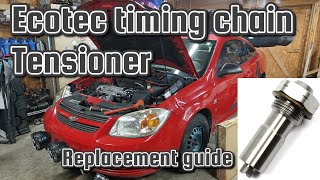
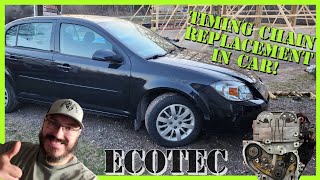
Typical fix: Replacement of the timing chain, tensioner, and all plastic guides with a complete kit. It is critical to use a quality kit and replace all components. Dropping the oil pan to clean out broken guide pieces is also recommended.
Est. part cost: $100-$250 - Faulty Exhaust Camshaft Position Actuator Solenoid (VVT Solenoid) 🔴 High Probability → Shop Engine Camshaft These solenoids operate using engine oil and can become clogged with sludge from infrequent oil changes or fail electronically over time. This is a common issue on many GM vehicles with VVT.
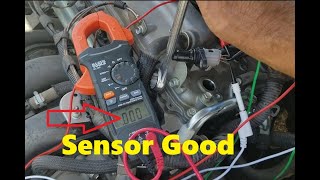
How to confirm: A simple and effective diagnostic test is to swap the exhaust solenoid with the identical intake solenoid. They are located on top of the valve cover and are easily accessible. Clear the codes and drive the vehicle. If the code changes to P0016 (Intake Cam Correlation), the solenoid is confirmed to be faulty. The solenoid's internal resistance can also be tested with a multimeter and should be between 8 and 13 ohms.
Typical fix: Replace the exhaust camshaft position actuator solenoid. It is highly recommended to replace both intake and exhaust solenoids at the same time as a pair, as they are the same age and subject to the same conditions.
Est. part cost: $20-$50 - Low or Dirty Engine Oil 🟡 Medium Probability The Variable Valve Timing (VVT) system is entirely dependent on oil pressure and cleanliness to function. Low oil levels or oil that is dirty, sludgy, or the wrong viscosity (requires 5W-30) can restrict flow to the VVT solenoids and cam phasers, preventing them from adjusting timing correctly and triggering correlation codes.
How to confirm: Check the oil level on the dipstick and inspect its condition. If it's low or appears very dark/sludgy, this is a likely contributor. An oil change is the first, cheapest step in diagnosis.
Typical fix: Perform an oil and filter change using a quality full synthetic 5W-30 oil and a new filter. If the problem was low oil, top it off and inspect for leaks that may have caused the low level.
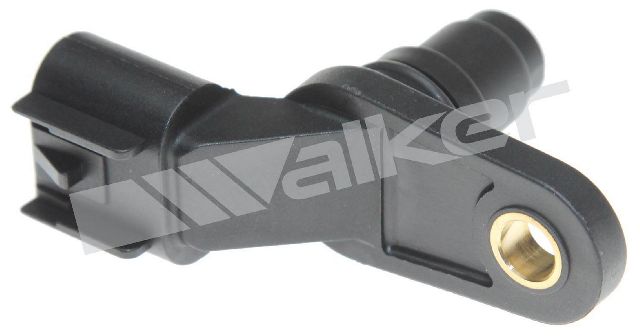
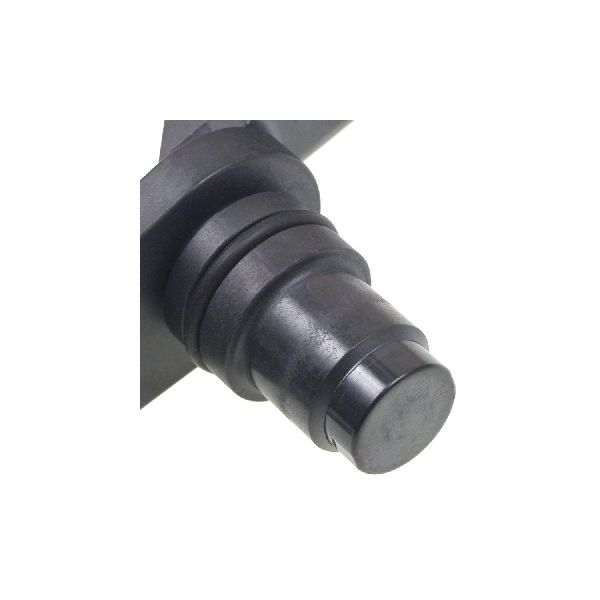
Est. part cost: $30-$70 - Faulty Exhaust Camshaft Position (CMP) Sensor ⚪ Low Probability → Shop Engine Camshaft Position Sensor
How to confirm: The sensor can be tested with a multimeter for resistance or by swapping it with the intake CMP sensor (if they are identical) to see if the code follows. However, forum discussions repeatedly show that this is an uncommon cause, and replacing sensors is a frequent misdiagnosis.
Typical fix: Replace the exhaust camshaft position sensor.
Est. part cost: $25-$70
Rare But Worth Checking
- Slipped Camshaft Reluctor Ring: → Shop Engine Camshaft As mentioned in GM Technical Service Bulletin #PIP4548F, the reluctor ring (a toothed wheel which the cam sensor reads) can spin on the camshaft, especially after an engine overheat event. The ring is press-fit and not keyed. This causes a correlation error even if the timing chain is perfectly aligned. This failure requires camshaft replacement, as the ring cannot be repositioned.
- Wiring Harness Damage: Frayed or corroded wiring or a bad connector for the camshaft position sensor or actuator solenoid can cause intermittent or false signals to the ECM. This can happen from heat, age, or being disturbed during other repairs.
- Failed Cam Phaser (Actuator Gear): → Shop Engine Timing Gear The gear itself on the end of the camshaft, which is hydraulically adjusted by the solenoid, can fail internally. It can get stuck, or the internal locking pin can fail. This is less common than a solenoid or chain issue but can happen, especially if there is significant sludge in the engine.
Diagnosis Steps
- Check the engine oil level and condition. Ensure it is full and clean. If in doubt, perform an oil and filter change with 5W-30 synthetic oil.
- Scan the ECM for any other trouble codes. Codes like P0016, P0014, or P0011 provide valuable diagnostic clues.
- Listen for a distinct rattling sound from the passenger side of the engine during a cold startup. A rattle lasting 2-5 seconds is a classic symptom of a timing chain tensioner/guide issue.
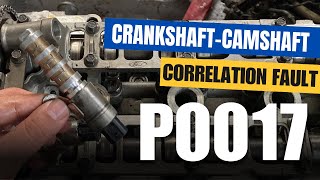
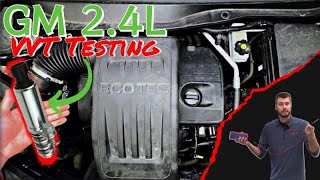
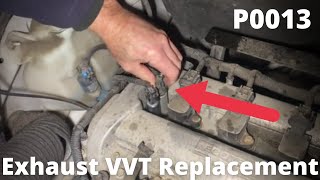
- Perform the VVT Solenoid Swap Test: The intake and exhaust solenoids are identical and located on top of the valve cover, held by one bolt each. Swap their positions, clear the codes, and run the engine. If the code changes from P0017 to P0016, the solenoid you moved to the intake side is faulty and needs replacement.
- Inspect the wiring and connectors for the exhaust camshaft position sensor and actuator solenoid for any visible damage, corrosion, or loose connections.
- If the solenoid swap does not change the code and a rattle is present, the issue is very likely the timing chain system.
- For advanced diagnosis, a professional can use a lab scope to compare the crankshaft and camshaft sensor waveforms to visually confirm the timing relationship without disassembly.
- The final confirmation step is to remove the valve cover and timing cover to physically inspect the timing components for wear, slack, broken guides, and to verify alignment of all timing marks. This is a labor-intensive step.
Parts You'll Likely Need
- Exhaust Camshaft Position Actuator Solenoid
(OEM #12655421 (may be superseded by 12679100))— This VVT solenoid is a very common failure point. It gets clogged with oil sludge or fails electronically, causing the exhaust cam timing to be incorrect.
Related Codes That Often Appear With This One
- P0016 — This code indicates a correlation issue with the *intake* camshaft. Seeing both P0016 and P0017 together strongly suggests a base timing problem, like a stretched timing chain, that is affecting both camshafts and has progressed beyond the initial slack.
- P0014 — This code indicates the exhaust camshaft timing is over-advanced. It can be caused by a stuck VVT actuator solenoid, a faulty cam phaser, or a base timing issue, all of which are common causes for P0017 as well.
- P0011 — This is the intake-side equivalent of P0014, indicating over-advanced timing. Seeing it with P0017 could point to a widespread oil pressure/sludge issue affecting both VVT systems or a severe timing chain problem.
Technical Service Bulletins (TSBs) & Recalls
- PIP4716F: Notes that a startup rattle accompanied by codes P0011, P0014, P0016 or P0017 points to timing system issues.
- PIP4548F: Advises technicians to inspect the camshaft reluctor ring for movement on the camshaft if P0016/P0017 codes are present on a properly timed engine.
Platform-Specific Known Issues
- Timing Chain System Weakness: The 2.2L and 2.4L Ecotec engines are widely known for problems with the timing chain tensioner failing, allowing the chain to develop slack. This slack can cause the chain to wear out the plastic guides, and in worst-case scenarios, jump a tooth or break. Owners on forums frequently confirm this is the ultimate fix for persistent P0016/P0017 codes.
- TSB for Startup Rattle: Technical Service Bulletin #PIP4716F directly links P0017 with a "short, sharp rattle noise from the front of the engine at start up," pointing towards timing component issues.
- TSB for Slipped Reluctor Ring: TSB #PIP4548F notes that P0017 can occur even with correct timing if the camshaft reluctor ring has spun on the camshaft, a rare but documented failure that requires replacing the entire camshaft. This can be triggered by an engine overheat.
Mechanic-Grade Diagnostic Values
- VVT Solenoid (Camshaft Position Actuator) Resistance — expected: 8 to 13 Ohms. Failure: A reading outside this range, or an unstable reading that fluctuates when wiggling the connector, indicates a faulty solenoid. An 'open' or infinite resistance reading means the internal coil is broken.
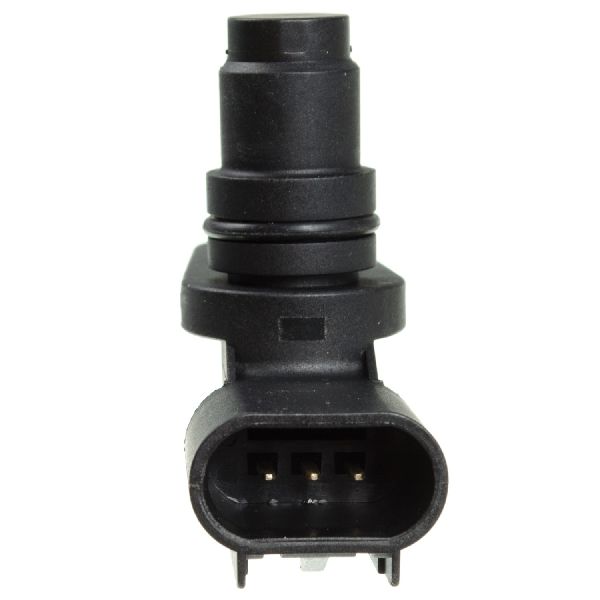
- Camshaft Position (CMP) Sensor Circuit Voltage Check (at connector with key on, engine off) — expected: Pin 1: 5V reference, Pin 2: Ground, Pin 3: 5V signal.. Failure: Missing 5V on either the reference or signal wire, or a bad ground, points to a wiring or ECM issue, not a bad sensor.
Scan Tool Commands That Help
- GDS2/Tech2 or equivalent professional scan tool: VVT Solenoid Actuation Test / Camshaft Position Actuator Control — This bidirectional command allows a technician to manually command the VVT solenoid on and off while monitoring engine RPM and cam/crank sensor data. If commanding the exhaust solenoid causes the engine to stumble or miss, but the scan tool data for the actual cam position doesn't change, it can point towards a faulty cam position sensor or a wiring issue, rather than a problem with the solenoid or phaser.
Wiring & Ground Locations
- G107 — A stud on the transmission housing, located down and to the right of the oil filter housing.. This is a primary engine/transmission ground point. A loose or corroded connection at G107 can cause erratic behavior and incorrect readings from various engine sensors, including the crank and cam position sensors, potentially leading to false correlation codes.
- G108 — Located on the right rear of the engine block.. This is another critical engine ground. Similar to G107, a poor connection here can affect the ground reference for sensors and the ECM, causing a variety of electrical issues and potentially triggering timing correlation faults.
- CMP Sensor Connector (3-wire) — On the sensor itself, located on the front (intake) or rear (exhaust) of the cylinder head.. When testing, the three pins are typically a 5-volt reference, a low reference (ground), and a 5-volt signal wire that pulses as the reluctor wheel passes the sensor. Verifying voltage at the connector is crucial to rule out wiring issues before replacing the sensor.
Real Owner Repair Stories
- Mitchell1 SureTrack Community Fix (2017 GMC Terrain 2.4L LEA (similar Ecotec architecture)) — Check Engine Light on with code P0017.
❌ Tried (didn't work) Replacing the timing chain and actuators (phasers) with new GM parts., Swapping camshaft position sensors.
✅ What actually fixed it The reluctor ring (tone ring) on the exhaust camshaft had physically slipped. After confirming the slip by comparing it to a known-good engine, the exhaust camshaft was replaced, which resolved the code. This was diagnosed after confirming the issue described in GM bulletin PIP4548G. - Reddit user on r/MechanicAdvice (Vehicle with P0017, likely Ecotec based on description) — Car started running badly after an oil consumption issue led to a low oil level. Timing jumped two teeth.
❌ Tried (didn't work) Replacing timing chain, tensioners, and both CVVT sprockets (phasers)., Replacing the exhaust camshaft because the alignment dowel pin broke., Cleaning and testing both VVT solenoids (oil control valves).
✅ What actually fixed it The user's post was a request for help as the P0017 code remained after all the mechanical timing components were replaced. This highlights a common scenario where the root cause is not the primary timing components themselves, but a secondary issue like a slipped reluctor, wiring fault, or an issue with the new parts.
OEM Part Supersession History
12628348→12655421, then 12679100— GM has updated the VVT solenoid design multiple times to improve reliability and resistance to oil contamination.
Heads up: While older numbers are superseded, it is always best to use the latest available part number (e.g., 12679100) for the best performance and longevity. The parts are physically interchangeable.
Model Year Variations Within This Range
- 2006-2008 (2.2L): These years primarily used the 2.2L L61 engine, which does NOT have Variable Valve Timing (VVT). Therefore, a P0017 code is not possible on a stock L61 engine as it lacks the camshaft actuators and sensors that trigger it. P0017 applies to the 2.4L LE5 in these years.
- 2009-2010 (2.2L): For the 2009 model year, the 2.2L engine was updated to the LAP engine, which added Variable Valve Timing (VVT). Therefore, P0017 is a possible code on 2009 and later 2.2L HHRs, but not on earlier 2.2L models.
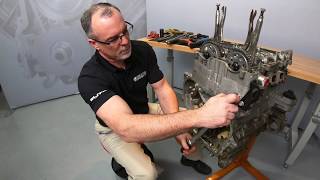
Helpful Videos

We Have This Part in Stock



The information in this article is provided for general reference and educational purposes only. Vehicle specifications, procedures, and part compatibility can vary by production date, trim level, and region. Always consult your vehicle's factory service manual and verify part numbers before purchasing or performing repairs. Safety-critical components such as airbags, seat belts, and braking systems should be installed by a qualified professional.
- Chevrolet HHR:
- 🧭 Diagnostic Flowchart
- 🎬 Helpful Videos
- 🛍️ Shop This Part
- What's Unique About the 2006-2010 Chevrolet HHR
- Symptoms You May Notice
- Most Likely Causes
- Rare But Worth Checking
- Diagnosis Steps
- Parts You'll Likely Need
- Related Codes That Often Appear With This One
- Technical Service Bulletins (TSBs) & Recalls
- Platform-Specific Known Issues
- Mechanic-Grade Diagnostic Values
- Scan Tool Commands That Help
- Wiring & Ground Locations
- Real Owner Repair Stories
- OEM Part Supersession History
- Model Year Variations Within This Range
- 🎟️ Get 5% Off